www.management30.com
version 1.1
Alexandre Cuva
Email :                     Organizational Coaching
alexandre.cuva@altran.com   (Management 3.0, Scrum)
Twitter: @cuvaalex
                            Team Coaching
Blog: http://agile-
alexcuva.blogspot.com/      (Scrum, XP, Kanban)
Phone: +41 78 715 8309      Technical Coaching
                            (TDD, BDD, C#, Java, Groovy)
                            Agile Training
                            (Management 3.0, Agile, Scrum, XP)
Why

3.0?
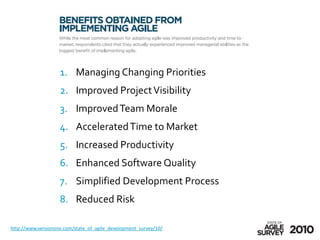
1. Managing Changing Priorities
                    2. Improved Project Visibility
                    3. Improved Team Morale
                    4. Accelerated Time to Market
                    5. Increased Productivity
                    6. Enhanced Software Quality
                    7. Simplified Development Process
                    8. Reduced Risk

http://www.versionone.com/state_of_agile_development_survey/10/
Management is about human beings. Its task is
to make people capable of joint performance, to
make their strengths effective and their
weaknesses irrelevant. This is what organization
is all about, and it is the reason that management
is the critical, determining factor.”

- Peter F. Drucker, Management Rev. Ed.
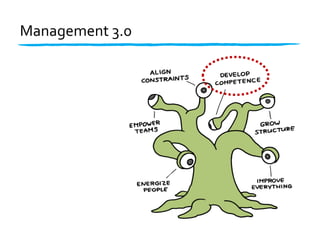
Management 3.0
A team is a complex adaptive system (CAS), because
it consists of parts (people) that form a system (team),
and the system shows complex behavior while it keeps
adapting to a changing environment.
Complexity theory is about change
   Complexity theory is […] about the
dynamics of change in a system.
– Irene Sanders
The Interaction of Complexity and Management
People and relationships
   […] a new theory of business that places
people and relationships into dramatic relief.
– Roger Lewin, Birute Regine
The Interaction of Complexity and Management
Use a diversity of models
    Complexity itself is anti-methodology. It is
against "one size fits all."
– Tom Petzinger
The Interaction of Complexity and Management


Multiple weak models can make just as much
sense as one strong model.
Anticipate, adapt, experiment
Anticipation
Looking forward, proactive, imagining improvement


Adaptation
Looking backward, reactive, responding to change


Experimentation
Trying things out, exploration, experience feedback
Assume subjectivity and reflexivity
The observer influences the system, and the
system influences the observer.
The people form the culture, and the culture
forms the people.
Management 3.0
Extrinsic Motivation
Desire to achieve goal G
Reward result R
Assuming R leads to G


Problems with non-linear effects
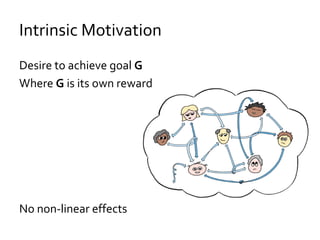
Intrinsic Motivation
Desire to achieve goal G
Where G is its own reward


No non-linear effects
“16 Basic Desires”
Acceptance       The need for approval
Physical Activity Or exercise
Curiosity        The need to think
Power            The need for influence of will
Eating           The need for food
Romance          The need for love and sex
Family           The need to raise children
Saving           The need to collect
Honor            Being loyal to a group
Social Contact The need for friends
Idealism         The need for purpose
Status           The need for social standing
Independence Being an individual
Tranquility      The need to be safe
                                                  Steven Reiss. Who Am I? The 16 Basic Desires
Order            Or stable environments           That Motivate Our Actions and Define Our
Vengeance        The need to strike back          Personalities. City: Berkley Trade, 2002
“16 Basic Desires”
Acceptance       The need for approval
Physical Activity Or exercise
Curiosity        The need to think
Power            The need for influence of will
Eating           The need for food
Romance          The need for love and sex
Family           The need to raise children
Saving           The need to collect
Honor            Being loyal to a group
Social Contact The need for friends
Idealism         The need for purpose
Status           The need for social standing
Independence Being an individual
Tranquility      The need to be safe
                                                  Steven Reiss. Who Am I? The 16 Basic Desires
Order            Or stable environments           That Motivate Our Actions and Define Our
Vengeance        The need to strike back          Personalities. City: Berkley Trade, 2002
“16 Basic Desires”
Acceptance       The need for approval
Curiosity        The need to think
Power            The need for influence of will
Honor            Being loyal to a group
Social Contact   The need for friends
Idealism         The need for purpose
Status           The need for social standing
Independence     Being an individual
Order            Or stable environments


                                                  Steven Reiss. Who Am I? The 16 Basic Desires
                                                  That Motivate Our Actions and Define Our
                                                  Personalities. City: Berkley Trade, 2002
“Self-Determination Theory”
Acceptance       The need for approval
Curiosity        The need to think
Power            The need for influence of will
Honor            Being loyal to a group
Social Contact   The need for friends
Idealism         The need for purpose
Status           The need for social standing
Independence     Being an individual
Order            Or stable environments

Competence       The need to feel capable
Autonomy         The need to choose one’s own actions
Relatedness      The need to be socially involved

                                                  Edward L. Deci and Richard M. Ryan. The
                                                  Handbook of Self-Determination Research.
                                                  Rochester: University of Rochester Press, 2004
“Self-Determination Theory”
Acceptance                     The need for approval
Curiosity                      The need to think
Power                          The need for influence of will
Honor                          Being loyal to a group
Social Contact / Relatedness   The need for friends
Idealism                       The need for purpose
Status                         The need for social standing
Independence / Autonomy        Being an individual
Order                          Or stable environments
Competence                     The need to feel capable


                                                      Edward L. Deci and Richard M. Ryan. The
                                                      Handbook of Self-Determination Research.
                                                      Rochester: University of Rochester Press, 2004
10 Intrinsic Desires
Acceptance                     The need for approval
Curiosity                      The need to think
Power                          The need for influence of will
Honor                          Being loyal to a group
Social Contact / Relatedness   The need for friends
Idealism                       The need for purpose
Status                         The need for social standing
Independence / Autonomy        Being an individual
Order                          Or stable environments
Competence                     The need to feel capable
“Drive”
Acceptance                     The need for approval
Curiosity                      The need to think
Power                          The need for influence of will
Honor                          Being loyal to a group
Social Contact / Relatedness   The need for friends
Idealism / Purpose             The need for purpose
Status                         The need for social standing
Independence / Autonomy        Being an individual
Order                          Or stable environments
Competence / Mastery           The need to feel capable


                                                      Daniel H. Pink, Drive: The Surprising Truth
                                                      About What Motivates Us. Riverhead, 2009
10 Intrinsic Desires
Curiosity                           The need to think
Honor                               Being loyal to a group
Acceptance                          The need for approval
Mastery / Competence                The need to feel capable
Power                               The need for influence of will
Freedom / Independence / Autonomy   Being an individual
Relatedness / Social Contact        The need for friends
Order                               Or stable environments
Goal / Idealism / Purpose           The need for purpose
Status                              The need for social standing
360 Degree evaluations
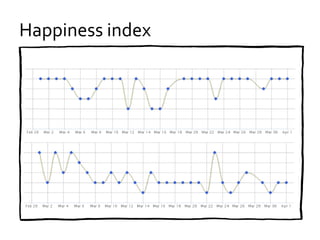
Happiness index
Social networks
B = f (P,E)
Behavior is a function of an individual’s
personality and his/her environment.

- Kurt Lewin
Management 3.0
Empowerment
is implementing
distributed control by
delegating authority
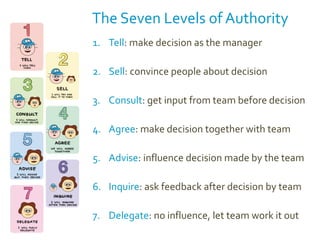
The Seven Levels of Authority
1. Tell: make decision as the manager

2. Sell: convince people about decision

3. Consult: get input from team before decision

4. Agree: make decision together with team

5. Advise: influence decision made by the team

6. Inquire: ask feedback after decision by team

7. Delegate: no influence, let team work it out
Management 3.0
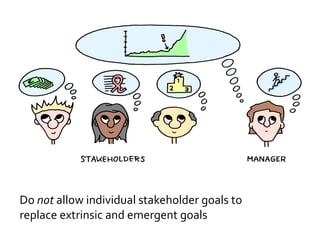
Do not allow individual stakeholder goals to
replace extrinsic and emergent goals
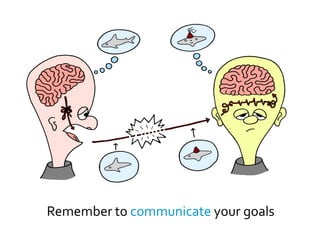
Remember to communicate your goals
Management 3.0
Three maturity levels (for skill)
Shu                traditional wisdom, learning fundamentals            (apprentice)
Ha                 detachment, breaking with tradition                  (journeyman)
Ri                 transcendence, everything is natural                 (master)

(last column: three similar levels in medieval European guild system)


Note: the Dreyfus Model lists five levels of skill acquisition:
Beginner, Advanced Beginner, Competent, Proficient, Expert


http://en.wikipedia.org/wiki/Shuhari
http://en.wikipedia.org/wiki/Master_craftsman
http://en.wikipedia.org/wiki/Dreyfus_model_of_skill_acquisition
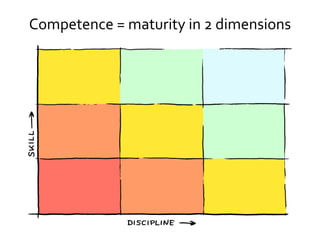
Competence = maturity in 2 dimensions
7 Approaches to competency development

1. Self-Development

2. Coaching & Mentoring

3. Training & Certification

4. Culture & Socialization

5. Tools & Infrastructure

6. Supervision & Control

7. Management
3 Principles for good KPI’s / metrics
1. The KPI relates to a stakeholder’s purpose
2. The KPI helps improve an aspect of the system
3. The KPI is part of the work of those who are interested in it

Examples:

What about velocity?
What about bug count?
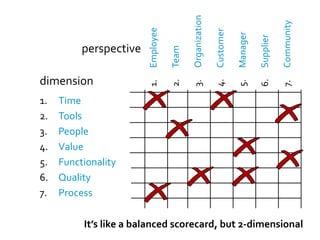
Organization


                                                                                         Community
                        Employee


                                                         Customer

                                                                    Manager

                                                                              Supplier
          perspective


                                   Team
dimension


                                                                              6.
                                                         4.
                                   2.


                                                                    5.
                                          3.
                        1.


                                                                                         7.
1.   Time
2.   Tools
3.   People
4.   Value
5.   Functionality
6.   Quality
7.   Process

          It’s like a balanced scorecard, but 2-dimensional
Management 3.0
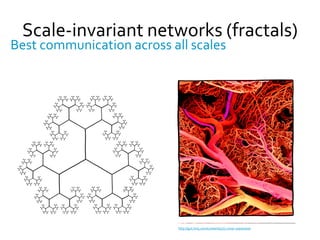
Scale-invariant networks (fractals)
Best communication across all scales


                            http://gut.bmj.com/content/57/7.cover-expansion
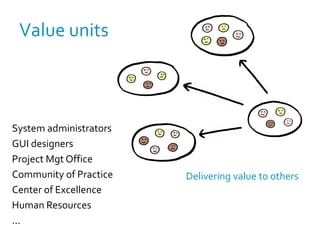
Value units


System administrators
GUI designers
Project Mgt Office
Community of Practice   Delivering value to others
Center of Excellence
Human Resources
...
Management 3.0
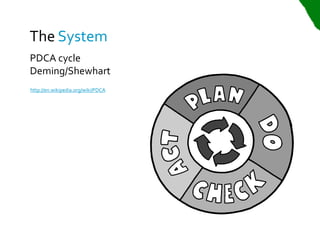
Consider the system
The System
PDCA cycle
Deming/Shewhart
http://en.wikipedia.org/wiki/PDCA
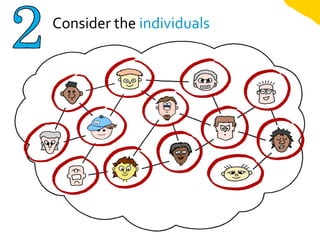
Consider the individuals
The Individuals
ADKAR model
Hiatt
http://www.change-management.com/
Consider the interactions
The Interactions
Adoption Curve model
Rogers
http://en.wikipedia.org/wiki/Diffusion_of_innovations
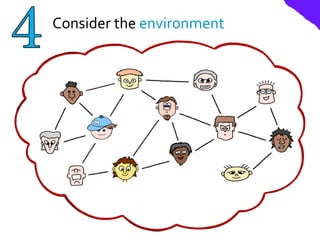
Consider the environment
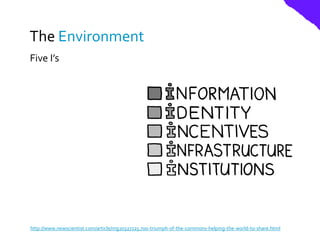
The Environment
Five I’s


http://www.newscientist.com/article/mg20327225.700-triumph-of-the-commons-helping-the-world-to-share.html
The Management 3.0 model

Six organizational
views based on
complexity thinking
Alexandre Cuva
Email :                     Organizational Coaching
alexandre.cuva@altran.com   (Management 3.0, Scrum)
Twitter: @cuvaalex
                            Team Coaching
Blog: http://agile-
alexcuva.blogspot.com/      (Scrum, XP, Kanban)
Phone: +41 78 715 8309      Technical Coaching
                            (TDD, BDD, C#, Java, Groovy)
                            Agile Training
                            (Management 3.0, Agile, Scrum, XP)
https://plus.google.com/u/0/102628787365618084989


http://ch.linkedin.com/in/cuvaalex


@cuvaalex (twitter)


http://agile-alexcuva.blogspot.ch (blog)


http://www.slideshare.net/GToronto


 management30.com (book)


                                                    59

Management 3.0 overview

  • 1.
  • 2.
    Alexandre Cuva Email : Organizational Coaching alexandre.cuva@altran.com (Management 3.0, Scrum) Twitter: @cuvaalex Team Coaching Blog: http://agile- alexcuva.blogspot.com/ (Scrum, XP, Kanban) Phone: +41 78 715 8309 Technical Coaching (TDD, BDD, C#, Java, Groovy) Agile Training (Management 3.0, Agile, Scrum, XP)
  • 3.
  • 4.
    1. Managing ChangingPriorities 2. Improved Project Visibility 3. Improved Team Morale 4. Accelerated Time to Market 5. Increased Productivity 6. Enhanced Software Quality 7. Simplified Development Process 8. Reduced Risk http://www.versionone.com/state_of_agile_development_survey/10/
  • 5.
  • 6.
    Management is abouthuman beings. Its task is to make people capable of joint performance, to make their strengths effective and their weaknesses irrelevant. This is what organization is all about, and it is the reason that management is the critical, determining factor.” - Peter F. Drucker, Management Rev. Ed.
  • 7.
  • 8.
    A team isa complex adaptive system (CAS), because it consists of parts (people) that form a system (team), and the system shows complex behavior while it keeps adapting to a changing environment.
  • 9.
    Complexity theory isabout change Complexity theory is […] about the dynamics of change in a system. – Irene Sanders The Interaction of Complexity and Management
  • 10.
    People and relationships […] a new theory of business that places people and relationships into dramatic relief. – Roger Lewin, Birute Regine The Interaction of Complexity and Management
  • 11.
    Use a diversityof models Complexity itself is anti-methodology. It is against "one size fits all." – Tom Petzinger The Interaction of Complexity and Management Multiple weak models can make just as much sense as one strong model.
  • 12.
    Anticipate, adapt, experiment Anticipation Lookingforward, proactive, imagining improvement Adaptation Looking backward, reactive, responding to change Experimentation Trying things out, exploration, experience feedback
  • 13.
    Assume subjectivity andreflexivity The observer influences the system, and the system influences the observer. The people form the culture, and the culture forms the people.
  • 14.
  • 15.
    Extrinsic Motivation Desire toachieve goal G Reward result R Assuming R leads to G Problems with non-linear effects
  • 16.
    Intrinsic Motivation Desire toachieve goal G Where G is its own reward No non-linear effects
  • 17.
    “16 Basic Desires” Acceptance The need for approval Physical Activity Or exercise Curiosity The need to think Power The need for influence of will Eating The need for food Romance The need for love and sex Family The need to raise children Saving The need to collect Honor Being loyal to a group Social Contact The need for friends Idealism The need for purpose Status The need for social standing Independence Being an individual Tranquility The need to be safe Steven Reiss. Who Am I? The 16 Basic Desires Order Or stable environments That Motivate Our Actions and Define Our Vengeance The need to strike back Personalities. City: Berkley Trade, 2002
  • 18.
    “16 Basic Desires” Acceptance The need for approval Physical Activity Or exercise Curiosity The need to think Power The need for influence of will Eating The need for food Romance The need for love and sex Family The need to raise children Saving The need to collect Honor Being loyal to a group Social Contact The need for friends Idealism The need for purpose Status The need for social standing Independence Being an individual Tranquility The need to be safe Steven Reiss. Who Am I? The 16 Basic Desires Order Or stable environments That Motivate Our Actions and Define Our Vengeance The need to strike back Personalities. City: Berkley Trade, 2002
  • 19.
    “16 Basic Desires” Acceptance The need for approval Curiosity The need to think Power The need for influence of will Honor Being loyal to a group Social Contact The need for friends Idealism The need for purpose Status The need for social standing Independence Being an individual Order Or stable environments Steven Reiss. Who Am I? The 16 Basic Desires That Motivate Our Actions and Define Our Personalities. City: Berkley Trade, 2002
  • 20.
    “Self-Determination Theory” Acceptance The need for approval Curiosity The need to think Power The need for influence of will Honor Being loyal to a group Social Contact The need for friends Idealism The need for purpose Status The need for social standing Independence Being an individual Order Or stable environments Competence The need to feel capable Autonomy The need to choose one’s own actions Relatedness The need to be socially involved Edward L. Deci and Richard M. Ryan. The Handbook of Self-Determination Research. Rochester: University of Rochester Press, 2004
  • 21.
    “Self-Determination Theory” Acceptance The need for approval Curiosity The need to think Power The need for influence of will Honor Being loyal to a group Social Contact / Relatedness The need for friends Idealism The need for purpose Status The need for social standing Independence / Autonomy Being an individual Order Or stable environments Competence The need to feel capable Edward L. Deci and Richard M. Ryan. The Handbook of Self-Determination Research. Rochester: University of Rochester Press, 2004
  • 22.
    10 Intrinsic Desires Acceptance The need for approval Curiosity The need to think Power The need for influence of will Honor Being loyal to a group Social Contact / Relatedness The need for friends Idealism The need for purpose Status The need for social standing Independence / Autonomy Being an individual Order Or stable environments Competence The need to feel capable
  • 23.
    “Drive” Acceptance The need for approval Curiosity The need to think Power The need for influence of will Honor Being loyal to a group Social Contact / Relatedness The need for friends Idealism / Purpose The need for purpose Status The need for social standing Independence / Autonomy Being an individual Order Or stable environments Competence / Mastery The need to feel capable Daniel H. Pink, Drive: The Surprising Truth About What Motivates Us. Riverhead, 2009
  • 24.
    10 Intrinsic Desires Curiosity The need to think Honor Being loyal to a group Acceptance The need for approval Mastery / Competence The need to feel capable Power The need for influence of will Freedom / Independence / Autonomy Being an individual Relatedness / Social Contact The need for friends Order Or stable environments Goal / Idealism / Purpose The need for purpose Status The need for social standing
  • 25.
  • 26.
  • 27.
  • 28.
    B = f(P,E) Behavior is a function of an individual’s personality and his/her environment. - Kurt Lewin
  • 29.
  • 30.
  • 31.
    The Seven Levelsof Authority 1. Tell: make decision as the manager 2. Sell: convince people about decision 3. Consult: get input from team before decision 4. Agree: make decision together with team 5. Advise: influence decision made by the team 6. Inquire: ask feedback after decision by team 7. Delegate: no influence, let team work it out
  • 33.
  • 34.
    Do not allowindividual stakeholder goals to replace extrinsic and emergent goals
  • 35.
  • 36.
  • 37.
    Three maturity levels(for skill) Shu traditional wisdom, learning fundamentals (apprentice) Ha detachment, breaking with tradition (journeyman) Ri transcendence, everything is natural (master) (last column: three similar levels in medieval European guild system) Note: the Dreyfus Model lists five levels of skill acquisition: Beginner, Advanced Beginner, Competent, Proficient, Expert http://en.wikipedia.org/wiki/Shuhari http://en.wikipedia.org/wiki/Master_craftsman http://en.wikipedia.org/wiki/Dreyfus_model_of_skill_acquisition
  • 38.
    Competence = maturityin 2 dimensions
  • 39.
    7 Approaches tocompetency development 1. Self-Development 2. Coaching & Mentoring 3. Training & Certification 4. Culture & Socialization 5. Tools & Infrastructure 6. Supervision & Control 7. Management
  • 40.
    3 Principles forgood KPI’s / metrics 1. The KPI relates to a stakeholder’s purpose 2. The KPI helps improve an aspect of the system 3. The KPI is part of the work of those who are interested in it Examples: What about velocity? What about bug count?
  • 41.
    Organization Community Employee Customer Manager Supplier perspective Team dimension 6. 4. 2. 5. 3. 1. 7. 1. Time 2. Tools 3. People 4. Value 5. Functionality 6. Quality 7. Process It’s like a balanced scorecard, but 2-dimensional
  • 42.
  • 43.
    Scale-invariant networks (fractals) Bestcommunication across all scales http://gut.bmj.com/content/57/7.cover-expansion
  • 44.
    Value units System administrators GUIdesigners Project Mgt Office Community of Practice Delivering value to others Center of Excellence Human Resources ...
  • 45.
  • 46.
  • 47.
  • 48.
  • 49.
  • 50.
  • 51.
    The Interactions Adoption Curvemodel Rogers http://en.wikipedia.org/wiki/Diffusion_of_innovations
  • 52.
  • 53.
  • 54.
    The Management 3.0model Six organizational views based on complexity thinking
  • 55.
    Alexandre Cuva Email : Organizational Coaching alexandre.cuva@altran.com (Management 3.0, Scrum) Twitter: @cuvaalex Team Coaching Blog: http://agile- alexcuva.blogspot.com/ (Scrum, XP, Kanban) Phone: +41 78 715 8309 Technical Coaching (TDD, BDD, C#, Java, Groovy) Agile Training (Management 3.0, Agile, Scrum, XP)
  • 56.