

Introduction to Agile
                           Alexandre Cuva
Agile Coach, LSTM, CSM, CSPO, PSM I, HSPTP
                                      2012
Practical Stuff


2
Alexandre Cuva

      Email :                     Organizational Coaching
      alexandre.cuva@altran.com   (Management 3.0, Scrum)
      Twitter: @cuvaalex
                                  Team Coaching
      Blog: http://agile-
      alexcuva.blogspot.com/      (Scrum, XP, Kanban)
      Phone: +41 78 715 8309      Technical Coaching
                                  (TDD, BDD, C#, Java, Groovy)
                                  Agile Training
                                  (Management 3.0, Agile, Scrum, XP)


3
Exercise: Introduction

      For each person at the table:
      1. Think about your personal goal for this course
         (Why are you here, and not somewhere else?)
      2. Write down your goal (you will need it later)
      3. Introduce yourself to the group (if needed), and
         explain your goal
      4. Offer a “Little Know Fact” about yourself


               15 minutes


4     Source: Management 3.0 Courseware developed by Jurgen Appelo
Observation

      The complexity is growing fast


5
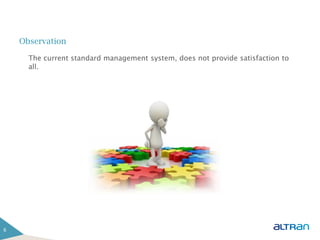
Observation

      The current standard management system, does not provide satisfaction to
      all.


6
“Organizations can become learning networks of
    diverse individuals creating value, and the role
    of leaders should include the stewardship of the
    living rather than the management of the
    machine.”

    http://www.stoosnetwork.org


7
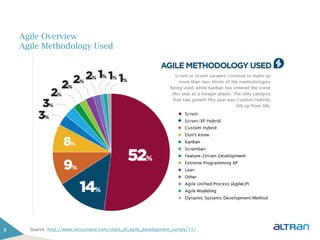
Agile Overview
    Agile Methodology Used


8     Source: http://www.versionone.com/state_of_agile_development_survey/11/
Agile Overview
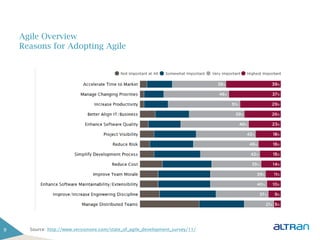
    Reasons for Adopting Agile


9     Source: http://www.versionone.com/state_of_agile_development_survey/11/
Agile Overview
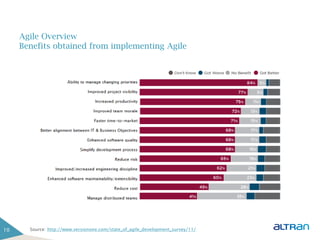
     Benefits obtained from implementing Agile


10     Source: http://www.versionone.com/state_of_agile_development_survey/11/
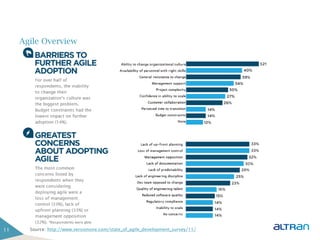
Agile Overview


11     Source: http://www.versionone.com/state_of_agile_development_survey/11/
12
Agile Overview
     Exercise : Myth and Facts about Scrum
     On the post-its in front of you, write 3 facts you already know
     and 3 myths you’ve heard about agile and /or Scrum. Write only
     one fact or myth per note, and don't indicate whether any
     particular note is a fact or a myth. Don't share them yet.

          10 minutes


     Someone from each table gather post-‐its from your team and
     pass to the next table
     As a team, take the post-‐its from the other team and post on
     your flip chart as fact or myth (if you are not sure – put in the
     middle)

          10 minutes

13
Agility Overview
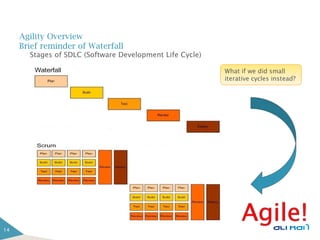
     Brief reminder of Waterfall
       Stages of SDLC (Software Development Life Cycle)

                                                          What if we did small
                                                          iterative cycles instead?


                    Business Solutions


14
Agile Overview
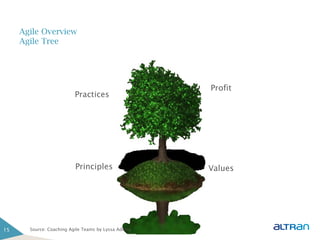
     Agile Tree


                                                      Profit
                          Practices


                          Principles                  Values


15     Source: Coaching Agile Teams by Lyssa Adkins
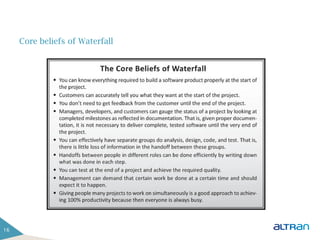
Core beliefs of Waterfall


16
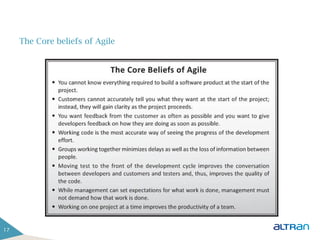
The Core beliefs of Agile


17
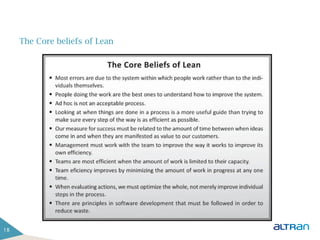
The Core beliefs of Lean


18
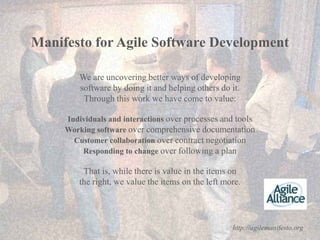
Manifesto for Agile Software Development

              We are uncovering better ways of developing
              software by doing it and helping others do it.
               Through this work we have come to value:

          Individuals and interactions over processes and tools
          Working software over comprehensive documentation
            Customer collaboration over contract negotiation
              Responding to change over following a plan

               That is, while there is value in the items on
              the right, we value the items on the left more.


19                                                        http://agilemanifesto.org
Agile Overview
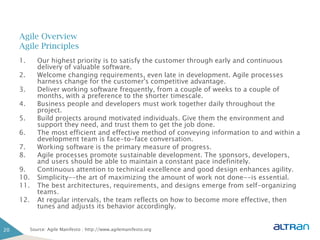
     Agile Principles
     1.       Our highest priority is to satisfy the customer through early and continuous
              delivery of valuable software.
     2.       Welcome changing requirements, even late in development. Agile processes
              harness change for the customer's competitive advantage.
     3.       Deliver working software frequently, from a couple of weeks to a couple of
              months, with a preference to the shorter timescale.
     4.       Business people and developers must work together daily throughout the
              project.
     5.       Build projects around motivated individuals. Give them the environment and
              support they need, and trust them to get the job done.
     6.       The most efficient and effective method of conveying information to and within a
              development team is face-to-face conversation.
     7.       Working software is the primary measure of progress.
     8.       Agile processes promote sustainable development. The sponsors, developers,
              and users should be able to maintain a constant pace indefinitely.
     9.       Continuous attention to technical excellence and good design enhances agility.
     10.      Simplicity--the art of maximizing the amount of work not done--is essential.
     11.      The best architectures, requirements, and designs emerge from self-organizing
              teams.
     12.      At regular intervals, the team reflects on how to become more effective, then
              tunes and adjusts its behavior accordingly.


20         Source: Agile Manifesto : http://www.agilemanifesto.org
Agile Overview
     Exercise: Agile Principles
       •   In your groups on a flip chart paper, write the numbers 1 through 12.
       •   Come up with three words maximum that effectively capture each of the
           twelve principles.


            15 minutes


       •   Also as a team pick the three principle you feel are most valuable, if you
           could only keep 3
       •   Report back to the class


             10 minutes


21
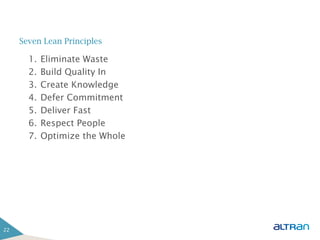
Seven Lean Principles

       1.   Eliminate Waste
       2.   Build Quality In
       3.   Create Knowledge
       4.   Defer Commitment
       5.   Deliver Fast
       6.   Respect People
       7.   Optimize the Whole


22
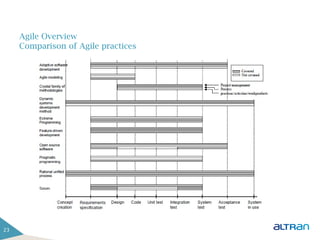
Agile Overview
     Comparison of Agile practices


                   Business Solutions


23
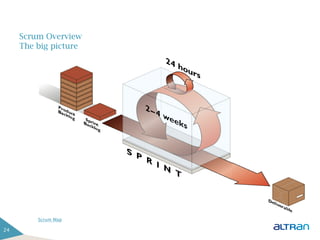
Scrum Overview
     The big picture


                     Business Solutions


         Scrum Map

24
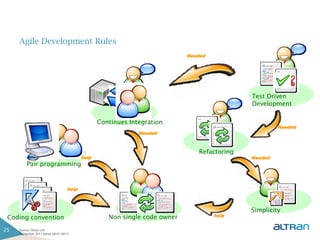
Agile Development Rules
                                                                            Needed


                                                                                              Test Driven
                                                                                              Development

                                                 Continues Integration
                                                                                                       Needed
                                                              Needed


                                                                                Refactoring
                                          help                                                Needed
         Pair programming


                                   help


                                                                                              Simplicity
 Coding convention                                  Non single code owner            help


25   Source: Altran CIS
     Septembre 2011 Altran AESI V2011
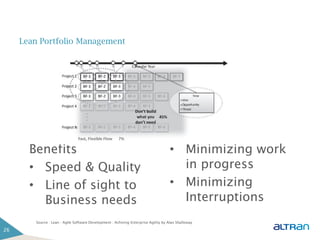
Lean Portfolio Management


       Benefits                                                                      • Minimizing work
       • Speed & Quality                                                               in progress
       • Line of sight to                                                            • Minimizing
         Business needs                                                                Interruptions
        Source : Lean - Agile Software Development : Achiving Enterprise Agility by Alan Shalloway

26
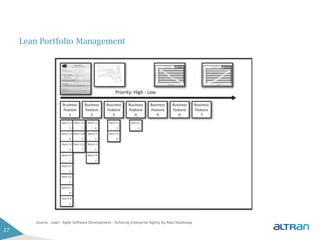
Lean Portfolio Management


        Source : Lean - Agile Software Development : Achiving Enterprise Agility by Alan Shalloway

27
28
Retrospective
Learning Framework

     SCRUM OVERVIEW


30
Scrum Overview
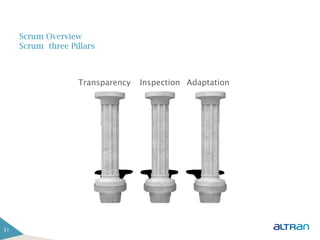
     Scrum three Pillars


                   Transparency   Inspection Adaptation


31
Scrum Overview
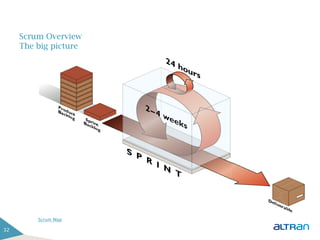
     The big picture


                     Business Solutions


         Scrum Map

32
Scrum Overview
     The main highlights

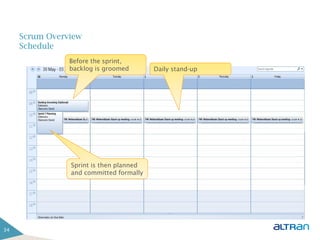
     The project is chopped into small iterations called Sprints. Each sprint
     takes usually between 2-4 weeks.

     The goal of every sprint is to deliver new functionality that can be
     potentially delivered to the stakeholders

     At the beginning of the sprint, the team meets up and prepares the work
     for the upcoming sprint

     There is a daily stand-up ceremony
                     Business Solutions
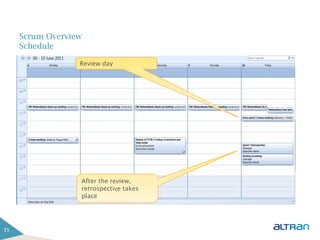
     At the end of the sprint, a review of the work done takes place

     Also, there is a retrospective of what went wrong/well, points to improve,
     etc

     Finally, the backlog is groomed depending on customer feedback,
     priorities, etc

33
Scrum Overview
     Schedule
                Before the sprint,
                backlog is groomed       Daily stand-up


                  Business Solutions
                Sprint is then planned
                and committed formally


34
Scrum Overview
     Schedule

                  Review day


                  Business Solutions

                  After the review,
                  retrospective takes
                  place


35
Retrospective
Scrum a Learning Framework

     SCRUM ROLES


37
Scrum Roles
     Exercise : Scrum Roles
       Form groups
       On Post-It’s write responsibilities and tasks that a project manager
       traditionally had
       Discuss where either each of the notes now belongs to the Scrum Master, the
       Product Owner or the team.
       Put the notes on the board accordingly


           20 minutes


38
Scrum Roles
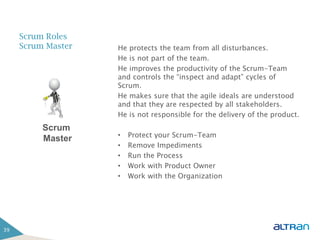
     Scrum Master   He protects the team from all disturbances.
                    He is not part of the team.
                    He improves the productivity of the Scrum-Team
                    and controls the “inspect and adapt” cycles of
                    Scrum.
                    He makes sure that the agile ideals are understood
                    and that they are respected by all stakeholders.
                    He is not responsible for the delivery of the product.
          Scrum
                    •   Protect your Scrum-Team
          Master
                    •   Remove Impediments
                    •   Run the Process
                    •   Work with Product Owner
                    •   Work with the Organization


39
Scrum Roles
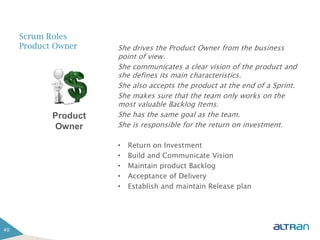
     Product Owner    She drives the Product Owner from the business
                      point of view.
                      She communicates a clear vision of the product and
                      she defines its main characteristics.
                      She also accepts the product at the end of a Sprint.
                      She makes sure that the team only works on the
                      most valuable Backlog Items.
            Product   She has the same goal as the team.
            Owner     She is responsible for the return on investment.

                      •   Return on Investment
                      •   Build and Communicate Vision
                      •   Maintain product Backlog
                      •   Acceptance of Delivery
                      •   Establish and maintain Release plan


40
Scrum Roles
     The Team

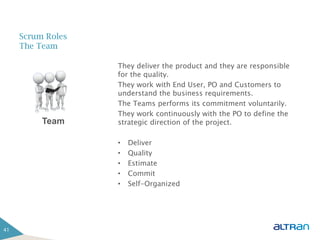
                   They deliver the product and they are responsible
                   for the quality.
                   They work with End User, PO and Customers to
                   understand the business requirements.
                   The Teams performs its commitment voluntarily.
                   They work continuously with the PO to define the
          Team     strategic direction of the project.

                   •   Deliver
                   •   Quality
                   •   Estimate
                   •   Commit
                   •   Self-Organized


41
Retrospective
Ressources

       Geneva – Lausanne Agile / Lean / Scrum Communities


43
Alexandre Cuva


Email : alexandre.cuva@altran.com
Twitter: @cuvaalex
Blog: http://agile-alexcuva.blogspot.com/
Phone: +41 78 715 8309
Introduction to agility

Introduction to agility

  • 1.
    Introduction to Agile Alexandre Cuva Agile Coach, LSTM, CSM, CSPO, PSM I, HSPTP 2012
  • 2.
  • 3.
    Alexandre Cuva Email : Organizational Coaching alexandre.cuva@altran.com (Management 3.0, Scrum) Twitter: @cuvaalex Team Coaching Blog: http://agile- alexcuva.blogspot.com/ (Scrum, XP, Kanban) Phone: +41 78 715 8309 Technical Coaching (TDD, BDD, C#, Java, Groovy) Agile Training (Management 3.0, Agile, Scrum, XP) 3
  • 4.
    Exercise: Introduction For each person at the table: 1. Think about your personal goal for this course (Why are you here, and not somewhere else?) 2. Write down your goal (you will need it later) 3. Introduce yourself to the group (if needed), and explain your goal 4. Offer a “Little Know Fact” about yourself 15 minutes 4 Source: Management 3.0 Courseware developed by Jurgen Appelo
  • 5.
    Observation The complexity is growing fast 5
  • 6.
    Observation The current standard management system, does not provide satisfaction to all. 6
  • 7.
    “Organizations can becomelearning networks of diverse individuals creating value, and the role of leaders should include the stewardship of the living rather than the management of the machine.” http://www.stoosnetwork.org 7
  • 8.
    Agile Overview Agile Methodology Used 8 Source: http://www.versionone.com/state_of_agile_development_survey/11/
  • 9.
    Agile Overview Reasons for Adopting Agile 9 Source: http://www.versionone.com/state_of_agile_development_survey/11/
  • 10.
    Agile Overview Benefits obtained from implementing Agile 10 Source: http://www.versionone.com/state_of_agile_development_survey/11/
  • 11.
    Agile Overview 11 Source: http://www.versionone.com/state_of_agile_development_survey/11/
  • 12.
  • 13.
    Agile Overview Exercise : Myth and Facts about Scrum On the post-its in front of you, write 3 facts you already know and 3 myths you’ve heard about agile and /or Scrum. Write only one fact or myth per note, and don't indicate whether any particular note is a fact or a myth. Don't share them yet. 10 minutes Someone from each table gather post-‐its from your team and pass to the next table As a team, take the post-‐its from the other team and post on your flip chart as fact or myth (if you are not sure – put in the middle) 10 minutes 13
  • 14.
    Agility Overview Brief reminder of Waterfall Stages of SDLC (Software Development Life Cycle) What if we did small iterative cycles instead? Business Solutions 14
  • 15.
    Agile Overview Agile Tree Profit Practices Principles Values 15 Source: Coaching Agile Teams by Lyssa Adkins
  • 16.
    Core beliefs ofWaterfall 16
  • 17.
    The Core beliefsof Agile 17
  • 18.
    The Core beliefsof Lean 18
  • 19.
    Manifesto for AgileSoftware Development We are uncovering better ways of developing software by doing it and helping others do it. Through this work we have come to value: Individuals and interactions over processes and tools Working software over comprehensive documentation Customer collaboration over contract negotiation Responding to change over following a plan That is, while there is value in the items on the right, we value the items on the left more. 19 http://agilemanifesto.org
  • 20.
    Agile Overview Agile Principles 1. Our highest priority is to satisfy the customer through early and continuous delivery of valuable software. 2. Welcome changing requirements, even late in development. Agile processes harness change for the customer's competitive advantage. 3. Deliver working software frequently, from a couple of weeks to a couple of months, with a preference to the shorter timescale. 4. Business people and developers must work together daily throughout the project. 5. Build projects around motivated individuals. Give them the environment and support they need, and trust them to get the job done. 6. The most efficient and effective method of conveying information to and within a development team is face-to-face conversation. 7. Working software is the primary measure of progress. 8. Agile processes promote sustainable development. The sponsors, developers, and users should be able to maintain a constant pace indefinitely. 9. Continuous attention to technical excellence and good design enhances agility. 10. Simplicity--the art of maximizing the amount of work not done--is essential. 11. The best architectures, requirements, and designs emerge from self-organizing teams. 12. At regular intervals, the team reflects on how to become more effective, then tunes and adjusts its behavior accordingly. 20 Source: Agile Manifesto : http://www.agilemanifesto.org
  • 21.
    Agile Overview Exercise: Agile Principles • In your groups on a flip chart paper, write the numbers 1 through 12. • Come up with three words maximum that effectively capture each of the twelve principles. 15 minutes • Also as a team pick the three principle you feel are most valuable, if you could only keep 3 • Report back to the class 10 minutes 21
  • 22.
    Seven Lean Principles 1. Eliminate Waste 2. Build Quality In 3. Create Knowledge 4. Defer Commitment 5. Deliver Fast 6. Respect People 7. Optimize the Whole 22
  • 23.
    Agile Overview Comparison of Agile practices Business Solutions 23
  • 24.
    Scrum Overview The big picture Business Solutions Scrum Map 24
  • 25.
    Agile Development Rules Needed Test Driven Development Continues Integration Needed Needed Refactoring help Needed Pair programming help Simplicity Coding convention Non single code owner help 25 Source: Altran CIS Septembre 2011 Altran AESI V2011
  • 26.
    Lean Portfolio Management Benefits • Minimizing work • Speed & Quality in progress • Line of sight to • Minimizing Business needs Interruptions Source : Lean - Agile Software Development : Achiving Enterprise Agility by Alan Shalloway 26
  • 27.
    Lean Portfolio Management Source : Lean - Agile Software Development : Achiving Enterprise Agility by Alan Shalloway 27
  • 28.
  • 29.
  • 30.
    Learning Framework SCRUM OVERVIEW 30
  • 31.
    Scrum Overview Scrum three Pillars Transparency Inspection Adaptation 31
  • 32.
    Scrum Overview The big picture Business Solutions Scrum Map 32
  • 33.
    Scrum Overview The main highlights The project is chopped into small iterations called Sprints. Each sprint takes usually between 2-4 weeks. The goal of every sprint is to deliver new functionality that can be potentially delivered to the stakeholders At the beginning of the sprint, the team meets up and prepares the work for the upcoming sprint There is a daily stand-up ceremony Business Solutions At the end of the sprint, a review of the work done takes place Also, there is a retrospective of what went wrong/well, points to improve, etc Finally, the backlog is groomed depending on customer feedback, priorities, etc 33
  • 34.
    Scrum Overview Schedule Before the sprint, backlog is groomed Daily stand-up Business Solutions Sprint is then planned and committed formally 34
  • 35.
    Scrum Overview Schedule Review day Business Solutions After the review, retrospective takes place 35
  • 36.
  • 37.
    Scrum a LearningFramework SCRUM ROLES 37
  • 38.
    Scrum Roles Exercise : Scrum Roles Form groups On Post-It’s write responsibilities and tasks that a project manager traditionally had Discuss where either each of the notes now belongs to the Scrum Master, the Product Owner or the team. Put the notes on the board accordingly 20 minutes 38
  • 39.
    Scrum Roles Scrum Master He protects the team from all disturbances. He is not part of the team. He improves the productivity of the Scrum-Team and controls the “inspect and adapt” cycles of Scrum. He makes sure that the agile ideals are understood and that they are respected by all stakeholders. He is not responsible for the delivery of the product. Scrum • Protect your Scrum-Team Master • Remove Impediments • Run the Process • Work with Product Owner • Work with the Organization 39
  • 40.
    Scrum Roles Product Owner She drives the Product Owner from the business point of view. She communicates a clear vision of the product and she defines its main characteristics. She also accepts the product at the end of a Sprint. She makes sure that the team only works on the most valuable Backlog Items. Product She has the same goal as the team. Owner She is responsible for the return on investment. • Return on Investment • Build and Communicate Vision • Maintain product Backlog • Acceptance of Delivery • Establish and maintain Release plan 40
  • 41.
    Scrum Roles The Team They deliver the product and they are responsible for the quality. They work with End User, PO and Customers to understand the business requirements. The Teams performs its commitment voluntarily. They work continuously with the PO to define the Team strategic direction of the project. • Deliver • Quality • Estimate • Commit • Self-Organized 41
  • 42.
  • 43.
    Ressources Geneva – Lausanne Agile / Lean / Scrum Communities 43
  • 44.
    Alexandre Cuva Email :alexandre.cuva@altran.com Twitter: @cuvaalex Blog: http://agile-alexcuva.blogspot.com/ Phone: +41 78 715 8309