MAMMOGRAPHY
Presented by: Sabin Gwachha
B Sc. MIT 2013
Moderator : Mr. Ranjit Jha
(senior demonstrator)
Mammograms
don’t look fun
but they can save
a life!
What is mammography..??
 Mammography is a radiographic modality to
detect breast pathology and cancer.
 Breast cancer accounts for 32% of cancer
incidence and 18% of cancer deaths in women in
the United States.
 Approximately 1 in 8 or 9 women in the US will
develop breast cancer over her lifetime.
 A mammogram can find breast cancer when it is
very small -- 2 to 3 years before we can feel it.
 No screening tool is 100% effective. Good
quality mammograms can find 85-90% of
cancers.
Some cancers are not found
until they reach this size
A mammogram can find
Cancer even when it is micro in
size
 The standard techniques used for breast imaging
are:
1. Screen film x-Ray mammography.
2. Real-Time ultrasound.
3. Other new techniques include:
 MRI
 Color Doppler
 Contrast ultrasound
 Digital Mammography
 Scintimammography
Principles Of Breast Cancer
 Patients in the early stages respond well to
extensive surgery
 Patients with advanced disease do poorly
 The earlier the diagnosis, the better the
chance of survival
 Mammography is the tool for early detection
Indication
 pain/tenderness
 Swelling
 Nipple discharge (mild)
 Calcification
 Benign or malignant tumor
 Lymph node enlargement
contraindication
 Breast implant
 Severe nipple discharge
 Large palpable mass
 Inflammation
 Women within reproductive age
15-40 (benefit over risk)
BI-RADS mammographic
assessment categories
 Categ.0 : incomplete
 Categ.1 : negative / normal
 Categ.2 : benign finding
 Categ.3 : probably benign
 Categ.4 : suspicious abnormality
 Categ.5 : highly suspicious of malignancy
 Categ.6 : known biopsy with prone
malignancy
Patient preparation
 The patient is requested to take proper bath before coming
for the procedure
 Patient should not wear deodorant, talcum powder or
lotion under her arms or on her breasts as these may appear
on the mammogram and interfere with correct diagnosis.
 She is suggested to wear loose clothing so that it is easier
for her to change for the procedure
 She is asked to bring along any histopathological report if
done before mammography for clinical co-relation
 A clean green hospital gown should be provided to the
patient before procedure.
 Patient privacy should be maintained and a conducive
environment should be created.
Development Of Mammography
 In 1913, radiographic appearance of breast cancers was
first reported
 1950’s – Industrial grade x-ray film used
 1975 – High speed/resolution film introduced by
DuPont
 1992 – MQSA implemented
MQSA
 Mammography Quality Standards Act
 Mandated the following:
 Formal training and continuing education
 Required regular inspection of equipment
 Documentation of quality assurance
 Report means of reporting results, follow-
up, tracking patients, and monitoring
outcomes
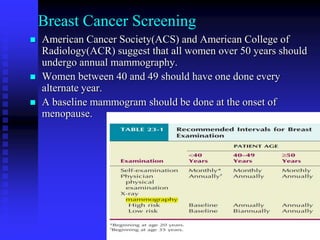
Breast Cancer Screening
 American Cancer Society(ACS) and American College of
Radiology(ACR) suggest that all women over 50 years should
undergo annual mammography.
 Women between 40 and 49 should have one done every
alternate year.
 A baseline mammogram should be done at the onset of
menopause.
Risk Factors
 Age
 Incidence increases with age
 Hormonal History
 More sensitive to carcinogens during
menarche
 Family History
 Women with positive family members
are more prone to breast cancer
Type of mammographic
examination
1.Diagnostic mammography is performed on
patients with symptoms or elevated risk
factors. Two or three views of each breast
may be required.
2.Screening mammography is performed on
asymptomatic women with the use of a two-
view protocol, usually medial lateral
oblique and cranial caudad, to detect on
unsuspected cancer
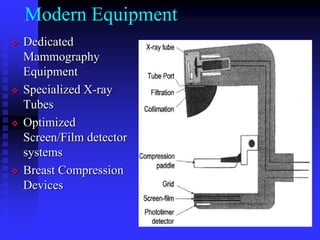
Modern Equipment
 Dedicated
Mammography
Equipment
 Specialized X-ray
Tubes
 Optimized
Screen/Film detector
systems
 Breast Compression
Devices
How x-ray is produce?
 X-rays are produced due to sudden
deceleration of fast moving electrons when
they collide or interact with the target
anode. In this process, 99% of the electron
energy is converted into heat and 1% of
energy is converted into X-ray.
 There are two type of x-ray production
1.bremsstrahlung x-ray
2.characteristic x-ray
1.bremsstrahlung x-ray
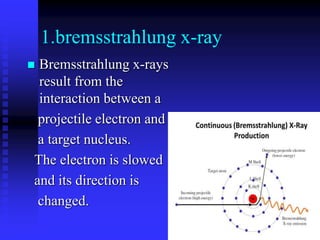
 Bremsstrahlung x-rays
result from the
interaction between a
projectile electron and
a target nucleus.
The electron is slowed
and its direction is
changed.
Characteristic x-ray
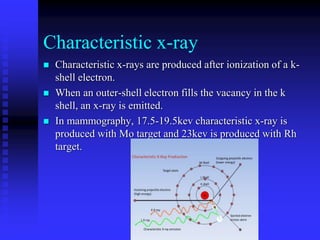
 Characteristic x-rays are produced after ionization of a k-
shell electron.
 When an outer-shell electron fills the vacancy in the k
shell, an x-ray is emitted.
 In mammography, 17.5-19.5kev characteristic x-ray is
produced with Mo target and 23kev is produced with Rh
target.
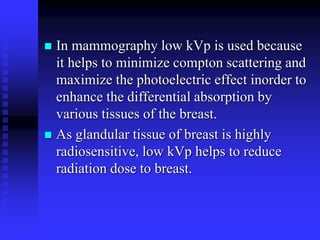
 In mammography low kVp is used because
it helps to minimize compton scattering and
maximize the photoelectric effect inorder to
enhance the differential absorption by
various tissues of the breast.
 As glandular tissue of breast is highly
radiosensitive, low kVp helps to reduce
radiation dose to breast.
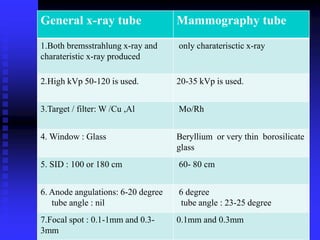
General x-ray tube Mammography tube
1.Both bremsstrahlung x-ray and
charateristic x-ray produced
only charaterisctic x-ray
2.High kVp 50-120 is used. 20-35 kVp is used.
3.Target / filter: W /Cu ,Al Mo/Rh
4. Window : Glass Beryllium or very thin borosilicate
glass
5. SID : 100 or 180 cm 60- 80 cm
6. Anode angulations: 6-20 degree
tube angle : nil
6 degree
tube angle : 23-25 degree
7.Focal spot : 0.1-1mm and 0.3-
3mm
0.1mm and 0.3mm
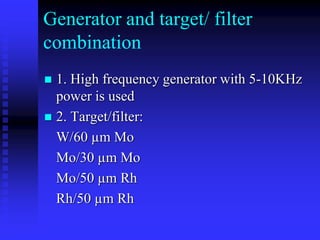
Generator and target/ filter
combination
 1. High frequency generator with 5-10KHz
power is used
 2. Target/filter:
W/60 µm Mo
Mo/30 µm Mo
Mo/50 µm Rh
Rh/50 µm Rh
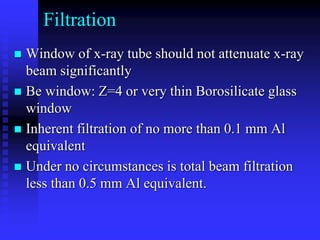
Filtration
 Window of x-ray tube should not attenuate x-ray
beam significantly
 Be window: Z=4 or very thin Borosilicate glass
window
 Inherent filtration of no more than 0.1 mm Al
equivalent
 Under no circumstances is total beam filtration
less than 0.5 mm Al equivalent.
HTC Grid
http://www.hologic.com/oem/pdf/W-BI-HTC_HTC%20GRID_09-04.pdf
• 3.8:1 grid ratio and dose
as conventional linear grids
•Copper as strip and air
interspace
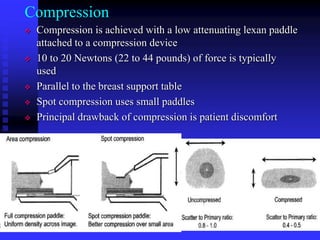
Compression
 Compression is achieved with a low attenuating lexan paddle
attached to a compression device
 10 to 20 Newtons (22 to 44 pounds) of force is typically
used
 Parallel to the breast support table
 Spot compression uses small paddles
 Principal drawback of compression is patient discomfort
Compression
 Breast compression is necessary
 Spread the anatomy out to minimise overlaying
structures (improve contrast)
 Equalise thickness to ensure homogenous density
on the radiograph
 Bring the structures closer to the detector to
reduce geometric unshaprness
 less scatter, more contrast, less geometric
blurring of the anatomic structures, less motion
and lower radiation dose to the tissues
Automatic Exposure Control (AEC)
 The AEC, also called a phototimer, is a device that uses a
radiation sensor, an amplifier and .a voltage comparator to
control the exposure.
 It is a device that automatically calculates the exposure
time that is required to produce optimum density on the
film.
 When the required optimum density is produced, the AEC
terminate the exposure and hence reduces the dose that
may have increased with manual selection of exposure
factor and exposure time.
 AEC detector is located underneath the cassette in
mammography unlike conventional radiography.
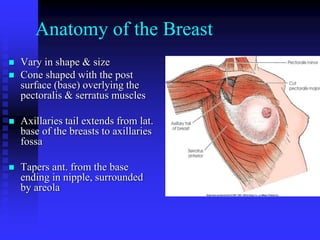
Anatomy of the Breast
 Vary in shape & size
 Cone shaped with the post
surface (base) overlying the
pectoralis & serratus muscles
 Axillaries tail extends from lat.
base of the breasts to axillaries
fossa
 Tapers ant. from the base
ending in nipple, surrounded
by areola
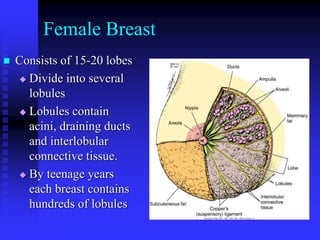
Female Breast
 Consists of 15-20 lobes
 Divide into several
lobules
 Lobules contain
acini, draining ducts
and interlobular
connective tissue.
 By teenage years
each breast contains
hundreds of lobules
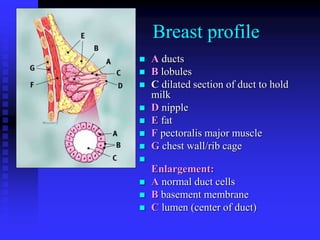
 A ducts
 B lobules
 C dilated section of duct to hold
milk
 D nipple
 E fat
 F pectoralis major muscle
 G chest wall/rib cage

Enlargement:
 A normal duct cells
 B basement membrane
 C lumen (center of duct)
Breast profile
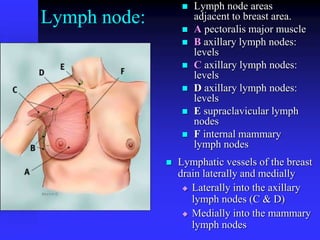
Lymph node:
 Lymphatic vessels of the breast
drain laterally and medially
 Laterally into the axillary
lymph nodes (C & D)
 Medially into the mammary
lymph nodes
 Lymph node areas
adjacent to breast area.
 A pectoralis major muscle
 B axillary lymph nodes:
levels
 C axillary lymph nodes:
levels
 D axillary lymph nodes:
levels
 E supraclavicular lymph
nodes
 F internal mammary
lymph nodes
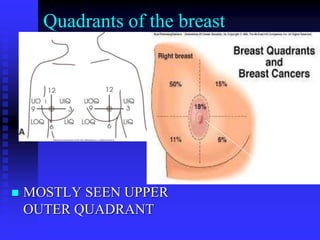
Quadrants of the breast
 MOSTLY SEEN UPPER
OUTER QUADRANT
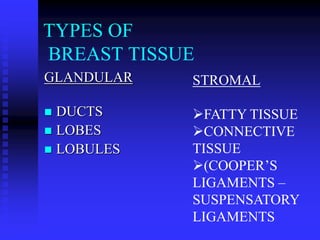
TYPES OF
BREAST TISSUE
GLANDULAR
 DUCTS
 LOBES
 LOBULES
STROMAL
FATTY TISSUE
CONNECTIVE
TISSUE
(COOPER’S
LIGAMENTS –
SUSPENSATORY
LIGAMENTS
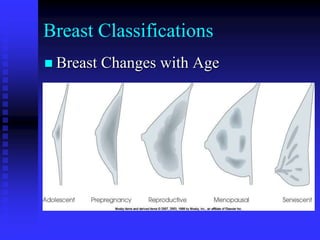
Breast Classifications
 Breast Changes with Age
35
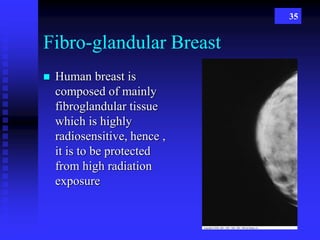
Fibro-glandular Breast
 Human breast is
composed of mainly
fibroglandular tissue
which is highly
radiosensitive, hence ,
it is to be protected
from high radiation
exposure
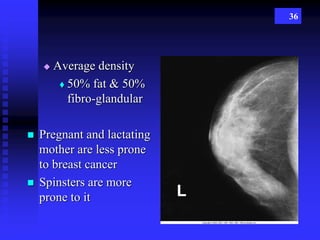
36
 Average density
 50% fat & 50%
fibro-glandular
 Pregnant and lactating
mother are less prone
to breast cancer
 Spinsters are more
prone to it
37
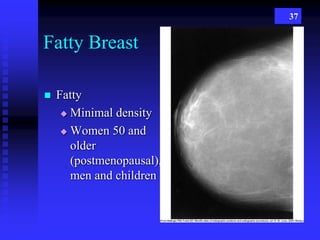
Fatty Breast
 Fatty
 Minimal density
 Women 50 and
older
(postmenopausal),
men and children
38
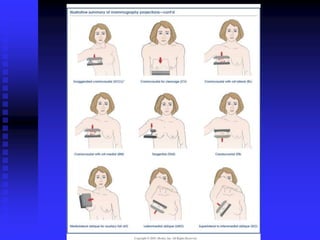
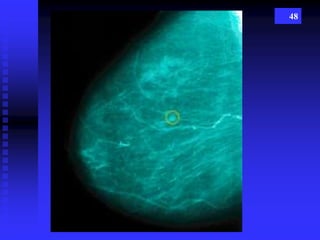
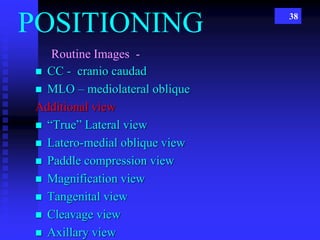
Routine Images -
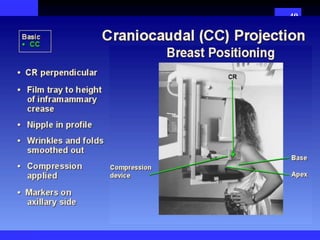
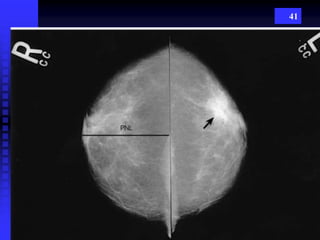
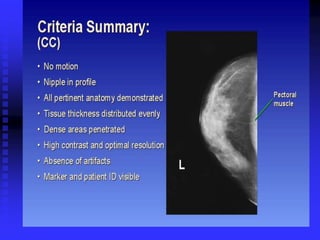
 CC - cranio caudad
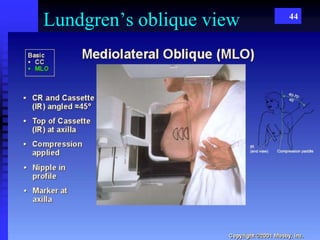
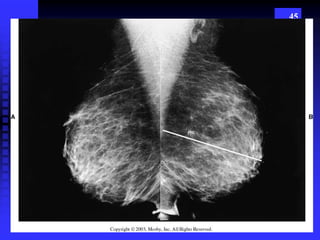
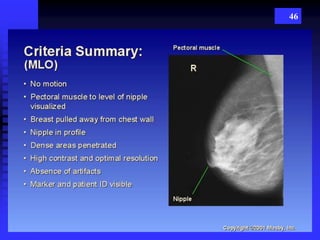
 MLO – mediolateral oblique
Additional view
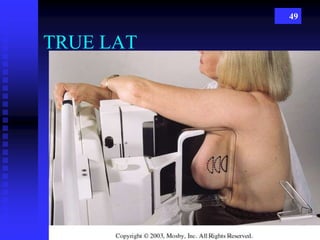
 “True” Lateral view
 Latero-medial oblique view
 Paddle compression view
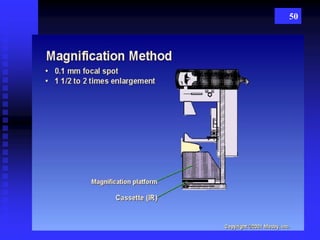
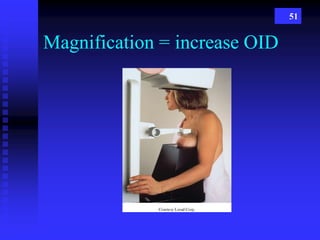
 Magnification view
 Tangenital view
 Cleavage view
 Axillary view
POSITIONING
40
41
42
43
Lundgren’s oblique view 44
45
46
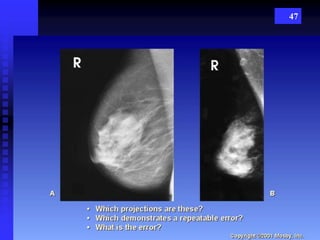
47
48
49
TRUE LAT
50
51
Magnification = increase OID
52
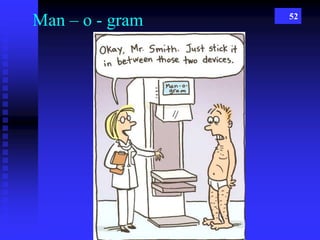
Man – o - gram
53
THE MALE BREAST
Male Mammography and Cancer
54
Male Breast Cancer Statistics:
 According to the American Cancer Society, about 0.22
percent of men’s cancer deaths are from breast cancer.
 This disease is 100 times more common in women than
it is in men.
 Benign excessive development of male mammary gland
 Occurs in 40% of male cancer pt’s
 Survival rates with treatment are 97% for 5 years
55
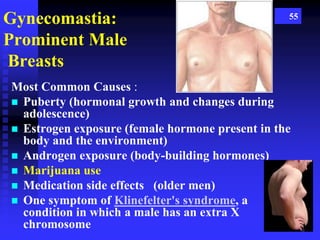
Gynecomastia:
Prominent Male
Breasts
Most Common Causes :
 Puberty (hormonal growth and changes during
adolescence)
 Estrogen exposure (female hormone present in the
body and the environment)
 Androgen exposure (body-building hormones)
 Marijuana use
 Medication side effects (older men)
 One symptom of Klinefelter's syndrome, a
condition in which a male has an extra X
chromosome
56
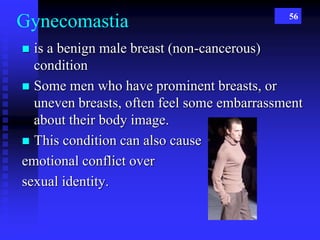
Gynecomastia
 is a benign male breast (non-cancerous)
condition
 Some men who have prominent breasts, or
uneven breasts, often feel some embarrassment
about their body image.
 This condition can also cause
emotional conflict over
sexual identity.
57
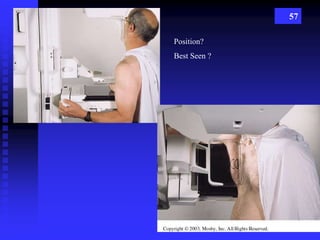
Position?
Best Seen ?
58
Male Mammography
 1300 men get breast cancer per year
 1/3 die
 Most are 60 years or older
 Nearly all are primary tumors
 Symptoms include:
 Nipple retraction
 Crusting
 Discharge
 Ulceration
Full-field digital
mammography (FFDM).
Recently approved by the U.S. Food and
Drug Administration (FDA), this technique
involves taking digital images of the breast.
Digital images are captured electronically
and can be viewed on a computer. Their
magnification, brightness and contrast can be
adjusted and enhanced to better reveal
abnormalities.
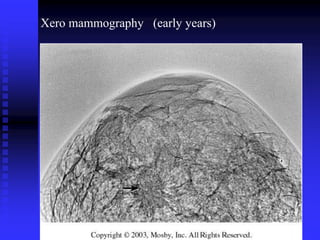
Xeromammography
 Xeromammography is a photoelectric method of
recording an x-ray image on a coated metal plate,
using low-energy photon beams, long exposure
time, and dry chemical developers.
 It is a form of xeroradiography.[1]
 This process was developed in the late 1960s by
Jerry Hedstrom, and used to image soft tissue, and
later focused on using the process to detect breast
cancer.
Xero mammography (early years)
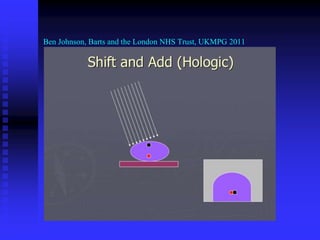
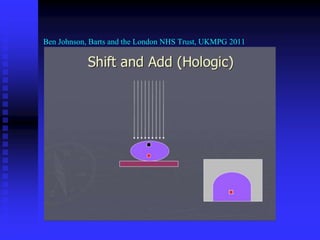
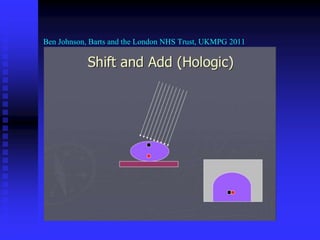
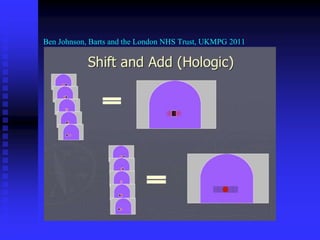
Tomosynthesis
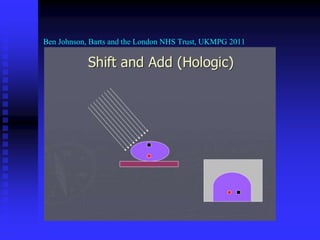
 Tomosynthesis: Tomosynthesis is a special kind
of mammogram that produces a 3-dimensional
image of the breast by using several low dose x-
rays obtained at different angles. For
tomosynthesis, the breast is positioned and
compressed in the same way as for a mammogram
but the x-ray tube moves in a circular arc around
the breast. It takes less than 10 seconds for the
imaging. The information from the x-rays is sent
to a computer, which produces a focused 3-D
image of the breast. The x-ray dose for a
tomosynthesis image is similar to that of a regular
mammogram
Ben Johnson, Barts and the London NHS Trust, UKMPG 2011
 In the scintimammography
procedure, a woman receives
an injection of a small amount
of a radioactive substance
called 99technetium sestamibi,
which is taken up by cancer
cells, and a gamma camera is
used to take pictures of the
breasts.
 Also called miraluma test
(when with sestamibi)
Breast Scintomotography
(NMBI)
Isotope matches tumor to node involvement
70
THANK YOU…..!!!!!

Mammography

  • 1.
    MAMMOGRAPHY Presented by: SabinGwachha B Sc. MIT 2013 Moderator : Mr. Ranjit Jha (senior demonstrator)
  • 2.
    Mammograms don’t look fun butthey can save a life!
  • 3.
    What is mammography..?? Mammography is a radiographic modality to detect breast pathology and cancer.  Breast cancer accounts for 32% of cancer incidence and 18% of cancer deaths in women in the United States.  Approximately 1 in 8 or 9 women in the US will develop breast cancer over her lifetime.  A mammogram can find breast cancer when it is very small -- 2 to 3 years before we can feel it.
  • 4.
     No screeningtool is 100% effective. Good quality mammograms can find 85-90% of cancers. Some cancers are not found until they reach this size A mammogram can find Cancer even when it is micro in size
  • 5.
     The standardtechniques used for breast imaging are: 1. Screen film x-Ray mammography. 2. Real-Time ultrasound. 3. Other new techniques include:  MRI  Color Doppler  Contrast ultrasound  Digital Mammography  Scintimammography
  • 6.
    Principles Of BreastCancer  Patients in the early stages respond well to extensive surgery  Patients with advanced disease do poorly  The earlier the diagnosis, the better the chance of survival  Mammography is the tool for early detection
  • 7.
    Indication  pain/tenderness  Swelling Nipple discharge (mild)  Calcification  Benign or malignant tumor  Lymph node enlargement
  • 8.
    contraindication  Breast implant Severe nipple discharge  Large palpable mass  Inflammation  Women within reproductive age 15-40 (benefit over risk)
  • 9.
    BI-RADS mammographic assessment categories Categ.0 : incomplete  Categ.1 : negative / normal  Categ.2 : benign finding  Categ.3 : probably benign  Categ.4 : suspicious abnormality  Categ.5 : highly suspicious of malignancy  Categ.6 : known biopsy with prone malignancy
  • 10.
    Patient preparation  Thepatient is requested to take proper bath before coming for the procedure  Patient should not wear deodorant, talcum powder or lotion under her arms or on her breasts as these may appear on the mammogram and interfere with correct diagnosis.  She is suggested to wear loose clothing so that it is easier for her to change for the procedure  She is asked to bring along any histopathological report if done before mammography for clinical co-relation  A clean green hospital gown should be provided to the patient before procedure.  Patient privacy should be maintained and a conducive environment should be created.
  • 11.
    Development Of Mammography In 1913, radiographic appearance of breast cancers was first reported  1950’s – Industrial grade x-ray film used  1975 – High speed/resolution film introduced by DuPont  1992 – MQSA implemented
  • 12.
    MQSA  Mammography QualityStandards Act  Mandated the following:  Formal training and continuing education  Required regular inspection of equipment  Documentation of quality assurance  Report means of reporting results, follow- up, tracking patients, and monitoring outcomes
  • 13.
    Breast Cancer Screening American Cancer Society(ACS) and American College of Radiology(ACR) suggest that all women over 50 years should undergo annual mammography.  Women between 40 and 49 should have one done every alternate year.  A baseline mammogram should be done at the onset of menopause.
  • 14.
    Risk Factors  Age Incidence increases with age  Hormonal History  More sensitive to carcinogens during menarche  Family History  Women with positive family members are more prone to breast cancer
  • 15.
    Type of mammographic examination 1.Diagnosticmammography is performed on patients with symptoms or elevated risk factors. Two or three views of each breast may be required. 2.Screening mammography is performed on asymptomatic women with the use of a two- view protocol, usually medial lateral oblique and cranial caudad, to detect on unsuspected cancer
  • 16.
    Modern Equipment  Dedicated Mammography Equipment Specialized X-ray Tubes  Optimized Screen/Film detector systems  Breast Compression Devices
  • 17.
    How x-ray isproduce?  X-rays are produced due to sudden deceleration of fast moving electrons when they collide or interact with the target anode. In this process, 99% of the electron energy is converted into heat and 1% of energy is converted into X-ray.  There are two type of x-ray production 1.bremsstrahlung x-ray 2.characteristic x-ray
  • 18.
    1.bremsstrahlung x-ray  Bremsstrahlungx-rays result from the interaction between a projectile electron and a target nucleus. The electron is slowed and its direction is changed.
  • 19.
    Characteristic x-ray  Characteristicx-rays are produced after ionization of a k- shell electron.  When an outer-shell electron fills the vacancy in the k shell, an x-ray is emitted.  In mammography, 17.5-19.5kev characteristic x-ray is produced with Mo target and 23kev is produced with Rh target.
  • 20.
     In mammographylow kVp is used because it helps to minimize compton scattering and maximize the photoelectric effect inorder to enhance the differential absorption by various tissues of the breast.  As glandular tissue of breast is highly radiosensitive, low kVp helps to reduce radiation dose to breast.
  • 21.
    General x-ray tubeMammography tube 1.Both bremsstrahlung x-ray and charateristic x-ray produced only charaterisctic x-ray 2.High kVp 50-120 is used. 20-35 kVp is used. 3.Target / filter: W /Cu ,Al Mo/Rh 4. Window : Glass Beryllium or very thin borosilicate glass 5. SID : 100 or 180 cm 60- 80 cm 6. Anode angulations: 6-20 degree tube angle : nil 6 degree tube angle : 23-25 degree 7.Focal spot : 0.1-1mm and 0.3- 3mm 0.1mm and 0.3mm
  • 22.
    Generator and target/filter combination  1. High frequency generator with 5-10KHz power is used  2. Target/filter: W/60 µm Mo Mo/30 µm Mo Mo/50 µm Rh Rh/50 µm Rh
  • 23.
    Filtration  Window ofx-ray tube should not attenuate x-ray beam significantly  Be window: Z=4 or very thin Borosilicate glass window  Inherent filtration of no more than 0.1 mm Al equivalent  Under no circumstances is total beam filtration less than 0.5 mm Al equivalent.
  • 24.
    HTC Grid http://www.hologic.com/oem/pdf/W-BI-HTC_HTC%20GRID_09-04.pdf • 3.8:1grid ratio and dose as conventional linear grids •Copper as strip and air interspace
  • 25.
    Compression  Compression isachieved with a low attenuating lexan paddle attached to a compression device  10 to 20 Newtons (22 to 44 pounds) of force is typically used  Parallel to the breast support table  Spot compression uses small paddles  Principal drawback of compression is patient discomfort
  • 26.
    Compression  Breast compressionis necessary  Spread the anatomy out to minimise overlaying structures (improve contrast)  Equalise thickness to ensure homogenous density on the radiograph  Bring the structures closer to the detector to reduce geometric unshaprness  less scatter, more contrast, less geometric blurring of the anatomic structures, less motion and lower radiation dose to the tissues
  • 27.
    Automatic Exposure Control(AEC)  The AEC, also called a phototimer, is a device that uses a radiation sensor, an amplifier and .a voltage comparator to control the exposure.  It is a device that automatically calculates the exposure time that is required to produce optimum density on the film.  When the required optimum density is produced, the AEC terminate the exposure and hence reduces the dose that may have increased with manual selection of exposure factor and exposure time.  AEC detector is located underneath the cassette in mammography unlike conventional radiography.
  • 28.
    Anatomy of theBreast  Vary in shape & size  Cone shaped with the post surface (base) overlying the pectoralis & serratus muscles  Axillaries tail extends from lat. base of the breasts to axillaries fossa  Tapers ant. from the base ending in nipple, surrounded by areola
  • 29.
    Female Breast  Consistsof 15-20 lobes  Divide into several lobules  Lobules contain acini, draining ducts and interlobular connective tissue.  By teenage years each breast contains hundreds of lobules
  • 30.
     A ducts B lobules  C dilated section of duct to hold milk  D nipple  E fat  F pectoralis major muscle  G chest wall/rib cage  Enlargement:  A normal duct cells  B basement membrane  C lumen (center of duct) Breast profile
  • 31.
    Lymph node:  Lymphaticvessels of the breast drain laterally and medially  Laterally into the axillary lymph nodes (C & D)  Medially into the mammary lymph nodes  Lymph node areas adjacent to breast area.  A pectoralis major muscle  B axillary lymph nodes: levels  C axillary lymph nodes: levels  D axillary lymph nodes: levels  E supraclavicular lymph nodes  F internal mammary lymph nodes
  • 32.
    Quadrants of thebreast  MOSTLY SEEN UPPER OUTER QUADRANT
  • 33.
    TYPES OF BREAST TISSUE GLANDULAR DUCTS  LOBES  LOBULES STROMAL FATTY TISSUE CONNECTIVE TISSUE (COOPER’S LIGAMENTS – SUSPENSATORY LIGAMENTS
  • 34.
  • 35.
    35 Fibro-glandular Breast  Humanbreast is composed of mainly fibroglandular tissue which is highly radiosensitive, hence , it is to be protected from high radiation exposure
  • 36.
    36  Average density 50% fat & 50% fibro-glandular  Pregnant and lactating mother are less prone to breast cancer  Spinsters are more prone to it
  • 37.
    37 Fatty Breast  Fatty Minimal density  Women 50 and older (postmenopausal), men and children
  • 38.
    38 Routine Images - CC - cranio caudad  MLO – mediolateral oblique Additional view  “True” Lateral view  Latero-medial oblique view  Paddle compression view  Magnification view  Tangenital view  Cleavage view  Axillary view POSITIONING
  • 40.
  • 41.
  • 42.
  • 43.
  • 44.
  • 45.
  • 46.
  • 47.
  • 48.
  • 49.
  • 50.
  • 51.
  • 52.
  • 53.
    53 THE MALE BREAST MaleMammography and Cancer
  • 54.
    54 Male Breast CancerStatistics:  According to the American Cancer Society, about 0.22 percent of men’s cancer deaths are from breast cancer.  This disease is 100 times more common in women than it is in men.  Benign excessive development of male mammary gland  Occurs in 40% of male cancer pt’s  Survival rates with treatment are 97% for 5 years
  • 55.
    55 Gynecomastia: Prominent Male Breasts Most CommonCauses :  Puberty (hormonal growth and changes during adolescence)  Estrogen exposure (female hormone present in the body and the environment)  Androgen exposure (body-building hormones)  Marijuana use  Medication side effects (older men)  One symptom of Klinefelter's syndrome, a condition in which a male has an extra X chromosome
  • 56.
    56 Gynecomastia  is abenign male breast (non-cancerous) condition  Some men who have prominent breasts, or uneven breasts, often feel some embarrassment about their body image.  This condition can also cause emotional conflict over sexual identity.
  • 57.
  • 58.
    58 Male Mammography  1300men get breast cancer per year  1/3 die  Most are 60 years or older  Nearly all are primary tumors  Symptoms include:  Nipple retraction  Crusting  Discharge  Ulceration
  • 59.
    Full-field digital mammography (FFDM). Recentlyapproved by the U.S. Food and Drug Administration (FDA), this technique involves taking digital images of the breast. Digital images are captured electronically and can be viewed on a computer. Their magnification, brightness and contrast can be adjusted and enhanced to better reveal abnormalities.
  • 60.
    Xeromammography  Xeromammography isa photoelectric method of recording an x-ray image on a coated metal plate, using low-energy photon beams, long exposure time, and dry chemical developers.  It is a form of xeroradiography.[1]  This process was developed in the late 1960s by Jerry Hedstrom, and used to image soft tissue, and later focused on using the process to detect breast cancer.
  • 61.
  • 62.
    Tomosynthesis  Tomosynthesis: Tomosynthesisis a special kind of mammogram that produces a 3-dimensional image of the breast by using several low dose x- rays obtained at different angles. For tomosynthesis, the breast is positioned and compressed in the same way as for a mammogram but the x-ray tube moves in a circular arc around the breast. It takes less than 10 seconds for the imaging. The information from the x-rays is sent to a computer, which produces a focused 3-D image of the breast. The x-ray dose for a tomosynthesis image is similar to that of a regular mammogram
  • 63.
    Ben Johnson, Bartsand the London NHS Trust, UKMPG 2011
  • 64.
    Ben Johnson, Bartsand the London NHS Trust, UKMPG 2011
  • 65.
    Ben Johnson, Bartsand the London NHS Trust, UKMPG 2011
  • 66.
    Ben Johnson, Bartsand the London NHS Trust, UKMPG 2011
  • 67.
    Ben Johnson, Bartsand the London NHS Trust, UKMPG 2011
  • 68.
    Ben Johnson, Bartsand the London NHS Trust, UKMPG 2011
  • 69.
     In thescintimammography procedure, a woman receives an injection of a small amount of a radioactive substance called 99technetium sestamibi, which is taken up by cancer cells, and a gamma camera is used to take pictures of the breasts.  Also called miraluma test (when with sestamibi) Breast Scintomotography (NMBI) Isotope matches tumor to node involvement
  • 70.