
University of Salahaddin /Hawler, College of Science/
Computer Department


Supervisor
Dr.sarah
Prepared by
Hemn amin abduljabar
hemnamin10@gmail.com
Virus is a computer program that can copy
itself and infect computer without
permission or knowledge of the user. A virus
can only spread from one computer to
another when its host is taken to the
uninfected computer, for instance by a user
sending it over a network or the Internet, or
by carrying it on a removable medium such
as a floppy disk, CD, or USB drive.
Going back to the origin of viruses, it was in
1949 that Mathematician John Von Neumann
described self-replicating programs which could
resemble computer viruses as they are known
today. In that decade, a group of programmers
developed a game called Core Wars, which
could reproduce every time it was run, and even
saturate the memory of other players'
computers. The creators of this peculiar game
also created the first antivirus, an application
named Reaper, which could destroy copies
created by Core Wars.
The term Malware is derived from two different
words - "malicious" and "software.
Indeed, Malware is a general term for any kind of
program that is designed to harm your computer.
Adware, Spyware, Trojans, Viruses and tracking
cookies are all types of Malware.
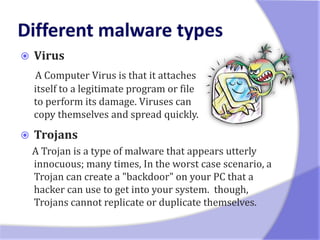
   Virus
    A Computer Virus is that it attaches
    itself to a legitimate program or file
    to perform its damage. Viruses can
    copy themselves and spread quickly.
   Trojans
    A Trojan is a type of malware that appears utterly
    innocuous; many times, In the worst case scenario, a
    Trojan can create a "backdoor" on your PC that a
    hacker can use to get into your system. though,
    Trojans cannot replicate or duplicate themselves.
   Worms
    A Worm is also a type of computer Malware. As such it
    can replicate itself with ease. though, is that they can
    do so without human assistance. Worms travel across
    computer networks . They suck up a lot of system
    memory and are known to crash entire networks.
   Spyware
    Spyware is a kind of malware; it has a specific
    objective, though: Running in the background
    to gather information from your computer
    system. Needless to say, spyware isn't
    something that you want running on your
    computer.
   Adware
    Adware is a word formed from combining
    "Advertising" and "Software." In essence Adware is
    advertising-supported software. Adware is more
    annoying than harmful on its own.
   They are transmitted through
    computer networks, the Internet
    and portable media like USB
    drives, DVDs and CDs. You can
    receive computer viruses via
    email or by copying a program
    onto a CD and installing it onto
    your PC.
   Applications that don't work properly.
   Disks can't be accessed.
   Printing doesn't work correctly.
   File size changes for no apparent reason.
   Date of last access does not match date of last
    use.
   An increase in the number of files on the system
    when nothing has been added
   Unusual error messages.
   System slows down, freezes or crashes.
   Best way to protect yourself
    is to prepare your computer
    anti viruses in advance. One
    way to protect you
    computer is to use updated
    anti-virus program.
Antivirus programs were initially introduced
in the mid-1980s and became popular in
1988. During this time, many computer
hackers released viruses.
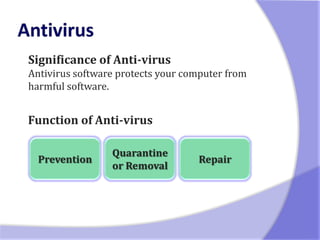
Significance of Anti-virus
Antivirus software protects your computer from
harmful software.


Function of Anti-virus

                 Quarantine
  Prevention                       Repair
                 or Removal
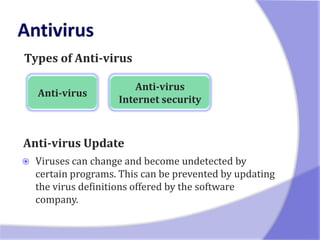
Types of Anti-virus

                        Anti-virus
    Anti-virus
                     Internet security


Anti-virus Update
   Viruses can change and become undetected by
    certain programs. This can be prevented by updating
    the virus definitions offered by the software
    company.
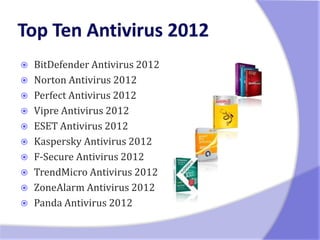
 BitDefender Antivirus 2012
 Norton Antivirus 2012
 Perfect Antivirus 2012
 Vipre Antivirus 2012
 ESET Antivirus 2012
 Kaspersky Antivirus 2012
 F-Secure Antivirus 2012
 TrendMicro Antivirus 2012
 ZoneAlarm Antivirus 2012
 Panda Antivirus 2012
Computer virus

Computer virus

  • 1.
    University of Salahaddin/Hawler, College of Science/ Computer Department Supervisor Dr.sarah Prepared by Hemn amin abduljabar hemnamin10@gmail.com
  • 2.
    Virus is acomputer program that can copy itself and infect computer without permission or knowledge of the user. A virus can only spread from one computer to another when its host is taken to the uninfected computer, for instance by a user sending it over a network or the Internet, or by carrying it on a removable medium such as a floppy disk, CD, or USB drive.
  • 3.
    Going back tothe origin of viruses, it was in 1949 that Mathematician John Von Neumann described self-replicating programs which could resemble computer viruses as they are known today. In that decade, a group of programmers developed a game called Core Wars, which could reproduce every time it was run, and even saturate the memory of other players' computers. The creators of this peculiar game also created the first antivirus, an application named Reaper, which could destroy copies created by Core Wars.
  • 4.
    The term Malwareis derived from two different words - "malicious" and "software. Indeed, Malware is a general term for any kind of program that is designed to harm your computer. Adware, Spyware, Trojans, Viruses and tracking cookies are all types of Malware.
  • 5.
    Virus A Computer Virus is that it attaches itself to a legitimate program or file to perform its damage. Viruses can copy themselves and spread quickly.  Trojans A Trojan is a type of malware that appears utterly innocuous; many times, In the worst case scenario, a Trojan can create a "backdoor" on your PC that a hacker can use to get into your system. though, Trojans cannot replicate or duplicate themselves.
  • 6.
    Worms A Worm is also a type of computer Malware. As such it can replicate itself with ease. though, is that they can do so without human assistance. Worms travel across computer networks . They suck up a lot of system memory and are known to crash entire networks.
  • 7.
    Spyware Spyware is a kind of malware; it has a specific objective, though: Running in the background to gather information from your computer system. Needless to say, spyware isn't something that you want running on your computer.  Adware Adware is a word formed from combining "Advertising" and "Software." In essence Adware is advertising-supported software. Adware is more annoying than harmful on its own.
  • 8.
    They are transmitted through computer networks, the Internet and portable media like USB drives, DVDs and CDs. You can receive computer viruses via email or by copying a program onto a CD and installing it onto your PC.
  • 9.
    Applications that don't work properly.  Disks can't be accessed.  Printing doesn't work correctly.  File size changes for no apparent reason.  Date of last access does not match date of last use.  An increase in the number of files on the system when nothing has been added  Unusual error messages.  System slows down, freezes or crashes.
  • 10.
    Best way to protect yourself is to prepare your computer anti viruses in advance. One way to protect you computer is to use updated anti-virus program.
  • 11.
    Antivirus programs wereinitially introduced in the mid-1980s and became popular in 1988. During this time, many computer hackers released viruses.
  • 12.
    Significance of Anti-virus Antivirussoftware protects your computer from harmful software. Function of Anti-virus Quarantine Prevention Repair or Removal
  • 13.
    Types of Anti-virus Anti-virus Anti-virus Internet security Anti-virus Update  Viruses can change and become undetected by certain programs. This can be prevented by updating the virus definitions offered by the software company.
  • 14.
     BitDefender Antivirus2012  Norton Antivirus 2012  Perfect Antivirus 2012  Vipre Antivirus 2012  ESET Antivirus 2012  Kaspersky Antivirus 2012  F-Secure Antivirus 2012  TrendMicro Antivirus 2012  ZoneAlarm Antivirus 2012  Panda Antivirus 2012