Buccal Drug Delivery System
Introduction
i. The Buccal mucosa lines the inner cheek
ii. Placed between the upper gingivae and cheek
iii.Treat local and systemic conditions
Typically large, Hydrophilic and unstable proteins,
Oligonucleotides and Polysaccharides
Advantage
 Avoids first pass effect
 Abundance of blood vessel
 Less friendly environment that
GIT
 Permeability enhancers
 Easy of administration and
termination
 Fast cellular recovery
 Directly & easily modify
microenvironment
Disadvantages
i. Less permeable than the small
intestine
ii. Salivation and swallowing
iii. Movement affects
mucoadhesive systems
iv. Relative small absorptive
surface area (0.01 sq m vs 100
sq m for GIT)
Role of glands
Role of Saliva
i. Continuous mineralization/
demineralization of the
tooth enamel
ii. Protective fluid for all
tissues of the oral cavity
iii.To hydrate oral mucosal
dosage forms
Role of Mucus
i. Bioadhesion of
mucoadhesive drug delivery
system
ii. Made up of proteins and
carbohydrates
iii. Cell-cell adhesion
iv. Lubrication
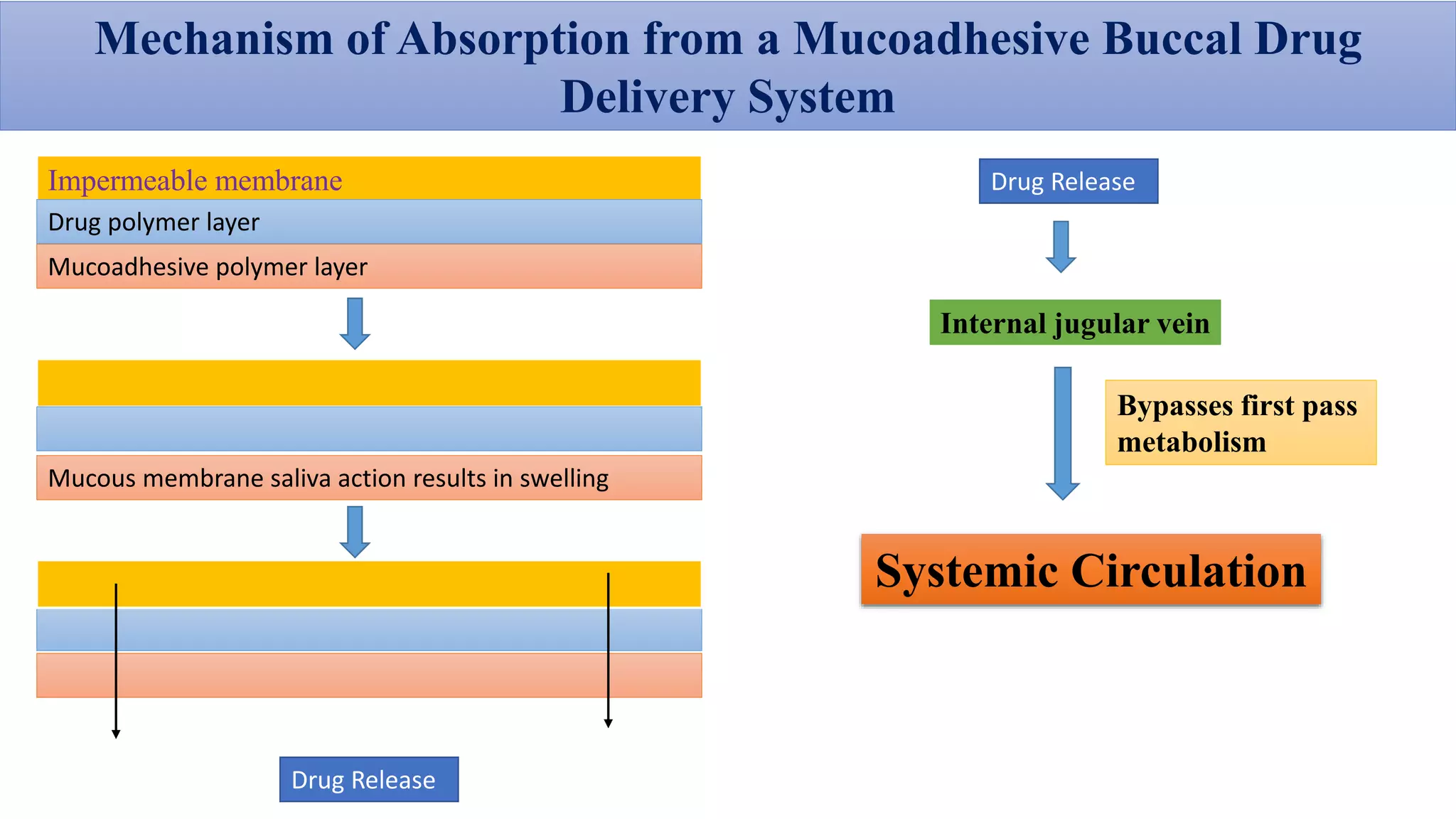
Mechanism of Absorption from a Mucoadhesive Buccal Drug
Delivery System
Bypasses first pass
metabolism
Impermeable membrane
Drug polymer layer
Mucoadhesive polymer layer
Drug Release
Systemic Circulation
Internal jugular vein
Mucous membrane saliva action results in swelling
Drug Release
Drug Delivery Pathways
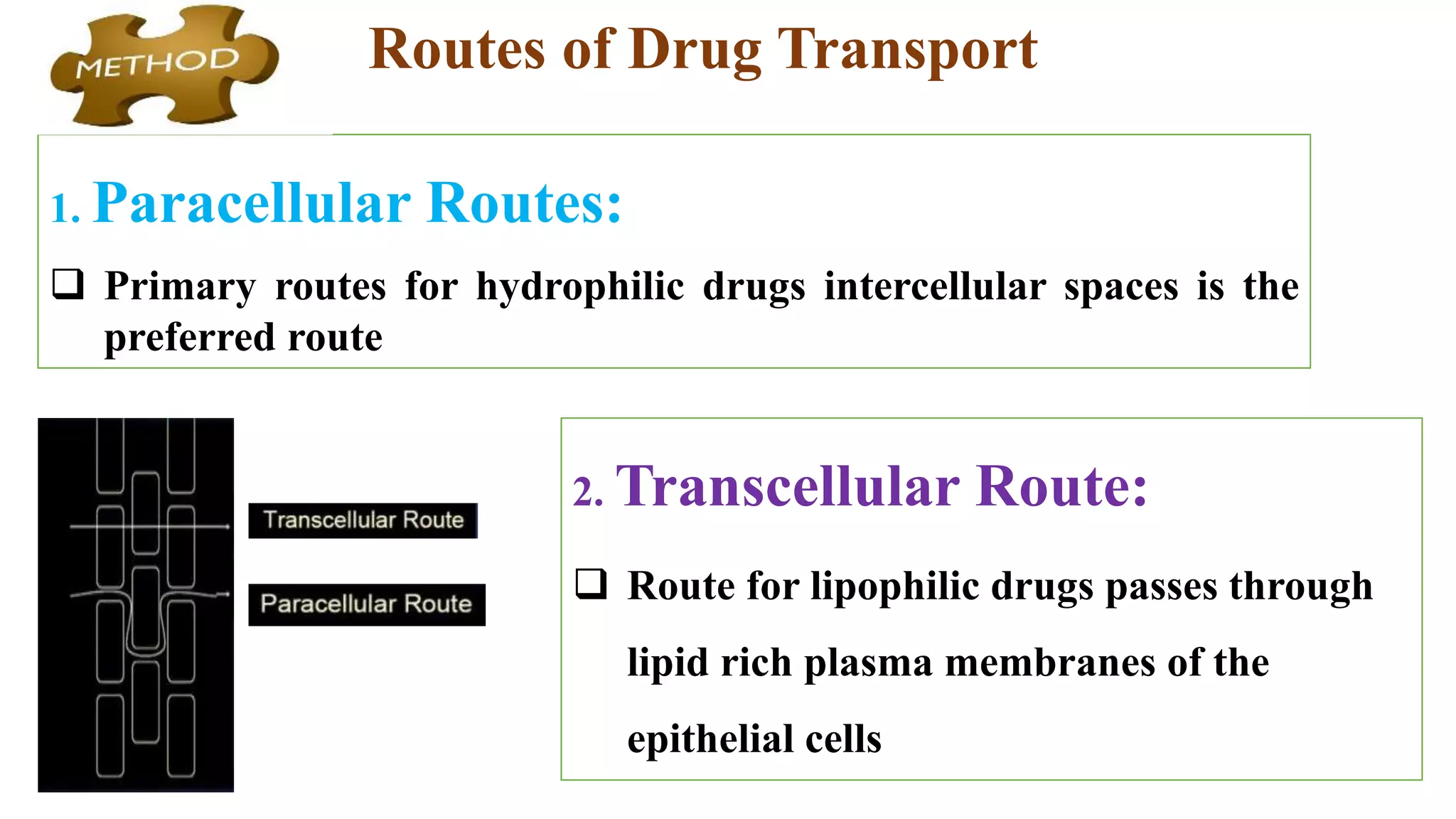
Two Possible routes of drug absorption through oral mucosa
Routes of Drug Transport
1. Paracellular Routes:
 Primary routes for hydrophilic drugs intercellular spaces is the
preferred route
2. Transcellular Route:
 Route for lipophilic drugs passes through
lipid rich plasma membranes of the
epithelial cells
I. Function of Oral Mucosa
 Provide Protection
 Acts as a barrier
 Provides adhesion
 Keep the Mucosal Membrane Moist
I. Regional Differences in Mucosal Permeability
 Permeability: Intermediate between epidermis & intestinal
mucosa
 Permeability of oral mucosa
 Sublingual ˃ Buccal ˃ Palate
 Palate (keratinized), Sublingual (thiner & immersed in saliva)
Buccal Mucoadhesive Dosage Forms
 Single layer device with multidirectional release
 Significant drug loss due to swallowing
 Impermeable backing layer is superimposed
 Preventing drug loss into the oral cavity
 Unidirectional release device, drug loss is minimal
 Achieved by coating every face except contact face
Three types based on their geometry
Type-1
Type-2
Type-3
Applications
Permeability Enhancers
Substances added to pharmaceuticals
formulation in order to increase the
membrane permeation rate or
absorption rate of Co-administered
drug.
E.g.; By using di- and tri-hydrogen bile salts, the
permeability of buccal mucosa to fluorescein
isothiocynate (FITC) increased by 100-200 fold
compared to FITC alone.
 Applications: Bioavailability of drugs 5%-40%
 Limitation: Potential membrane damage.
Design of Buccal Dosage Form
Matrix type : the Buccal patch designed
in a matrix configuration contains drug,
adhesive and mixed together
Bi-directional patches release drug
in both the mucosa and the mouth
……………………………………..
……………………………………..
Drug
+
Mucoadhesive
Reference
 Abuja A, Khar RK, Ali J. Mucoadhesive drug delivery systems. Drug Development and Industrial
Pharmacy. 1997; 23: 489–517.
 Agarwal V, Mishra B. Design development and biopharmaceutical a property of buccoadhesive
compacts of pentazocine. Drug Development and Industrial Pharmacy. 1999; 25: 701–709.
 Kamimori GH, Karyekar CS. The rate of absorption and relative bioavailability of caffeine
administered in chewing gum. International Journal of Pharmacy. 2002; 234 (1-2): 159-167.
 Miller NS, Johnston TP. The use of mucoadhesive polymers in buccal drug delivery. Advanced Drug
Delivery Reviews. 2005; 57: 1666–91.
 Sayani AP, Chien YW. Systemic delivery of peptides and proteins across absorptive mucosa. Critical
Reviews Drug Carrier System. 1996; 13: 85-184.
Buccal drug delivery system

Buccal drug delivery system

  • 1.
    Buccal Drug DeliverySystem Introduction i. The Buccal mucosa lines the inner cheek ii. Placed between the upper gingivae and cheek iii.Treat local and systemic conditions Typically large, Hydrophilic and unstable proteins, Oligonucleotides and Polysaccharides
  • 2.
    Advantage  Avoids firstpass effect  Abundance of blood vessel  Less friendly environment that GIT  Permeability enhancers  Easy of administration and termination  Fast cellular recovery  Directly & easily modify microenvironment Disadvantages i. Less permeable than the small intestine ii. Salivation and swallowing iii. Movement affects mucoadhesive systems iv. Relative small absorptive surface area (0.01 sq m vs 100 sq m for GIT)
  • 3.
    Role of glands Roleof Saliva i. Continuous mineralization/ demineralization of the tooth enamel ii. Protective fluid for all tissues of the oral cavity iii.To hydrate oral mucosal dosage forms Role of Mucus i. Bioadhesion of mucoadhesive drug delivery system ii. Made up of proteins and carbohydrates iii. Cell-cell adhesion iv. Lubrication
  • 4.
    Mechanism of Absorptionfrom a Mucoadhesive Buccal Drug Delivery System Bypasses first pass metabolism Impermeable membrane Drug polymer layer Mucoadhesive polymer layer Drug Release Systemic Circulation Internal jugular vein Mucous membrane saliva action results in swelling Drug Release
  • 5.
    Drug Delivery Pathways TwoPossible routes of drug absorption through oral mucosa
  • 6.
    Routes of DrugTransport 1. Paracellular Routes:  Primary routes for hydrophilic drugs intercellular spaces is the preferred route 2. Transcellular Route:  Route for lipophilic drugs passes through lipid rich plasma membranes of the epithelial cells
  • 7.
    I. Function ofOral Mucosa  Provide Protection  Acts as a barrier  Provides adhesion  Keep the Mucosal Membrane Moist I. Regional Differences in Mucosal Permeability  Permeability: Intermediate between epidermis & intestinal mucosa  Permeability of oral mucosa  Sublingual ˃ Buccal ˃ Palate  Palate (keratinized), Sublingual (thiner & immersed in saliva)
  • 8.
    Buccal Mucoadhesive DosageForms  Single layer device with multidirectional release  Significant drug loss due to swallowing  Impermeable backing layer is superimposed  Preventing drug loss into the oral cavity  Unidirectional release device, drug loss is minimal  Achieved by coating every face except contact face Three types based on their geometry Type-1 Type-2 Type-3
  • 9.
    Applications Permeability Enhancers Substances addedto pharmaceuticals formulation in order to increase the membrane permeation rate or absorption rate of Co-administered drug. E.g.; By using di- and tri-hydrogen bile salts, the permeability of buccal mucosa to fluorescein isothiocynate (FITC) increased by 100-200 fold compared to FITC alone.  Applications: Bioavailability of drugs 5%-40%  Limitation: Potential membrane damage. Design of Buccal Dosage Form Matrix type : the Buccal patch designed in a matrix configuration contains drug, adhesive and mixed together Bi-directional patches release drug in both the mucosa and the mouth …………………………………….. …………………………………….. Drug + Mucoadhesive
  • 10.
    Reference  Abuja A,Khar RK, Ali J. Mucoadhesive drug delivery systems. Drug Development and Industrial Pharmacy. 1997; 23: 489–517.  Agarwal V, Mishra B. Design development and biopharmaceutical a property of buccoadhesive compacts of pentazocine. Drug Development and Industrial Pharmacy. 1999; 25: 701–709.  Kamimori GH, Karyekar CS. The rate of absorption and relative bioavailability of caffeine administered in chewing gum. International Journal of Pharmacy. 2002; 234 (1-2): 159-167.  Miller NS, Johnston TP. The use of mucoadhesive polymers in buccal drug delivery. Advanced Drug Delivery Reviews. 2005; 57: 1666–91.  Sayani AP, Chien YW. Systemic delivery of peptides and proteins across absorptive mucosa. Critical Reviews Drug Carrier System. 1996; 13: 85-184.