Identify the
Male Organs
of the
Reproductive
System
Interest Approach
 Ask the male students if they remember when their
voice changed and when they started to get facial
hair. Ask them if they know why these changes
occurred. Now tell the class that this lesson will give
them an understanding of the hormones that initiate
these changes, as well as how the male reproductive
system functions.
Terms. The following terms are presented in this
lesson (shown in bold italics):
 acrosome
 axillary
 bulbourethral glands
 corpora cavernosa penis
 corpus spongiosum penis
 Cowper’s glands
 ductus deferens
 ejaculation
 ejaculatory duct
 epididymis
 flagellum
 follicle-stimulating hormone
(FSH)
 foreskin
 glans penis
 luteinizing hormone (LH)
 midpiece
 penis
 prepuce
 prostate gland
 scrotum
 semen
 seminal fluid
 seminal vesicle
 seminiferous tubules
 spermatogenesis
 spermatozoa
 testes
 testosterone
 tunica albuginea
 vas deferens
Student Learning Objectives. Instruction in this
lesson should result in students achieving the
following objectives:
 1 Describe the anatomy of the male
reproductive system.
 2 Describe the functions of the male
reproductive organs.
 3 Describe the hormones of the male
reproductive system.
OBJECTIVE 1: Describe the anatomy of the male
reproductive system.
Anticipated Problem: What is the
anatomy of male reproductive system?
I. The male reproductive system is
composed of individual organs that
work together.
OBJECTIVE 1 continued
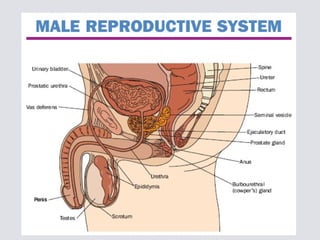
 A. The testes are the male gonads, and
normally each male has two.
 1. The testes are located outside of the body in
a sac of skin called the scrotum.
 2. The testes are egg-shaped and measure
approximately 4.0 cm (1.5 in.) long and 2.5
cm (1 in.) around.
OBJECTIVE 1 continued
 3. They are surrounded by a dense fibrous
capsule called the tunica albuginea.
 4. The testes are suspended by the
spermatic cord.
 5. During embryo development, the testes
are formed from tissue located by the
kidneys, and, four to eight weeks before
birth, they will travel down the inguinal
canal to the scrotum.
 6. The testes are divided into sections called
lobules that contain the seminiferous
tubules, which are tiny coiled tubes.
OBJECTIVE 1 continued
 B. The epididymis is a greatly coiled
tube that can be found on the surface
of the testes.
 1. This tube measures 20 feet in
length.
 2. The epididymis is divided into three
sections called the head, the body, and
the tail.
OBJECTIVE 1 continued
 C. The ductus deferens, or vas deferens, is a
long duct (18 in.) which connects the epididymis to
the ejaculatory duct posterior to the urinary bladder.
 1. The ductus deferens is composed of smooth
muscle and is lined with epithelial tissue.
 2. The ductus deferens helps to form the spermatic
cord and passes through the inguinal canal.
 3. It travels up and over the bladder.
OBJECTIVE 1 continued
 D. On the back side of the bladder, the
ductus deferens joins with a duct called
the seminal vesicle.
 1. The seminal vesicles are twisted tubes
made of muscle tissue.
 2. They are approximately 7.5 cm (3 in.)
long.
OBJECTIVE 1 continued
 E. The seminal vesicle and the ductus deferens
together form the ejaculatory duct.
 1. The bilateral ejaculatory ducts travel through the
prostate gland and then into the urethra.
OBJECTIVE 1 continued
 F. The prostate gland can be found below the
bladder.
 1. It is shaped like a donut and is about the size of a
walnut.
 2. The prostate gland wraps around the urethra.
OBJECTIVE 1 continued
 G. Bulbourethral glands, or Cowper’s glands,
are a pair of structures located just below the
prostate gland.
 1. These glands are about the size of a pea.
 2. They can be found on either side of the urethra.
OBJECTIVE 1 continued
 H. Semen, or seminal fluid, is a mixture
of sperm and the secretions of the seminal
vesicles, prostate gland, and bulbourethral
glands.
 1. The average volume of semen for
ejaculation is 2.5 to 5 milliliters.
 2. There are about 50 to 150 million
spermatozoa per milliliter of semen.
 3. Semen is a sticky, milky, white fluid.
OBJECTIVE 1 continued
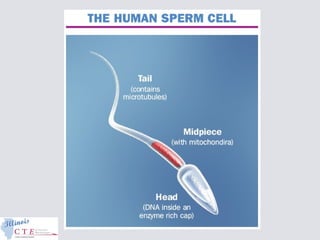
 4. Spermatozoa are the male sex cells.
 a. Each spermatozoon has a head made up of a
nucleus that contains chromosomes.
 b. The head is a cover with a cap-like structure called
the acrosome.
(1) The acrosome contains enzymes that will assist
the sperm to penetrate the ovum.
 c. The tail, or flagellum, of the sperm whips back
and forth to propel it through the female
reproductive tract.
 d. The middle section of the sperm, called the
midpiece, contains mitochondria for energy.
OBJECTIVE 1 continued
 I. The penis is a cylindrical organ which surrounds the
urethra.
 1. It consists of a body, root, and glans penis.
 a. The body is composed of three cylindrical masses of tissue, each
bound by fibrous tissue.
 (1) The corpora cavernosa penis are the two most dorsal and
lateral masses of the penis.
 (2) The corpus spongiosum penis is the smaller, mid-ventral mass
of the penis through which the urethra passes.
 (3) All three masses are enclosed by fascia and skin and consist of
erectile tissue permeated by blood sinuses.
 (4) When sexual stimulation (visual, tactile, auditory, olfactory,
and/or imagination) occurs, the arteries supplying the penis dilate and
large quantities of blood enter the sinuses, and an erection occurs.
OBJECTIVE 1 continued
 b. The root is the portion of the penis attached to the pelvic
area.
 c. The glans penis is made up of a slightly enlarged, distal
end of the corpus spongiosum.
 (1) It is separated from the body of the penis by a marginal area
called the corona.
 (2) It is covered by loose-fitting skin called the foreskin or
prepuce.
OBJECTIVE 2: Describe the functions of the
male reproductive organs.
Anticipated Problem: What are the
functions of the male reproductive
organs?
II. The male reproductive organs work
together to allow production of
offspring to continue the species.
OBJECTIVE 2 continued
 A. The function of the testes is
spermatogenesis, or the production of
spermatozoa.
 1. This occurs in the seminiferous tubules.
 2. This function can only occur properly if the
testes maintain a temperature several degrees
lower than the core body.
 3. The other function of the testes is the
production of the male hormone testosterone.
 a. This occurs in the interstitial cells of the testes, which are
found between the seminiferous tubules.
OBJECTIVE 2 continued
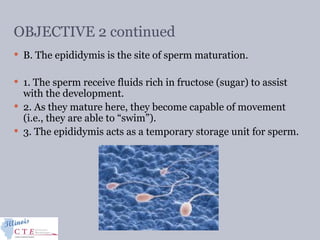
 B. The epididymis is the site of sperm maturation.
 1. The sperm receive fluids rich in fructose (sugar) to assist
with the development.
 2. As they mature here, they become capable of movement
(i.e., they are able to “swim”).
 3. The epididymis acts as a temporary storage unit for sperm.
OBJECTIVE 2 continued
 C. The ductus deferens (vas deferens) serves as a
passageway for sperm.
 1. This passageway carries the sperm from the
epididymis to the urethra.
 2. During ejaculation, the process of ejecting
semen from the penis, the muscle of the vas deferens
contracts to move the sperm forward.
OBJECTIVE 2 continued
 D. The seminal vesicles produce an alkaline fluid
rich in fructose.
 1. This fluid helps to nourish the sperm and
neutralize the acid created by the sperm’s waste
products.
 2. It helps to form about 60% of the fluid or
semen.
 E. The ejaculatory duct ejects sperm into the
prostatic urethra just prior to ejaculation.
OBJECTIVE 2 continued
 F. The prostate gland secretes a fluid that is slightly
alkaline in nature.
 1. It contains simple sugars, enzymes, zinc, and citric acid
among other substances.
 a. These fluids make up 30% of the fluid found with sperm.
 2. The alkaline composition of the prostate fluid
neutralizes the acidity of the vagina.
 a. This allows the sperm to be more mobile.
 3. The prostate gland also has smooth muscle which
contracts to help expel semen when the male ejaculates.
OBJECTIVE 2 continued
 G. The bulbourethral glands, or Cowper’s glands,
also secrete an alkaline substance.
 1. This substance is the first released during sexual
stimulation and serves to neutralize the acidic
environment of the male urethra.
 2. This fluid also helps provide lubrication for sexual
intercourse.
OBJECTIVE 2 continued
 H. Semen, and the secretions found
in it, serves numerous functions.
 1. It nourishes and transports sperm.
 2. It neutralizes the acidity of the
male urethra and female vagina.
 3. Semen acts as a lubricant during
sexual intercourse.
 4. It also helps prevent infection with
the use of enzymes and antibodies.
OBJECTIVE 2 continued
 I. The penis, with the urethra passing through it,
conducts urine to the exterior and is the portion of
the male anatomy used to introduce the sperm into
the female vagina during intercourse.
 1. These two actions do not occur at the same time.
OBJECTIVE 3: Describe the hormones of the
male reproductive system.
Anticipated Problem: What are the
hormones of the male reproductive
system?
III. There are three hormones that are
essential to the function of the male
reproductive system.
OBJECTIVE 3 continued
 A. Male hormones are also called androgens.
 B. The male reproductive system cannot function
without hormones.
OBJECTIVE 3 continued
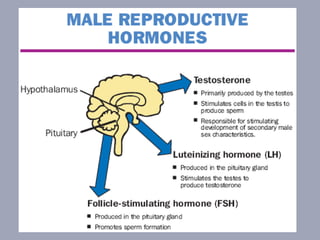
 C. Testosterone is the primary male
hormone.
 1. The testes are the primary producer of
testosterone, although a little testosterone is
produced by the adrenal cortex.
 2. Testosterone production begins when a
boy reaches puberty around the age of 12–15
years.
 3. Once produced by the testes, testosterone
is absorbed into the bloodstream.
OBJECTIVE 3 continued
 4. Testosterone has several functions in the
male:
 a. The first function is the maintenance of the male
reproductive system.
 b. Testosterone also is responsible for the development
of sperm.
 c. It also is responsible for stimulating development of
secondary male sex characteristics, which include:
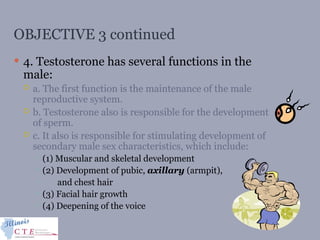
 (1) Muscular and skeletal development
 (2) Development of pubic, axillary (armpit),
 and chest hair
 (3) Facial hair growth
 (4) Deepening of the voice
OBJECTIVE 3 continued
 D. The follicle-stimulating hormone (FSH) is a
male sex hormone produced by the pituitary gland.
 1. This hormone promotes sperm formation.
OBJECTIVE 3 continued
 E. The third male sex hormone is the luteinizing
hormone (LH).
 1. This hormone is also produced in the pituitary
gland.
 2. The luteinizing hormone stimulates the testes to
produce testosterone.
REVIEW
 1. What is the anatomy of male reproductive
system?
 2. What are the functions of the male
reproductive organs?
 3. What are the hormones of the male
reproductive system?
HST-P630073.pptxxxxxxxxxxxxxxxxxxxxxxxxxx

  • 1.
    Identify the Male Organs ofthe Reproductive System
  • 2.
    Interest Approach  Askthe male students if they remember when their voice changed and when they started to get facial hair. Ask them if they know why these changes occurred. Now tell the class that this lesson will give them an understanding of the hormones that initiate these changes, as well as how the male reproductive system functions.
  • 3.
    Terms. The followingterms are presented in this lesson (shown in bold italics):  acrosome  axillary  bulbourethral glands  corpora cavernosa penis  corpus spongiosum penis  Cowper’s glands  ductus deferens  ejaculation  ejaculatory duct  epididymis  flagellum  follicle-stimulating hormone (FSH)  foreskin  glans penis  luteinizing hormone (LH)  midpiece  penis  prepuce  prostate gland  scrotum  semen  seminal fluid  seminal vesicle  seminiferous tubules  spermatogenesis  spermatozoa  testes  testosterone  tunica albuginea  vas deferens
  • 4.
    Student Learning Objectives.Instruction in this lesson should result in students achieving the following objectives:  1 Describe the anatomy of the male reproductive system.  2 Describe the functions of the male reproductive organs.  3 Describe the hormones of the male reproductive system.
  • 5.
    OBJECTIVE 1: Describethe anatomy of the male reproductive system. Anticipated Problem: What is the anatomy of male reproductive system? I. The male reproductive system is composed of individual organs that work together.
  • 7.
    OBJECTIVE 1 continued A. The testes are the male gonads, and normally each male has two.  1. The testes are located outside of the body in a sac of skin called the scrotum.  2. The testes are egg-shaped and measure approximately 4.0 cm (1.5 in.) long and 2.5 cm (1 in.) around.
  • 8.
    OBJECTIVE 1 continued 3. They are surrounded by a dense fibrous capsule called the tunica albuginea.  4. The testes are suspended by the spermatic cord.  5. During embryo development, the testes are formed from tissue located by the kidneys, and, four to eight weeks before birth, they will travel down the inguinal canal to the scrotum.  6. The testes are divided into sections called lobules that contain the seminiferous tubules, which are tiny coiled tubes.
  • 9.
    OBJECTIVE 1 continued B. The epididymis is a greatly coiled tube that can be found on the surface of the testes.  1. This tube measures 20 feet in length.  2. The epididymis is divided into three sections called the head, the body, and the tail.
  • 10.
    OBJECTIVE 1 continued C. The ductus deferens, or vas deferens, is a long duct (18 in.) which connects the epididymis to the ejaculatory duct posterior to the urinary bladder.  1. The ductus deferens is composed of smooth muscle and is lined with epithelial tissue.  2. The ductus deferens helps to form the spermatic cord and passes through the inguinal canal.  3. It travels up and over the bladder.
  • 11.
    OBJECTIVE 1 continued D. On the back side of the bladder, the ductus deferens joins with a duct called the seminal vesicle.  1. The seminal vesicles are twisted tubes made of muscle tissue.  2. They are approximately 7.5 cm (3 in.) long.
  • 12.
    OBJECTIVE 1 continued E. The seminal vesicle and the ductus deferens together form the ejaculatory duct.  1. The bilateral ejaculatory ducts travel through the prostate gland and then into the urethra.
  • 13.
    OBJECTIVE 1 continued F. The prostate gland can be found below the bladder.  1. It is shaped like a donut and is about the size of a walnut.  2. The prostate gland wraps around the urethra.
  • 14.
    OBJECTIVE 1 continued G. Bulbourethral glands, or Cowper’s glands, are a pair of structures located just below the prostate gland.  1. These glands are about the size of a pea.  2. They can be found on either side of the urethra.
  • 15.
    OBJECTIVE 1 continued H. Semen, or seminal fluid, is a mixture of sperm and the secretions of the seminal vesicles, prostate gland, and bulbourethral glands.  1. The average volume of semen for ejaculation is 2.5 to 5 milliliters.  2. There are about 50 to 150 million spermatozoa per milliliter of semen.  3. Semen is a sticky, milky, white fluid.
  • 16.
    OBJECTIVE 1 continued 4. Spermatozoa are the male sex cells.  a. Each spermatozoon has a head made up of a nucleus that contains chromosomes.  b. The head is a cover with a cap-like structure called the acrosome. (1) The acrosome contains enzymes that will assist the sperm to penetrate the ovum.  c. The tail, or flagellum, of the sperm whips back and forth to propel it through the female reproductive tract.  d. The middle section of the sperm, called the midpiece, contains mitochondria for energy.
  • 18.
    OBJECTIVE 1 continued I. The penis is a cylindrical organ which surrounds the urethra.  1. It consists of a body, root, and glans penis.  a. The body is composed of three cylindrical masses of tissue, each bound by fibrous tissue.  (1) The corpora cavernosa penis are the two most dorsal and lateral masses of the penis.  (2) The corpus spongiosum penis is the smaller, mid-ventral mass of the penis through which the urethra passes.  (3) All three masses are enclosed by fascia and skin and consist of erectile tissue permeated by blood sinuses.  (4) When sexual stimulation (visual, tactile, auditory, olfactory, and/or imagination) occurs, the arteries supplying the penis dilate and large quantities of blood enter the sinuses, and an erection occurs.
  • 19.
    OBJECTIVE 1 continued b. The root is the portion of the penis attached to the pelvic area.  c. The glans penis is made up of a slightly enlarged, distal end of the corpus spongiosum.  (1) It is separated from the body of the penis by a marginal area called the corona.  (2) It is covered by loose-fitting skin called the foreskin or prepuce.
  • 20.
    OBJECTIVE 2: Describethe functions of the male reproductive organs. Anticipated Problem: What are the functions of the male reproductive organs? II. The male reproductive organs work together to allow production of offspring to continue the species.
  • 21.
    OBJECTIVE 2 continued A. The function of the testes is spermatogenesis, or the production of spermatozoa.  1. This occurs in the seminiferous tubules.  2. This function can only occur properly if the testes maintain a temperature several degrees lower than the core body.  3. The other function of the testes is the production of the male hormone testosterone.  a. This occurs in the interstitial cells of the testes, which are found between the seminiferous tubules.
  • 22.
    OBJECTIVE 2 continued B. The epididymis is the site of sperm maturation.  1. The sperm receive fluids rich in fructose (sugar) to assist with the development.  2. As they mature here, they become capable of movement (i.e., they are able to “swim”).  3. The epididymis acts as a temporary storage unit for sperm.
  • 23.
    OBJECTIVE 2 continued C. The ductus deferens (vas deferens) serves as a passageway for sperm.  1. This passageway carries the sperm from the epididymis to the urethra.  2. During ejaculation, the process of ejecting semen from the penis, the muscle of the vas deferens contracts to move the sperm forward.
  • 24.
    OBJECTIVE 2 continued D. The seminal vesicles produce an alkaline fluid rich in fructose.  1. This fluid helps to nourish the sperm and neutralize the acid created by the sperm’s waste products.  2. It helps to form about 60% of the fluid or semen.  E. The ejaculatory duct ejects sperm into the prostatic urethra just prior to ejaculation.
  • 25.
    OBJECTIVE 2 continued F. The prostate gland secretes a fluid that is slightly alkaline in nature.  1. It contains simple sugars, enzymes, zinc, and citric acid among other substances.  a. These fluids make up 30% of the fluid found with sperm.  2. The alkaline composition of the prostate fluid neutralizes the acidity of the vagina.  a. This allows the sperm to be more mobile.  3. The prostate gland also has smooth muscle which contracts to help expel semen when the male ejaculates.
  • 26.
    OBJECTIVE 2 continued G. The bulbourethral glands, or Cowper’s glands, also secrete an alkaline substance.  1. This substance is the first released during sexual stimulation and serves to neutralize the acidic environment of the male urethra.  2. This fluid also helps provide lubrication for sexual intercourse.
  • 27.
    OBJECTIVE 2 continued H. Semen, and the secretions found in it, serves numerous functions.  1. It nourishes and transports sperm.  2. It neutralizes the acidity of the male urethra and female vagina.  3. Semen acts as a lubricant during sexual intercourse.  4. It also helps prevent infection with the use of enzymes and antibodies.
  • 28.
    OBJECTIVE 2 continued I. The penis, with the urethra passing through it, conducts urine to the exterior and is the portion of the male anatomy used to introduce the sperm into the female vagina during intercourse.  1. These two actions do not occur at the same time.
  • 29.
    OBJECTIVE 3: Describethe hormones of the male reproductive system. Anticipated Problem: What are the hormones of the male reproductive system? III. There are three hormones that are essential to the function of the male reproductive system.
  • 30.
    OBJECTIVE 3 continued A. Male hormones are also called androgens.  B. The male reproductive system cannot function without hormones.
  • 31.
    OBJECTIVE 3 continued C. Testosterone is the primary male hormone.  1. The testes are the primary producer of testosterone, although a little testosterone is produced by the adrenal cortex.  2. Testosterone production begins when a boy reaches puberty around the age of 12–15 years.  3. Once produced by the testes, testosterone is absorbed into the bloodstream.
  • 32.
    OBJECTIVE 3 continued 4. Testosterone has several functions in the male:  a. The first function is the maintenance of the male reproductive system.  b. Testosterone also is responsible for the development of sperm.  c. It also is responsible for stimulating development of secondary male sex characteristics, which include:  (1) Muscular and skeletal development  (2) Development of pubic, axillary (armpit),  and chest hair  (3) Facial hair growth  (4) Deepening of the voice
  • 33.
    OBJECTIVE 3 continued D. The follicle-stimulating hormone (FSH) is a male sex hormone produced by the pituitary gland.  1. This hormone promotes sperm formation.
  • 34.
    OBJECTIVE 3 continued E. The third male sex hormone is the luteinizing hormone (LH).  1. This hormone is also produced in the pituitary gland.  2. The luteinizing hormone stimulates the testes to produce testosterone.
  • 36.
    REVIEW  1. Whatis the anatomy of male reproductive system?  2. What are the functions of the male reproductive organs?  3. What are the hormones of the male reproductive system?