by Emmanuel Baisire
Malaria Detection Model Using Convolutional Neural Network
Agenda
Discussion Topics
• Global Malaria Health Risks
• Data Preprocessing and Exploration
• Solution Design
• Recommended Model Architecture
• Opportunities and Challenges
3
Deep Learning Model
Problem Statement:
• According to WHO, Malaria infected 241 millions cases and 627,000 deaths in 2021.
• It is transmitted through mosquito bites leading to high fever, chills and even death.
• Diagnostic tools include microscopes by experienced nurses, rapid diagnostic test and polymerase chain
reaction.
• Current methods are time consuming, requires a trained microscopist to read hundreds of smear images to
detect malaria.
• Build a deep learning model that can automatically detect malaria parasite in blood smear images.
4
Deep Learning Model
Data Exploration
• Malaria cell images dataset contained 24,958 train and 2,600 test images.
• Test and Train images were of pixel values ranging from 0 to 255.
• Parasite and uninfected labels were balanced for Train and Test data.
• Parasitized blood cells have visibly red marks on any side of the image while uninfected images have no
marks.
5
Deep Learning Model
Solution Design
• A Convolution Neural Network architecture was preferred due to its strengthen to classify images.
• The problem was a binary classification to determine if an image had a parasite or uninfected
• A total of 6 models were trained and tested to choose the best performing models
• They were divided into 4 distinct CNNs and 2 VGG type neural networks
6
Deep Learning Model
Solution Design
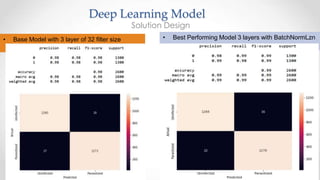
• Base Model with 3 layer of 32 filter size • Best Performing Model 3 layers with BatchNormLzn
7
Deep Learning Model
Recommended Model Architecture
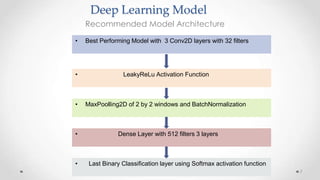
• Best Performing Model with 3 Conv2D layers with 32 filters
• LeakyReLu Activation Function
• Dense Layer with 512 filters 3 layers
• MaxPoolling2D of 2 by 2 windows and BatchNormalization
• Last Binary Classification layer using Softmax activation function
8
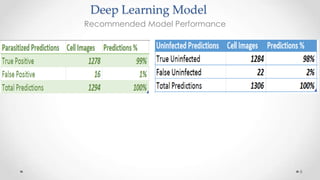
Deep Learning Model
Recommended Model Performance
9
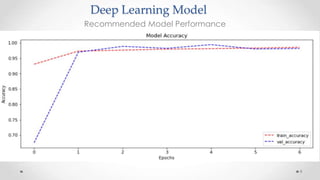
Deep Learning Model
Recommended Model Performance
10
Deep Learning Model
Model Deployment
• It is a great candidate as a Phone App to provide diagnostic results
• user will scan cell images to the mobile app to get patient’s positive or negative results.
• The model will be deployed using TensorFlow REST API with less little infrastructure and network
maintenance costs.
• CNN deep learning-based model performed better than other experimental models.
• It was able to identify malaria parasites at an accuracy rate of about 98% with relatively few cell
images.
11
Deep Learning Model
Recommendations and Conclusions
• Perform further review of the cell images that seemed to be wrongly labeled during data collection.
• Collect more cell image dataset sample with varying parasite markers.
• Seek expert knowledge from skilled microscopist to review mislabeled images by the model.
• Image dataset should be split into 3 sets that include training, validation and test datasets. Instead of
using only 2 datasets.
• For validation purpose, I would also recommend the K-Fold validation use by splitting the data into 3
partitions
• In conclusion, the general architecture for this solution involved data-preprocessing to ensure that we
are able feed the input data into a model to predict Parasitic and uninfected people at 98% accuracy.

Malaria Detection Deep Learning Models.pptx

  • 1.
    by Emmanuel Baisire MalariaDetection Model Using Convolutional Neural Network
  • 2.
    Agenda Discussion Topics • GlobalMalaria Health Risks • Data Preprocessing and Exploration • Solution Design • Recommended Model Architecture • Opportunities and Challenges
  • 3.
    3 Deep Learning Model ProblemStatement: • According to WHO, Malaria infected 241 millions cases and 627,000 deaths in 2021. • It is transmitted through mosquito bites leading to high fever, chills and even death. • Diagnostic tools include microscopes by experienced nurses, rapid diagnostic test and polymerase chain reaction. • Current methods are time consuming, requires a trained microscopist to read hundreds of smear images to detect malaria. • Build a deep learning model that can automatically detect malaria parasite in blood smear images.
  • 4.
    4 Deep Learning Model DataExploration • Malaria cell images dataset contained 24,958 train and 2,600 test images. • Test and Train images were of pixel values ranging from 0 to 255. • Parasite and uninfected labels were balanced for Train and Test data. • Parasitized blood cells have visibly red marks on any side of the image while uninfected images have no marks.
  • 5.
    5 Deep Learning Model SolutionDesign • A Convolution Neural Network architecture was preferred due to its strengthen to classify images. • The problem was a binary classification to determine if an image had a parasite or uninfected • A total of 6 models were trained and tested to choose the best performing models • They were divided into 4 distinct CNNs and 2 VGG type neural networks
  • 6.
    6 Deep Learning Model SolutionDesign • Base Model with 3 layer of 32 filter size • Best Performing Model 3 layers with BatchNormLzn
  • 7.
    7 Deep Learning Model RecommendedModel Architecture • Best Performing Model with 3 Conv2D layers with 32 filters • LeakyReLu Activation Function • Dense Layer with 512 filters 3 layers • MaxPoolling2D of 2 by 2 windows and BatchNormalization • Last Binary Classification layer using Softmax activation function
  • 8.
  • 9.
  • 10.
    10 Deep Learning Model ModelDeployment • It is a great candidate as a Phone App to provide diagnostic results • user will scan cell images to the mobile app to get patient’s positive or negative results. • The model will be deployed using TensorFlow REST API with less little infrastructure and network maintenance costs. • CNN deep learning-based model performed better than other experimental models. • It was able to identify malaria parasites at an accuracy rate of about 98% with relatively few cell images.
  • 11.
    11 Deep Learning Model Recommendationsand Conclusions • Perform further review of the cell images that seemed to be wrongly labeled during data collection. • Collect more cell image dataset sample with varying parasite markers. • Seek expert knowledge from skilled microscopist to review mislabeled images by the model. • Image dataset should be split into 3 sets that include training, validation and test datasets. Instead of using only 2 datasets. • For validation purpose, I would also recommend the K-Fold validation use by splitting the data into 3 partitions • In conclusion, the general architecture for this solution involved data-preprocessing to ensure that we are able feed the input data into a model to predict Parasitic and uninfected people at 98% accuracy.