Machine Learning an
Introduction
branch of AI or Artificial Intelligence,
since, the ability to change
experience into expertise or to detect
patterns in complex data is a mark of
human or animal intelligence.
Source Materials
• R. Duda, P. Hart & D. Stork, Pattern
Classification (2nd ed.), Wiley (Required)
• T. Mitchell, Machine Learning,
McGraw-Hill (Recommended)
• Papers
A Few Quotes
• “A breakthrough in machine learning would be worth
ten Microsofts” (Bill Gates, Chairman, Microsoft)
• “Machine learning is the next Internet”
(Tony Tether, Director, DARPA)
• Machine learning is the hot new thing”
(John Hennessy, President, Stanford)
• “Web rankings today are mostly a matter of machine
learning” (Prabhakar Raghavan, Dir. Research, Yahoo)
• “Machine learning is going to result in a real revolution”
(Greg Papadopoulos, CTO, Sun)
• “Machine learning is today’s discontinuity”
(Jerry Yang, CEO, Yahoo)
So What Is Machine Learning?
• Automating automation
• Getting computers to program themselves
• Writing software is the bottleneck
• Let the data do the work instead!
Traditional Programming
Machine Learning
Computer
Data
Program
Output
Computer
Data
Output
Program
Machine Learning
• Programming the systems so as to make them automatically learn
and improve with experience.
• learning implies recognizing and understanding the input data and
taking informed decisions based on the supplied data.
• very difficult to consider all the decisions based on all possible
inputs.
• solve this problem, algorithms are developed that build knowledge
from a specific data and past experience
• Applying the principles of statistical science, probability, logic,
mathematical optimization, reinforcement learning, and control
theory
Applications
Vision processing
Language processing
Forecasting things like stock market
trends, weather
Pattern recognition
Games
Data mining
 Expert systems
 Robotics
Applications contd..
• Web search
• Computational biology
• Finance
• E-commerce
• Space exploration
• nformation extraction
• Social networks
• Debugging
• [Your favorite area]
Applications contd..
• Talking to the voice assistant on our
smart phones
• Recommending the right product for
our customers
• Stopping credit card fraud
• Filtering out spam from our e-mail
inboxes
• Detecting and diagnosing medical
diseases
• the list goes on and on.
Six components of Machine
Learning
• Data
• Tasks
• Models
• Loss Function
• Learning algorithm
• Evaluation
A machine learning project involves the following steps:
• Defining a Problem
• Preparing Data
• Evaluating Algorithms
• Improving Results
• Presenting Results
ML in a Nutshell
• Tens of thousands of machine learning
algorithms
• Hundreds new every year
• Every machine learning algorithm has
three components:
– Representation
– Evaluation
– Optimization
Representation
• Decision trees
• Sets of rules / Logic programs
• Instances
• Graphical models (Bayes/Markov nets)
• Neural networks
• Support vector machines
• Model ensembles
• Etc.
Evaluation
• Accuracy
• Precision and recall
• Squared error
• Likelihood
• Posterior probability
• Cost / Utility
• Margin
• Entropy
• K-L divergence
• Etc.
Optimization
• Combinatorial optimization
– E.g.: Greedy search
• Convex optimization
– E.g.: Gradient descent
• Constrained optimization
– E.g.: Linear programming
Types of Learning
• Supervised (inductive) learning
– Training data includes desired outputs
• Unsupervised learning
– Training data does not include desired outputs
• Semi-supervised learning
– Training data includes a few desired outputs
• Reinforcement learning
– Rewards from sequence of actions
Supervised Learning
• commonly used in real world applications,
such as face and speech recognition,
products or movie recommendations, and
sales forecasting.
• Regression and Classification.
• Regression trains on and predicts a
continuous-valued response, for example
predicting real estate prices.
Supervised learning
• learning data comes with description,
labels, targets or desired outputs and the
objective is to find a general rule that
maps inputs to outputs.
• learning data = labeled data.
• The learning rule is then used to label new
data with unknown outputs.
• Supervised learning involves building a
machine learning model that is based on
labeled samples
Supervised learning
• learning a function from available training
data.
• a learning algorithm analyzes the training
data
• produces a derived function
• used for mapping new examples.
• Logistic Regression, Neural networks,
Support Vector Machines (SVMs), and
Naive Bayes classifiers
Examples
• Classification attempts to find the
appropriate class label
• Analyzing positive/negative sentiment,
• male and female persons
• benign and malignant tumors
• secure and unsecure loans etc.
Unsupervised learning
• to detect anomalies, outliers, such as
fraud or defective equipment,
• to group customers with similar behaviors
for a sales campaign.
• opposite of supervised learning.
• no labeled data here.
• learning data contains only some
indications without any description or
labels
Semi-supervised Learning
• some learning samples are labelled, but
some other are not labelled.
• large amount of unlabeled data for training
and a small amount of labelled data for
testing
• expensive to acquire a fully labelled
dataset while more practical to label a
small subset
Semi-supervised Learning
• often requires skilled experts to label
certain remote sensing images,
• lots of field experiments to locate oil at a
particular location.
• acquiring unlabeled data is relatively easy.
Reinforcement Learning
• learning data gives feedback so that the
system adjusts to dynamic conditions in
order to achieve a certain objective.
• The system evaluates its performance
based on the feedback responses and
reacts accordingly.
• self-driving cars and chess master
algorithm AlphaGo
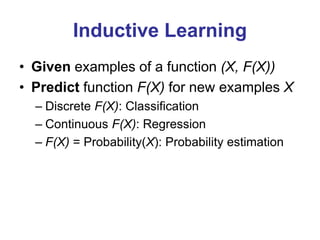
Inductive Learning
• Given examples of a function (X, F(X))
• Predict function F(X) for new examples X
– Discrete F(X): Classification
– Continuous F(X): Regression
– F(X) = Probability(X): Probability estimation
What We’ll Cover
• Supervised learning
– Decision tree induction
– Rule induction
– Instance-based learning
– Bayesian learning
– Neural networks
– Support vector machines
– Model ensembles
– Learning theory
• Unsupervised learning
– Clustering
– Dimensionality reduction
ML in Practice
• Understanding domain, prior knowledge,
and goals
• Data integration, selection, cleaning,
pre-processing, etc.
• Learning models
• Interpreting results
• Consolidating and deploying discovered
knowledge
• Loop
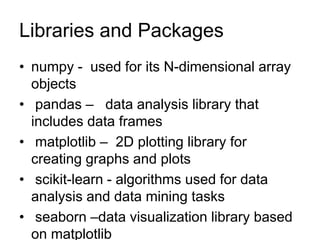
Libraries and Packages
• numpy - used for its N-dimensional array
objects
• pandas – data analysis library that
includes data frames
• matplotlib – 2D plotting library for
creating graphs and plots
• scikit-learn - algorithms used for data
analysis and data mining tasks
• seaborn –data visualization library based
on matplotlib
Purpose of Machine Learning
• purpose of machine learning is not
building an automated duplication of
intelligent behavior,
• but using the power of computers to
complement and supplement human
intelligence.
• For example, machine learning programs
can scan and process huge databases
detecting patterns that are beyond the
scope of human perception.

machine learning

  • 1.
    Machine Learning an Introduction branchof AI or Artificial Intelligence, since, the ability to change experience into expertise or to detect patterns in complex data is a mark of human or animal intelligence.
  • 2.
    Source Materials • R.Duda, P. Hart & D. Stork, Pattern Classification (2nd ed.), Wiley (Required) • T. Mitchell, Machine Learning, McGraw-Hill (Recommended) • Papers
  • 3.
    A Few Quotes •“A breakthrough in machine learning would be worth ten Microsofts” (Bill Gates, Chairman, Microsoft) • “Machine learning is the next Internet” (Tony Tether, Director, DARPA) • Machine learning is the hot new thing” (John Hennessy, President, Stanford) • “Web rankings today are mostly a matter of machine learning” (Prabhakar Raghavan, Dir. Research, Yahoo) • “Machine learning is going to result in a real revolution” (Greg Papadopoulos, CTO, Sun) • “Machine learning is today’s discontinuity” (Jerry Yang, CEO, Yahoo)
  • 4.
    So What IsMachine Learning? • Automating automation • Getting computers to program themselves • Writing software is the bottleneck • Let the data do the work instead!
  • 5.
  • 6.
    Machine Learning • Programmingthe systems so as to make them automatically learn and improve with experience. • learning implies recognizing and understanding the input data and taking informed decisions based on the supplied data. • very difficult to consider all the decisions based on all possible inputs. • solve this problem, algorithms are developed that build knowledge from a specific data and past experience • Applying the principles of statistical science, probability, logic, mathematical optimization, reinforcement learning, and control theory
  • 7.
    Applications Vision processing Language processing Forecastingthings like stock market trends, weather Pattern recognition Games Data mining  Expert systems  Robotics
  • 8.
    Applications contd.. • Websearch • Computational biology • Finance • E-commerce • Space exploration • nformation extraction • Social networks • Debugging • [Your favorite area]
  • 9.
    Applications contd.. • Talkingto the voice assistant on our smart phones • Recommending the right product for our customers • Stopping credit card fraud • Filtering out spam from our e-mail inboxes • Detecting and diagnosing medical diseases • the list goes on and on.
  • 10.
    Six components ofMachine Learning • Data • Tasks • Models • Loss Function • Learning algorithm • Evaluation
  • 11.
    A machine learningproject involves the following steps: • Defining a Problem • Preparing Data • Evaluating Algorithms • Improving Results • Presenting Results
  • 12.
    ML in aNutshell • Tens of thousands of machine learning algorithms • Hundreds new every year • Every machine learning algorithm has three components: – Representation – Evaluation – Optimization
  • 13.
    Representation • Decision trees •Sets of rules / Logic programs • Instances • Graphical models (Bayes/Markov nets) • Neural networks • Support vector machines • Model ensembles • Etc.
  • 14.
    Evaluation • Accuracy • Precisionand recall • Squared error • Likelihood • Posterior probability • Cost / Utility • Margin • Entropy • K-L divergence • Etc.
  • 15.
    Optimization • Combinatorial optimization –E.g.: Greedy search • Convex optimization – E.g.: Gradient descent • Constrained optimization – E.g.: Linear programming
  • 16.
    Types of Learning •Supervised (inductive) learning – Training data includes desired outputs • Unsupervised learning – Training data does not include desired outputs • Semi-supervised learning – Training data includes a few desired outputs • Reinforcement learning – Rewards from sequence of actions
  • 17.
    Supervised Learning • commonlyused in real world applications, such as face and speech recognition, products or movie recommendations, and sales forecasting. • Regression and Classification. • Regression trains on and predicts a continuous-valued response, for example predicting real estate prices.
  • 18.
    Supervised learning • learningdata comes with description, labels, targets or desired outputs and the objective is to find a general rule that maps inputs to outputs. • learning data = labeled data. • The learning rule is then used to label new data with unknown outputs. • Supervised learning involves building a machine learning model that is based on labeled samples
  • 19.
    Supervised learning • learninga function from available training data. • a learning algorithm analyzes the training data • produces a derived function • used for mapping new examples. • Logistic Regression, Neural networks, Support Vector Machines (SVMs), and Naive Bayes classifiers
  • 20.
    Examples • Classification attemptsto find the appropriate class label • Analyzing positive/negative sentiment, • male and female persons • benign and malignant tumors • secure and unsecure loans etc.
  • 21.
    Unsupervised learning • todetect anomalies, outliers, such as fraud or defective equipment, • to group customers with similar behaviors for a sales campaign. • opposite of supervised learning. • no labeled data here. • learning data contains only some indications without any description or labels
  • 22.
    Semi-supervised Learning • somelearning samples are labelled, but some other are not labelled. • large amount of unlabeled data for training and a small amount of labelled data for testing • expensive to acquire a fully labelled dataset while more practical to label a small subset
  • 23.
    Semi-supervised Learning • oftenrequires skilled experts to label certain remote sensing images, • lots of field experiments to locate oil at a particular location. • acquiring unlabeled data is relatively easy.
  • 24.
    Reinforcement Learning • learningdata gives feedback so that the system adjusts to dynamic conditions in order to achieve a certain objective. • The system evaluates its performance based on the feedback responses and reacts accordingly. • self-driving cars and chess master algorithm AlphaGo
  • 25.
    Inductive Learning • Givenexamples of a function (X, F(X)) • Predict function F(X) for new examples X – Discrete F(X): Classification – Continuous F(X): Regression – F(X) = Probability(X): Probability estimation
  • 26.
    What We’ll Cover •Supervised learning – Decision tree induction – Rule induction – Instance-based learning – Bayesian learning – Neural networks – Support vector machines – Model ensembles – Learning theory • Unsupervised learning – Clustering – Dimensionality reduction
  • 27.
    ML in Practice •Understanding domain, prior knowledge, and goals • Data integration, selection, cleaning, pre-processing, etc. • Learning models • Interpreting results • Consolidating and deploying discovered knowledge • Loop
  • 28.
    Libraries and Packages •numpy - used for its N-dimensional array objects • pandas – data analysis library that includes data frames • matplotlib – 2D plotting library for creating graphs and plots • scikit-learn - algorithms used for data analysis and data mining tasks • seaborn –data visualization library based on matplotlib
  • 29.
    Purpose of MachineLearning • purpose of machine learning is not building an automated duplication of intelligent behavior, • but using the power of computers to complement and supplement human intelligence. • For example, machine learning programs can scan and process huge databases detecting patterns that are beyond the scope of human perception.