Case3.2

Done by: Maryam AL-Qhatany.
Learning Objectives
Malaria
1Definition of malaria.
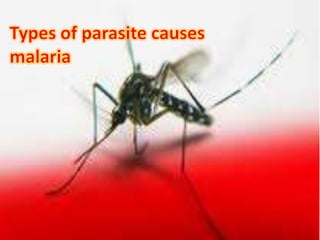
2Types of parasite causes malaria .
3Life cycle of different malaria parasite+
Pathogenesis
4Symptoms and sign of malaria.
5Investigation of malaria .
6 Differential diagnosis
7 treatment and prevention of malaria .

diagnosis
Introduction
Approximately 300 million
people worldwide are affected
by malaria and between 1 and
1.5 million people die from it
every year. Previously extremely
widespread, the malaria is now
mainly confined to Africa, Asia
and Latin America
Malaria
is an infectious disease caused by a
parasite, (called Plasmodium), which
is transmitted via the bites of
infected mosquitoes , that infect red
blood cells in the human body.
Causes
Malaria is caused by a type of
microscopic parasite that's
transmitted most commonly by
mosquito bites(female
Anopheles mosquito).
Plasmodium ovale (P.o).
Plasmodium malariae (P.m).

Plasmodium vivax (P.v.).
Plasmodium falciparum (P.f).
This is the rarest of all the malaria types and is
mostly found in Ghana, Liberia, Nigeria and the
tropical West African region

Symptoms:

fatigue, diarrhoea, bouts of fever and chills
incubation period:
This type of malaria is not as wide spread as the
other types and is known to have less than 1
percent infections in the Indian subcontinent.

Symptoms:

high fever and chills.
incubation period:
It has the widest distribution around the globe.
Approximately 60% of infections in India are caused by P.v.
Although it seldom causes death or other serious
problems, it can still cause major illness

Symptoms:
fatigue, diarrhoea, bouts of fever and chills. Flulike symptoms.

incubation period:
(P.f).
The plasmodium parasite is recognised as the
most lethal parasite that causes most infections
and deaths related to malaria

Symptoms:

incubation
period:

fatigue, dizziness, abdominal pain, aching
muscles, enlarged spleen, sore back, joint pain,
vomiting, nausea, fever, headache.
+
Pathogenesis
Pathogenesis
numerous known
and unknown waste
substances, such as
red cell membrane
products, hemozoin
pigment, and other
toxic factors
headache, fever, nausea and
vomiting, diarrhea, anorexia,
tiredness, aching joints and
muscles, thrombocytopenia,
immunosuppression, and central
nervous system manifestations .

activate macrophages and
endothelial cells to secrete
cytokines and inflammatory
mediators such as tumor necrosis
factor, interferon-γ and other
factor.
hemolytic anemia

destruction of red blood
cell

Clot
(blood in stools)

adhesion of red blood cell on wall of
blood vessel
Chills

Fever

early stages
Sweats
Headache
Fatigue

Nausea
vomiting
Other common symptoms:

Dry cough
Muscle and/or back pain.
Jaundice
Hepatomegaly

Fever
Hemolytic Anaemia
Diagnosis
Dr. ask the patient number of
questions concerning:
•Current symptoms.
•Medical conditions.
•Family medical history.
•Current medications.
•Recent travel history.
Laboratory
diagnosis

identification of
malaria parasite or
its antigens/products
in the blood of the
patient.
Microscopy

Most
Malaria parasites are recognizable by
their physical features and by the
appearance of the red blood cells.
Other tests:
Polymerase chain reaction
(PCR).

Serology
Immunologic tests
•The flu (influenza).
•Common cold .
•Meningitis.
•Typhoid fever.
•Dengue fever.
•Bacteremia/septicemia (infection in blood)
•Hepatitis.
•Viral gastroenteritis .
•Yellow fever (disease typically transmitted by
mosquitoes).
Treatment
And
prevention
treatment:

IF
Early

Delay

cure
severe

serious effects of
malaria can be
prevented

fatal
disease
The specific malaria treatment recommended will depend on:

•The type (species) of the infecting parasite.
•The severity of malaria symptoms .
•The patient's age .
•Any other illnesses or conditions.
•Pregnancy.
•Drug allergies.
•Other medications taken by the patient.
Medications

•Chloroquine
•Mefloquine .
•Sulfadoxine-pyrimethamine .
• Quinine sulfate.
•Doxycycline.
• Hydroxychloroquine.
Complications
Splenomegaly
(Enlarged spleen).

Cerebral malaria
Prevention :
Protecting
yourself

against
mosquito
bites
Taking antimalarial
medicines
young children
and pregnant
women avoid
traveling to
areas where
malaria is
common
Conclusion

you should see the doctor
if you experience a high
fever while living in or
after traveling to high-risk
malaria region.
References
*Microorganism book
*http://www.webmd.com/a-to-z-guides/malaria-symptoms
*http://emedicine.medscape.com/article/221134-differential
*http://www.parn.org.pk/index_files/Laboratory%20Diagn
osis%20of%20Malaria.html
*http://malaria.emedtv.com/malaria/malaria-diagnosis.html
*http://www.onlymyhealth.com/what-types-malaria1302068689
*http://www.niaid.nih.gov/topics/malaria/pages/lifecycle.aspx
*http://www.vitalhealthzone.com/health/conditions/m/
malaria/06_complications_of_malaria.html#1
Malaria

Malaria