
salient features
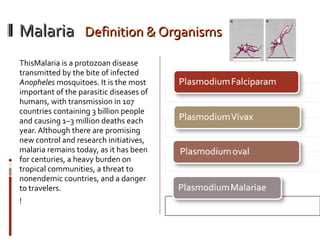
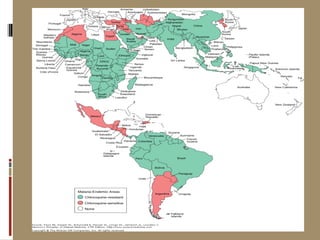
Malaria  Definition & Organisms ThisMalaria is a protozoan disease transmitted by the bite of infected  Anopheles  mosquitoes. It is the most important of the parasitic diseases of humans, with transmission in 107 countries containing 3 billion people and causing 1–3 million deaths each year. Although there are promising new control and research initiatives, malaria remains today, as it has been for centuries, a heavy burden on tropical communities, a threat to nonendemic countries, and a danger to travelers. !
 
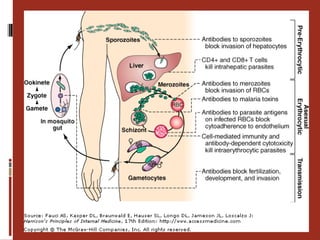
Etiology and Pathogenesis Four species of the genus  Plasmodium  cause nearly all malarial infections in humans .These are  P. falciparum ,  P. vivax ,  P. ovale , and  P. malariae  . Almost all deaths are caused by falciparum malaria.   Human infection begins when a female anopheline mosquito inoculates plasmodial  sporozoites  from its salivary gland during a blood meal . These microscopic malarial parasites are carried rapidly via the bloodstream to the liver, where they invade hepatic parenchymal cells and begin a period of asexual reproduction. By this amplification process a single sporozoite eventually may produce from 10,000 to >30,000 daughter merozoites. The swollen infected liver cell eventually bursts, discharging motile  merozoites  into the bloodstream. These then invade the red blood cells (RBCs) and multiply six- to twentyfold every 48–72 h. When the parasites reach densities of ~50/L of blood, the symptomatic stage of the infection begins.  In  P. vivax  and  P. ovale  infections, a proportion of the intrahepatic forms do not divide immediately but remain dormant for a period ranging from 3 weeks to a year or longer before reproduction begins. These dormant forms, or  hypnozoites , are the cause of the relapses that characterize infection with these two species .
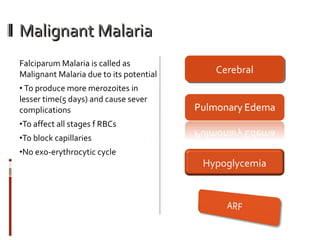
Malignant Malaria Falciparum Malaria is called as Malignant Malaria due to its potential To produce more merozoites in lesser time(5 days) and cause sever complications  To affect all stages f RBCs To block capillaries No exo-erythrocytic cycle Cerebral Hypoglycemia
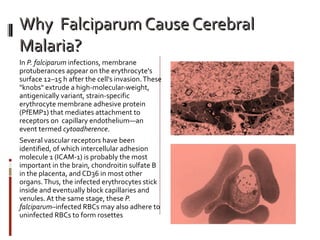
Why  Falciparum Cause Cerebral Malaria? In  P. falciparum  infections, membrane protuberances appear on the erythrocyte's surface 12–15 h after the cell's invasion. These "knobs" extrude a high-molecular-weight, antigenically variant, strain-specific erythrocyte membrane adhesive protein (PfEMP1) that mediates attachment to receptors on  capillary endothelium—an event termed  cytoadherence .  Several vascular receptors have been identified, of which intercellular adhesion molecule 1 (ICAM-1) is probably the most important in the brain, chondroitin sulfate B in the placenta, and CD36 in most other organs. Thus, the infected erythrocytes stick inside and eventually block capillaries and venules. At the same stage, these  P. falciparum –infected RBCs may also adhere to uninfected RBCs to form rosettes
 
Several days of prodromal symptoms such as malaise, headache, myalgia , anorexia, and mild fever are interrupted by the first paroxysm. Suddenly the patient feels inexplicably cold (in a hot climate) and apprehensive. Mild shivering quickly turns into violent shaking with teeth-chattering .
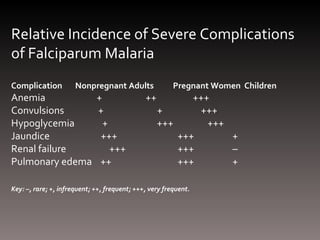
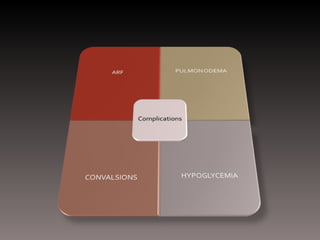
Relative Incidence of Severe Complications of Falciparum Malaria Complication Nonpregnant Adults  Pregnant Women  Children Anemia  +   ++  +++ Convulsions  +  +  +++ Hypoglycemia  +  +++  +++ Jaundice   +++   +++  + Renal failure   +++   +++  – Pulmonary edema  ++   +++  + Key: –, rare; +, infrequent; ++, frequent; +++, very frequent.
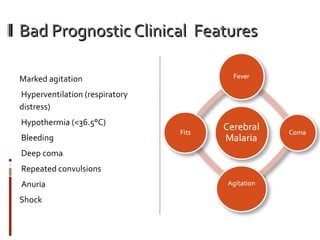
Bad Prognostic Clinical  Features Marked agitation Hyperventilation (respiratory distress) Hypothermia (<36.5°C) Bleeding Deep coma Repeated convulsions Anuria  Shock
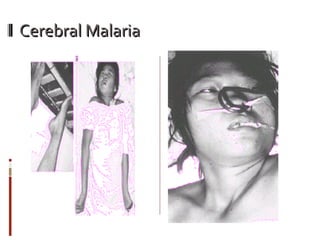
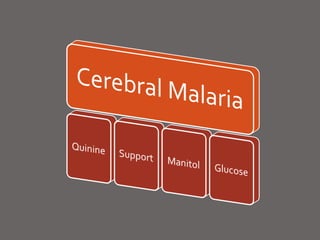
Cerebral Malaria
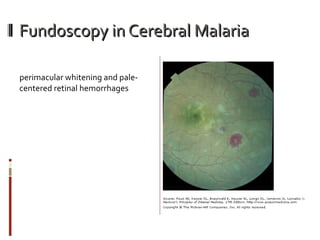
Fundoscopy in Cerebral Malaria perimacular whitening and pale-centered retinal hemorrhages
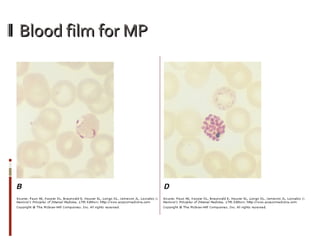
Blood film for MP
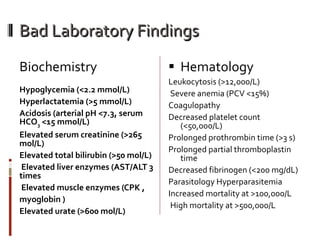
Bad Laboratory Findings Biochemistry  Hypoglycemia (<2.2 mmol/L)  Hyperlactatemia (>5 mmol/L)  Acidosis (arterial pH <7.3, serum HCO 3  <15 mmol/L)  Elevated serum creatinine (>265 mol/L)  Elevated total bilirubin (>50 mol/L) Elevated liver enzymes (AST/ALT 3 times Elevated muscle enzymes (CPK ,  myoglobin )  Elevated urate (>600 mol/L) Hematology  Leukocytosis (>12,000/L) Severe anemia (PCV <15%) Coagulopathy  Decreased platelet count (<50,000/L)  Prolonged prothrombin time (>3 s) Prolonged partial thromboplastin time  Decreased fibrinogen (<200 mg/dL)  Parasitology Hyperparasitemia  Increased mortality at >100,000/L High mortality at >500,000/L


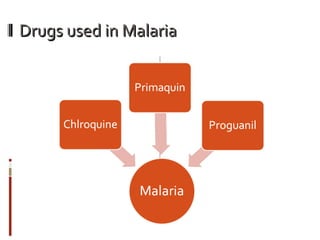
Drugs used in Malaria
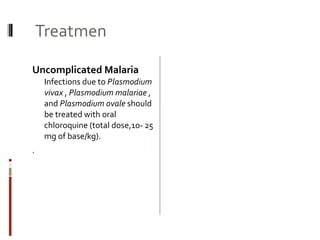
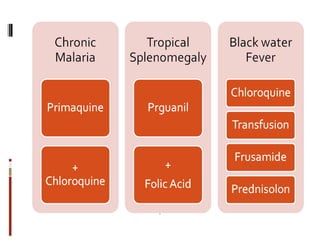
Treatmen Uncomplicated Malaria  Infections due to  Plasmodium vivax  ,  Plasmodium malariae  , and  Plasmodium ovale  should be treated with oral chloroquine (total dose,10- 25 mg of base/kg).  . Tropical Splenomegaly is   treated by Prguanil 100mg/day+ Folic Acid 5 mg Chronic Malaria   is treated by Primaquine 15mg/day + Chloroquine
 
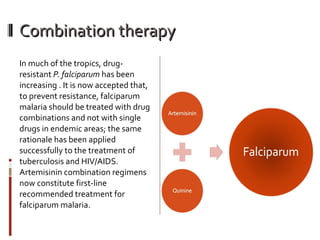
Combination therapy In much of the tropics, drug-resistant  P. falciparum  has been increasing . It is now accepted that, to prevent resistance, falciparum malaria should be treated with drug combinations and not with single drugs in endemic areas; the same rationale has been applied successfully to the treatment of tuberculosis and HIV/AIDS. Artemisinin combination regimens now constitute first-line recommended treatment for falciparum malaria.
Prevention Eradication of malaria. Health Education Self Protection Chemoprophylaxis

4.malaria acute chronic cerebral

  • 1.
  • 2.
    Malaria Definition& Organisms ThisMalaria is a protozoan disease transmitted by the bite of infected Anopheles mosquitoes. It is the most important of the parasitic diseases of humans, with transmission in 107 countries containing 3 billion people and causing 1–3 million deaths each year. Although there are promising new control and research initiatives, malaria remains today, as it has been for centuries, a heavy burden on tropical communities, a threat to nonendemic countries, and a danger to travelers. !
  • 3.
  • 4.
    Etiology and PathogenesisFour species of the genus Plasmodium cause nearly all malarial infections in humans .These are P. falciparum , P. vivax , P. ovale , and P. malariae . Almost all deaths are caused by falciparum malaria. Human infection begins when a female anopheline mosquito inoculates plasmodial sporozoites from its salivary gland during a blood meal . These microscopic malarial parasites are carried rapidly via the bloodstream to the liver, where they invade hepatic parenchymal cells and begin a period of asexual reproduction. By this amplification process a single sporozoite eventually may produce from 10,000 to >30,000 daughter merozoites. The swollen infected liver cell eventually bursts, discharging motile merozoites into the bloodstream. These then invade the red blood cells (RBCs) and multiply six- to twentyfold every 48–72 h. When the parasites reach densities of ~50/L of blood, the symptomatic stage of the infection begins. In P. vivax and P. ovale infections, a proportion of the intrahepatic forms do not divide immediately but remain dormant for a period ranging from 3 weeks to a year or longer before reproduction begins. These dormant forms, or hypnozoites , are the cause of the relapses that characterize infection with these two species .
  • 5.
    Malignant Malaria FalciparumMalaria is called as Malignant Malaria due to its potential To produce more merozoites in lesser time(5 days) and cause sever complications To affect all stages f RBCs To block capillaries No exo-erythrocytic cycle Cerebral Hypoglycemia
  • 6.
    Why FalciparumCause Cerebral Malaria? In P. falciparum infections, membrane protuberances appear on the erythrocyte's surface 12–15 h after the cell's invasion. These &quot;knobs&quot; extrude a high-molecular-weight, antigenically variant, strain-specific erythrocyte membrane adhesive protein (PfEMP1) that mediates attachment to receptors on capillary endothelium—an event termed cytoadherence . Several vascular receptors have been identified, of which intercellular adhesion molecule 1 (ICAM-1) is probably the most important in the brain, chondroitin sulfate B in the placenta, and CD36 in most other organs. Thus, the infected erythrocytes stick inside and eventually block capillaries and venules. At the same stage, these P. falciparum –infected RBCs may also adhere to uninfected RBCs to form rosettes
  • 7.
  • 8.
    Several days ofprodromal symptoms such as malaise, headache, myalgia , anorexia, and mild fever are interrupted by the first paroxysm. Suddenly the patient feels inexplicably cold (in a hot climate) and apprehensive. Mild shivering quickly turns into violent shaking with teeth-chattering .
  • 9.
    Relative Incidence ofSevere Complications of Falciparum Malaria Complication Nonpregnant Adults Pregnant Women Children Anemia + ++ +++ Convulsions + + +++ Hypoglycemia + +++ +++ Jaundice +++ +++ + Renal failure +++ +++ – Pulmonary edema ++ +++ + Key: –, rare; +, infrequent; ++, frequent; +++, very frequent.
  • 10.
    Bad Prognostic Clinical Features Marked agitation Hyperventilation (respiratory distress) Hypothermia (<36.5°C) Bleeding Deep coma Repeated convulsions Anuria Shock
  • 11.
  • 12.
    Fundoscopy in CerebralMalaria perimacular whitening and pale-centered retinal hemorrhages
  • 13.
  • 14.
    Bad Laboratory FindingsBiochemistry Hypoglycemia (<2.2 mmol/L) Hyperlactatemia (>5 mmol/L) Acidosis (arterial pH <7.3, serum HCO 3 <15 mmol/L) Elevated serum creatinine (>265 mol/L) Elevated total bilirubin (>50 mol/L) Elevated liver enzymes (AST/ALT 3 times Elevated muscle enzymes (CPK , myoglobin ) Elevated urate (>600 mol/L) Hematology Leukocytosis (>12,000/L) Severe anemia (PCV <15%) Coagulopathy Decreased platelet count (<50,000/L) Prolonged prothrombin time (>3 s) Prolonged partial thromboplastin time Decreased fibrinogen (<200 mg/dL) Parasitology Hyperparasitemia Increased mortality at >100,000/L High mortality at >500,000/L
  • 15.
  • 16.
  • 17.
  • 18.
  • 19.
    Treatmen Uncomplicated Malaria Infections due to Plasmodium vivax , Plasmodium malariae , and Plasmodium ovale should be treated with oral chloroquine (total dose,10- 25 mg of base/kg). . Tropical Splenomegaly is treated by Prguanil 100mg/day+ Folic Acid 5 mg Chronic Malaria is treated by Primaquine 15mg/day + Chloroquine
  • 20.
  • 21.
    Combination therapy Inmuch of the tropics, drug-resistant P. falciparum has been increasing . It is now accepted that, to prevent resistance, falciparum malaria should be treated with drug combinations and not with single drugs in endemic areas; the same rationale has been applied successfully to the treatment of tuberculosis and HIV/AIDS. Artemisinin combination regimens now constitute first-line recommended treatment for falciparum malaria.
  • 22.
    Prevention Eradication ofmalaria. Health Education Self Protection Chemoprophylaxis