n
t
r
o
d
u
c
t
i
o
n
1
Malaria
Malaria is a major
public health problem
in warm climates
especially in
developing countries.
It is a leading cause of
disease and death
among children under
five years, pregnant
women and non-
immune
travellers/immigrants.
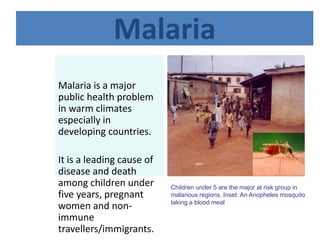
Children under 5 are the major at risk group in
malarious regions. Inset: An Anopheles mosquito
taking a blood meal
What is malaria ?
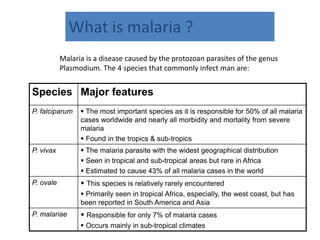
Malaria is a disease caused by the protozoan parasites of the genus
Plasmodium. The 4 species that commonly infect man are:
Species Major features
P. falciparum  The most important species as it is responsible for 50% of all malaria
cases worldwide and nearly all morbidity and mortality from severe
malaria
 Found in the tropics & sub-tropics
P. vivax  The malaria parasite with the widest geographical distribution
 Seen in tropical and sub-tropical areas but rare in Africa
 Estimated to cause 43% of all malaria cases in the world
P. ovale  This species is relatively rarely encountered
 Primarily seen in tropical Africa, especially, the west coast, but has
been reported in South America and Asia
P. malariae  Responsible for only 7% of malaria cases
 Occurs mainly in sub-tropical climates
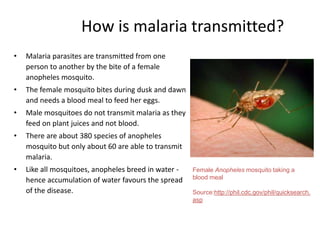
Female Anopheles mosquito taking a
blood meal
Source:http://phil.cdc.gov/phil/quicksearch.
asp
How is malaria transmitted?
• Malaria parasites are transmitted from one
person to another by the bite of a female
anopheles mosquito.
• The female mosquito bites during dusk and dawn
and needs a blood meal to feed her eggs.
• Male mosquitoes do not transmit malaria as they
feed on plant juices and not blood.
• There are about 380 species of anopheles
mosquito but only about 60 are able to transmit
malaria.
• Like all mosquitoes, anopheles breed in water -
hence accumulation of water favours the spread
of the disease.
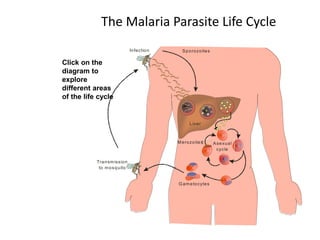
How does infection develop ?
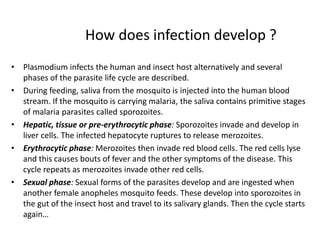
• Plasmodium infects the human and insect host alternatively and several
phases of the parasite life cycle are described.
• During feeding, saliva from the mosquito is injected into the human blood
stream. If the mosquito is carrying malaria, the saliva contains primitive stages
of malaria parasites called sporozoites.
• Hepatic, tissue or pre-erythrocytic phase: Sporozoites invade and develop in
liver cells. The infected hepatocyte ruptures to release merozoites.
• Erythrocytic phase: Merozoites then invade red blood cells. The red cells lyse
and this causes bouts of fever and the other symptoms of the disease. This
cycle repeats as merozoites invade other red cells.
• Sexual phase: Sexual forms of the parasites develop and are ingested when
another female anopheles mosquito feeds. These develop into sporozoites in
the gut of the insect host and travel to its salivary glands. Then the cycle starts
again…
Infection Sporozoites
Liver
Asexual
cycle
Gametocytes
Merozoites
Transmission
to mosquito
Click on the
diagram to
explore
different areas
of the life cycle
The Malaria Parasite Life Cycle
Severity of disease and host factors
In addition to parasite factors, several host factors determine the outcome of exposure to malaria:
• Naturally-acquired immunity. People who are constantly exposed to malaria gradually acquire
immunity, firstly against clinical disease and later against parasite infection. Clinical
manifestations of malaria are most severe in the non-immune. In holoendemic areas, these are
children aged <5 years and pregnant women (especially primagravidae). People of any age
from areas that are free from malaria, or have limited malaria transmission, are at risk when
they are exposed to malaria.
• Red cell and haemoglobin variants. Well known examples of inherited factors that protect
against malaria are Haemoglobin S carrier state, the thalassaemias and Glucose-6-phosphate
dehydrogenase (G6PD) deficiency. Malaria provides the best known example whereby an
environmental factor (malaria) has selected human genes because of their survival advantage.
• Foetal haemoglobin (HbF): High levels of HbF occur in neonates, and in some people with
inherited haemoglobin variants, protect against severe forms of P. falciparum malaria.
• Duffy blood group: P. vivax requires the Duffy blood receptor to enter red blood cells.
Therefore, people who do not carry the Duffy blood group are resistant to this malaria species.
This explains the rarity of P. vivax in Africa, as most Africans are Duffy blood group negative.
The clinical course of P. falciparum
Following a bite by an infected mosquito, many people do not develop any
signs of infection. If infection does progress, the outcome is one of three
depending on the host and parasite factors enumerated in the previous
slides:
A. Asymptomatic parasitaemia (“clinical
immunity”)
B. Acute, uncomplicated malaria
C. Severe malaria
This is usually seen in older children and adults
who have acquired natural immunity to clinical
disease as a consequence of living in areas with
high malaria endemicity. There are malaria
parasites in the peripheral blood but no
symptoms. These individuals may be important
reservoirs for disease transmission.
Some individuals may even develop anti-
parasite immunity so that they do not develop
parasitaemia following infection.
A. Asymptomatic parasitaemia
B. Simple, uncomplicated malaria
• This can occur at any age but it is more likely to
be seen in individuals with some degree of
immunity to malaria. The affected person,
though ill, does not manifest life-threatening
disease.
• Fever is the most constant symptom of malaria.
It may occur in paroxysms when lysis of red cells
releases merozoites resulting in fever, chills and
rigors (uncontrollable shivering).
Other features of simple,
uncomplicated malaria include:
o Vomiting
o Diarrhoea – more commonly seen in young children and, when vomiting also occurs, may
be misdiagnosed as viral gastroenteritis
o Convulsions – commonly seen in young children. Malaria is the leading cause of
convulsions with fever in African children.
o Pallor – resulting mainly from the lysis of red blood cells. Malaria also reduces the
synthesis of red blood cells in the bone marrow.
o Jaundice – mainly due to haemolysis.
Malaria is a multisystem disease. Other common clinical features are:
o Anorexia
o Cough
o Headache
o Malaise
o Muscle aches
o Splenomegaly
o Tender hepatomegaly
C. Severe and complicated malaria
1. Cerebral malaria
2. Severe malaria anaemia
3. Hypoglycaemia
4. Metabolic acidosis
5. Acute renal failure
6. Pulmonary oedema
7. Circulatory collapse, shock
or “algid malaria”
8. Blackwater fever
Nearly all severe disease and the estimated >1 million deaths
from malaria are due to P. falciparum. Although severe malaria
is both preventable and treatable, it is frequently a fatal
disease.
The following are 8 important severe manifestations of
malaria:
Click on each severe manifestation for details
Note: It is common for an individual patient to have
more than one severe manifestation of malaria!
Diagnosis
Malaria is a multisystem disease. It presents with a wide variety of non-specific clinical features:
there are no pathognomonic symptoms or signs. Many patients have fever, general aches and
pains and malaise and are initially misdiagnosed as having “flu”.
P. falciparum malaria can be rapidly progressive and fatal. Prompt diagnosis saves lives and relies
on astute clinical assessment:
• A good history
– Residence or a recent visit (in the preceding 3 months) to a malaria endemic area
– History of fever (may be paroxysmal in nature)
– Recognise significance of non-specific clinical features such as vomiting, diarrhoea,
headache, malaise
• Physical examination
– Identify signs consistent with malaria: fever, pallor, jaundice, splenomegaly
– Exclude other possible causes of fever (e.g. signs of viral and bacterial infections)
The diagnosis of malaria should be considered in any unwell
person who has been in a malarious area recently
Investigations
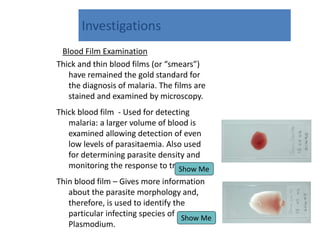
Blood Film Examination
Thick and thin blood films (or “smears”)
have remained the gold standard for
the diagnosis of malaria. The films are
stained and examined by microscopy.
Thick blood film - Used for detecting
malaria: a larger volume of blood is
examined allowing detection of even
low levels of parasitaemia. Also used
for determining parasite density and
monitoring the response to treatment.
Thin blood film – Gives more information
about the parasite morphology and,
therefore, is used to identify the
particular infecting species of
Plasmodium.
Show Me
Show Me
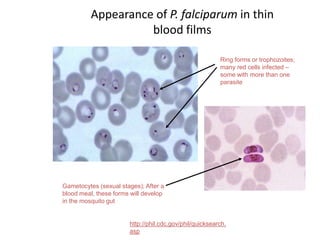
Ring forms or trophozoites;
many red cells infected –
some with more than one
parasite
Gametocytes (sexual stages); After a
blood meal, these forms will develop
in the mosquito gut
Appearance of P. falciparum in thin
blood films
http://phil.cdc.gov/phil/quicksearch.
asp
Other methods of diagnosis of malaria
These are not routinely used in clinical practice. They include :
a) Antigen capture kits. Uses a dipstick and a finger prick
blood sample. Rapid test - results are available in 10-15
minutes. Expensive and sensitivity drops with decreasing
parasitaemia.
b) PCR based techniques. Detects DNA or mRNA sequences
specific to Plasmodium. Sensitivity and specificity high but
test is expensive, takes several hours and requires technical
expertise.
c) Fluorescent techniques. Relatively low specificity and
sensitivity. Cannot identify the parasite species. Expensive
and requires skilled personnel.
d) Serologic tests. Based on immunofluorescence detection of
antibodies against Plasmodium species. Useful for
epidemiologic and not diagnostic purposes.
Treatment
1. Supportive treatment.
2. Blood Schizonticial drugs( for clinical cure):
• Quinine, Halofantrine, Artemether,
• Sulphdoxine/pyrimethamine (Fansidar)
and Metakelfin and Mefloquine.
• Chloroquine for sensitive species and strains
of P. falciparum.
Treatment
• For eradication of hypnozoites (dormant
stages of P. vivax and P. ovale):
Primaquine.
Immunity to malaria
• Natural:
• People with some haemoglobinopathies are
less susceptible to severe malaria such as:
Hb S trait, Beta thalassaemia, G6PD deficiency.
Immunity to malaria
• Acquired
• Acquired immunity to malaria is known as
premunition or premunity.
• The person is protected from severe malaria
as long as he/she is frequently exposed to the
parasite.
• Vaccination: There is no effective vaccine.
Prevention
• a. Treatment of cases.
• b. Prevention of people mosquito contact by:
• 1. Citing of human dwellings far away from the
breading places of the vectors.
• 2. Zoo-prophylaxis by citing animals between
breeding places and human residence.
• 3. Use of mosquito-bed nets and house
screening.
Prevention
4. Use of mosquito repellents.
C. Eradication of the mosquitoes:
1. Flying stage: By use of residual chemical
insecticides .
2. Aquatic stage:
 Use of larvicides.
 Oiling of the surface of water.
 Drainage of water where breeding occurs.
 Biological.

Malaria

  • 1.
    n t r o d u c t i o n 1 Malaria Malaria is amajor public health problem in warm climates especially in developing countries. It is a leading cause of disease and death among children under five years, pregnant women and non- immune travellers/immigrants. Children under 5 are the major at risk group in malarious regions. Inset: An Anopheles mosquito taking a blood meal
  • 2.
    What is malaria? Malaria is a disease caused by the protozoan parasites of the genus Plasmodium. The 4 species that commonly infect man are: Species Major features P. falciparum  The most important species as it is responsible for 50% of all malaria cases worldwide and nearly all morbidity and mortality from severe malaria  Found in the tropics & sub-tropics P. vivax  The malaria parasite with the widest geographical distribution  Seen in tropical and sub-tropical areas but rare in Africa  Estimated to cause 43% of all malaria cases in the world P. ovale  This species is relatively rarely encountered  Primarily seen in tropical Africa, especially, the west coast, but has been reported in South America and Asia P. malariae  Responsible for only 7% of malaria cases  Occurs mainly in sub-tropical climates
  • 3.
    Female Anopheles mosquitotaking a blood meal Source:http://phil.cdc.gov/phil/quicksearch. asp How is malaria transmitted? • Malaria parasites are transmitted from one person to another by the bite of a female anopheles mosquito. • The female mosquito bites during dusk and dawn and needs a blood meal to feed her eggs. • Male mosquitoes do not transmit malaria as they feed on plant juices and not blood. • There are about 380 species of anopheles mosquito but only about 60 are able to transmit malaria. • Like all mosquitoes, anopheles breed in water - hence accumulation of water favours the spread of the disease.
  • 4.
    How does infectiondevelop ? • Plasmodium infects the human and insect host alternatively and several phases of the parasite life cycle are described. • During feeding, saliva from the mosquito is injected into the human blood stream. If the mosquito is carrying malaria, the saliva contains primitive stages of malaria parasites called sporozoites. • Hepatic, tissue or pre-erythrocytic phase: Sporozoites invade and develop in liver cells. The infected hepatocyte ruptures to release merozoites. • Erythrocytic phase: Merozoites then invade red blood cells. The red cells lyse and this causes bouts of fever and the other symptoms of the disease. This cycle repeats as merozoites invade other red cells. • Sexual phase: Sexual forms of the parasites develop and are ingested when another female anopheles mosquito feeds. These develop into sporozoites in the gut of the insect host and travel to its salivary glands. Then the cycle starts again…
  • 5.
    Infection Sporozoites Liver Asexual cycle Gametocytes Merozoites Transmission to mosquito Clickon the diagram to explore different areas of the life cycle The Malaria Parasite Life Cycle
  • 6.
    Severity of diseaseand host factors In addition to parasite factors, several host factors determine the outcome of exposure to malaria: • Naturally-acquired immunity. People who are constantly exposed to malaria gradually acquire immunity, firstly against clinical disease and later against parasite infection. Clinical manifestations of malaria are most severe in the non-immune. In holoendemic areas, these are children aged <5 years and pregnant women (especially primagravidae). People of any age from areas that are free from malaria, or have limited malaria transmission, are at risk when they are exposed to malaria. • Red cell and haemoglobin variants. Well known examples of inherited factors that protect against malaria are Haemoglobin S carrier state, the thalassaemias and Glucose-6-phosphate dehydrogenase (G6PD) deficiency. Malaria provides the best known example whereby an environmental factor (malaria) has selected human genes because of their survival advantage. • Foetal haemoglobin (HbF): High levels of HbF occur in neonates, and in some people with inherited haemoglobin variants, protect against severe forms of P. falciparum malaria. • Duffy blood group: P. vivax requires the Duffy blood receptor to enter red blood cells. Therefore, people who do not carry the Duffy blood group are resistant to this malaria species. This explains the rarity of P. vivax in Africa, as most Africans are Duffy blood group negative.
  • 7.
    The clinical courseof P. falciparum Following a bite by an infected mosquito, many people do not develop any signs of infection. If infection does progress, the outcome is one of three depending on the host and parasite factors enumerated in the previous slides: A. Asymptomatic parasitaemia (“clinical immunity”) B. Acute, uncomplicated malaria C. Severe malaria
  • 8.
    This is usuallyseen in older children and adults who have acquired natural immunity to clinical disease as a consequence of living in areas with high malaria endemicity. There are malaria parasites in the peripheral blood but no symptoms. These individuals may be important reservoirs for disease transmission. Some individuals may even develop anti- parasite immunity so that they do not develop parasitaemia following infection. A. Asymptomatic parasitaemia
  • 9.
    B. Simple, uncomplicatedmalaria • This can occur at any age but it is more likely to be seen in individuals with some degree of immunity to malaria. The affected person, though ill, does not manifest life-threatening disease. • Fever is the most constant symptom of malaria. It may occur in paroxysms when lysis of red cells releases merozoites resulting in fever, chills and rigors (uncontrollable shivering).
  • 10.
    Other features ofsimple, uncomplicated malaria include: o Vomiting o Diarrhoea – more commonly seen in young children and, when vomiting also occurs, may be misdiagnosed as viral gastroenteritis o Convulsions – commonly seen in young children. Malaria is the leading cause of convulsions with fever in African children. o Pallor – resulting mainly from the lysis of red blood cells. Malaria also reduces the synthesis of red blood cells in the bone marrow. o Jaundice – mainly due to haemolysis. Malaria is a multisystem disease. Other common clinical features are: o Anorexia o Cough o Headache o Malaise o Muscle aches o Splenomegaly o Tender hepatomegaly
  • 11.
    C. Severe andcomplicated malaria 1. Cerebral malaria 2. Severe malaria anaemia 3. Hypoglycaemia 4. Metabolic acidosis 5. Acute renal failure 6. Pulmonary oedema 7. Circulatory collapse, shock or “algid malaria” 8. Blackwater fever Nearly all severe disease and the estimated >1 million deaths from malaria are due to P. falciparum. Although severe malaria is both preventable and treatable, it is frequently a fatal disease. The following are 8 important severe manifestations of malaria: Click on each severe manifestation for details Note: It is common for an individual patient to have more than one severe manifestation of malaria!
  • 12.
    Diagnosis Malaria is amultisystem disease. It presents with a wide variety of non-specific clinical features: there are no pathognomonic symptoms or signs. Many patients have fever, general aches and pains and malaise and are initially misdiagnosed as having “flu”. P. falciparum malaria can be rapidly progressive and fatal. Prompt diagnosis saves lives and relies on astute clinical assessment: • A good history – Residence or a recent visit (in the preceding 3 months) to a malaria endemic area – History of fever (may be paroxysmal in nature) – Recognise significance of non-specific clinical features such as vomiting, diarrhoea, headache, malaise • Physical examination – Identify signs consistent with malaria: fever, pallor, jaundice, splenomegaly – Exclude other possible causes of fever (e.g. signs of viral and bacterial infections) The diagnosis of malaria should be considered in any unwell person who has been in a malarious area recently
  • 13.
    Investigations Blood Film Examination Thickand thin blood films (or “smears”) have remained the gold standard for the diagnosis of malaria. The films are stained and examined by microscopy. Thick blood film - Used for detecting malaria: a larger volume of blood is examined allowing detection of even low levels of parasitaemia. Also used for determining parasite density and monitoring the response to treatment. Thin blood film – Gives more information about the parasite morphology and, therefore, is used to identify the particular infecting species of Plasmodium. Show Me Show Me
  • 14.
    Ring forms ortrophozoites; many red cells infected – some with more than one parasite Gametocytes (sexual stages); After a blood meal, these forms will develop in the mosquito gut Appearance of P. falciparum in thin blood films http://phil.cdc.gov/phil/quicksearch. asp
  • 15.
    Other methods ofdiagnosis of malaria These are not routinely used in clinical practice. They include : a) Antigen capture kits. Uses a dipstick and a finger prick blood sample. Rapid test - results are available in 10-15 minutes. Expensive and sensitivity drops with decreasing parasitaemia. b) PCR based techniques. Detects DNA or mRNA sequences specific to Plasmodium. Sensitivity and specificity high but test is expensive, takes several hours and requires technical expertise. c) Fluorescent techniques. Relatively low specificity and sensitivity. Cannot identify the parasite species. Expensive and requires skilled personnel. d) Serologic tests. Based on immunofluorescence detection of antibodies against Plasmodium species. Useful for epidemiologic and not diagnostic purposes.
  • 16.
    Treatment 1. Supportive treatment. 2.Blood Schizonticial drugs( for clinical cure): • Quinine, Halofantrine, Artemether, • Sulphdoxine/pyrimethamine (Fansidar) and Metakelfin and Mefloquine. • Chloroquine for sensitive species and strains of P. falciparum.
  • 17.
    Treatment • For eradicationof hypnozoites (dormant stages of P. vivax and P. ovale): Primaquine.
  • 18.
    Immunity to malaria •Natural: • People with some haemoglobinopathies are less susceptible to severe malaria such as: Hb S trait, Beta thalassaemia, G6PD deficiency.
  • 19.
    Immunity to malaria •Acquired • Acquired immunity to malaria is known as premunition or premunity. • The person is protected from severe malaria as long as he/she is frequently exposed to the parasite. • Vaccination: There is no effective vaccine.
  • 20.
    Prevention • a. Treatmentof cases. • b. Prevention of people mosquito contact by: • 1. Citing of human dwellings far away from the breading places of the vectors. • 2. Zoo-prophylaxis by citing animals between breeding places and human residence. • 3. Use of mosquito-bed nets and house screening.
  • 21.
    Prevention 4. Use ofmosquito repellents. C. Eradication of the mosquitoes: 1. Flying stage: By use of residual chemical insecticides . 2. Aquatic stage:  Use of larvicides.  Oiling of the surface of water.  Drainage of water where breeding occurs.  Biological.