



Making teams work for your organization by Toronto Training and HR September 2011
	3-4 Introduction to Toronto 	Training and HR	5-6	Definition7-8	What can be achieved by teamworking?9-10	Advantages of teamworking11-12	Quality training for teams13-14	Running improvement teams15-17	Roles within teams18-20	A model for teamwork21-29	Leading the team30-31	Dysfunctional teams 32-33	Empowering the workforce  34-36	Virtual teams37-38	Elements of collaboration39-40Create a culture of teamwork41-42	Managing team conflict43-45	Challenges for the team46-48	Team alignment49-50	Drill51-52	Conclusion and questionsContentsPage 2
Page 3Introduction
Page 4Introduction to Toronto Training and HRToronto Training and HRis a specialist training and human resources consultancy headed by Timothy Holden 10 years in banking10 years in training and human resourcesFreelance practitioner since 2006The core services provided by Toronto Training and HR are:Training course design
Training course delivery-  Reducing costsSaving time
Improving employee engagement & morale
Services for job seekersPage 5Definition
Page 6DefinitionTeamwork
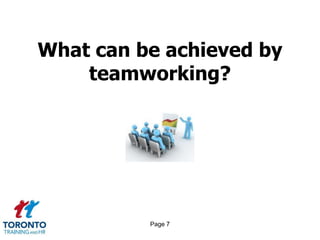
Page 7What can be achieved by teamworking?
Page 8What can be achieved by teamworking? Responding to a specific change within a business, as a result of a merger or take-over or in response to new customer requirementsResponding to opportunities or risk as a result of change in the outside business environmentTo improve production, speed up workflow or improve customer focusTo improve employee morale and motivation and encourage flexibilityTo improve problem solving or creativity skills
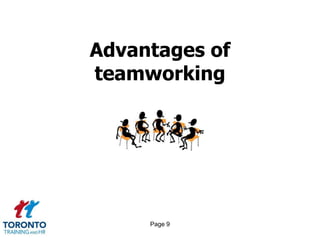
Page 9Advantages of teamworking
Page 10Advantages of teamworkingA greater variety of complex issues can be tackled by pooling expertise and resourcesProblems are exposed to a greater diversity of knowledge, skill and experienceThe approach boosts morale and ownership through participative decision makingImprovement opportunities that cross departmental or functional boundaries can be more easily addressedThe recommendations are more likely to be implemented than if they come from an individual
Page 11Quality training for teams
Page 12Quality training for teamsEnsure training is part of the quality policyAllocate responsibilities for trainingDefine training objectivesEstablish a training organizationSpecify quality training needsPrepare training programs and materialsImplement and monitor trainingAssess the resultsReview the effectiveness of the training
Page 13Running improvement teams
Page 14Running improvement teamsTeam selection and leadershipTeam objectivesTeam meetingsTeam assignmentsTeam dynamicsTeam results and reviews
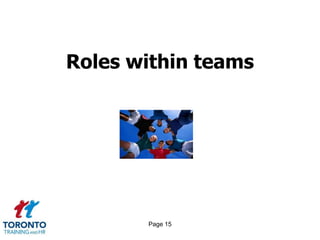
Page 15Roles within teams
Page 16Roles within teams 1 of 2Co-ordinatorShaperPlantMonitor-EvaluatorImplementerResource InvestigatorTeam WorkerFinisher
Page 17Roles within teams 2 of 2IMPROVEMENTS THAT CAN TAKE PLACEUnderachievement demands a good co-ordinator or finisherConflict requires a team worker or strong co-ordinatorMediocre performance needs a resource investigator, innovator or shaperError prone teams need an evaluator
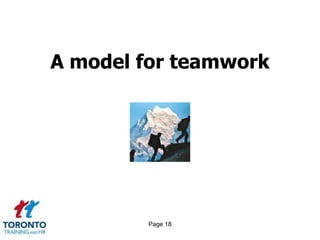
Page 18A model for teamwork
Page 19A model for teamwork 1 of 2TeamTaskIndividual
Page 20A model for teamwork 2 of 2PlanningInitiatingControllingSupportingInformingEvaluating
Page 21Leading the team
Page 22Leading the team 1 of 8MANAGERIAL ROLE CHANGESReduction of some controlGreater use of “people skills”Understanding and usage of group dynamicsGreater use of facilitation skillsFamiliarity with cross-functional tasks and operationsVision developerHandling conflict and ambiguity
Page 23Leading the team 2 of 8MANAGERIAL ROLE CHANGESBecoming a better listenerCommunicate to a greater degree the values and “shared” meanings of the organizationGenerating a consensus of opinion among team members
Page 24Leading the team 3 of 8INITIATIVES AS PART OF THE TEAMBUILDING PROCESSDevelop various “mind-joggers” that can be put on wall charts or on floor mats since many people look downwhen they walk. Concepts such as the following might be used:Focused excellenceEveryone is an internal supplierZero defectsWe are all dependent on each otherManage each impression as if it were your first and lastAttitude is everything
Page 25Leading the team 4 of 8INITIATIVES AS PART OF THE TEAMBUILDING PROCESSInitiate and update wall charts with pertinent information on such things as sales, labour costs, food costs, waste, promotional costs, etc.Put job-aid notes on the cash register to help out the employee who might not know what to say to a frustrated customer. All the employee has to do is “read the line.” This provides a certain degree of confidence.Develop and nurture an elite identity for your team.
Page 26Leading the team 5 of 8INITIATIVES AS PART OF THE TEAMBUILDING PROCESSConstruct a Problem Avoidance List that can be placed where everyone can see it. Get the input of all team members as to what should go on thislist. You now have many eyes and ears spotting potential problems — such as wobbly chairs, burned-out lights, customers waiting, etc.
Page 27Leading the team 6 of 8INITIATIVES AS PART OF THE TEAMBUILDING PROCESSDevelop a “just-in-time” scheduling system. In the service business, you can never predict when someone will call in sick or whatever. On a busy day or night, this can be disastrous. So pay 2- 3 people to stay home for “x” number of hours in the event they might be needed. The amount of compensation per hour would have to be determined. Also be sure to check on the legal requirements regarding this.
Page 28Leading the team 7 of 8INITIATIVES AS PART OF THE TEAMBUILDING PROCESSPublish an “Acres of Diamonds” bulletin. Let team members know what’s going right and point out some positive things employees might be taking for granted.Put together a “Shift Assessment Sheet.” The idea of this is to avoid surprises if you’re the head manager. On a piece of paper put three sections— Problem(s) Encountered, ActionTaken and Comments. Ask each employee on each shift to complete the form, if necessary, and put it in a box outside your office. When you come in the next morning, you’ll be well advised of what was resolved and/or what to expect.
Page 29Leading the team 8 of 8INITIATIVES AS PART OF THE TEAMBUILDING PROCESSDevise an incentive system that rewards your “Best Month Ever” — one in which each member of the team benefits. The category you choose for measurement could, obviously, be one of many, e.g., sales volume, customer complaints, etc.Institute a system for team compensation on an ongoingbasis that supplements the individual compensation system. This can be done in a variety of ways.
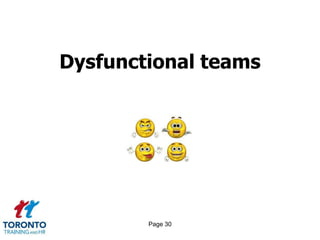
Page 30Dysfunctional teams
Page 31Dysfunctional teamsTYPES The team of individualistsFactional teamsThe conflict-avoiding teamThe indecisive team
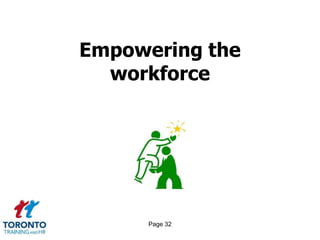
Page 32Empowering the workforce
Page 33Empowering the workforceTellSell ConsultJoinDelegate
Page 34Virtual teams
Page 35Virtual teams 1 of 2CRUCIAL CONVERSATIONSTalk before problems startPraise earlyNever raise individual concerns publicly
Page 36Virtual teams 2 of 2WHAT MANAGERS SHOULD DOMake conversations more personalBe attuned to the mood and nuances of virtual meetingsKeep employees engaged and focusedEstablish one-on-one time with each member of the team
Page 37Elements of collaboration
Page 38Elements of collaborationStay connected to a compelling purposeCultivate a culture of trust and respectThe performance management system places emphasis and value on teamworkIncrease competence in emotional competence, physical competence and intellectual competencePersevere in the face of breakdown and failureEngage the power of appreciation
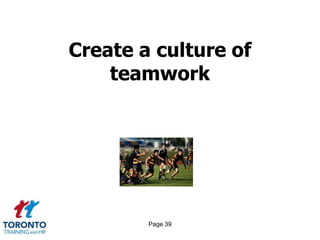
Page 39Create a culture of teamwork
Page 40Create a culture of teamworkLeaders communicate the clear expectation that teamwork and collaboration are expectedLeaders model teamwork in their interaction with each other and the rest of the organizationThe organization members talk about and identify the value of a teamwork cultureTeamwork is rewarded and recognizedImportant stories and folklore that people discuss within the company emphasize teamworkThe performance management system places emphasis and value on teamwork
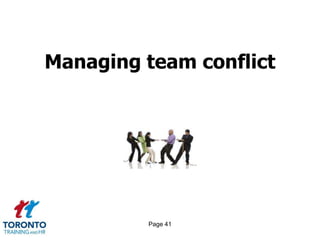
Page 41Managing team conflict
Page 42Managing team conflictGround rulesBuild cohesion and trustStick to the factsLead by example
Page 43Challenges for the team
Page 44Challenges for the team 1 of 2Share as much information as you canAsk for their inputStretch your peopleMake it fun, actionable and visibleHelp people feel the challenge
Page 45Challenges for the team 2 of 2BUILDING TEAM EFFECTIVENESSShare informationBalance freedom and guidanceGive people room to stretchHave some funMake the challenge visceral
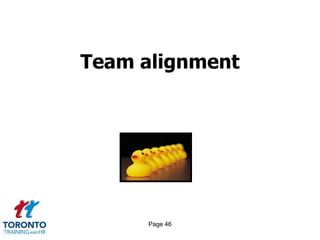
Page 46Team alignment
Page 47Team alignment 1 of 2ESSENTIAL COMPONENTSPurposeValuesVision
Page 48Team alignment 2 of 2MAINTAINING ALIGNMENTExpect an absolute commitment to alignment from the team to the purpose, values, and vision.Build trust, leading by example: tell the truth, be open to new ideas, be respectful of each individual, keep commitments, seek excellence—and expect the same from all team members.Get tough where necessary and provide strong leadership, without micromanaging his team. Senior team members need to be free to use their creativity and exercise their talents, provided they stay in alignment with the purpose, values, and vision.
Page 49Drill
Page 50Drill

Making teams work within your organization September 2011

  • 1.
    Making teams workfor your organization by Toronto Training and HR September 2011
  • 2.
    3-4 Introduction toToronto Training and HR 5-6 Definition7-8 What can be achieved by teamworking?9-10 Advantages of teamworking11-12 Quality training for teams13-14 Running improvement teams15-17 Roles within teams18-20 A model for teamwork21-29 Leading the team30-31 Dysfunctional teams 32-33 Empowering the workforce 34-36 Virtual teams37-38 Elements of collaboration39-40Create a culture of teamwork41-42 Managing team conflict43-45 Challenges for the team46-48 Team alignment49-50 Drill51-52 Conclusion and questionsContentsPage 2
  • 3.
  • 4.
    Page 4Introduction toToronto Training and HRToronto Training and HRis a specialist training and human resources consultancy headed by Timothy Holden 10 years in banking10 years in training and human resourcesFreelance practitioner since 2006The core services provided by Toronto Training and HR are:Training course design
  • 5.
    Training course delivery- Reducing costsSaving time
  • 6.
  • 7.
    Services for jobseekersPage 5Definition
  • 8.
  • 9.
    Page 7What canbe achieved by teamworking?
  • 10.
    Page 8What canbe achieved by teamworking? Responding to a specific change within a business, as a result of a merger or take-over or in response to new customer requirementsResponding to opportunities or risk as a result of change in the outside business environmentTo improve production, speed up workflow or improve customer focusTo improve employee morale and motivation and encourage flexibilityTo improve problem solving or creativity skills
  • 11.
  • 12.
    Page 10Advantages ofteamworkingA greater variety of complex issues can be tackled by pooling expertise and resourcesProblems are exposed to a greater diversity of knowledge, skill and experienceThe approach boosts morale and ownership through participative decision makingImprovement opportunities that cross departmental or functional boundaries can be more easily addressedThe recommendations are more likely to be implemented than if they come from an individual
  • 13.
  • 14.
    Page 12Quality trainingfor teamsEnsure training is part of the quality policyAllocate responsibilities for trainingDefine training objectivesEstablish a training organizationSpecify quality training needsPrepare training programs and materialsImplement and monitor trainingAssess the resultsReview the effectiveness of the training
  • 15.
  • 16.
    Page 14Running improvementteamsTeam selection and leadershipTeam objectivesTeam meetingsTeam assignmentsTeam dynamicsTeam results and reviews
  • 17.
  • 18.
    Page 16Roles withinteams 1 of 2Co-ordinatorShaperPlantMonitor-EvaluatorImplementerResource InvestigatorTeam WorkerFinisher
  • 19.
    Page 17Roles withinteams 2 of 2IMPROVEMENTS THAT CAN TAKE PLACEUnderachievement demands a good co-ordinator or finisherConflict requires a team worker or strong co-ordinatorMediocre performance needs a resource investigator, innovator or shaperError prone teams need an evaluator
  • 20.
    Page 18A modelfor teamwork
  • 21.
    Page 19A modelfor teamwork 1 of 2TeamTaskIndividual
  • 22.
    Page 20A modelfor teamwork 2 of 2PlanningInitiatingControllingSupportingInformingEvaluating
  • 23.
  • 24.
    Page 22Leading theteam 1 of 8MANAGERIAL ROLE CHANGESReduction of some controlGreater use of “people skills”Understanding and usage of group dynamicsGreater use of facilitation skillsFamiliarity with cross-functional tasks and operationsVision developerHandling conflict and ambiguity
  • 25.
    Page 23Leading theteam 2 of 8MANAGERIAL ROLE CHANGESBecoming a better listenerCommunicate to a greater degree the values and “shared” meanings of the organizationGenerating a consensus of opinion among team members
  • 26.
    Page 24Leading theteam 3 of 8INITIATIVES AS PART OF THE TEAMBUILDING PROCESSDevelop various “mind-joggers” that can be put on wall charts or on floor mats since many people look downwhen they walk. Concepts such as the following might be used:Focused excellenceEveryone is an internal supplierZero defectsWe are all dependent on each otherManage each impression as if it were your first and lastAttitude is everything
  • 27.
    Page 25Leading theteam 4 of 8INITIATIVES AS PART OF THE TEAMBUILDING PROCESSInitiate and update wall charts with pertinent information on such things as sales, labour costs, food costs, waste, promotional costs, etc.Put job-aid notes on the cash register to help out the employee who might not know what to say to a frustrated customer. All the employee has to do is “read the line.” This provides a certain degree of confidence.Develop and nurture an elite identity for your team.
  • 28.
    Page 26Leading theteam 5 of 8INITIATIVES AS PART OF THE TEAMBUILDING PROCESSConstruct a Problem Avoidance List that can be placed where everyone can see it. Get the input of all team members as to what should go on thislist. You now have many eyes and ears spotting potential problems — such as wobbly chairs, burned-out lights, customers waiting, etc.
  • 29.
    Page 27Leading theteam 6 of 8INITIATIVES AS PART OF THE TEAMBUILDING PROCESSDevelop a “just-in-time” scheduling system. In the service business, you can never predict when someone will call in sick or whatever. On a busy day or night, this can be disastrous. So pay 2- 3 people to stay home for “x” number of hours in the event they might be needed. The amount of compensation per hour would have to be determined. Also be sure to check on the legal requirements regarding this.
  • 30.
    Page 28Leading theteam 7 of 8INITIATIVES AS PART OF THE TEAMBUILDING PROCESSPublish an “Acres of Diamonds” bulletin. Let team members know what’s going right and point out some positive things employees might be taking for granted.Put together a “Shift Assessment Sheet.” The idea of this is to avoid surprises if you’re the head manager. On a piece of paper put three sections— Problem(s) Encountered, ActionTaken and Comments. Ask each employee on each shift to complete the form, if necessary, and put it in a box outside your office. When you come in the next morning, you’ll be well advised of what was resolved and/or what to expect.
  • 31.
    Page 29Leading theteam 8 of 8INITIATIVES AS PART OF THE TEAMBUILDING PROCESSDevise an incentive system that rewards your “Best Month Ever” — one in which each member of the team benefits. The category you choose for measurement could, obviously, be one of many, e.g., sales volume, customer complaints, etc.Institute a system for team compensation on an ongoingbasis that supplements the individual compensation system. This can be done in a variety of ways.
  • 32.
  • 33.
    Page 31Dysfunctional teamsTYPESThe team of individualistsFactional teamsThe conflict-avoiding teamThe indecisive team
  • 34.
  • 35.
    Page 33Empowering theworkforceTellSell ConsultJoinDelegate
  • 36.
  • 37.
    Page 35Virtual teams1 of 2CRUCIAL CONVERSATIONSTalk before problems startPraise earlyNever raise individual concerns publicly
  • 38.
    Page 36Virtual teams2 of 2WHAT MANAGERS SHOULD DOMake conversations more personalBe attuned to the mood and nuances of virtual meetingsKeep employees engaged and focusedEstablish one-on-one time with each member of the team
  • 39.
    Page 37Elements ofcollaboration
  • 40.
    Page 38Elements ofcollaborationStay connected to a compelling purposeCultivate a culture of trust and respectThe performance management system places emphasis and value on teamworkIncrease competence in emotional competence, physical competence and intellectual competencePersevere in the face of breakdown and failureEngage the power of appreciation
  • 41.
    Page 39Create aculture of teamwork
  • 42.
    Page 40Create aculture of teamworkLeaders communicate the clear expectation that teamwork and collaboration are expectedLeaders model teamwork in their interaction with each other and the rest of the organizationThe organization members talk about and identify the value of a teamwork cultureTeamwork is rewarded and recognizedImportant stories and folklore that people discuss within the company emphasize teamworkThe performance management system places emphasis and value on teamwork
  • 43.
  • 44.
    Page 42Managing teamconflictGround rulesBuild cohesion and trustStick to the factsLead by example
  • 45.
  • 46.
    Page 44Challenges forthe team 1 of 2Share as much information as you canAsk for their inputStretch your peopleMake it fun, actionable and visibleHelp people feel the challenge
  • 47.
    Page 45Challenges forthe team 2 of 2BUILDING TEAM EFFECTIVENESSShare informationBalance freedom and guidanceGive people room to stretchHave some funMake the challenge visceral
  • 48.
  • 49.
    Page 47Team alignment1 of 2ESSENTIAL COMPONENTSPurposeValuesVision
  • 50.
    Page 48Team alignment2 of 2MAINTAINING ALIGNMENTExpect an absolute commitment to alignment from the team to the purpose, values, and vision.Build trust, leading by example: tell the truth, be open to new ideas, be respectful of each individual, keep commitments, seek excellence—and expect the same from all team members.Get tough where necessary and provide strong leadership, without micromanaging his team. Senior team members need to be free to use their creativity and exercise their talents, provided they stay in alignment with the purpose, values, and vision.
  • 51.
  • 52.