






Managing to performby Toronto Training and HR April 2011
Contents3-4 Introduction to Toronto Training 		and HR	5-6	Definition and setting the scene	7-8	Drill9-16	Performance appraisals17-23	Performance management systems	24-27	Case studies A & B28-31	High performers	32-33	Promises v performance	34-35	Performance? You’re harassing me!	36-39	Is the job a good fit?40-41	Helping poor performers42-43	Progressive discipline44-46	Performance monitoring47-48	Mistakes around accountability	49-50	Benefits in admitting weaknesses51-54	Case studies C & D55-56	Conclusion and questionsPage 2
Page 3Introduction
Page 4Introduction to Toronto Training and HRToronto Training and HRis a specialist training and human resources consultancy headed by Timothy Holden 10 years in banking10 years in training and human resourcesFreelance practitioner since 2006The core services provided by Toronto Training and HR are:Training course design
Training course delivery-  Reducing costsSaving time
Improving employee engagement & morale
Services for job seekersPage 5Definition and setting the scene
Page 6Definition and setting the sceneWhat is performance management?Goals of performance managementOrganization drivers/what needs to be definedAlign, adapt and achieveFinancial and operational objectivesQuantitative and qualitative measurementsPerformance management objectivesPerformance management cycleSeven deadly sins of measurement
Page 7Drill
Page 8Drill
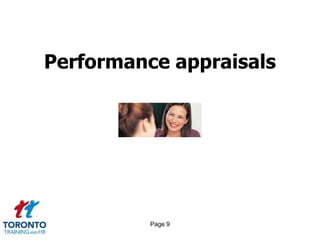
Page 9Performance appraisals
Page 10Performance appraisals 1 of 7APPRAISAL METHODSCategory rating appraisalComparison or comparative appraisalNarrative appraisalSpecial types of appraisal
Page 11Performance appraisals 2 of 7CATEGORY RATING APPRAISALGraphic scaleChecklistForced choice
Page 12Performance appraisals 3 of 7COMPARISON OR COMPARATIVE APPRAISALRankingPaired comparisonForced distribution
Page 13Performance appraisals 4 of 7NARRATIVE APPRAISALEssayCritical incidentsField review
Page 14Performance appraisals 5 of 7SPECIAL TYPES OF APPRAISALBehaviourally anchored rating scaleBehaviour observation scale360 degree feedback
Page 15Performance appraisals 6 of 7WHAT IS TYPICALLY COVERED?HR informationSummary of accomplishmentsPerformance appraisal measuresRating scaleSummary scoreObjectivesComments and signature
Page 16Performance appraisals 7 of 7PREPARATIONDocumentationRater errorsPlanning for the discussionPromote two-way dialogueSetting the meeting
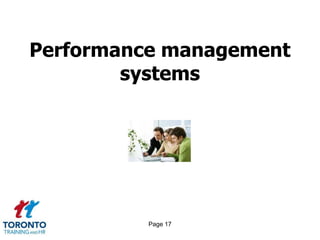
Page 17Performance management systems
Page 18Performance management systems 1 of 6BUILDING A ROBUST PERFORMANCE MANAGEMENT SYSTEMDesignImplementationCapability enhancement
Page 19Performance management systems 2 of 6KEY SUCCESS CRITERIAThe reality of the working relationships between individuals.How these relationships can be made more effective.How contemporary tools can be deployed to increase process effectiveness.How we can create an environment in which most individuals realise their true potential.
Page 20Performance management systems 3 of 6KEY SUCCESS CRITERIAHow we can increase compliance with processes by those at whom those processes are aimed. You don’t need to design processes for the top performers-they will do the right thing despite you!How we can cope with the demands and expectations of members of the team as well as the managers.How we can optimise individual performance.   
Page 21Performance management systems 4 of 6EFFECTIVE PERFORMANCE MANAGEMENT SYSTEMSSystem contains useful measuresThose useful measures are displayed in a usable manner
Page 22Performance management systems 5 of 6INSTALLING A MEANINGFUL SYSTEMBase the review on performance expectationsMinimize the prominence and importance of numbersReveal the form earlyReview performance oftenTrain all team members on the process and how todeliver feedback
Page 23Performance management systems 6 of 6INSTALLING A MEANINGFUL SYSTEMIncorporate self-assessmentsGenerate upward feedbackRequire follow-up meetingsConsider separating reviews from evaluationsRe-examine the system
Page 24Case study A
Page 25Case study A
Page 26Case study B
Page 27Case study B
Page 28High performers
Page 29High performers 1 of 3CLUSTERSBusiness thinking (BT)People development (PD)Inspiring people (IP)Achieving success (AS)
Page 30High performers 2 of 3BEHAVIOURSBT-Information search (IS), Concept formation (CF) Conceptual flexibility (CX)PD-Empathy (EM), Teamwork (TW) Developing people (DP)IP-Influence (IN), Building confidence (BC), Presentation (PR)AS-Proactivity (PO), Continuousimprovement (CI), Customer focus (Cfu).
Page 31High performers 3 of 3SELF-DESTRUCTIONPamper your pets in public, not in privateWork golden geese like rented mulesAffording challenging opportunities is not the same as demanding more
Page 32Promises v performance
Page 33Promises v performanceWhat is capability?Set standardsProvide regular feedbackProvide early guidance and correctionFocus on the factsGive time to improve
Page 34Performance? You’re harassing me!
Page 35Performance? You’re harassing me!Make sure that your dignity at work procedure points out that managers have a right and a duty to manage.  If a manager is seeking to help and encourage an employee to do his job, it does not constitute bullying or harassment.Provide evidence of poor work performance to support what you say.Ask why the employee thinks he is being bullied.  Ask ’Help me understand why you think I’m treating you less favourably than anyone else who performs at this level?’  By putting the onus back on the employee, you start to call him to account.
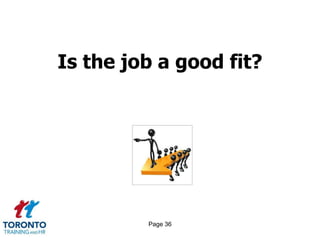
Page 36Is the job a good fit?
Page 37Is the job a good fit? 1 of 3What are you best at doing?What do you like to do the most?What do you wish you were better at?What talents do you have that you haven’t developed?Which of your skills are you most proud of?What do others most often say are your greateststrengths?What have you gotten better at?What can you just not get better at no matter how hard you try?
Page 38Is the job a good fit? 2 of 3What do you most dislike doing? Which skills need developing in order to perform your job?What sort of people do you work best/worst with?What sort of organizational culture brings out the best in you? What were you doing when you were happiest in your work life? What are your most cherished hopes for your future work life?How could your time be better used in your current job to add value to the organization?
Page 39Is the job a good fit? 3 of 3CYCLE OF EXCELLENCESelectConnectPlayGrapple and growShine
Page 40Helping poor performers
Page 41Helping poor performersSay somethingGive it to them straightCheck they understandMake a planHave hopeAvoid assumptionsShare your visionBe there
Page 42Progressive discipline
Page 43Progressive disciplineStrategies to avoid initiating progressive disciplineWhat constitutes need for progressive disciplineTypes of behaviour that could result in progressive discipline or immediate terminationAdministration considerationsProgressive discipline stepsFacts and supportWarningsTermination
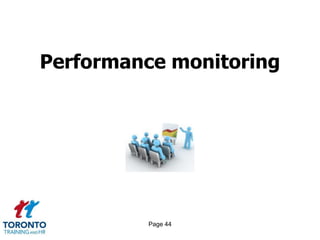
Page 44Performance monitoring
Page 45Performance monitoring 1 of 2OBJECTIVES OF SUPERVISORY MONITORINGTo ensure the task is performed as requiredTo provide supervision with accurate data for organizational performance appraisalsTo motivate employees to work at peak performance even when the supervisor is not present To motivate workers to display citizenship behaviours
Page 46Performance monitoring 2 of 2MONITORING TECHNIQUESAutomated surveillanceDirect observationInspection of workChecklistsPerformance indicesOne-on-one reviewsFollow-up conversationsReportsTeam meetingsPresentations
Page 47Mistakes around accountability
Page 48Mistakes around accountabilityThis too shall passThey know how I feelIt will turn into an argumentI made my expectations clearI’ll demotivate or lose themI’ll be seen as a micro-managerIt’s easier if I just do it myself
Page 49Benefits in admitting weakness
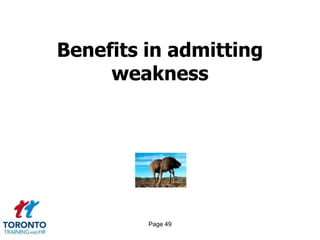
Page 50Benefits in admitting weaknessPeople hate to have their intelligence insultedPeople give sacrifices to deities but have dinner with effective leadersAsserting you are bulletproof smacks of hubrisThe “blame game” is despicable and doomed to failureIf you assume 100% of the blame for an errant act, you take the wind out of potential critics’ sails
Page 51Case study C
Page 52Case study C
Page 53Case study D
Page 54Case study D

Managing to perform April 2011

  • 1.
    Managing to performbyToronto Training and HR April 2011
  • 2.
    Contents3-4 Introduction toToronto Training and HR 5-6 Definition and setting the scene 7-8 Drill9-16 Performance appraisals17-23 Performance management systems 24-27 Case studies A & B28-31 High performers 32-33 Promises v performance 34-35 Performance? You’re harassing me! 36-39 Is the job a good fit?40-41 Helping poor performers42-43 Progressive discipline44-46 Performance monitoring47-48 Mistakes around accountability 49-50 Benefits in admitting weaknesses51-54 Case studies C & D55-56 Conclusion and questionsPage 2
  • 3.
  • 4.
    Page 4Introduction toToronto Training and HRToronto Training and HRis a specialist training and human resources consultancy headed by Timothy Holden 10 years in banking10 years in training and human resourcesFreelance practitioner since 2006The core services provided by Toronto Training and HR are:Training course design
  • 5.
    Training course delivery- Reducing costsSaving time
  • 6.
  • 7.
    Services for jobseekersPage 5Definition and setting the scene
  • 8.
    Page 6Definition andsetting the sceneWhat is performance management?Goals of performance managementOrganization drivers/what needs to be definedAlign, adapt and achieveFinancial and operational objectivesQuantitative and qualitative measurementsPerformance management objectivesPerformance management cycleSeven deadly sins of measurement
  • 9.
  • 10.
  • 11.
  • 12.
    Page 10Performance appraisals1 of 7APPRAISAL METHODSCategory rating appraisalComparison or comparative appraisalNarrative appraisalSpecial types of appraisal
  • 13.
    Page 11Performance appraisals2 of 7CATEGORY RATING APPRAISALGraphic scaleChecklistForced choice
  • 14.
    Page 12Performance appraisals3 of 7COMPARISON OR COMPARATIVE APPRAISALRankingPaired comparisonForced distribution
  • 15.
    Page 13Performance appraisals4 of 7NARRATIVE APPRAISALEssayCritical incidentsField review
  • 16.
    Page 14Performance appraisals5 of 7SPECIAL TYPES OF APPRAISALBehaviourally anchored rating scaleBehaviour observation scale360 degree feedback
  • 17.
    Page 15Performance appraisals6 of 7WHAT IS TYPICALLY COVERED?HR informationSummary of accomplishmentsPerformance appraisal measuresRating scaleSummary scoreObjectivesComments and signature
  • 18.
    Page 16Performance appraisals7 of 7PREPARATIONDocumentationRater errorsPlanning for the discussionPromote two-way dialogueSetting the meeting
  • 19.
  • 20.
    Page 18Performance managementsystems 1 of 6BUILDING A ROBUST PERFORMANCE MANAGEMENT SYSTEMDesignImplementationCapability enhancement
  • 21.
    Page 19Performance managementsystems 2 of 6KEY SUCCESS CRITERIAThe reality of the working relationships between individuals.How these relationships can be made more effective.How contemporary tools can be deployed to increase process effectiveness.How we can create an environment in which most individuals realise their true potential.
  • 22.
    Page 20Performance managementsystems 3 of 6KEY SUCCESS CRITERIAHow we can increase compliance with processes by those at whom those processes are aimed. You don’t need to design processes for the top performers-they will do the right thing despite you!How we can cope with the demands and expectations of members of the team as well as the managers.How we can optimise individual performance.   
  • 23.
    Page 21Performance managementsystems 4 of 6EFFECTIVE PERFORMANCE MANAGEMENT SYSTEMSSystem contains useful measuresThose useful measures are displayed in a usable manner
  • 24.
    Page 22Performance managementsystems 5 of 6INSTALLING A MEANINGFUL SYSTEMBase the review on performance expectationsMinimize the prominence and importance of numbersReveal the form earlyReview performance oftenTrain all team members on the process and how todeliver feedback
  • 25.
    Page 23Performance managementsystems 6 of 6INSTALLING A MEANINGFUL SYSTEMIncorporate self-assessmentsGenerate upward feedbackRequire follow-up meetingsConsider separating reviews from evaluationsRe-examine the system
  • 26.
  • 27.
  • 28.
  • 29.
  • 30.
  • 31.
    Page 29High performers1 of 3CLUSTERSBusiness thinking (BT)People development (PD)Inspiring people (IP)Achieving success (AS)
  • 32.
    Page 30High performers2 of 3BEHAVIOURSBT-Information search (IS), Concept formation (CF) Conceptual flexibility (CX)PD-Empathy (EM), Teamwork (TW) Developing people (DP)IP-Influence (IN), Building confidence (BC), Presentation (PR)AS-Proactivity (PO), Continuousimprovement (CI), Customer focus (Cfu).
  • 33.
    Page 31High performers3 of 3SELF-DESTRUCTIONPamper your pets in public, not in privateWork golden geese like rented mulesAffording challenging opportunities is not the same as demanding more
  • 34.
  • 35.
    Page 33Promises vperformanceWhat is capability?Set standardsProvide regular feedbackProvide early guidance and correctionFocus on the factsGive time to improve
  • 36.
  • 37.
    Page 35Performance? You’reharassing me!Make sure that your dignity at work procedure points out that managers have a right and a duty to manage.  If a manager is seeking to help and encourage an employee to do his job, it does not constitute bullying or harassment.Provide evidence of poor work performance to support what you say.Ask why the employee thinks he is being bullied.  Ask ’Help me understand why you think I’m treating you less favourably than anyone else who performs at this level?’  By putting the onus back on the employee, you start to call him to account.
  • 38.
    Page 36Is thejob a good fit?
  • 39.
    Page 37Is thejob a good fit? 1 of 3What are you best at doing?What do you like to do the most?What do you wish you were better at?What talents do you have that you haven’t developed?Which of your skills are you most proud of?What do others most often say are your greateststrengths?What have you gotten better at?What can you just not get better at no matter how hard you try?
  • 40.
    Page 38Is thejob a good fit? 2 of 3What do you most dislike doing? Which skills need developing in order to perform your job?What sort of people do you work best/worst with?What sort of organizational culture brings out the best in you? What were you doing when you were happiest in your work life? What are your most cherished hopes for your future work life?How could your time be better used in your current job to add value to the organization?
  • 41.
    Page 39Is thejob a good fit? 3 of 3CYCLE OF EXCELLENCESelectConnectPlayGrapple and growShine
  • 42.
  • 43.
    Page 41Helping poorperformersSay somethingGive it to them straightCheck they understandMake a planHave hopeAvoid assumptionsShare your visionBe there
  • 44.
  • 45.
    Page 43Progressive disciplineStrategiesto avoid initiating progressive disciplineWhat constitutes need for progressive disciplineTypes of behaviour that could result in progressive discipline or immediate terminationAdministration considerationsProgressive discipline stepsFacts and supportWarningsTermination
  • 46.
  • 47.
    Page 45Performance monitoring1 of 2OBJECTIVES OF SUPERVISORY MONITORINGTo ensure the task is performed as requiredTo provide supervision with accurate data for organizational performance appraisalsTo motivate employees to work at peak performance even when the supervisor is not present To motivate workers to display citizenship behaviours
  • 48.
    Page 46Performance monitoring2 of 2MONITORING TECHNIQUESAutomated surveillanceDirect observationInspection of workChecklistsPerformance indicesOne-on-one reviewsFollow-up conversationsReportsTeam meetingsPresentations
  • 49.
  • 50.
    Page 48Mistakes aroundaccountabilityThis too shall passThey know how I feelIt will turn into an argumentI made my expectations clearI’ll demotivate or lose themI’ll be seen as a micro-managerIt’s easier if I just do it myself
  • 51.
    Page 49Benefits inadmitting weakness
  • 52.
    Page 50Benefits inadmitting weaknessPeople hate to have their intelligence insultedPeople give sacrifices to deities but have dinner with effective leadersAsserting you are bulletproof smacks of hubrisThe “blame game” is despicable and doomed to failureIf you assume 100% of the blame for an errant act, you take the wind out of potential critics’ sails
  • 53.
  • 54.
  • 55.
  • 56.