
TRAFFIC SIMULATION
Presented By:
Amit Baghel(9910103532)
Utkarsh Agarwal(9910103441)
Major Project II
Mid Term Evaluation
On
CONTENT
 Introduction
 Related Work
i. SUMO
ii. MATSim
iii. AIM
 MAP
 Traffic Simulation Modeling
 Future Work
 References
INTRODUCTION
QUICK OVERVIEW
 For anybody that drives in a city, it takes few
statistics to motivate the search for solutions to
traffic problems. In 2012, drivers just in the New
Delhi spent 5.5 billion hours, burned 2:9 billion
gallons of fuel, wasted Rs1210 billion in lost time
and fuel, and emitted 56 billion pounds of carbon
dioxide while stuck in traffic.
 Three high-level goals have directed this
development and distinguish it from other
simulators:
1. Reasonably realistic simulations on real city
maps.
CONT.
1. Real-time, user-friendly interaction on cheap
machines.
2. Simple, high-level code that's easily extended.
 This leads to the choice of our simulator being an agent-
based microscopic simulator, meaning each vehicle in the
simulation is an autonomous agent, perceiving and
reacting to the world, orchestrated by nobody. The second
is the reason that it can be used with a simple GUI and
that a reader with minimal knowledge can start running
simulations in their favorite city in about 5 minutes.
Literature
Survey
 SUMO:
1. SUMO, the Simulation of Urban Mobility, is one of the most
widely used microscopic simulators right now. SUMO has a high
degree of congurability, mostly through XML les for demand data,
routes, turn definitions at junctions, the map, traffic signal
timings, and so on. More things are tuneable than in AORTA
without editing the source. However, its numerous capabilities
come at the cost of a massive code-base of 125, 000 lines of C++.
2. SUMO also has a high startup cost to begin using it. Using
provided tutorials, an attempt was made to run a simulation
using an OpenStreetMap encoding of New Delhi. The map
importer lacks reasonable defaults: the option to remove
disconnected portions of the map is o by default. A sepa-rate
Python script is needed to generate random trips, uniformly
distributed through the city.
 MATSim:
1. MATSim, the Multi-Agent Transport Simulation, is
another major traffic simulator. Its focus is on the bigger
picture of evaluating how people choose different aspects of
their trips { where to go, when to leave, what route to take
{ rather than simulating detailed traffic conditions. It has
two traffic flow models, the newer of which is discrete-
event based.
2. MATSim is agent-based in the sense that each driver
updates their trip plan after getting a score from
simulation. Modeling new control policies for intersections,
for instance, would not be straightforward in MATSim.
3. MATSim 0.5 consists of 1,40,000 lines of well-organized
and documented Java. The tutorials make it quick to start
using, but getting visualization components to run takes
more work.
 AIM:
1. The Autonomous Intersection Management (AIM) project
introduces an intersection control scheme designed for
autonomous vehicles. As drivers approach an intersection,
they request their desired movement from an intersection
agent. This intersection manager determines when the
driver can safely make their turn and sends back a reply.
The manager predicts potential collisions by dividing the
intersection into a grid and reserving space-time tiles for
each vehicle.
2. AIM is a large source of inspiration for our simulator:
originally it was conceived to explore the idea of running
AIM's intersection protocol at every intersection in an
entire city.
3. This simulator uses more realistic data, which can't as
easily be divided into grids.
MAP
MAP
 OpenStreetMap
Based on the three goals, OpenStreetMap (OSM) as chosen as the
source for map data. OSM is a project that releases city maps
under the Creative Commons license. Anybody can contribute
map data, and quality control is done on a volunteer basis. All
major cities are included.
The OSM map model consists of ways and nodes. Nodes are a single
latitude/longitude pair, and ways are a sequence of nodes. The
nodes in a way encode an approximation of the center of a road.
Ways have many annotations, describing the road's classification
and any one-way restrictions. OSM les also encode other
information like the presence of points of interest and bike paths,
which our simulator ignores. OSM les are XML and easily parsed.
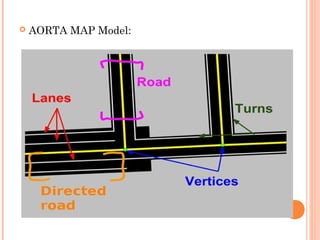
 AORTA MAP Model:
 MAP Construction:
I. Scrap Data From OSM.
II. Spit Ways into Roads.
III.Merge short roads
IV.Collapse degenerate vertices
V. Multiply roads into lanes
VI.Filling out turns
VII.Trimming lane geometry.
Traffic Simulation Modelling
 Model:
THIS is a microscopic, agent-based traffic
simulator, meaning each vehicle is a separate
entity that perceives its environment and
responds accordingly. Time advances in discrete
steps of 1:0 second. Space is continuous, meaning
the front of a vehicle is located at a real-valued
distance from the start of the road. (The
alternative discrete space would split each road
into tiles, with a vehicle occupying only one tile
at a time.)
The simulation proceeds by repeating steps. Every
time-step or tick.
 Determinism:
Simulations are deterministic: given the same input, the
same sequence of events will occur. This allows controlled
experiments to be per-formed, so the effects of one change
can be evaluated without worrying about other factors.
Determinsm also makes reproducing bugs easy. In this
section, we characterize the input and give implementation
details for how determin-istic resimulation works.
Simulations often introduce noise to model realistic sensors
and actuators that cannot perfectly perceive and act in the
world. Noise is compatible with determinism by capturing
and repeating the seed of the pseudo-random number
generator used to produce the noise. Noise could be
introduced with human behaviors.
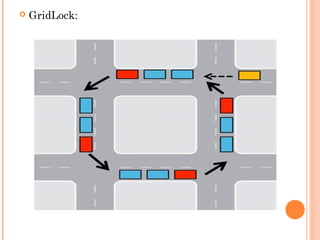
 GridLock:
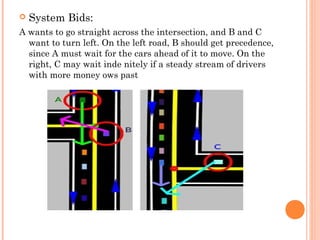
 System Bids:
A wants to go straight across the intersection, and B and C
want to turn left. On the left road, B should get precedence,
since A must wait for the cars ahead of it to move. On the
right, C may wait inde nitely if a steady stream of drivers
with more money ows past
Future Work
 Traffic lights, as implemented now, will wait for any agent to
finish once accepting it. Even if the cycle is only supposed to last
30 seconds, it'll last longer to let all accepted agents finish. That
means it shouldn't accept agents in the first place if they won't
finish their turn by the time the cycle ends. It's not necessarily
easy to estimate how long it'll take for an agent to reach the
intersection, when there are other drivers in front. Need to Come
up with a better heuristic.
 All drivers have the same parameters right now. Need to Come up
with different vehicle classes and have different max
acceleration/deceleration rates, lengths, etc. Lots of the physics
formulas assume all vehicles are the same right now; one way to
keep this easy is to make those formulas assume the worst-case
value once drivers have different parameters.
 Path finding is either fast and oblivious to congested roads
(using contraction hierarchies, a technique I don't understand
well -- We use the GraphHopper library) or slow but can weight
edges dynamically (A*). We've been looking around for new
algorithms that strike some sort of compromise, but haven't found
any.
REFERENCES
 Faststats accidents or unintentional injuries. Technical
report, National Center for Health Statistics, 2012.
 
Michael Balmer, Marcel Rieser, Konrad Meister, David
Charypar, Nico-las Lefebvre, and Kai Nagel. Matsim-t:
Architecture and simulation times.
Dustin Carlino, Stephen D. Boyles, and Peter Stone.
Auction-based autonomous intersection management. In
Proceedings of the 16th IEEE Intelligent Transportation
Systems Conference (ITSC), October 2013.
THANK YOU

Major ppt

  • 1.
    TRAFFIC SIMULATION Presented By: AmitBaghel(9910103532) Utkarsh Agarwal(9910103441) Major Project II Mid Term Evaluation On
  • 2.
    CONTENT  Introduction  RelatedWork i. SUMO ii. MATSim iii. AIM  MAP  Traffic Simulation Modeling  Future Work  References
  • 3.
  • 4.
    QUICK OVERVIEW  Foranybody that drives in a city, it takes few statistics to motivate the search for solutions to traffic problems. In 2012, drivers just in the New Delhi spent 5.5 billion hours, burned 2:9 billion gallons of fuel, wasted Rs1210 billion in lost time and fuel, and emitted 56 billion pounds of carbon dioxide while stuck in traffic.  Three high-level goals have directed this development and distinguish it from other simulators: 1. Reasonably realistic simulations on real city maps.
  • 5.
    CONT. 1. Real-time, user-friendlyinteraction on cheap machines. 2. Simple, high-level code that's easily extended.  This leads to the choice of our simulator being an agent- based microscopic simulator, meaning each vehicle in the simulation is an autonomous agent, perceiving and reacting to the world, orchestrated by nobody. The second is the reason that it can be used with a simple GUI and that a reader with minimal knowledge can start running simulations in their favorite city in about 5 minutes.
  • 6.
  • 7.
     SUMO: 1. SUMO,the Simulation of Urban Mobility, is one of the most widely used microscopic simulators right now. SUMO has a high degree of congurability, mostly through XML les for demand data, routes, turn definitions at junctions, the map, traffic signal timings, and so on. More things are tuneable than in AORTA without editing the source. However, its numerous capabilities come at the cost of a massive code-base of 125, 000 lines of C++. 2. SUMO also has a high startup cost to begin using it. Using provided tutorials, an attempt was made to run a simulation using an OpenStreetMap encoding of New Delhi. The map importer lacks reasonable defaults: the option to remove disconnected portions of the map is o by default. A sepa-rate Python script is needed to generate random trips, uniformly distributed through the city.
  • 8.
     MATSim: 1. MATSim,the Multi-Agent Transport Simulation, is another major traffic simulator. Its focus is on the bigger picture of evaluating how people choose different aspects of their trips { where to go, when to leave, what route to take { rather than simulating detailed traffic conditions. It has two traffic flow models, the newer of which is discrete- event based. 2. MATSim is agent-based in the sense that each driver updates their trip plan after getting a score from simulation. Modeling new control policies for intersections, for instance, would not be straightforward in MATSim. 3. MATSim 0.5 consists of 1,40,000 lines of well-organized and documented Java. The tutorials make it quick to start using, but getting visualization components to run takes more work.
  • 9.
     AIM: 1. TheAutonomous Intersection Management (AIM) project introduces an intersection control scheme designed for autonomous vehicles. As drivers approach an intersection, they request their desired movement from an intersection agent. This intersection manager determines when the driver can safely make their turn and sends back a reply. The manager predicts potential collisions by dividing the intersection into a grid and reserving space-time tiles for each vehicle. 2. AIM is a large source of inspiration for our simulator: originally it was conceived to explore the idea of running AIM's intersection protocol at every intersection in an entire city. 3. This simulator uses more realistic data, which can't as easily be divided into grids.
  • 10.
  • 11.
    MAP  OpenStreetMap Based onthe three goals, OpenStreetMap (OSM) as chosen as the source for map data. OSM is a project that releases city maps under the Creative Commons license. Anybody can contribute map data, and quality control is done on a volunteer basis. All major cities are included. The OSM map model consists of ways and nodes. Nodes are a single latitude/longitude pair, and ways are a sequence of nodes. The nodes in a way encode an approximation of the center of a road. Ways have many annotations, describing the road's classification and any one-way restrictions. OSM les also encode other information like the presence of points of interest and bike paths, which our simulator ignores. OSM les are XML and easily parsed.
  • 12.
  • 13.
     MAP Construction: I.Scrap Data From OSM. II. Spit Ways into Roads. III.Merge short roads IV.Collapse degenerate vertices V. Multiply roads into lanes VI.Filling out turns VII.Trimming lane geometry.
  • 14.
  • 15.
     Model: THIS isa microscopic, agent-based traffic simulator, meaning each vehicle is a separate entity that perceives its environment and responds accordingly. Time advances in discrete steps of 1:0 second. Space is continuous, meaning the front of a vehicle is located at a real-valued distance from the start of the road. (The alternative discrete space would split each road into tiles, with a vehicle occupying only one tile at a time.) The simulation proceeds by repeating steps. Every time-step or tick.
  • 16.
     Determinism: Simulations aredeterministic: given the same input, the same sequence of events will occur. This allows controlled experiments to be per-formed, so the effects of one change can be evaluated without worrying about other factors. Determinsm also makes reproducing bugs easy. In this section, we characterize the input and give implementation details for how determin-istic resimulation works. Simulations often introduce noise to model realistic sensors and actuators that cannot perfectly perceive and act in the world. Noise is compatible with determinism by capturing and repeating the seed of the pseudo-random number generator used to produce the noise. Noise could be introduced with human behaviors.
  • 17.
  • 18.
     System Bids: Awants to go straight across the intersection, and B and C want to turn left. On the left road, B should get precedence, since A must wait for the cars ahead of it to move. On the right, C may wait inde nitely if a steady stream of drivers with more money ows past
  • 19.
  • 20.
     Traffic lights,as implemented now, will wait for any agent to finish once accepting it. Even if the cycle is only supposed to last 30 seconds, it'll last longer to let all accepted agents finish. That means it shouldn't accept agents in the first place if they won't finish their turn by the time the cycle ends. It's not necessarily easy to estimate how long it'll take for an agent to reach the intersection, when there are other drivers in front. Need to Come up with a better heuristic.  All drivers have the same parameters right now. Need to Come up with different vehicle classes and have different max acceleration/deceleration rates, lengths, etc. Lots of the physics formulas assume all vehicles are the same right now; one way to keep this easy is to make those formulas assume the worst-case value once drivers have different parameters.  Path finding is either fast and oblivious to congested roads (using contraction hierarchies, a technique I don't understand well -- We use the GraphHopper library) or slow but can weight edges dynamically (A*). We've been looking around for new algorithms that strike some sort of compromise, but haven't found any.
  • 21.
    REFERENCES  Faststats accidents orunintentional injuries. Technical report, National Center for Health Statistics, 2012.   Michael Balmer, Marcel Rieser, Konrad Meister, David Charypar, Nico-las Lefebvre, and Kai Nagel. Matsim-t: Architecture and simulation times. Dustin Carlino, Stephen D. Boyles, and Peter Stone. Auction-based autonomous intersection management. In Proceedings of the 16th IEEE Intelligent Transportation Systems Conference (ITSC), October 2013.
  • 22.