TRAFFIC SIMULATION AND MODELLING
NAME : DHRUV J. PATEL
SUBJECT : TRANSPORTATION ENGINEERING – 1
ID NO : D18CL124
DIV : 2
BRANCH : CIVIL
INTRODUCTION
• Traffic flow phenomenon consists of a wide range of complex
activities,embrancing vehicle arrivals,speed of travel,lane
discipline ,overtaking and crossing logic, gap
acceptance,acceleration and deceleration.
• Different road characteristics will be govern by vehicle
performance, characteristics and behaviour of road user.
• The understanding of traffic flow can be attain by observing
how the vehicles move into the traffic stream by mathematical
models or analytical method.
INTRODUCTION
• The analytical approach requires that field data be collected on
a large scale.
i,e. If a proper understanding of a complex haterogeneous
traffic on INDIAN ROAD is to be achieved, Real life obervations
need to be collected.
• Like pavement widths, Roughness, Curvature ,Vertical profile
etc, So it is tedious
• Time consuming and expensive
• At last if still it has been done but the results are uncertain.
TRAFFIC MODELS
TRAFFIC FLOW MODELS
I. MICRO
II. MESO
III. MACRO
TRAFFIC MODELS
Traffic analytical models are ,where the solution to a set of
differential equations describing the traffic system is obtained
analytically,
• Analytical models can be static and Dynamic
• Numerical methods are used for solutins
But analytical models require large amount of field data such
as, Road Width, Lane Width,Roughness, Complete info. On
geometric design,Vehicle composition,Traffic Volumes, Speed
and Density.
• Extremely Costly and Tedious
• Often uncertainties are involved in the data
TRAFFIC MODELS
The simulation models are where the successive changes of the
traffic system over time are reproduced (Approximated)in the
model.
• Simulation models are Dynamic
• Macroscopic, Mesoscopic and Microscopic
TRAFFIC MODELS
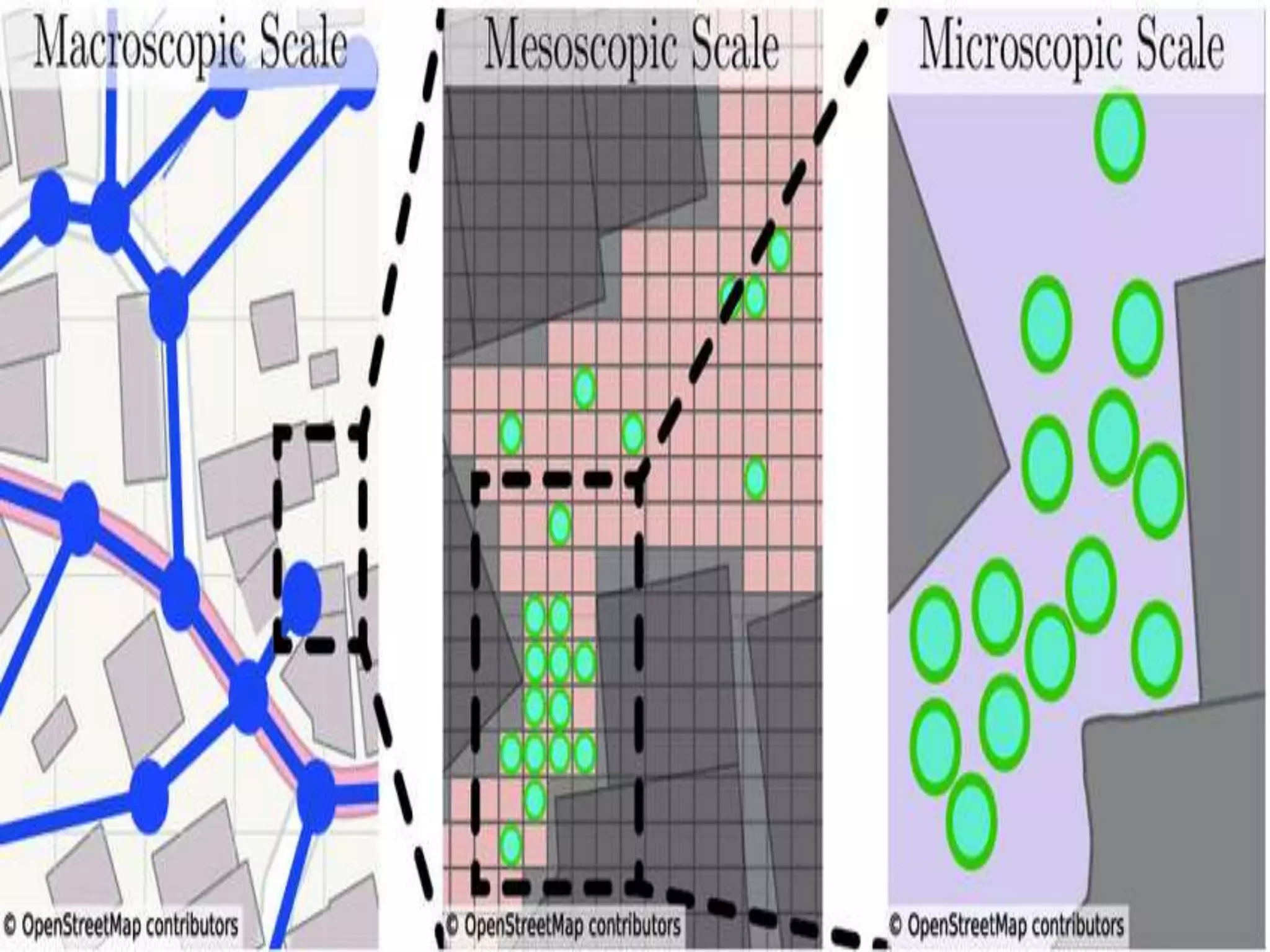
• Traffic simulation models can be classified as either
microscopic, mesoscopic, or macroscopic.
• Microscopic models are models that continuously or discretely
predict the state of individual vehicles.
• Microscopic measures are individual vehicle speeds and
locations.
• Macroscopic models aggregate the description of traffic flow.
• Macroscopic measures of effectiveness are speed, flow and
density.
• Mesoscopic models are models that have aspects of both macro
and microscopic models.
TRAFFIC MODELS
Macroscopic Simulation
o Macroscopic simulation models are based on the deterministic
relationships of the flow, speed, and density of the traffic
stream.
o The simulation in a macroscopic model takes place on a
section-by-section basis rather than by tracking individual
vehicles.
o Macroscopic simulation models were originally developed to
model traffic in distinct transportation subnetworks, such as
freeways, corridors (including freeways and parallel arterials),
surface-street grid networks, and rural highways
TRAFFIC MODELS
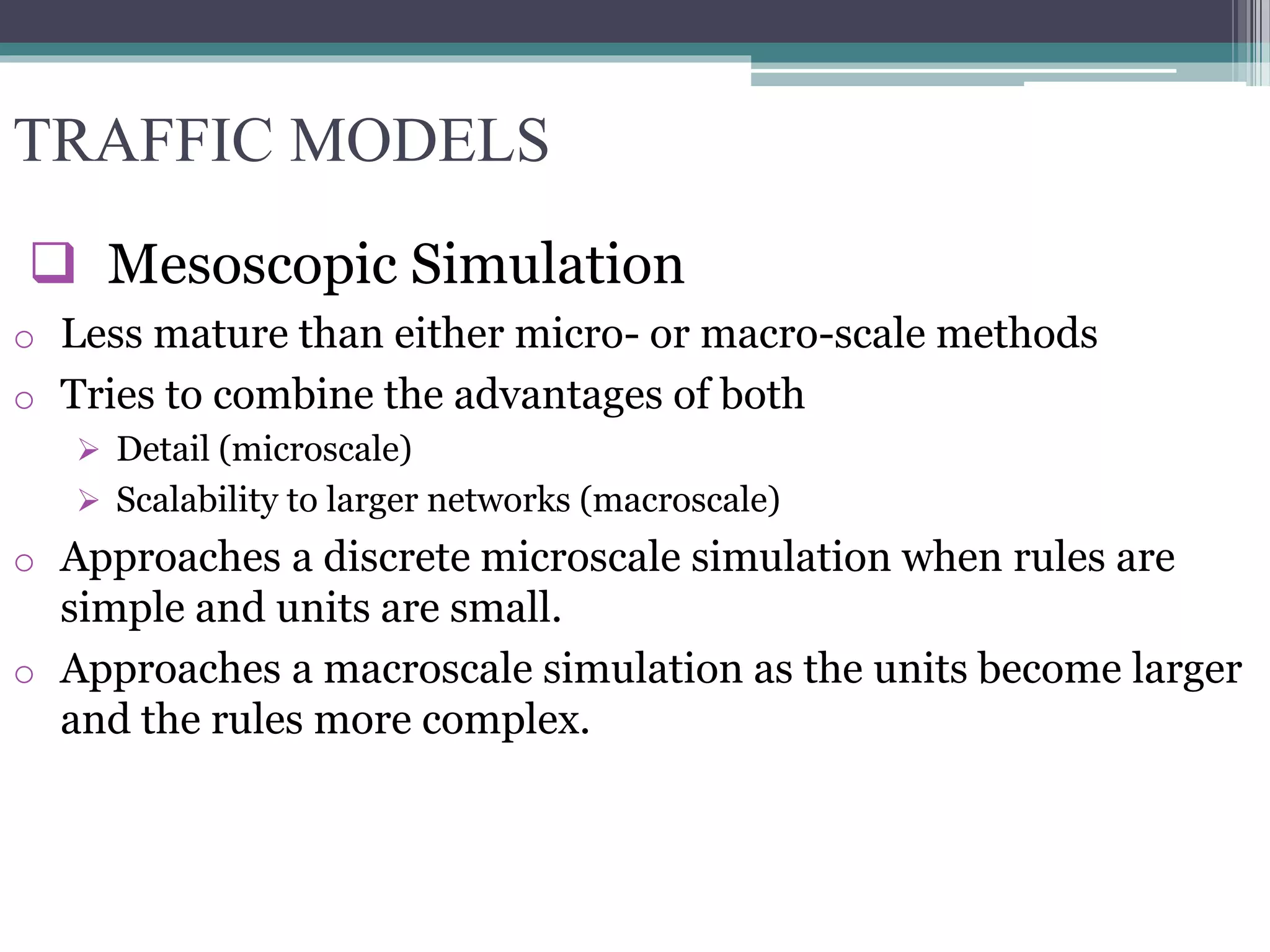
 Mesoscopic Simulation
o Less mature than either micro- or macro-scale methods
o Tries to combine the advantages of both
 Detail (microscale)
 Scalability to larger networks (macroscale)
o Approaches a discrete microscale simulation when rules are
simple and units are small.
o Approaches a macroscale simulation as the units become larger
and the rules more complex.
TRAFFIC MODELS
 Microscopic Traffic Simulation
o Unlike Macroscopic simulation, every vehicle in Microscopic
o There are three behaviors:
 Accelerations
 Braking decelerations
 Lane changes
o In order to achieve accuracy in modeling the traffic, many
factors must be considered. This leads to a simulation model
with high degree of parameters (50 parameters model is
common).
DEVELOPMENT OF SIMULATION
• New technique to solve the traffic problems
• It is a working analogy of real life problems into a computer
based model
• It is a technique where part of a real world is represented
dynamically by building a computer model , running the model
through time to solve problems having any given constraints
and inputes.
ADVANTAGES OF SIMULATION
• It is cheaper than any other on field methods
• It is a powerful tool for comparing the consequences of
alternative strategies and improvement plan
• Better involvement of competent authority
• In real life situation, It will be difficult to obtain condition in the
field which are needed for building a better analytical
formulation
• These techniques can be employed to check uncertain analytical
solution
• Some of the solution are doughtful in nature, simulation can
overcome with such deficiencies
• Simulation models are transparent
MAIN FACTOR OF TRAFFIC SIMULATION
• Advanced research in traffic theory
• Advancement in computer hardware technology
• Advancement in computer software technology
• Development in information
• Increased importance of traffic and transportation in the
society
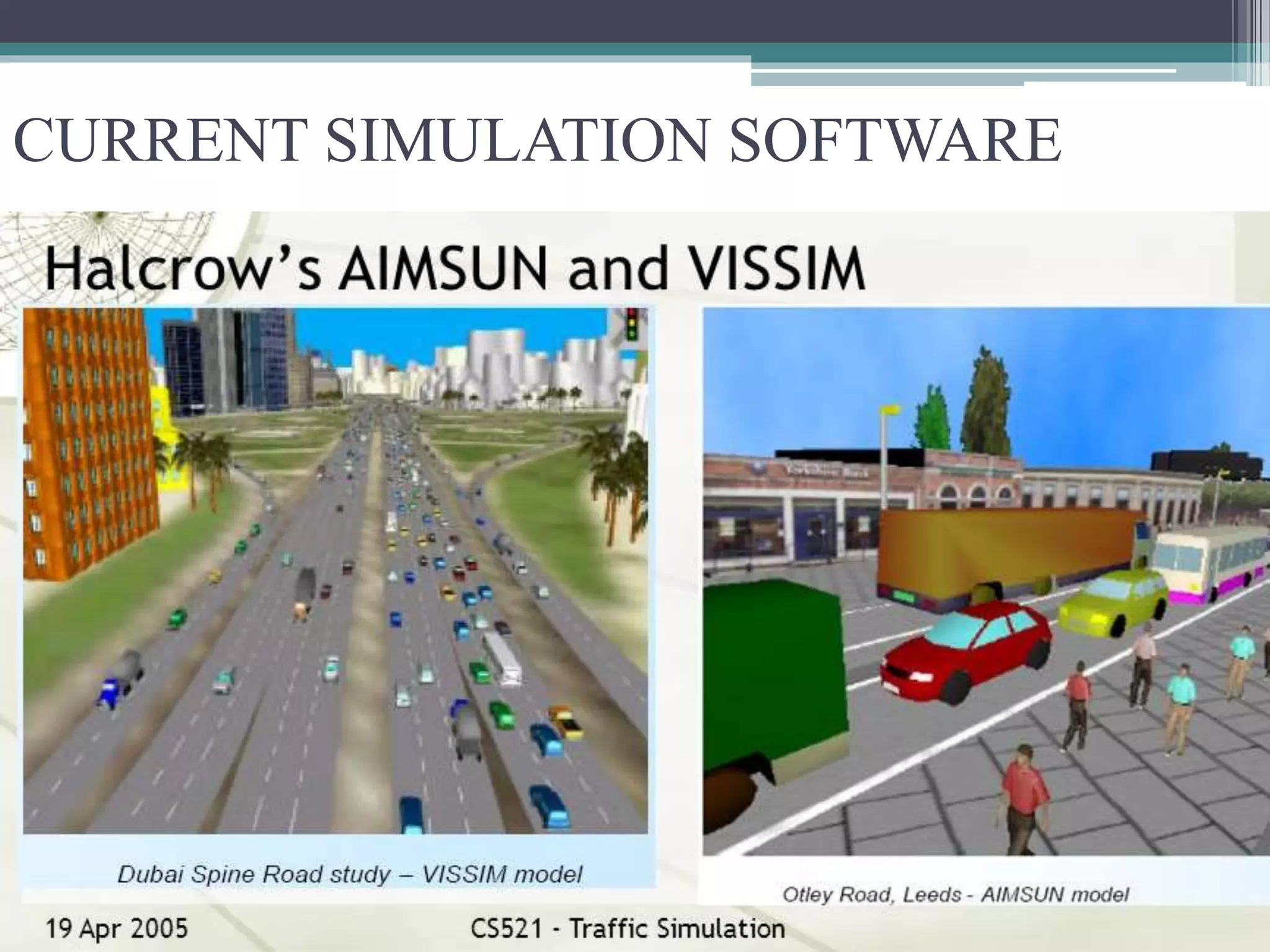
CURRENT SIMULATION SOFTWARE
Traffic simulation and modelling

Traffic simulation and modelling

  • 1.
    TRAFFIC SIMULATION ANDMODELLING NAME : DHRUV J. PATEL SUBJECT : TRANSPORTATION ENGINEERING – 1 ID NO : D18CL124 DIV : 2 BRANCH : CIVIL
  • 2.
    INTRODUCTION • Traffic flowphenomenon consists of a wide range of complex activities,embrancing vehicle arrivals,speed of travel,lane discipline ,overtaking and crossing logic, gap acceptance,acceleration and deceleration. • Different road characteristics will be govern by vehicle performance, characteristics and behaviour of road user. • The understanding of traffic flow can be attain by observing how the vehicles move into the traffic stream by mathematical models or analytical method.
  • 3.
    INTRODUCTION • The analyticalapproach requires that field data be collected on a large scale. i,e. If a proper understanding of a complex haterogeneous traffic on INDIAN ROAD is to be achieved, Real life obervations need to be collected. • Like pavement widths, Roughness, Curvature ,Vertical profile etc, So it is tedious • Time consuming and expensive • At last if still it has been done but the results are uncertain.
  • 5.
    TRAFFIC MODELS TRAFFIC FLOWMODELS I. MICRO II. MESO III. MACRO
  • 6.
    TRAFFIC MODELS Traffic analyticalmodels are ,where the solution to a set of differential equations describing the traffic system is obtained analytically, • Analytical models can be static and Dynamic • Numerical methods are used for solutins But analytical models require large amount of field data such as, Road Width, Lane Width,Roughness, Complete info. On geometric design,Vehicle composition,Traffic Volumes, Speed and Density. • Extremely Costly and Tedious • Often uncertainties are involved in the data
  • 7.
    TRAFFIC MODELS The simulationmodels are where the successive changes of the traffic system over time are reproduced (Approximated)in the model. • Simulation models are Dynamic • Macroscopic, Mesoscopic and Microscopic
  • 8.
    TRAFFIC MODELS • Trafficsimulation models can be classified as either microscopic, mesoscopic, or macroscopic. • Microscopic models are models that continuously or discretely predict the state of individual vehicles. • Microscopic measures are individual vehicle speeds and locations. • Macroscopic models aggregate the description of traffic flow. • Macroscopic measures of effectiveness are speed, flow and density. • Mesoscopic models are models that have aspects of both macro and microscopic models.
  • 9.
    TRAFFIC MODELS Macroscopic Simulation oMacroscopic simulation models are based on the deterministic relationships of the flow, speed, and density of the traffic stream. o The simulation in a macroscopic model takes place on a section-by-section basis rather than by tracking individual vehicles. o Macroscopic simulation models were originally developed to model traffic in distinct transportation subnetworks, such as freeways, corridors (including freeways and parallel arterials), surface-street grid networks, and rural highways
  • 10.
    TRAFFIC MODELS  MesoscopicSimulation o Less mature than either micro- or macro-scale methods o Tries to combine the advantages of both  Detail (microscale)  Scalability to larger networks (macroscale) o Approaches a discrete microscale simulation when rules are simple and units are small. o Approaches a macroscale simulation as the units become larger and the rules more complex.
  • 11.
    TRAFFIC MODELS  MicroscopicTraffic Simulation o Unlike Macroscopic simulation, every vehicle in Microscopic o There are three behaviors:  Accelerations  Braking decelerations  Lane changes o In order to achieve accuracy in modeling the traffic, many factors must be considered. This leads to a simulation model with high degree of parameters (50 parameters model is common).
  • 14.
    DEVELOPMENT OF SIMULATION •New technique to solve the traffic problems • It is a working analogy of real life problems into a computer based model • It is a technique where part of a real world is represented dynamically by building a computer model , running the model through time to solve problems having any given constraints and inputes.
  • 15.
    ADVANTAGES OF SIMULATION •It is cheaper than any other on field methods • It is a powerful tool for comparing the consequences of alternative strategies and improvement plan • Better involvement of competent authority • In real life situation, It will be difficult to obtain condition in the field which are needed for building a better analytical formulation • These techniques can be employed to check uncertain analytical solution • Some of the solution are doughtful in nature, simulation can overcome with such deficiencies • Simulation models are transparent
  • 16.
    MAIN FACTOR OFTRAFFIC SIMULATION • Advanced research in traffic theory • Advancement in computer hardware technology • Advancement in computer software technology • Development in information • Increased importance of traffic and transportation in the society
  • 17.