




Traffic Simulation
Prepared By:
Mr.Praful Shinkar
Assistant Professor and PG In-Charge
Introduction
• Traffic flow phenomenon consists of a wide range of complex activities,
embracing vehicle arrivals, speed of travel, lane discipline, overtaking and
crossing logic, gap acceptance, acceleration and deceleration etc..
• Different road characteristics will be govern by vehicle performance,
characteristics and behaviour of road user
• The understanding of traffic flow can be attain by observing how the vehicles
move into the traffic stream by mathematical models, or analytical methods
• The science of this study has been developed with this approach
Cont..
• The analytical approach requires that field data be collected on a large scale. i.e
if a proper understanding of a complex heterogeneous traffic on Indian Road is
to be achieved, real life observations need to be collected
• Like pavement widths, roughness, curvature, vertical profile etc. so it is tedious
• Time consuming and expensive
• At last if still it has been done but the results are uncertain
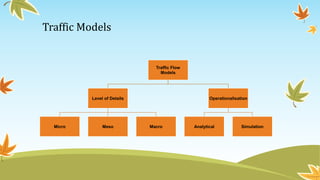
Traffic Models
Traffic Flow
Models
Level of Details
Micro Meso Macro
Operationalisation
Analytical Simulation
Cont..
• The analytical models are, where the solution to a set of differential equations
describing the traffic system is obtained analytically (using calculus)
• Analytical models can be static and dynamic
• Numerical methods are used for solutions
• But analytical models require large amount of field data such as, road width,
lane width, roughness, complete information on geometric design, vehicle
composition, type, traffic volumes, speeds & density etc.
• Extremely costly & tedious
• Often uncertainties are involved in the data
Cont…
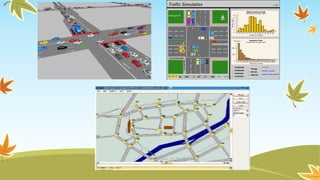
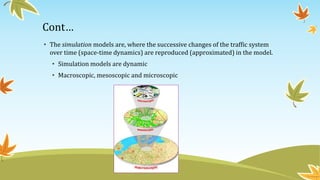
• The simulation models are, where the successive changes of the traffic system
over time (space-time dynamics) are reproduced (approximated) in the model.
• Simulation models are dynamic
• Macroscopic, mesoscopic and microscopic
Development of Simulation
• New technique to solve the traffic problems
• It is a working analogy of real life problems into a computer based model
• It is a technique where some part of a real world is represented dynamically by
building a computer model, running the model through time to solve problems
having any given constraints and inputs
Advantages
• It is cheaper than any other on field methods
• It is a powerful tool for comparing the consequences of a number of alternative
strategies and improvement plan
• Better involvement of competent authority
• In real life situations . It will be difficult to obtain conditions in the field which
are needed for building a better analytical formulation
• These techniques can be employed to check uncertain analytical solution
• These techniques provide opportunity for controlled experimentation, altering
one variable at a time or specific variables simultaneously
Cont..
• Some of the solutions are doughtful in nature, simulation can overcome with
such deficiencies
• Simulation models are transparent
Main factors of traffic simulation
1. Advanced research in traffic theory
2. Advancement in computer hardware technology
3. Advancement in computer software technology
4. Development in information, communication infrastructure
5. Increased importance of traffic and transportation in the society
Road Traffic as a Simulation Object
1. Transport networks cover wide physical areas
2. Large number of active participants or users and interaction among them
3. Objectives of the participants can be individualistic or social
4. Presence of independent variables outside the control of the operator and the
participants (the weather conditions, the number of users, etc.)
5. The road & highway traffic variables can be stochastic (inherent randomness)
and time varying in nature
6. Transportation systems involve both human interaction and vehicle
interaction with surroundings
Steps
Definition of problem
Field studies to determine inputs
Development of logic
Development of Computer
Simulation Programme
Calibration of model
Simulation runs covering actual
conditions
Validation of model
Development of Logic
• Certain activities in the models are inter related through some logic which has
to be established by the modeller
• For example for a given “T” intersection problem, the vehicle arriving at the side
road have to wait for suitable gaps in the traffic stream in the main road. Drivers
accept gaps which are safe, some are taking risks
• So, a logic in the modeller needed to be established
Traffic simulation

Traffic simulation

  • 1.
    Traffic Simulation Prepared By: Mr.PrafulShinkar Assistant Professor and PG In-Charge
  • 2.
    Introduction • Traffic flowphenomenon consists of a wide range of complex activities, embracing vehicle arrivals, speed of travel, lane discipline, overtaking and crossing logic, gap acceptance, acceleration and deceleration etc.. • Different road characteristics will be govern by vehicle performance, characteristics and behaviour of road user • The understanding of traffic flow can be attain by observing how the vehicles move into the traffic stream by mathematical models, or analytical methods • The science of this study has been developed with this approach
  • 4.
    Cont.. • The analyticalapproach requires that field data be collected on a large scale. i.e if a proper understanding of a complex heterogeneous traffic on Indian Road is to be achieved, real life observations need to be collected • Like pavement widths, roughness, curvature, vertical profile etc. so it is tedious • Time consuming and expensive • At last if still it has been done but the results are uncertain
  • 5.
    Traffic Models Traffic Flow Models Levelof Details Micro Meso Macro Operationalisation Analytical Simulation
  • 6.
    Cont.. • The analyticalmodels are, where the solution to a set of differential equations describing the traffic system is obtained analytically (using calculus) • Analytical models can be static and dynamic • Numerical methods are used for solutions • But analytical models require large amount of field data such as, road width, lane width, roughness, complete information on geometric design, vehicle composition, type, traffic volumes, speeds & density etc. • Extremely costly & tedious • Often uncertainties are involved in the data
  • 7.
    Cont… • The simulationmodels are, where the successive changes of the traffic system over time (space-time dynamics) are reproduced (approximated) in the model. • Simulation models are dynamic • Macroscopic, mesoscopic and microscopic
  • 8.
    Development of Simulation •New technique to solve the traffic problems • It is a working analogy of real life problems into a computer based model • It is a technique where some part of a real world is represented dynamically by building a computer model, running the model through time to solve problems having any given constraints and inputs
  • 9.
    Advantages • It ischeaper than any other on field methods • It is a powerful tool for comparing the consequences of a number of alternative strategies and improvement plan • Better involvement of competent authority • In real life situations . It will be difficult to obtain conditions in the field which are needed for building a better analytical formulation • These techniques can be employed to check uncertain analytical solution • These techniques provide opportunity for controlled experimentation, altering one variable at a time or specific variables simultaneously
  • 10.
    Cont.. • Some ofthe solutions are doughtful in nature, simulation can overcome with such deficiencies • Simulation models are transparent
  • 11.
    Main factors oftraffic simulation 1. Advanced research in traffic theory 2. Advancement in computer hardware technology 3. Advancement in computer software technology 4. Development in information, communication infrastructure 5. Increased importance of traffic and transportation in the society
  • 12.
    Road Traffic asa Simulation Object 1. Transport networks cover wide physical areas 2. Large number of active participants or users and interaction among them 3. Objectives of the participants can be individualistic or social 4. Presence of independent variables outside the control of the operator and the participants (the weather conditions, the number of users, etc.) 5. The road & highway traffic variables can be stochastic (inherent randomness) and time varying in nature 6. Transportation systems involve both human interaction and vehicle interaction with surroundings
  • 13.
    Steps Definition of problem Fieldstudies to determine inputs Development of logic Development of Computer Simulation Programme Calibration of model Simulation runs covering actual conditions Validation of model
  • 14.
    Development of Logic •Certain activities in the models are inter related through some logic which has to be established by the modeller • For example for a given “T” intersection problem, the vehicle arriving at the side road have to wait for suitable gaps in the traffic stream in the main road. Drivers accept gaps which are safe, some are taking risks • So, a logic in the modeller needed to be established