PART 3
TRAFFIC MANAGEMENT USING SATELLITE IMAGES
Go, change the
world
Intelligent Systems 1
The project is aimed at extracting
roads from high resolution satellite
imagery using image processing
techniques.In This way of road
extraction, the database of roads
and its usage can be tracked, going
further this can be used to create
databases for road maintenance
Main Objectives Go, change the world
2
Intelligent Systems
General Methodology Go, change the world
3
Intelligent Systems
SASSDCCDTELLITE IMAGESS
SATELLITE IMAGES
GRAY
SCALE
IMAGE
ADJUSTING THE
IMAGES ACC TO
THRESHOLD VALUES
OF ROAD
BINARY
IMAGE
MEDIAN
FILTERING
MORPHOLOGICAL
OPERATIONS
REMOVING
SMALL
OBJECTS
EDGE
DETECTION
OVERLAY THE
EXTRACTED ROAD ON
ORIGINAL IMAGE
 Due to numerious applications that applies diffirent road extraction
methods, it is not easy to classify the techniques in detail. High
number of research studies show that, most of the methods for
extracting road segments consist of
 knowledge based method
 classification-based method
 morphology-based and
 dynamic programming
Different techniqes used for road extactionGo, change the world
4
Intelligent Systems
long with the increasing use of unmanned aerial vehicles (UAVs), large volumes of aerial videos have been produced. It is unrealistic for humans to screen such big data and understand their contents.
..........contd
Go, change the world
5
Intelligent Systems
Classification-Based Methods
 Methods for classification-based techniques generally use geometric properties, photometric
properties, and texture properties for road sections.
 The accuracy for classification is unsatisfactory due to misclassification among road and road-
like objects such as roads and building structures, parking lots, area blocks and water areas.
 In general, three types of supervised classification method is described as follows.
1)Artificial Neural Networks Classification Method
• The first studies were based on spectral and contextual information of image pixels for
direct classification of back propagation neural networks and advanced model.
• The results can have good results throughout the system, even with many segments
that are not roadside.
• A method have been implemented with back-propagation network for road detection.
• As a first step, spectral information was used for road detection. After that, as an input
texture parameters for gray level co-occurrence matrix (GLCM), contrast, energy,
entropy, and homogeneity were calculated obtained from the input image.
dat
..........contd Go, change the world
Since, there are some disadvantages of the back propagation
neural network methods such as; slow convergence, required
more training samples, the performance is getting slow by
increasing the number of classes, and it is easy to encounter
over-fitting. Therefore, many newly enhenced neural network
models is proposed to derive the road sections from RS images.
2)Deep Learning Method
• Increasing the computing power with the GPU (Graphics Processing Unit) has increased the use of
algorithms such as deep learning so growing data sets can be used for training.
• The most commonly applied method class for analyzing visual imagery in Deep Learning is convolutional
neural network (CNN).
• In contrast to traditional machine learning methods where the features are chosen manually and extracted
through instructed algorithms, representation learning is composed of methods that first feed pixel values or
raw data into the system and allow it to automatically discover features or representations that can be used
for detecting, distinguishing, and classifying patterns.
Intelligent Systems 6
E
..........contd Go, change the world
7
Intelligent Systems
• This method does not consist any pre-processing stage. It is based on patch-based CNN, which consists of
five convolution layers and replaces fully connected layers with GAP
• .Low-level features of roads and buildings (e.g., asymmetry and compactness) of adjacent regions are
integrated with Convolutional Neural Network (CNN) features during the postprocessing stage to improve
the performance.
.........contd Go, change the world
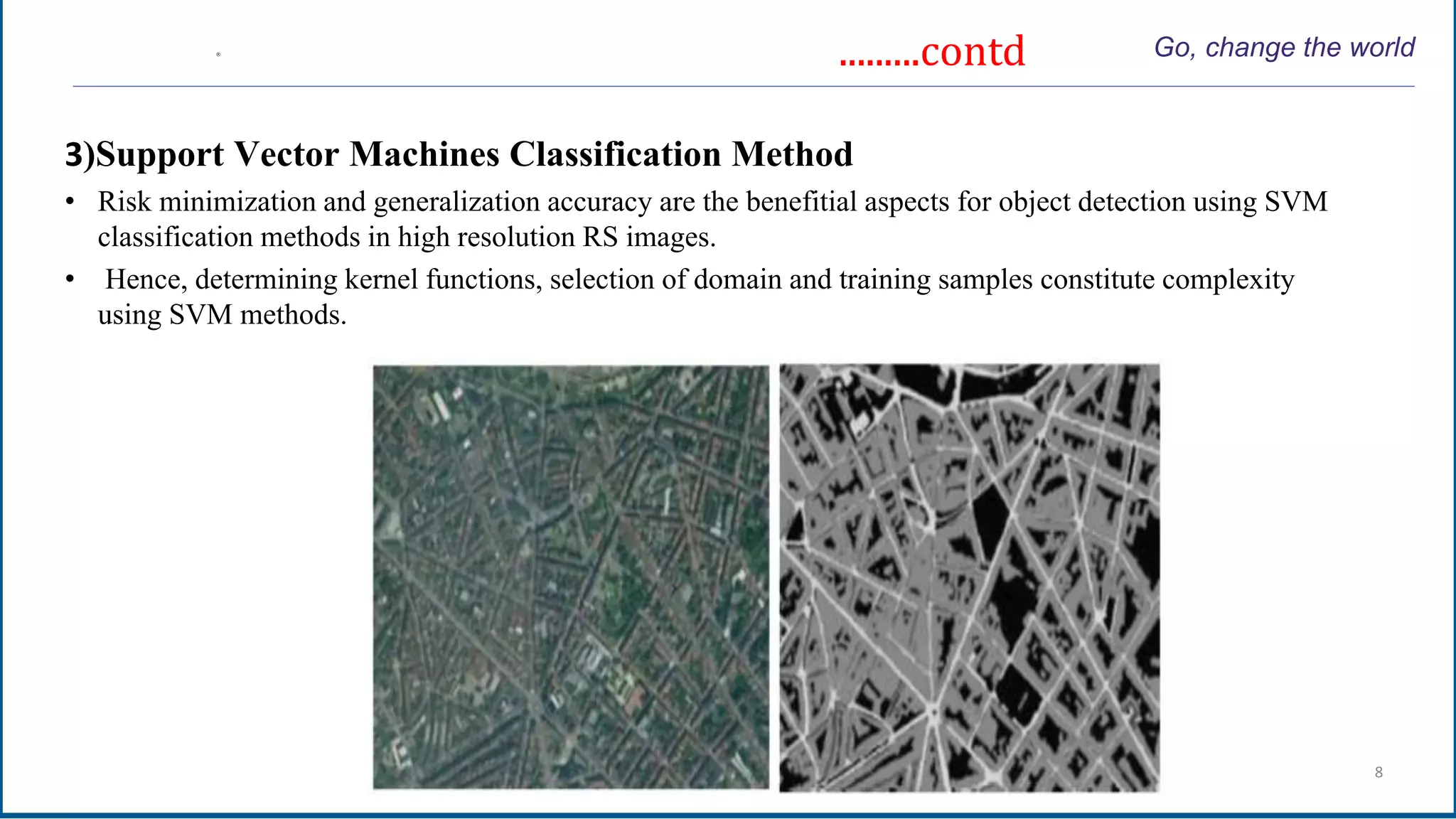
3)Support Vector Machines Classification Method
• Risk minimization and generalization accuracy are the benefitial aspects for object detection using SVM
classification methods in high resolution RS images.
• Hence, determining kernel functions, selection of domain and training samples constitute complexity
using SVM methods.
Intelligent Systems 8
..........contd Go, change the world
9
Intelligent Systems
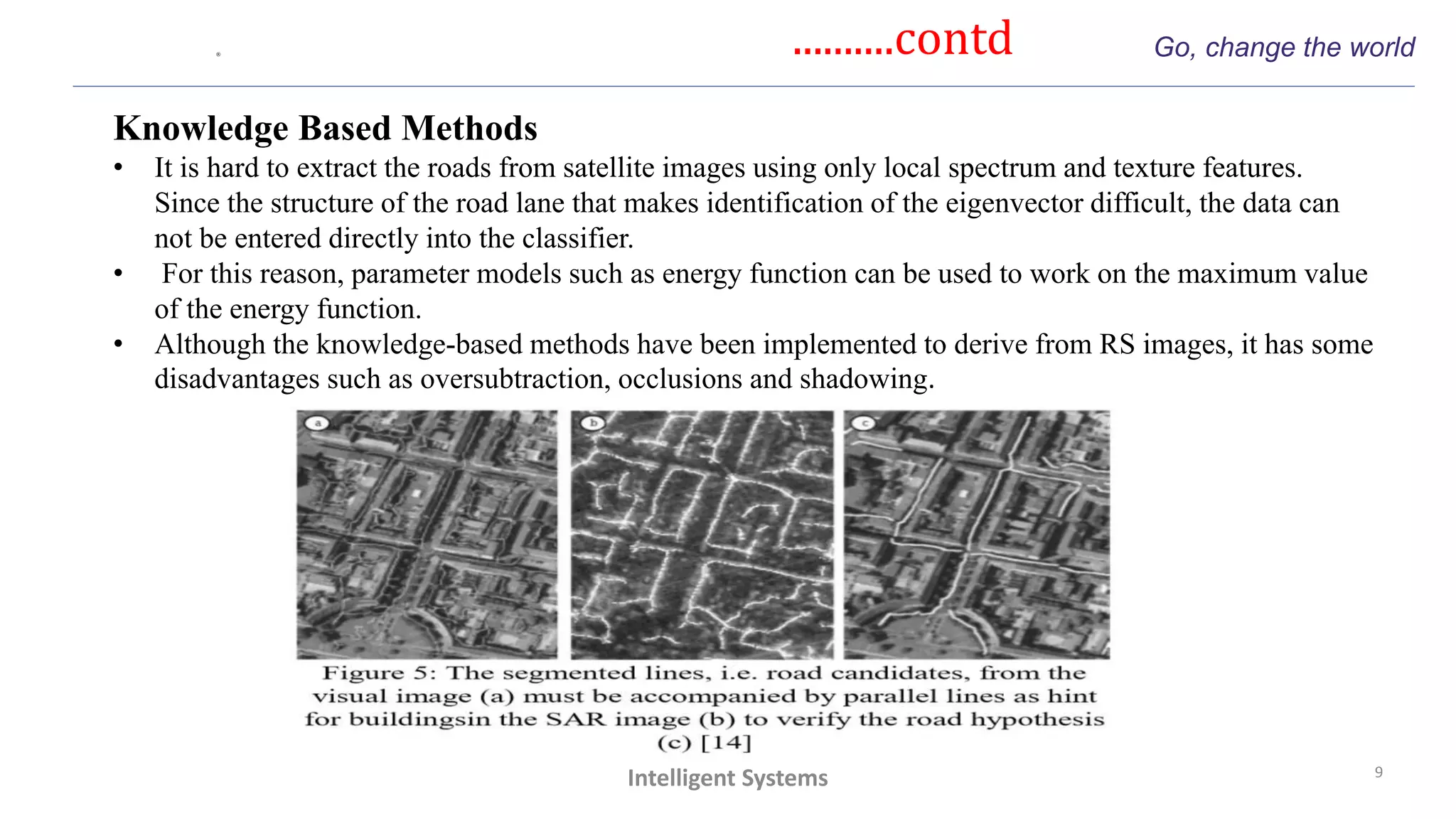
Knowledge Based Methods
• It is hard to extract the roads from satellite images using only local spectrum and texture features.
Since the structure of the road lane that makes identification of the eigenvector difficult, the data can
not be entered directly into the classifier.
• For this reason, parameter models such as energy function can be used to work on the maximum value
of the energy function.
• Although the knowledge-based methods have been implemented to derive from RS images, it has some
disadvantages such as oversubtraction, occlusions and shadowing.
..........contd Go, change the world
10
Intelligent Systems
Mathematical Morphology Methods
• Mathematical morphology takes a great deal of interest in academic areas, such as computer
vision, image processing, pattern recognition, and other topics.
• Since 1980s, researchers proposed many methods based on mathematical morphology for road
detection.
• Hence, image segmentation processes have been applied by mathematical morphology methods
combined with different convenient methods
• Mathematical morphology methods reveal certain advantages that are commonly used in deriving
from satellite images. The image segmentation outcome are considerably influenced by the
selection of the structural elements by shape and size.
• Since the components of the construction elements, it is hard to use only the mathematical
morphology method in order to obtain remarkable accuracy and significant extraction outcomes.
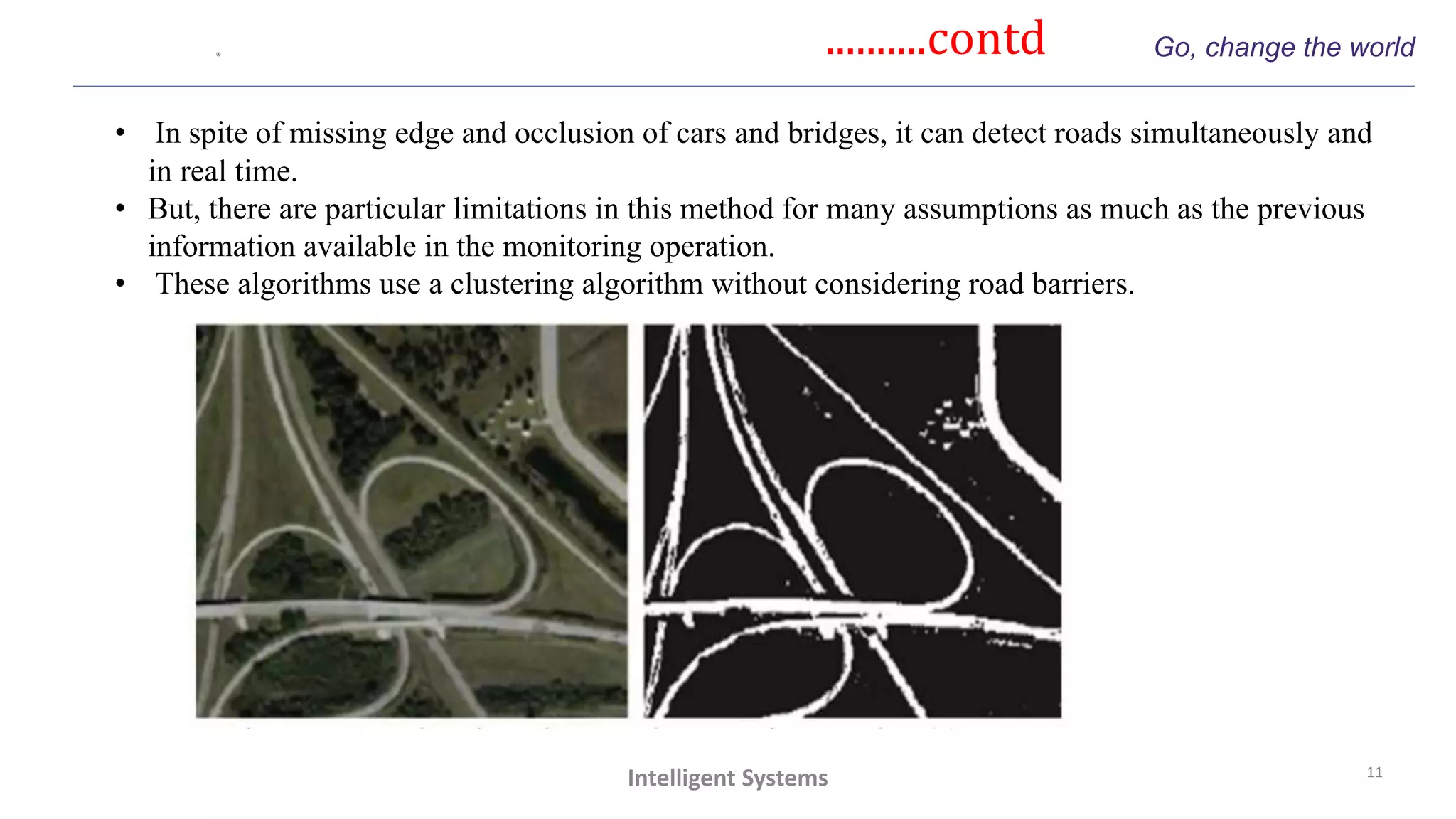
Dynamic Programming And Grouping
• Dynamic programming is a metod that implements a mathematical method to perform the decision
process. Ordinarily, the path must be given as a parameter model and expressed as a cost function.
• Dynamic programming is considered as a computation tool to specify the best path between the seed
points. An algorithm for automatic road detecting from an satellite image with dynamic programming
and Kalman filter for path monitoring is proposed.
..........contd Go, change the world
11
Intelligent Systems
• In spite of missing edge and occlusion of cars and bridges, it can detect roads simultaneously and
in real time.
• But, there are particular limitations in this method for many assumptions as much as the previous
information available in the monitoring operation.
• These algorithms use a clustering algorithm without considering road barriers.
Tools Used Go, change the world
12
Intelligent Systems
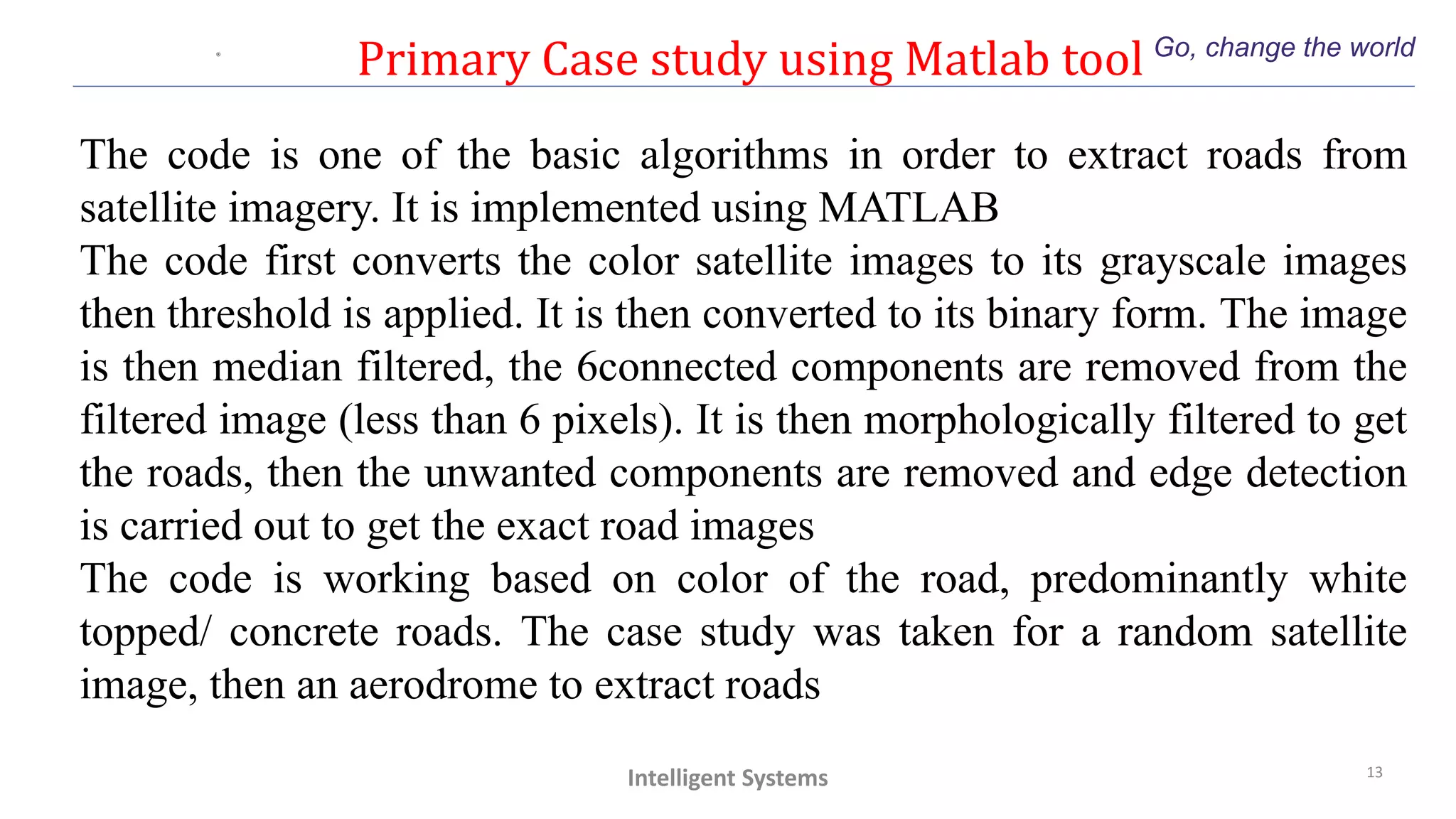
• Few common tools used for implementing image and satellite processing tools are
PHOTOGRAMMETRIC PROCESSING:
LECIA PHOTGRAMMETRIC SUITE (COMMERCIAL)
INPHO
ILWIS (OPEN SOURCE)
PROGRAMMING LANGUAGES USED FOR IMPLEMENTING IMAGE
PROCESSING
PYTHON WITH OPEN CV
MATLAB
Primary Case study using Matlab tool Go, change the world
13
Intelligent Systems
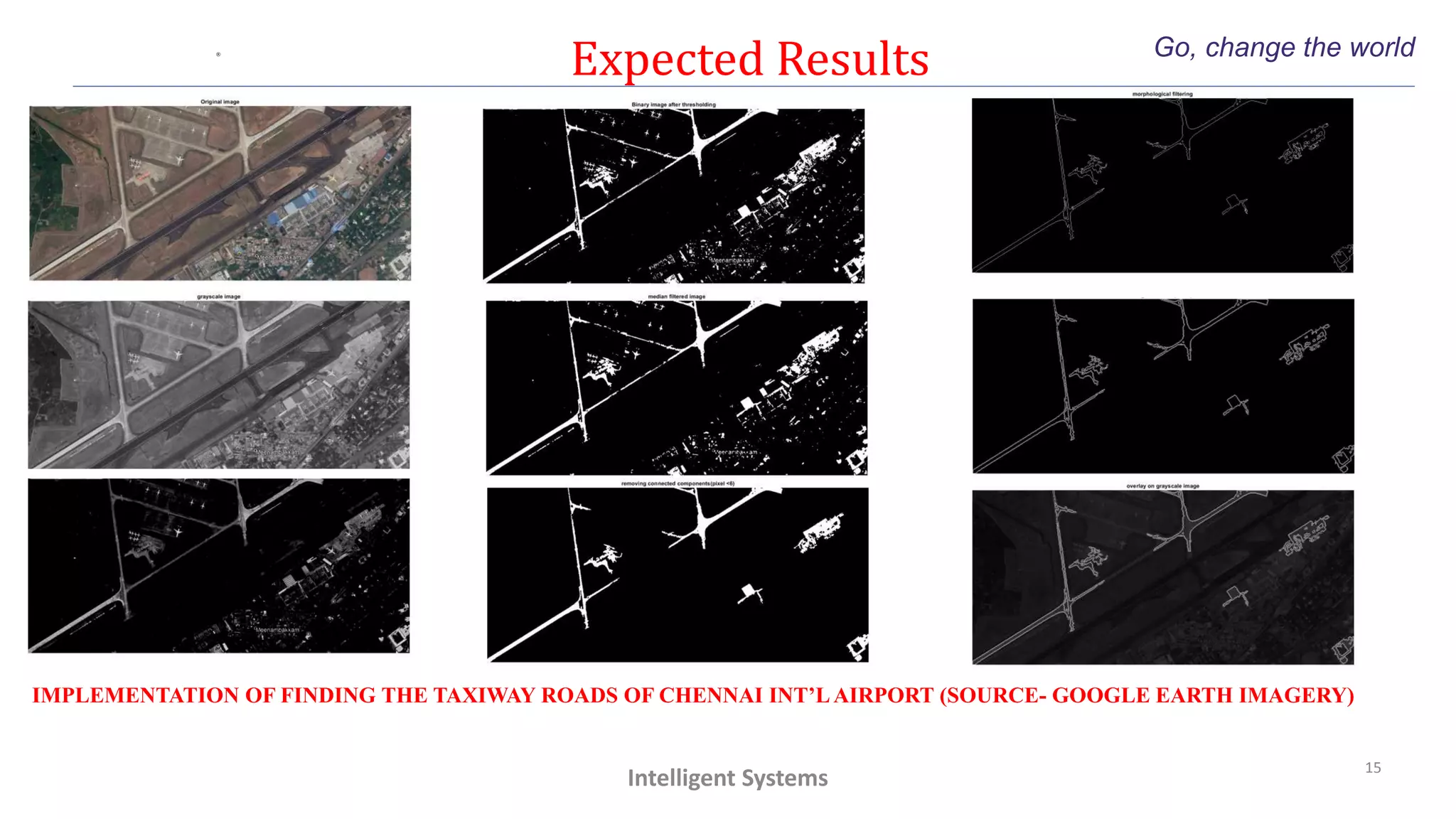
The code is one of the basic algorithms in order to extract roads from
satellite imagery. It is implemented using MATLAB
The code first converts the color satellite images to its grayscale images
then threshold is applied. It is then converted to its binary form. The image
is then median filtered, the 6connected components are removed from the
filtered image (less than 6 pixels). It is then morphologically filtered to get
the roads, then the unwanted components are removed and edge detection
is carried out to get the exact road images
The code is working based on color of the road, predominantly white
topped/ concrete roads. The case study was taken for a random satellite
image, then an aerodrome to extract roads
Code Go, change the world
14
Intelligent Systems
Clc
clear all;
close all;
addpath
'C:UsersJIOCHDesktop'
I=imread('input3.jpg');
figure;
imshow(I);
title('Original image');
%% coversion to grayscale
J=rgb2gray(I);
%whos
figure,imshow(J);
title('grayscale image');
%[a,b]=size(J);
%K = zeros(a,b);
K=imadjust(J,[0.5 0.9],[]);
%P=find(J >= 127.5);
%S=find(J <= 229.5);
%M=intersect(P,S);
%K(M)= J(M);
figure;
imshow(K);
%% threshold grayscale image and
binarize
level = graythresh(K);
I=imbinarize(K,level);
figure;
imshow(I);
title('Binary image after
thresholding');
%% median filtering
B = medfilt2(I);
figure,imshow(B);
title('median filtered image');
%% removal of unwanted
componets less than 6 pixels
im = bwareaopen(B,1200);
%Binary = imfill(im,'holes');
figure,imshow(im);
title('removing connected
components(pixel <6)');
%% morphological filtering
BW = bwmorph(im,'remove');
figure,imshow(BW);
title('morphological filtering');
%% edge detection algorithm
BW1 = edge(BW,'sobel');
figure,imshow(BW1);
title('edge detection(sobel)');
%% overlaying image
H = vision.AlphaBlender;
J = im2single(J);
BW1 = im2single(BW1);
Y = step(H,J,BW1);
figure,imshow(Y)
title('overlay on grayscale image');
%whos
%% final display
figure,imshow(J);
hold on;
contour(BW1,100);
hold off;
Expected Results Go, change the world
15
Intelligent Systems
IMPLEMENTATION OF FINDING THE TAXIWAY ROADS OF CHENNAI INT’LAIRPORT (SOURCE- GOOGLE EARTH IMAGERY)
Expected Outcome Go, change the world
16
Intelligent Systems
IMPLEMENTATION OF FINDING THE ROADS FROM A RANDOM SATELLITE IMAGE (SOURCE- GOOGLE EARTH IMAGERY)
References Go, change the world
17
Intelligent Systems
1.Road Extraction From Satellite Images, Satya Sai Venkata Raja Yalla , Indian Institute of
Information Technology Sricity, Chittoor, India.
2. D. Chaudhuri, N. K. Kushwaha, and A. Samal, “SemiAutomated Road Detection From High
Resolution Satellite Images by Directional Morphological Enhancement and Segmentation
Techniques” IEEE Journal Of Selected Topics In Applied Earth Observations And Remote
Sensing, Vol. 5, No. 5, October 2012
3. Yuilie A.L.,Coughlan J.M. 2000. Fundamntal Limits of Bayesian Inference:Orders and Phase
Transitions for Road Tracking.IEEE Transitions on Pattern Analysis and Machine
1ntel1igence. 22(2),pp.160-173.
4. Steger C.,Mayer H.,Radig B. .1997.The Role of Grouping for Road Extraction. Automatic
Extraction of Manmade Objects from Aerial and Space Images.Basel.Birkhaeuser
Verlag.pp.245-255.
5. https://github.com/rajayalla98/Road-Extraction-from-Satellite-Images
6.https://github.com/mhamas/road-extraction-from-aerial-images

TRAFFIC MANAGEMENT THROUGH SATELLITE IMAGING-- Part 3

  • 1.
    PART 3 TRAFFIC MANAGEMENTUSING SATELLITE IMAGES Go, change the world Intelligent Systems 1
  • 2.
    The project isaimed at extracting roads from high resolution satellite imagery using image processing techniques.In This way of road extraction, the database of roads and its usage can be tracked, going further this can be used to create databases for road maintenance Main Objectives Go, change the world 2 Intelligent Systems
  • 3.
    General Methodology Go,change the world 3 Intelligent Systems SASSDCCDTELLITE IMAGESS SATELLITE IMAGES GRAY SCALE IMAGE ADJUSTING THE IMAGES ACC TO THRESHOLD VALUES OF ROAD BINARY IMAGE MEDIAN FILTERING MORPHOLOGICAL OPERATIONS REMOVING SMALL OBJECTS EDGE DETECTION OVERLAY THE EXTRACTED ROAD ON ORIGINAL IMAGE
  • 4.
     Due tonumerious applications that applies diffirent road extraction methods, it is not easy to classify the techniques in detail. High number of research studies show that, most of the methods for extracting road segments consist of  knowledge based method  classification-based method  morphology-based and  dynamic programming Different techniqes used for road extactionGo, change the world 4 Intelligent Systems
  • 5.
    long with theincreasing use of unmanned aerial vehicles (UAVs), large volumes of aerial videos have been produced. It is unrealistic for humans to screen such big data and understand their contents. ..........contd Go, change the world 5 Intelligent Systems Classification-Based Methods  Methods for classification-based techniques generally use geometric properties, photometric properties, and texture properties for road sections.  The accuracy for classification is unsatisfactory due to misclassification among road and road- like objects such as roads and building structures, parking lots, area blocks and water areas.  In general, three types of supervised classification method is described as follows. 1)Artificial Neural Networks Classification Method • The first studies were based on spectral and contextual information of image pixels for direct classification of back propagation neural networks and advanced model. • The results can have good results throughout the system, even with many segments that are not roadside. • A method have been implemented with back-propagation network for road detection. • As a first step, spectral information was used for road detection. After that, as an input texture parameters for gray level co-occurrence matrix (GLCM), contrast, energy, entropy, and homogeneity were calculated obtained from the input image.
  • 6.
    dat ..........contd Go, changethe world Since, there are some disadvantages of the back propagation neural network methods such as; slow convergence, required more training samples, the performance is getting slow by increasing the number of classes, and it is easy to encounter over-fitting. Therefore, many newly enhenced neural network models is proposed to derive the road sections from RS images. 2)Deep Learning Method • Increasing the computing power with the GPU (Graphics Processing Unit) has increased the use of algorithms such as deep learning so growing data sets can be used for training. • The most commonly applied method class for analyzing visual imagery in Deep Learning is convolutional neural network (CNN). • In contrast to traditional machine learning methods where the features are chosen manually and extracted through instructed algorithms, representation learning is composed of methods that first feed pixel values or raw data into the system and allow it to automatically discover features or representations that can be used for detecting, distinguishing, and classifying patterns. Intelligent Systems 6
  • 7.
    E ..........contd Go, changethe world 7 Intelligent Systems • This method does not consist any pre-processing stage. It is based on patch-based CNN, which consists of five convolution layers and replaces fully connected layers with GAP • .Low-level features of roads and buildings (e.g., asymmetry and compactness) of adjacent regions are integrated with Convolutional Neural Network (CNN) features during the postprocessing stage to improve the performance.
  • 8.
    .........contd Go, changethe world 3)Support Vector Machines Classification Method • Risk minimization and generalization accuracy are the benefitial aspects for object detection using SVM classification methods in high resolution RS images. • Hence, determining kernel functions, selection of domain and training samples constitute complexity using SVM methods. Intelligent Systems 8
  • 9.
    ..........contd Go, changethe world 9 Intelligent Systems Knowledge Based Methods • It is hard to extract the roads from satellite images using only local spectrum and texture features. Since the structure of the road lane that makes identification of the eigenvector difficult, the data can not be entered directly into the classifier. • For this reason, parameter models such as energy function can be used to work on the maximum value of the energy function. • Although the knowledge-based methods have been implemented to derive from RS images, it has some disadvantages such as oversubtraction, occlusions and shadowing.
  • 10.
    ..........contd Go, changethe world 10 Intelligent Systems Mathematical Morphology Methods • Mathematical morphology takes a great deal of interest in academic areas, such as computer vision, image processing, pattern recognition, and other topics. • Since 1980s, researchers proposed many methods based on mathematical morphology for road detection. • Hence, image segmentation processes have been applied by mathematical morphology methods combined with different convenient methods • Mathematical morphology methods reveal certain advantages that are commonly used in deriving from satellite images. The image segmentation outcome are considerably influenced by the selection of the structural elements by shape and size. • Since the components of the construction elements, it is hard to use only the mathematical morphology method in order to obtain remarkable accuracy and significant extraction outcomes. Dynamic Programming And Grouping • Dynamic programming is a metod that implements a mathematical method to perform the decision process. Ordinarily, the path must be given as a parameter model and expressed as a cost function. • Dynamic programming is considered as a computation tool to specify the best path between the seed points. An algorithm for automatic road detecting from an satellite image with dynamic programming and Kalman filter for path monitoring is proposed.
  • 11.
    ..........contd Go, changethe world 11 Intelligent Systems • In spite of missing edge and occlusion of cars and bridges, it can detect roads simultaneously and in real time. • But, there are particular limitations in this method for many assumptions as much as the previous information available in the monitoring operation. • These algorithms use a clustering algorithm without considering road barriers.
  • 12.
    Tools Used Go,change the world 12 Intelligent Systems • Few common tools used for implementing image and satellite processing tools are PHOTOGRAMMETRIC PROCESSING: LECIA PHOTGRAMMETRIC SUITE (COMMERCIAL) INPHO ILWIS (OPEN SOURCE) PROGRAMMING LANGUAGES USED FOR IMPLEMENTING IMAGE PROCESSING PYTHON WITH OPEN CV MATLAB
  • 13.
    Primary Case studyusing Matlab tool Go, change the world 13 Intelligent Systems The code is one of the basic algorithms in order to extract roads from satellite imagery. It is implemented using MATLAB The code first converts the color satellite images to its grayscale images then threshold is applied. It is then converted to its binary form. The image is then median filtered, the 6connected components are removed from the filtered image (less than 6 pixels). It is then morphologically filtered to get the roads, then the unwanted components are removed and edge detection is carried out to get the exact road images The code is working based on color of the road, predominantly white topped/ concrete roads. The case study was taken for a random satellite image, then an aerodrome to extract roads
  • 14.
    Code Go, changethe world 14 Intelligent Systems Clc clear all; close all; addpath 'C:UsersJIOCHDesktop' I=imread('input3.jpg'); figure; imshow(I); title('Original image'); %% coversion to grayscale J=rgb2gray(I); %whos figure,imshow(J); title('grayscale image'); %[a,b]=size(J); %K = zeros(a,b); K=imadjust(J,[0.5 0.9],[]); %P=find(J >= 127.5); %S=find(J <= 229.5); %M=intersect(P,S); %K(M)= J(M); figure; imshow(K); %% threshold grayscale image and binarize level = graythresh(K); I=imbinarize(K,level); figure; imshow(I); title('Binary image after thresholding'); %% median filtering B = medfilt2(I); figure,imshow(B); title('median filtered image'); %% removal of unwanted componets less than 6 pixels im = bwareaopen(B,1200); %Binary = imfill(im,'holes'); figure,imshow(im); title('removing connected components(pixel <6)'); %% morphological filtering BW = bwmorph(im,'remove'); figure,imshow(BW); title('morphological filtering'); %% edge detection algorithm BW1 = edge(BW,'sobel'); figure,imshow(BW1); title('edge detection(sobel)'); %% overlaying image H = vision.AlphaBlender; J = im2single(J); BW1 = im2single(BW1); Y = step(H,J,BW1); figure,imshow(Y) title('overlay on grayscale image'); %whos %% final display figure,imshow(J); hold on; contour(BW1,100); hold off;
  • 15.
    Expected Results Go,change the world 15 Intelligent Systems IMPLEMENTATION OF FINDING THE TAXIWAY ROADS OF CHENNAI INT’LAIRPORT (SOURCE- GOOGLE EARTH IMAGERY)
  • 16.
    Expected Outcome Go,change the world 16 Intelligent Systems IMPLEMENTATION OF FINDING THE ROADS FROM A RANDOM SATELLITE IMAGE (SOURCE- GOOGLE EARTH IMAGERY)
  • 17.
    References Go, changethe world 17 Intelligent Systems 1.Road Extraction From Satellite Images, Satya Sai Venkata Raja Yalla , Indian Institute of Information Technology Sricity, Chittoor, India. 2. D. Chaudhuri, N. K. Kushwaha, and A. Samal, “SemiAutomated Road Detection From High Resolution Satellite Images by Directional Morphological Enhancement and Segmentation Techniques” IEEE Journal Of Selected Topics In Applied Earth Observations And Remote Sensing, Vol. 5, No. 5, October 2012 3. Yuilie A.L.,Coughlan J.M. 2000. Fundamntal Limits of Bayesian Inference:Orders and Phase Transitions for Road Tracking.IEEE Transitions on Pattern Analysis and Machine 1ntel1igence. 22(2),pp.160-173. 4. Steger C.,Mayer H.,Radig B. .1997.The Role of Grouping for Road Extraction. Automatic Extraction of Manmade Objects from Aerial and Space Images.Basel.Birkhaeuser Verlag.pp.245-255. 5. https://github.com/rajayalla98/Road-Extraction-from-Satellite-Images 6.https://github.com/mhamas/road-extraction-from-aerial-images