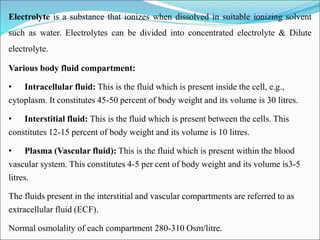
Electrolyte is a substance that ionizes when dissolved in suitable ionizing solvent
such as water. Electrolytes can be divided into concentrated electrolyte & Dilute
electrolyte.
Various body fluid compartment:
• Intracellular fluid: This is the fluid which is present inside the cell, e.g.,
cytoplasm. It constitutes 45-50 percent of body weight and its volume is 30 litres.
• Interstitial fluid: This is the fluid which is present between the cells. This
constitutes 12-15 percent of body weight and its volume is 10 litres.
• Plasma (Vascular fluid): This is the fluid which is present within the blood
vascular system. This constitutes 4-5 per cent of body weight and its volume is3-5
litres.
The fluids present in the interstitial and vascular compartments are referred to as
extracellular fluid (ECF).
Normal osmolality of each compartment 280-310 Osm/litre.
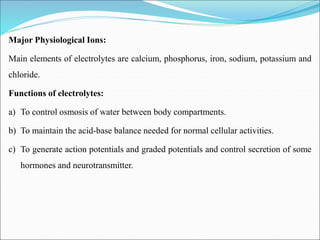
Major Physiological Ions:
Main elements of electrolytes are calcium, phosphorus, iron, sodium, potassium and
chloride.
Functions of electrolytes:
a) To control osmosis of water between body compartments.
b) To maintain the acid-base balance needed for normal cellular activities.
c) To generate action potentials and graded potentials and control secretion of some
hormones and neurotransmitter.
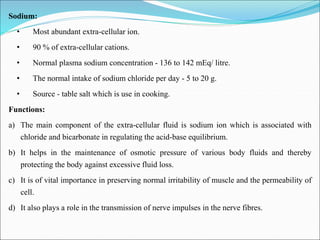
Sodium:
• Most abundant extra-cellular ion.
• 90 % of extra-cellular cations.
• Normal plasma sodium concentration - 136 to 142 mEq/ litre.
• The normal intake of sodium chloride per day - 5 to 20 g.
• Source - table salt which is use in cooking.
Functions:
a) The main component of the extra-cellular fluid is sodium ion which is associated with
chloride and bicarbonate in regulating the acid-base equilibrium.
b) It helps in the maintenance of osmotic pressure of various body fluids and thereby
protecting the body against excessive fluid loss.
c) It is of vital importance in preserving normal irritability of muscle and the permeability of
cell.
d) It also plays a role in the transmission of nerve impulses in the nerve fibres.
 Hyponatremia: It is the conditions under which serum sodium level decreases.
Causes
a) loss of sodium in excessive urination as in case of 'diabetes inspidus'.
b) Due to excessive sodium excretion in 'metabolic acidosis'.
c) Diarrhoea and vomiting
d) In Addison's disease in which there occurs a decreased excretion of hormone
aldosterone which is antidiuretic in nature.
 Hypernatremia: it is the conditions under which a serum sodium level increases.
Causes
a. Severe dehydration
b. Hyper adrenalism (cushing syndrome) .
c. Certain types of brain damage and
d. Treatment with sodium salts.
Potassium
• It is major intracellular cation present as about 23 times higher than present in extra-
cellular fluid in the human body.
• Normal Plasma K+ concentration - 3.8 to 5.0 mEq/litre.
• The daily requirement -1.5 to 4.5 g.
• Source - milk, certain vegetables, meat and whole grains.
Functions
a) The contraction of muscles (cardiac).
b) The transmission of nerve impulses.
c) Maintaining the electrolyte composition of various fluids.
d) In many biochemical activities inside the cells.
e) Helps to regulate pH by exchange against for hydrogen ion.
 Hypokalemia: It is the conditions under which serum potassium level decreases.
Causes
a) Illness in which post operative treatment includes intravenous administration of
solutions.
b) Malnutrition, gastrointestinal losses as in diarrhea and in metabolic alkalosis.
c) Use of diuretics like acetazolamide and chlorthiazide which increases the excreation of
potassium in urine.
 Hyperkalemia: It is the conditions under which a serum potassium level increases.
Causes
a. In Addisons desease there occurs an adrenal insufficiency which elevates, the serum
potassium.
Calcium
 The total calcium (Ca++) content in body - 22 g per kg body weight
 Daily requirement is about 0.8 g.
 A The normal range for total plasma calcium - 2.2-2.6 m mol/litre.
 Sources - milk, cheese, green vegetables, eggs and some fish.
The greater amount of calcium are needed in children and during pregnancy and lactation.
Functions
a) It is known to get associated with vitamin D and phosphorus in hardening of bones.
b) It involves in coagulation of blood and in impulse propagation and in muscles contraction.
c) It is needed to release acetylcholine from preganglionic nerve terminals.
Hypercalcemia: It is the condition in which serum calcium level increases.
It can be caused due to:
a. hyperparathyroidism
b. hypervitaminosis D
c. some bone neoplastic disease.
Symptoms include fatigue, muscle weakness, constipation, anorexia and cardiac irregularities.
If the conditions persists, Ca may be deposited in kidney and blood vessels.
Hypocalcemia: It is the condition in which serum calcium level decreases.
It can be caused due to:
a. hypoparathyroidism
b. Vitamin D deficiency
c. osteoblastic metastasis
d. acute pancreatitis
e. hyperphosphatemia
Magnesium
 It is regarded as the second most common intra-cellular electrolyte and the body’s fourth
most abundant cation.
 The adult human body contains 25 g of magnesium, about 54 per cent being present in the
bones along with phosphorus, about 45 per cent is in intra-cellular fluid, and about 1 per
cent is in extra-cellular fluid.
The daily requirement - 350 mg.
Sources - nuts, whole grains and sea foods.
Functions
a) Mg2+ ions are able to activate enzymes which are involved in carbohydrates and protein
metabolism.
b) It is also important in neural transmission, myocardial function and neuromuscular
activity.
c) It is needed for the operation of Na+-K+- ATPase pump system.
Hypermagnesaemia: It is the condition in which serum magnesium level increases.
Causes
a. Renal failure
b. Excess intake of antacids and laxatives
c. Lithium therapy
d. Hypothyroidism
e. Addison’s disease
f. Depression
Symptoms include nausea, flushing, headache, lethargy, drowsiness and diminished deep
tendon refluxes.
Hypomagnesaemia: It is the condition in which serum magnesium level decreases.
Causes
Related to the decrease magnesium intake
a. Starvation
b. Alcohol dependence
c. Total parenteral nutrition
Chloride
 The total chloride ion present in the body -50 m Eq per kg body weight
 Daily body requirement - 5 to 10 g as sodium chloride.
 Source - salt which is used in cooking.
 It occurs in all body secretions.
Functions
a) Chloride ion along with sodium ion is able to maintain osmotic balance between different
body fluid.
b) Chloride ion is able to maintain the charge balance between the body fluids, i.e., infra-
cellular and extra-cellular as they can pass through all membranes.
c) Chloride ions take part in formation of gastric, hydrochloric acid and also in maintenance
of acid-base balance.
Hyperchloremia: It is the condition in which serum chloride level increases.
Causes
a. Dehydration
b. Decreased renal blood flow found in congestive heart failure
c. Severe renal damage
d. Excessive chloride intake
Symptoms include fluid retention, high blood pressure, muscle weakness, spasms or twitches,
irregular heart rate, confusion, difficulty concentrating, personality changes, numbness or
tingling, seizures and convulsions.
Hypochloremia: It is the condition in which serum chloride level decreases.
Causes
a. salt-losing nephritis (inflammation of the kidney) associated with chronic pyelonephritis
(inflammation of the kidney and its pelvis) leading to a lack of tubular reabsorption of
chloride,
b. Metabolic acidosis such as found in diabetes mellitus and renal failure, causing either
excessive production or diminished excretion of acids leading to the replacement of
chloride by acetoacetate and phosphate
c. Prolonged vomiting with loss of chloride as gastric hydrochloric acid.
Symptoms include fluid loss, dehydration, weakness or fatigue, difficulty breathing, diarrhea
or vomiting caused by fluid loss.
Phosphate
• The phosphate ions such as H2PO4
-, HPO4
2- and PO4
3- are the main anions of the infra-
cellular compartment. Among these ions, HPO4
2- is found to be the most prevalent form
at the physiological pH 7.4.
• Normal plasma - 1.7 to 2.6 mEq/litre. 4/5 of the total body phosphate is present in teeth
and bones along with calcium.
Functions
a) It plays a vital role in buffering systems of the body.
b) Serum inorganic phosphate plays an important regulatory role in erythrocyte-glucose
metabolism.
The main dietary sources of phosphorus are milk, milk products, wholegrains legumes,
nuts, etc.
Hyperphosphatemia: It is the condition in which serum phosphate level increases.
It can be caused due to:
a. Renal failure
b. Hypoparathyroidism
Hyperphosphatemia does not usually have apparent symptoms. It is more likely that the
symptoms of an underlying disease that can cause high phosphate levels, such as
uncontrolled diabetes, are spotted first.
Hypophosphatemia: It is the condition in which serum phosphate level decreases.
It can be caused due to:
a. Vitamin D deficiency (rickets)
b. decreased intestinal calcium absorption
c. hyperparathyroidism
d. long term aluminium hydroxide gel antacid therapy.
Symptoms include muscle weakness, fatigue, bone pain, bone fractures, appetite loss,
irritability, numbness, confusion, slowed growth and shorter than normal height in children
and tooth decay or late baby teeth.
ELECTROLYTE USE D IN REPLCEMENT THERAPY
In a healthy person, the electrolyte concentration is maintained constant to
reestablish osmotic equilibrium.
However, replacement therapy is to be used when the body itself is unable to correct
an electrolyte imbalance because of the change in composition of the fluid. Certain
such conditions are:
a) Dehydration: It is the stage in which the water volume, but not usually the
amount of solute is low in all three compartment.
b) Hypovolemia: It is a stage in which the intravascular volume is low
c) Edema: It is the condition in which fluid get accumulated in the interstitial space
because of low osmotic pressure. The volume of third space gradually expands at
a expense of vascular space.
Types of solutions of electrolytes :
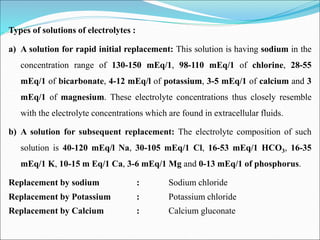
a) A solution for rapid initial replacement: This solution is having sodium in the
concentration range of 130-150 mEq/1, 98-110 mEq/1 of chlorine, 28-55
mEq/1 of bicarbonate, 4-12 mEq/l of potassium, 3-5 mEq/1 of calcium and 3
mEq/1 of magnesium. These electrolyte concentrations thus closely resemble
with the electrolyte concentrations which are found in extracellular fluids.
b) A solution for subsequent replacement: The electrolyte composition of such
solution is 40-120 mEq/l Na, 30-105 mEq/1 Cl, 16-53 mEq/1 HCO3, 16-35
mEq/1 K, 10-15 m Eq/1 Ca, 3-6 mEq/1 Mg and 0-13 mEq/1 of phosphorus.
Replacement by sodium : Sodium chloride
Replacement by Potassium : Potassium chloride
Replacement by Calcium : Calcium gluconate
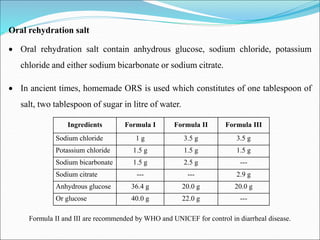
Oral rehydration salt
 Oral rehydration salt contain anhydrous glucose, sodium chloride, potassium
chloride and either sodium bicarbonate or sodium citrate.
 In ancient times, homemade ORS is used which constitutes of one tablespoon of
salt, two tablespoon of sugar in litre of water.
Ingredients Formula I Formula II Formula III
Sodium chloride 1 g 3.5 g 3.5 g
Potassium chloride 1.5 g 1.5 g 1.5 g
Sodium bicarbonate 1.5 g 2.5 g ---
Sodium citrate --- --- 2.9 g
Anhydrous glucose 36.4 g 20.0 g 20.0 g
Or glucose 40.0 g 22.0 g ---
Formula II and III are recommended by WHO and UNICEF for control in diarrheal disease.
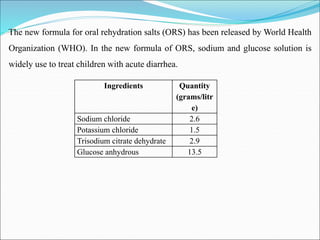
The new formula for oral rehydration salts (ORS) has been released by World Health
Organization (WHO). In the new formula of ORS, sodium and glucose solution is
widely use to treat children with acute diarrhea.
Ingredients Quantity
(grams/litr
e)
Sodium chloride 2.6
Potassium chloride 1.5
Trisodium citrate dehydrate 2.9
Glucose anhydrous 13.5
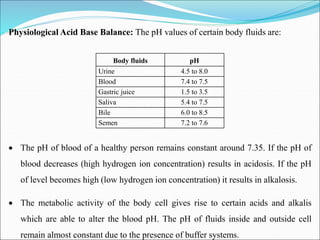
Physiological Acid Base Balance: The pH values of certain body fluids are:
 The pH of blood of a healthy person remains constant around 7.35. If the pH of
blood decreases (high hydrogen ion concentration) results in acidosis. If the pH
of level becomes high (low hydrogen ion concentration) it results in alkalosis.
 The metabolic activity of the body cell gives rise to certain acids and alkalis
which are able to alter the blood pH. The pH of fluids inside and outside cell
remain almost constant due to the presence of buffer systems.
Body fluids pH
Urine 4.5 to 8.0
Blood 7.4 to 7.5
Gastric juice 1.5 to 3.5
Saliva 5.4 to 7.5
Bile 6.0 to 8.5
Semen 7.2 to 7.6
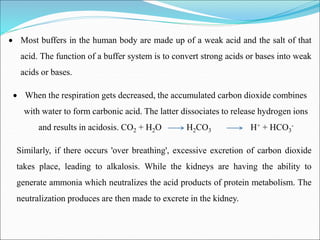
 Most buffers in the human body are made up of a weak acid and the salt of that
acid. The function of a buffer system is to convert strong acids or bases into weak
acids or bases.
 When the respiration gets decreased, the accumulated carbon dioxide combines
with water to form carbonic acid. The latter dissociates to release hydrogen ions
and results in acidosis. CO2 + H2O H2CO3 H+ + HCO3
-
Similarly, if there occurs 'over breathing', excessive excretion of carbon dioxide
takes place, leading to alkalosis. While the kidneys are having the ability to
generate ammonia which neutralizes the acid products of protein metabolism. The
neutralization produces are then made to excrete in the kidney.
Buffer systems:
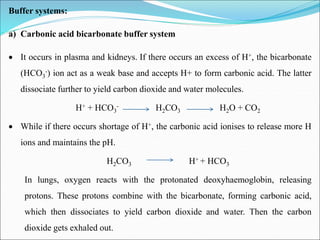
a) Carbonic acid bicarbonate buffer system
 It occurs in plasma and kidneys. If there occurs an excess of H+, the bicarbonate
(HCO3
-) ion act as a weak base and accepts H+ to form carbonic acid. The latter
dissociate further to yield carbon dioxide and water molecules.
H+ + HCO3
- H2CO3 H2O + CO2
 While if there occurs shortage of H+, the carbonic acid ionises to release more H
ions and maintains the pH.
H2CO3 H+ + HCO3
In lungs, oxygen reacts with the protonated deoxyhaemoglobin, releasing
protons. These protons combine with the bicarbonate, forming carbonic acid,
which then dissociates to yield carbon dioxide and water. Then the carbon
dioxide gets exhaled out.
a) Phosphate buffer system:
 The phosphate buffer system is considered to be an important regulator of pH in
the cytosol. This system occurs in the cells and kidneys. The system consists of
mnonohydrogen phosphate/dihydrogen phosphate (HPO4
2-/H2PO4-) anions.
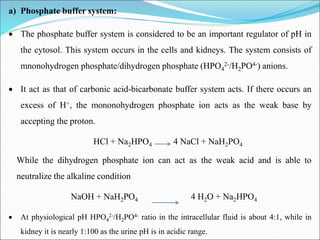
 It act as that of carbonic acid-bicarbonate buffer system acts. If there occurs an
excess of H+, the mononohydrogen phosphate ion acts as the weak base by
accepting the proton.
HCl + Na2HPO4 4 NaCl + NaH2PO4
While the dihydrogen phosphate ion can act as the weak acid and is able to
neutralize the alkaline condition
NaOH + NaH2PO4 4 H2O + Na2HPO4
 At physiological pH HPO4
2-/H2PO4- ratio in the intracellular fluid is about 4:1, while in
kidney it is nearly 1:100 as the urine pH is in acidic range.
a) Protein (Haemoglobin) buffer system:
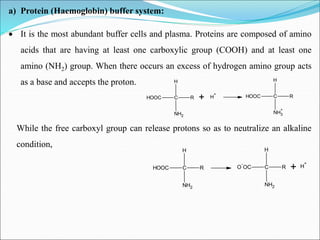
 It is the most abundant buffer cells and plasma. Proteins are composed of amino
acids that are having at least one carboxylic group (COOH) and at least one
amino (NH2) group. When there occurs an excess of hydrogen amino group acts
as a base and accepts the proton.
While the free carboxyl group can release protons so as to neutralize an alkaline
condition,
R
C
H
NH2
HOOC + H
+
R
C
H
NH3
+
HOOC
R
C
H
NH2
HOOC R
C
H
NH2
O
-
OC + H
+
 Thus, protein is able to serve both the functions of acid and base components of a
buffer system because of its amphoteric nature. At physiological pH, histidines
and cysteine are considered to be the most important amino acid buffers. As
haemoglobin, a protein, is composed of 37 histidines in its structure, it acts as an
effective physiological buffer.
 When carbon dioxide enters the erythrocytes from body cells, it rapidly combines
with water to form carbonic acid by involving the carbonic anhydrase enzyme. If
there occurs a shortage of H+ in erythrocytes, the carbonic acid gets dissociated
into H+ and HCO3
- ions.
 The bicarbonate anion then diffuses out of the erythrocytes. The bicarbonate in
plasma, along with the plasma carbonic acid behaves as an efficient buffer
system. H2CO3 H+ + HCO3
 At the same time, the oxyhaemoglobin is able to release its oxygen to the body
cells to become reduced haemoglobin (Hb-). As Hb- carries a negative charge, it
accepts a proton and tends to decrease the excess of protons (acidic condition) in
erythrocytes.
 In lungs, oxygen combing with the protonated deoxyhaemoglobin (reduced
protonated haemoglobin), releasing the protons. The latter undergoes
combination with the HCO3
+, forming carbonic acid, which then dissociates to
yield carbon dioxide and water. The carbon dioxide is then exhaled out.

Major intra extracellular electrolyes

  • 2.
    Electrolyte is asubstance that ionizes when dissolved in suitable ionizing solvent such as water. Electrolytes can be divided into concentrated electrolyte & Dilute electrolyte. Various body fluid compartment: • Intracellular fluid: This is the fluid which is present inside the cell, e.g., cytoplasm. It constitutes 45-50 percent of body weight and its volume is 30 litres. • Interstitial fluid: This is the fluid which is present between the cells. This constitutes 12-15 percent of body weight and its volume is 10 litres. • Plasma (Vascular fluid): This is the fluid which is present within the blood vascular system. This constitutes 4-5 per cent of body weight and its volume is3-5 litres. The fluids present in the interstitial and vascular compartments are referred to as extracellular fluid (ECF). Normal osmolality of each compartment 280-310 Osm/litre.
  • 3.
    Major Physiological Ions: Mainelements of electrolytes are calcium, phosphorus, iron, sodium, potassium and chloride. Functions of electrolytes: a) To control osmosis of water between body compartments. b) To maintain the acid-base balance needed for normal cellular activities. c) To generate action potentials and graded potentials and control secretion of some hormones and neurotransmitter.
  • 4.
    Sodium: • Most abundantextra-cellular ion. • 90 % of extra-cellular cations. • Normal plasma sodium concentration - 136 to 142 mEq/ litre. • The normal intake of sodium chloride per day - 5 to 20 g. • Source - table salt which is use in cooking. Functions: a) The main component of the extra-cellular fluid is sodium ion which is associated with chloride and bicarbonate in regulating the acid-base equilibrium. b) It helps in the maintenance of osmotic pressure of various body fluids and thereby protecting the body against excessive fluid loss. c) It is of vital importance in preserving normal irritability of muscle and the permeability of cell. d) It also plays a role in the transmission of nerve impulses in the nerve fibres.
  • 5.
     Hyponatremia: Itis the conditions under which serum sodium level decreases. Causes a) loss of sodium in excessive urination as in case of 'diabetes inspidus'. b) Due to excessive sodium excretion in 'metabolic acidosis'. c) Diarrhoea and vomiting d) In Addison's disease in which there occurs a decreased excretion of hormone aldosterone which is antidiuretic in nature.  Hypernatremia: it is the conditions under which a serum sodium level increases. Causes a. Severe dehydration b. Hyper adrenalism (cushing syndrome) . c. Certain types of brain damage and d. Treatment with sodium salts.
  • 6.
    Potassium • It ismajor intracellular cation present as about 23 times higher than present in extra- cellular fluid in the human body. • Normal Plasma K+ concentration - 3.8 to 5.0 mEq/litre. • The daily requirement -1.5 to 4.5 g. • Source - milk, certain vegetables, meat and whole grains. Functions a) The contraction of muscles (cardiac). b) The transmission of nerve impulses. c) Maintaining the electrolyte composition of various fluids. d) In many biochemical activities inside the cells. e) Helps to regulate pH by exchange against for hydrogen ion.
  • 7.
     Hypokalemia: Itis the conditions under which serum potassium level decreases. Causes a) Illness in which post operative treatment includes intravenous administration of solutions. b) Malnutrition, gastrointestinal losses as in diarrhea and in metabolic alkalosis. c) Use of diuretics like acetazolamide and chlorthiazide which increases the excreation of potassium in urine.  Hyperkalemia: It is the conditions under which a serum potassium level increases. Causes a. In Addisons desease there occurs an adrenal insufficiency which elevates, the serum potassium.
  • 8.
    Calcium  The totalcalcium (Ca++) content in body - 22 g per kg body weight  Daily requirement is about 0.8 g.  A The normal range for total plasma calcium - 2.2-2.6 m mol/litre.  Sources - milk, cheese, green vegetables, eggs and some fish. The greater amount of calcium are needed in children and during pregnancy and lactation. Functions a) It is known to get associated with vitamin D and phosphorus in hardening of bones. b) It involves in coagulation of blood and in impulse propagation and in muscles contraction. c) It is needed to release acetylcholine from preganglionic nerve terminals.
  • 9.
    Hypercalcemia: It isthe condition in which serum calcium level increases. It can be caused due to: a. hyperparathyroidism b. hypervitaminosis D c. some bone neoplastic disease. Symptoms include fatigue, muscle weakness, constipation, anorexia and cardiac irregularities. If the conditions persists, Ca may be deposited in kidney and blood vessels. Hypocalcemia: It is the condition in which serum calcium level decreases. It can be caused due to: a. hypoparathyroidism b. Vitamin D deficiency c. osteoblastic metastasis d. acute pancreatitis e. hyperphosphatemia
  • 10.
    Magnesium  It isregarded as the second most common intra-cellular electrolyte and the body’s fourth most abundant cation.  The adult human body contains 25 g of magnesium, about 54 per cent being present in the bones along with phosphorus, about 45 per cent is in intra-cellular fluid, and about 1 per cent is in extra-cellular fluid. The daily requirement - 350 mg. Sources - nuts, whole grains and sea foods. Functions a) Mg2+ ions are able to activate enzymes which are involved in carbohydrates and protein metabolism. b) It is also important in neural transmission, myocardial function and neuromuscular activity. c) It is needed for the operation of Na+-K+- ATPase pump system.
  • 11.
    Hypermagnesaemia: It isthe condition in which serum magnesium level increases. Causes a. Renal failure b. Excess intake of antacids and laxatives c. Lithium therapy d. Hypothyroidism e. Addison’s disease f. Depression Symptoms include nausea, flushing, headache, lethargy, drowsiness and diminished deep tendon refluxes. Hypomagnesaemia: It is the condition in which serum magnesium level decreases. Causes Related to the decrease magnesium intake a. Starvation b. Alcohol dependence c. Total parenteral nutrition
  • 12.
    Chloride  The totalchloride ion present in the body -50 m Eq per kg body weight  Daily body requirement - 5 to 10 g as sodium chloride.  Source - salt which is used in cooking.  It occurs in all body secretions. Functions a) Chloride ion along with sodium ion is able to maintain osmotic balance between different body fluid. b) Chloride ion is able to maintain the charge balance between the body fluids, i.e., infra- cellular and extra-cellular as they can pass through all membranes. c) Chloride ions take part in formation of gastric, hydrochloric acid and also in maintenance of acid-base balance.
  • 13.
    Hyperchloremia: It isthe condition in which serum chloride level increases. Causes a. Dehydration b. Decreased renal blood flow found in congestive heart failure c. Severe renal damage d. Excessive chloride intake Symptoms include fluid retention, high blood pressure, muscle weakness, spasms or twitches, irregular heart rate, confusion, difficulty concentrating, personality changes, numbness or tingling, seizures and convulsions. Hypochloremia: It is the condition in which serum chloride level decreases. Causes a. salt-losing nephritis (inflammation of the kidney) associated with chronic pyelonephritis (inflammation of the kidney and its pelvis) leading to a lack of tubular reabsorption of chloride, b. Metabolic acidosis such as found in diabetes mellitus and renal failure, causing either excessive production or diminished excretion of acids leading to the replacement of chloride by acetoacetate and phosphate c. Prolonged vomiting with loss of chloride as gastric hydrochloric acid. Symptoms include fluid loss, dehydration, weakness or fatigue, difficulty breathing, diarrhea or vomiting caused by fluid loss.
  • 14.
    Phosphate • The phosphateions such as H2PO4 -, HPO4 2- and PO4 3- are the main anions of the infra- cellular compartment. Among these ions, HPO4 2- is found to be the most prevalent form at the physiological pH 7.4. • Normal plasma - 1.7 to 2.6 mEq/litre. 4/5 of the total body phosphate is present in teeth and bones along with calcium. Functions a) It plays a vital role in buffering systems of the body. b) Serum inorganic phosphate plays an important regulatory role in erythrocyte-glucose metabolism. The main dietary sources of phosphorus are milk, milk products, wholegrains legumes, nuts, etc.
  • 15.
    Hyperphosphatemia: It isthe condition in which serum phosphate level increases. It can be caused due to: a. Renal failure b. Hypoparathyroidism Hyperphosphatemia does not usually have apparent symptoms. It is more likely that the symptoms of an underlying disease that can cause high phosphate levels, such as uncontrolled diabetes, are spotted first. Hypophosphatemia: It is the condition in which serum phosphate level decreases. It can be caused due to: a. Vitamin D deficiency (rickets) b. decreased intestinal calcium absorption c. hyperparathyroidism d. long term aluminium hydroxide gel antacid therapy. Symptoms include muscle weakness, fatigue, bone pain, bone fractures, appetite loss, irritability, numbness, confusion, slowed growth and shorter than normal height in children and tooth decay or late baby teeth.
  • 16.
    ELECTROLYTE USE DIN REPLCEMENT THERAPY In a healthy person, the electrolyte concentration is maintained constant to reestablish osmotic equilibrium. However, replacement therapy is to be used when the body itself is unable to correct an electrolyte imbalance because of the change in composition of the fluid. Certain such conditions are: a) Dehydration: It is the stage in which the water volume, but not usually the amount of solute is low in all three compartment. b) Hypovolemia: It is a stage in which the intravascular volume is low c) Edema: It is the condition in which fluid get accumulated in the interstitial space because of low osmotic pressure. The volume of third space gradually expands at a expense of vascular space.
  • 17.
    Types of solutionsof electrolytes : a) A solution for rapid initial replacement: This solution is having sodium in the concentration range of 130-150 mEq/1, 98-110 mEq/1 of chlorine, 28-55 mEq/1 of bicarbonate, 4-12 mEq/l of potassium, 3-5 mEq/1 of calcium and 3 mEq/1 of magnesium. These electrolyte concentrations thus closely resemble with the electrolyte concentrations which are found in extracellular fluids. b) A solution for subsequent replacement: The electrolyte composition of such solution is 40-120 mEq/l Na, 30-105 mEq/1 Cl, 16-53 mEq/1 HCO3, 16-35 mEq/1 K, 10-15 m Eq/1 Ca, 3-6 mEq/1 Mg and 0-13 mEq/1 of phosphorus. Replacement by sodium : Sodium chloride Replacement by Potassium : Potassium chloride Replacement by Calcium : Calcium gluconate
  • 18.
    Oral rehydration salt Oral rehydration salt contain anhydrous glucose, sodium chloride, potassium chloride and either sodium bicarbonate or sodium citrate.  In ancient times, homemade ORS is used which constitutes of one tablespoon of salt, two tablespoon of sugar in litre of water. Ingredients Formula I Formula II Formula III Sodium chloride 1 g 3.5 g 3.5 g Potassium chloride 1.5 g 1.5 g 1.5 g Sodium bicarbonate 1.5 g 2.5 g --- Sodium citrate --- --- 2.9 g Anhydrous glucose 36.4 g 20.0 g 20.0 g Or glucose 40.0 g 22.0 g --- Formula II and III are recommended by WHO and UNICEF for control in diarrheal disease.
  • 19.
    The new formulafor oral rehydration salts (ORS) has been released by World Health Organization (WHO). In the new formula of ORS, sodium and glucose solution is widely use to treat children with acute diarrhea. Ingredients Quantity (grams/litr e) Sodium chloride 2.6 Potassium chloride 1.5 Trisodium citrate dehydrate 2.9 Glucose anhydrous 13.5
  • 20.
    Physiological Acid BaseBalance: The pH values of certain body fluids are:  The pH of blood of a healthy person remains constant around 7.35. If the pH of blood decreases (high hydrogen ion concentration) results in acidosis. If the pH of level becomes high (low hydrogen ion concentration) it results in alkalosis.  The metabolic activity of the body cell gives rise to certain acids and alkalis which are able to alter the blood pH. The pH of fluids inside and outside cell remain almost constant due to the presence of buffer systems. Body fluids pH Urine 4.5 to 8.0 Blood 7.4 to 7.5 Gastric juice 1.5 to 3.5 Saliva 5.4 to 7.5 Bile 6.0 to 8.5 Semen 7.2 to 7.6
  • 21.
     Most buffersin the human body are made up of a weak acid and the salt of that acid. The function of a buffer system is to convert strong acids or bases into weak acids or bases.  When the respiration gets decreased, the accumulated carbon dioxide combines with water to form carbonic acid. The latter dissociates to release hydrogen ions and results in acidosis. CO2 + H2O H2CO3 H+ + HCO3 - Similarly, if there occurs 'over breathing', excessive excretion of carbon dioxide takes place, leading to alkalosis. While the kidneys are having the ability to generate ammonia which neutralizes the acid products of protein metabolism. The neutralization produces are then made to excrete in the kidney.
  • 22.
    Buffer systems: a) Carbonicacid bicarbonate buffer system  It occurs in plasma and kidneys. If there occurs an excess of H+, the bicarbonate (HCO3 -) ion act as a weak base and accepts H+ to form carbonic acid. The latter dissociate further to yield carbon dioxide and water molecules. H+ + HCO3 - H2CO3 H2O + CO2  While if there occurs shortage of H+, the carbonic acid ionises to release more H ions and maintains the pH. H2CO3 H+ + HCO3 In lungs, oxygen reacts with the protonated deoxyhaemoglobin, releasing protons. These protons combine with the bicarbonate, forming carbonic acid, which then dissociates to yield carbon dioxide and water. Then the carbon dioxide gets exhaled out.
  • 23.
    a) Phosphate buffersystem:  The phosphate buffer system is considered to be an important regulator of pH in the cytosol. This system occurs in the cells and kidneys. The system consists of mnonohydrogen phosphate/dihydrogen phosphate (HPO4 2-/H2PO4-) anions.  It act as that of carbonic acid-bicarbonate buffer system acts. If there occurs an excess of H+, the mononohydrogen phosphate ion acts as the weak base by accepting the proton. HCl + Na2HPO4 4 NaCl + NaH2PO4 While the dihydrogen phosphate ion can act as the weak acid and is able to neutralize the alkaline condition NaOH + NaH2PO4 4 H2O + Na2HPO4  At physiological pH HPO4 2-/H2PO4- ratio in the intracellular fluid is about 4:1, while in kidney it is nearly 1:100 as the urine pH is in acidic range.
  • 24.
    a) Protein (Haemoglobin)buffer system:  It is the most abundant buffer cells and plasma. Proteins are composed of amino acids that are having at least one carboxylic group (COOH) and at least one amino (NH2) group. When there occurs an excess of hydrogen amino group acts as a base and accepts the proton. While the free carboxyl group can release protons so as to neutralize an alkaline condition, R C H NH2 HOOC + H + R C H NH3 + HOOC R C H NH2 HOOC R C H NH2 O - OC + H +
  • 25.
     Thus, proteinis able to serve both the functions of acid and base components of a buffer system because of its amphoteric nature. At physiological pH, histidines and cysteine are considered to be the most important amino acid buffers. As haemoglobin, a protein, is composed of 37 histidines in its structure, it acts as an effective physiological buffer.  When carbon dioxide enters the erythrocytes from body cells, it rapidly combines with water to form carbonic acid by involving the carbonic anhydrase enzyme. If there occurs a shortage of H+ in erythrocytes, the carbonic acid gets dissociated into H+ and HCO3 - ions.  The bicarbonate anion then diffuses out of the erythrocytes. The bicarbonate in plasma, along with the plasma carbonic acid behaves as an efficient buffer system. H2CO3 H+ + HCO3
  • 26.
     At thesame time, the oxyhaemoglobin is able to release its oxygen to the body cells to become reduced haemoglobin (Hb-). As Hb- carries a negative charge, it accepts a proton and tends to decrease the excess of protons (acidic condition) in erythrocytes.  In lungs, oxygen combing with the protonated deoxyhaemoglobin (reduced protonated haemoglobin), releasing the protons. The latter undergoes combination with the HCO3 +, forming carbonic acid, which then dissociates to yield carbon dioxide and water. The carbon dioxide is then exhaled out.