e world forum 2011 NATIONAL  GEOSPATIAL POLICIES: FOR PUBLIC SAFETY, SECURITY,DISASTER MANAGEMENT  CHALLENGES &  WAY FORWARD By MAJ GEN RC PADHI Integrated Hqrs of Min of Defence (Army)
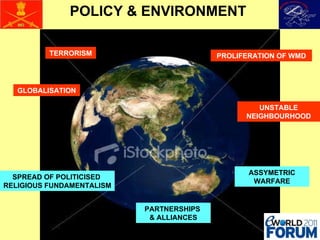
POLICY & ENVIRONMENT  PARTNERSHIPS  & ALLIANCES ASSYMETRIC WARFARE PROLIFERATION OF WMD GLOBALISATION TERRORISM UNSTABLE NEIGHBOURHOOD SPREAD OF POLITICISED  RELIGIOUS FUNDAMENTALISM MO
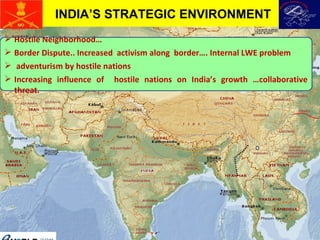
Hostile Neighborhood… Border Dispute.. Increased  activism along  border…. Internal LWE problem adventurism by hostile nations Increasing influence of  hostile nations on India’s growth …collaborative threat.  INDIA’S STRATEGIC ENVIRONMENT
NATIONAL MAP POLICY (NMP) CCS approved NMP initiated by DST on 27.04.05. SOI mandated to take leadership role in liberalizing access of spatial  data to user groups without jeopardizing national security. Two series maps namely Defence Series Maps (DSM) and Open Series  Maps (OSM) approved. OSMs on WGS-84 datum are unrestricted after one time security  clearance of MOD. Contents include contour and heights, in maps  pertaining to  unrestricted  zones.  DSMs will have VAs and VPs, on Everest/WGS-84 User agencies free to use/publish OSMs on hard copy and web with or  without GIS data base. All transactions registered in the Map Transaction  Registry (MTR) with the details of the receiving agency, end user.  Accuracy of OSMs and DSMs same and derived from National Topographical Data Base (NTDB). New Map Policy envisaged  implementation within one year . Progress so far slow.
REMOTE SENSING DATA POLICY All  data resolutions upto 1.0m shall be distributed on a non-discriminatory basis and on as requested by DOS. All data of 1.0m and better than 1.0m resolution will be screened by an appropriate agency before distribution to exclude images of sensitive areas. Data of 1m resolution and better will also be screened as above & distributed to Govt users without any further clearance. Pvt agencies recommended by at least one Govt agency for use of 1m and better resolution data for developmental activities can obtain without any further clearance. Other Pvt, foreign users can get 1m and better resolution data after further clearance from inter agency High Resolution Image Clearance Committee(HRC). Specific sale/non-disclosure agreements to be concluded between NRSA and users for data of 1m resolution and better.
AERIAL PHOTOGRAPHY POLICY The policy regarding Aerial Photography (AP)/Aircraft borne  remote sensing data and imageries acquisition, classification,  storage and Issue activities were  reviewed in 1989 . Policy focused on analogue aerial photography & was not  industry friendly. AP tasks carried out by two govt agencies IAF, NRSA.  Pvt agencies on case to case basis. Emergence of Digital camera, LiDAR technology, High  Resolution satellite data, GPS technology, GIS and civil needs for geospatial data  made the  policy inadequate. MoD  revised the AP policy in May 2006 covering new  sensors, pvt participation, and  rationalization of security  classifications. Further review under examination.
SECURITY IMPLICATIONS OSMs are compatible with GPS and satellite imageries. Maps, imageries in public domain contain info required by  anti  national groups/adversaries. Licensed Users of SoI authorized to publish value added  maps/products but many foreign companies publish maps,  imageries in web with out GOI approval.   Guidelines to audit  the end usage of the maps not adequate  from security prospective. National Map Transaction Registry  (NMTR)  record  transactions.   OSMs basically DSMs without sensitive details. Value  addition without scrutiny  & check makes  maps/Imegeries  vulnerable for security risk. Publishing of maps with or without GIS data base on web allowed in NMP. National GIS Policy not framed. Lack of legal teeth against misuse of Geospatial data.
SECURITY SAFEGUARDS SoI mandated with liberalization of geospatial data without jeopardizing  national  security.   Contents approved by CCS. Survey of India(SoI) to ensure  civil  and military VAs/VPs not shown on OSMs. MoD advice on OSMs are restricted only on the contours and other  projections in border areas and near defence installations. SoI will issue from time to time guidelines for access by user agencies. Sale of OSMs to any agency through an agreement for specific end use. Transaction through an agreement for specified end use with details of  the  receiving agency. SoI responsible for certification of International Boundary.   Large Scale city maps published by SoI in consultation with MOD.
MAPS ON WGS 84 As Per new map policy OSM/ DSMs will be on Everest/WGS-84 Datum with Polyconic/UTM Projections. Common Datum,reference System for the three Services. Geo-centric WGS-84 Datum,LCC Projection and exclusively designed grid for DSMs accepted. LCC Projections in place of UTM Projection has been chosen on which Grids will be super imposed. DSMs will be on scales 1:250k,1:50k,1:25k and 1:10k  . Map contents will be all Geographic features with civil and defence vital points and areas. A new lay out has been designed with new sheet numbering. The symbology and colour will be common for OSMs and DSMs.
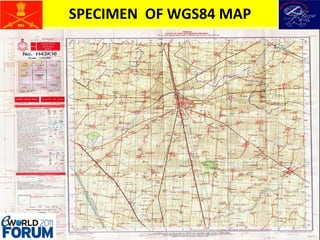
SPECIMEN  OF WGS84 MAP
IMPLEMENTATION CHALLENGES. WAY FORWARD WAY AHEAD
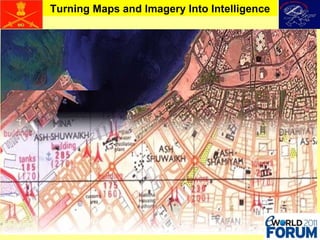
Turning Maps and Imagery Into Intelligence
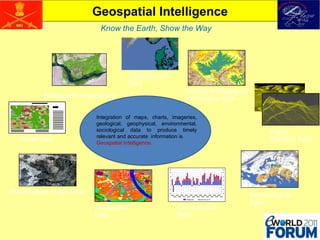
Integration of maps, charts, imageries, geological, geophysical, environmental, sociological data to produce timely relevant and accurate  information is  Geospatial Intelligence. Know the Earth, Show the Way Geospatial Intelligence Aerial/Satellite Image Data Digital  Elevation Data Topographic  Data Raster Data Biological/Ecological Data Geological/Geographic  Ethnological Data Oceanographic Data Meteorological Data Climatological Data
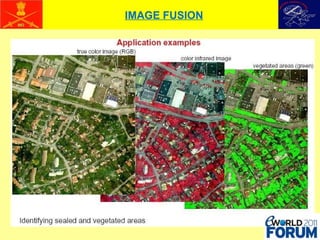
IMAGE FUSION
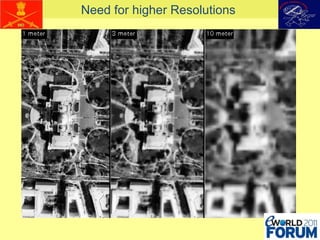
Need for higher Resolutions
ADVANCEMENT IN TECHNOLOGY …. INCREASE IN REACH, SOPHISTICATION OF THREATS…  OWN STRATEGIC ASSETS IN HINTERLAND  ALSO VULNERABLE. INCREASED SOPHISTICATION OF SYSTEMS UAVs AND DRONEs better 3 D data. C -130 …LOW FLYING AIR CRAFT REQUIRE HIGH RESOLUTION DEM,OBS DATA,AERONAUTICAL CHARTS. BALLISTIC AND CRUISE MISSILES WARGAMING  TAC & CIDSS SYS REQUIRE MENTS OF GEOSPATIAL DATA DENIAL  OF OWN GEO-SPATIAL DATA TO INIMICAL COUNTRIES RECEIVED THROUGH GOOGLE & OTHER SOURCES TO PROTECT OWN STRATEGIC AND OTHER ASSETS & PROVIDE ACCURATE LATEST DATA TO OWN FORCES. TECHNOLOGICAL CHALLANGES
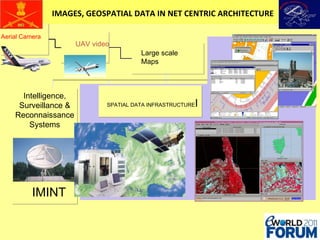
IMAGES, GEOSPATIAL DATA IN NET CENTRIC ARCHITECTURE Aerial Camera IMINT UAV video C3I Naval & Ground Systems Airborne Systems Large scale Maps Intelligence, Surveillance & Reconnaissance Systems SPATIAL DATA INFRASTRUCTURE I
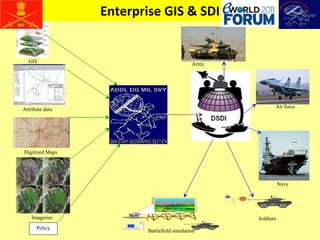
Enterprise GIS & SDI GIS Attribute data Digitized Maps Imageries Policy Army Air force Navy Battlefield simulation Soldiers
CONCLUDING REMARKS NMP& liberalized Geospatial policies provides an opportunity to support development without compromising security. High resolution Mapping  & GIS requirements  being huge  out sourcing  of defence needs to Geospatial Industry recommended. Geo spatial Industry  required to  invest in aerial survey, Image processing, LiDAR mapping, development of GIS applications . Focus on Capacity building by academia/universities . Policy require further liberalization to make it more Industry friendly and support on PPP mode on Geospatial  services. Change in mindset of security agencies necessary to look map as a development tool instead of security threat.
Questions?
THANK  YOU

Maj Gen R C Padhi

  • 1.
    e world forum2011 NATIONAL GEOSPATIAL POLICIES: FOR PUBLIC SAFETY, SECURITY,DISASTER MANAGEMENT CHALLENGES & WAY FORWARD By MAJ GEN RC PADHI Integrated Hqrs of Min of Defence (Army)
  • 2.
    POLICY & ENVIRONMENT PARTNERSHIPS & ALLIANCES ASSYMETRIC WARFARE PROLIFERATION OF WMD GLOBALISATION TERRORISM UNSTABLE NEIGHBOURHOOD SPREAD OF POLITICISED RELIGIOUS FUNDAMENTALISM MO
  • 3.
    Hostile Neighborhood… BorderDispute.. Increased activism along border…. Internal LWE problem adventurism by hostile nations Increasing influence of hostile nations on India’s growth …collaborative threat. INDIA’S STRATEGIC ENVIRONMENT
  • 4.
    NATIONAL MAP POLICY(NMP) CCS approved NMP initiated by DST on 27.04.05. SOI mandated to take leadership role in liberalizing access of spatial data to user groups without jeopardizing national security. Two series maps namely Defence Series Maps (DSM) and Open Series Maps (OSM) approved. OSMs on WGS-84 datum are unrestricted after one time security clearance of MOD. Contents include contour and heights, in maps pertaining to unrestricted zones. DSMs will have VAs and VPs, on Everest/WGS-84 User agencies free to use/publish OSMs on hard copy and web with or without GIS data base. All transactions registered in the Map Transaction Registry (MTR) with the details of the receiving agency, end user. Accuracy of OSMs and DSMs same and derived from National Topographical Data Base (NTDB). New Map Policy envisaged implementation within one year . Progress so far slow.
  • 5.
    REMOTE SENSING DATAPOLICY All data resolutions upto 1.0m shall be distributed on a non-discriminatory basis and on as requested by DOS. All data of 1.0m and better than 1.0m resolution will be screened by an appropriate agency before distribution to exclude images of sensitive areas. Data of 1m resolution and better will also be screened as above & distributed to Govt users without any further clearance. Pvt agencies recommended by at least one Govt agency for use of 1m and better resolution data for developmental activities can obtain without any further clearance. Other Pvt, foreign users can get 1m and better resolution data after further clearance from inter agency High Resolution Image Clearance Committee(HRC). Specific sale/non-disclosure agreements to be concluded between NRSA and users for data of 1m resolution and better.
  • 6.
    AERIAL PHOTOGRAPHY POLICYThe policy regarding Aerial Photography (AP)/Aircraft borne remote sensing data and imageries acquisition, classification, storage and Issue activities were reviewed in 1989 . Policy focused on analogue aerial photography & was not industry friendly. AP tasks carried out by two govt agencies IAF, NRSA. Pvt agencies on case to case basis. Emergence of Digital camera, LiDAR technology, High Resolution satellite data, GPS technology, GIS and civil needs for geospatial data made the policy inadequate. MoD revised the AP policy in May 2006 covering new sensors, pvt participation, and rationalization of security classifications. Further review under examination.
  • 7.
    SECURITY IMPLICATIONS OSMsare compatible with GPS and satellite imageries. Maps, imageries in public domain contain info required by anti national groups/adversaries. Licensed Users of SoI authorized to publish value added maps/products but many foreign companies publish maps, imageries in web with out GOI approval. Guidelines to audit the end usage of the maps not adequate from security prospective. National Map Transaction Registry (NMTR) record transactions. OSMs basically DSMs without sensitive details. Value addition without scrutiny & check makes maps/Imegeries vulnerable for security risk. Publishing of maps with or without GIS data base on web allowed in NMP. National GIS Policy not framed. Lack of legal teeth against misuse of Geospatial data.
  • 8.
    SECURITY SAFEGUARDS SoImandated with liberalization of geospatial data without jeopardizing national security. Contents approved by CCS. Survey of India(SoI) to ensure civil and military VAs/VPs not shown on OSMs. MoD advice on OSMs are restricted only on the contours and other projections in border areas and near defence installations. SoI will issue from time to time guidelines for access by user agencies. Sale of OSMs to any agency through an agreement for specific end use. Transaction through an agreement for specified end use with details of the receiving agency. SoI responsible for certification of International Boundary. Large Scale city maps published by SoI in consultation with MOD.
  • 9.
    MAPS ON WGS84 As Per new map policy OSM/ DSMs will be on Everest/WGS-84 Datum with Polyconic/UTM Projections. Common Datum,reference System for the three Services. Geo-centric WGS-84 Datum,LCC Projection and exclusively designed grid for DSMs accepted. LCC Projections in place of UTM Projection has been chosen on which Grids will be super imposed. DSMs will be on scales 1:250k,1:50k,1:25k and 1:10k . Map contents will be all Geographic features with civil and defence vital points and areas. A new lay out has been designed with new sheet numbering. The symbology and colour will be common for OSMs and DSMs.
  • 10.
    SPECIMEN OFWGS84 MAP
  • 11.
  • 12.
    Turning Maps andImagery Into Intelligence
  • 13.
    Integration of maps,charts, imageries, geological, geophysical, environmental, sociological data to produce timely relevant and accurate information is Geospatial Intelligence. Know the Earth, Show the Way Geospatial Intelligence Aerial/Satellite Image Data Digital Elevation Data Topographic Data Raster Data Biological/Ecological Data Geological/Geographic Ethnological Data Oceanographic Data Meteorological Data Climatological Data
  • 14.
  • 15.
    Need for higherResolutions
  • 16.
    ADVANCEMENT IN TECHNOLOGY…. INCREASE IN REACH, SOPHISTICATION OF THREATS… OWN STRATEGIC ASSETS IN HINTERLAND ALSO VULNERABLE. INCREASED SOPHISTICATION OF SYSTEMS UAVs AND DRONEs better 3 D data. C -130 …LOW FLYING AIR CRAFT REQUIRE HIGH RESOLUTION DEM,OBS DATA,AERONAUTICAL CHARTS. BALLISTIC AND CRUISE MISSILES WARGAMING TAC & CIDSS SYS REQUIRE MENTS OF GEOSPATIAL DATA DENIAL OF OWN GEO-SPATIAL DATA TO INIMICAL COUNTRIES RECEIVED THROUGH GOOGLE & OTHER SOURCES TO PROTECT OWN STRATEGIC AND OTHER ASSETS & PROVIDE ACCURATE LATEST DATA TO OWN FORCES. TECHNOLOGICAL CHALLANGES
  • 17.
    IMAGES, GEOSPATIAL DATAIN NET CENTRIC ARCHITECTURE Aerial Camera IMINT UAV video C3I Naval & Ground Systems Airborne Systems Large scale Maps Intelligence, Surveillance & Reconnaissance Systems SPATIAL DATA INFRASTRUCTURE I
  • 18.
    Enterprise GIS &SDI GIS Attribute data Digitized Maps Imageries Policy Army Air force Navy Battlefield simulation Soldiers
  • 19.
    CONCLUDING REMARKS NMP&liberalized Geospatial policies provides an opportunity to support development without compromising security. High resolution Mapping & GIS requirements being huge out sourcing of defence needs to Geospatial Industry recommended. Geo spatial Industry required to invest in aerial survey, Image processing, LiDAR mapping, development of GIS applications . Focus on Capacity building by academia/universities . Policy require further liberalization to make it more Industry friendly and support on PPP mode on Geospatial services. Change in mindset of security agencies necessary to look map as a development tool instead of security threat.
  • 20.
  • 21.

Editor's Notes

  • #14 To this end, the Bundeswehr Geoinformation Service is setting up the GeoInfo Database, a database that is free of redundancies and contains many different types of geospatial and environmental information as you may see on this slide. In addition, the database is divided into different levels of resolution, that is to say different scales. 