Geospatial Big Data
Location Intelligence in Digital
Transformation
Mifan Careem
Director, Solution Architecture
WSO2
“As geospatial technology becomes more pervasive
across a multitude of applications, it is becoming
harder to quantify it as a discrete sector, as opposed
to part of the broader IT industry”
Dr. Vanessa Lawrence, Director General, Ordnance Survey, “Investigation into spatial capability of Australia”
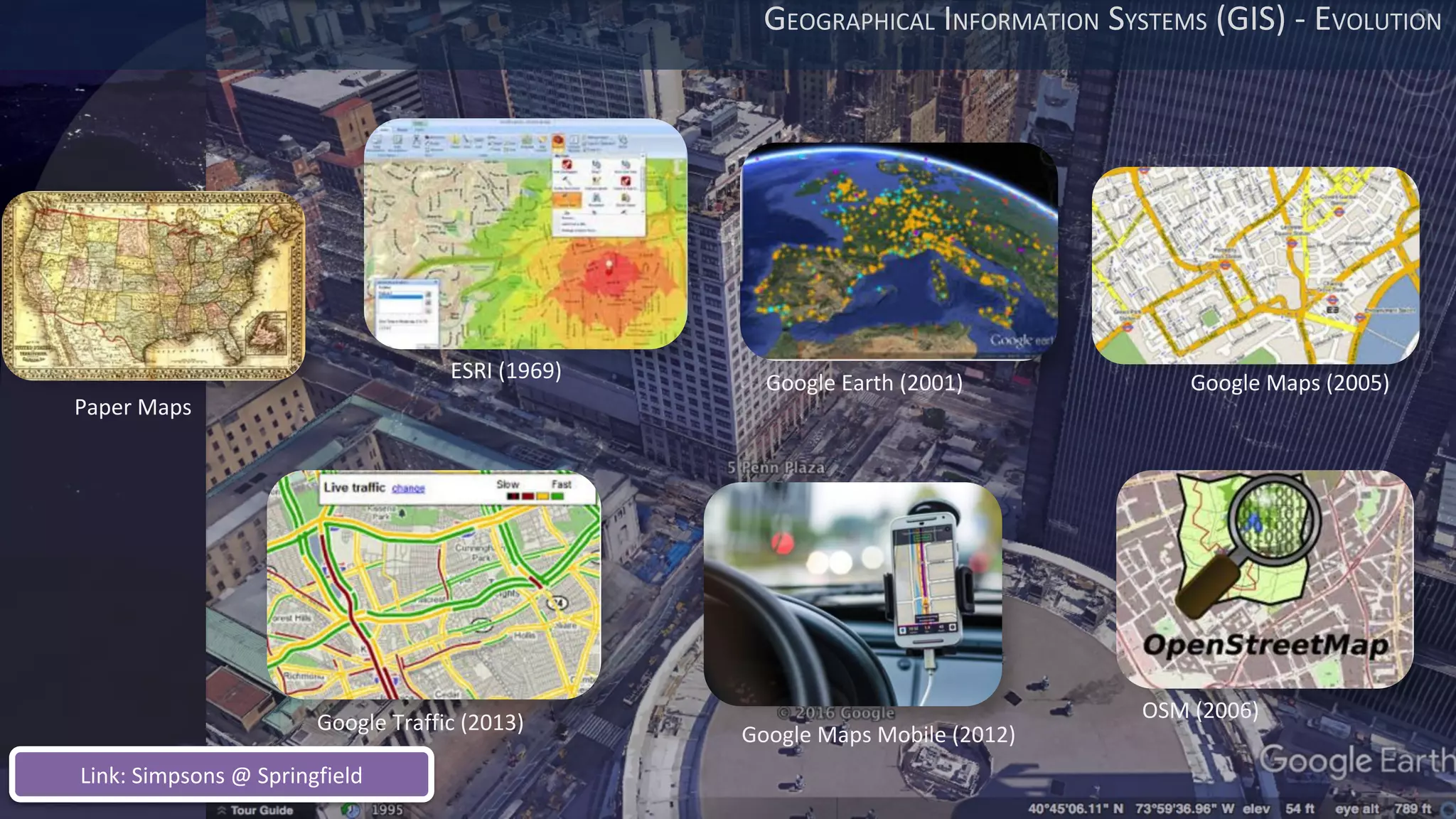
GEOGRAPHICAL INFORMATION SYSTEMS (GIS) - EVOLUTION
Paper Maps
ESRI (1969)
Google Maps (2005)Google Earth (2001)
OSM (2006)
Google Maps Mobile (2012)
Google Traffic (2013)
Link: Simpsons @ Springfield
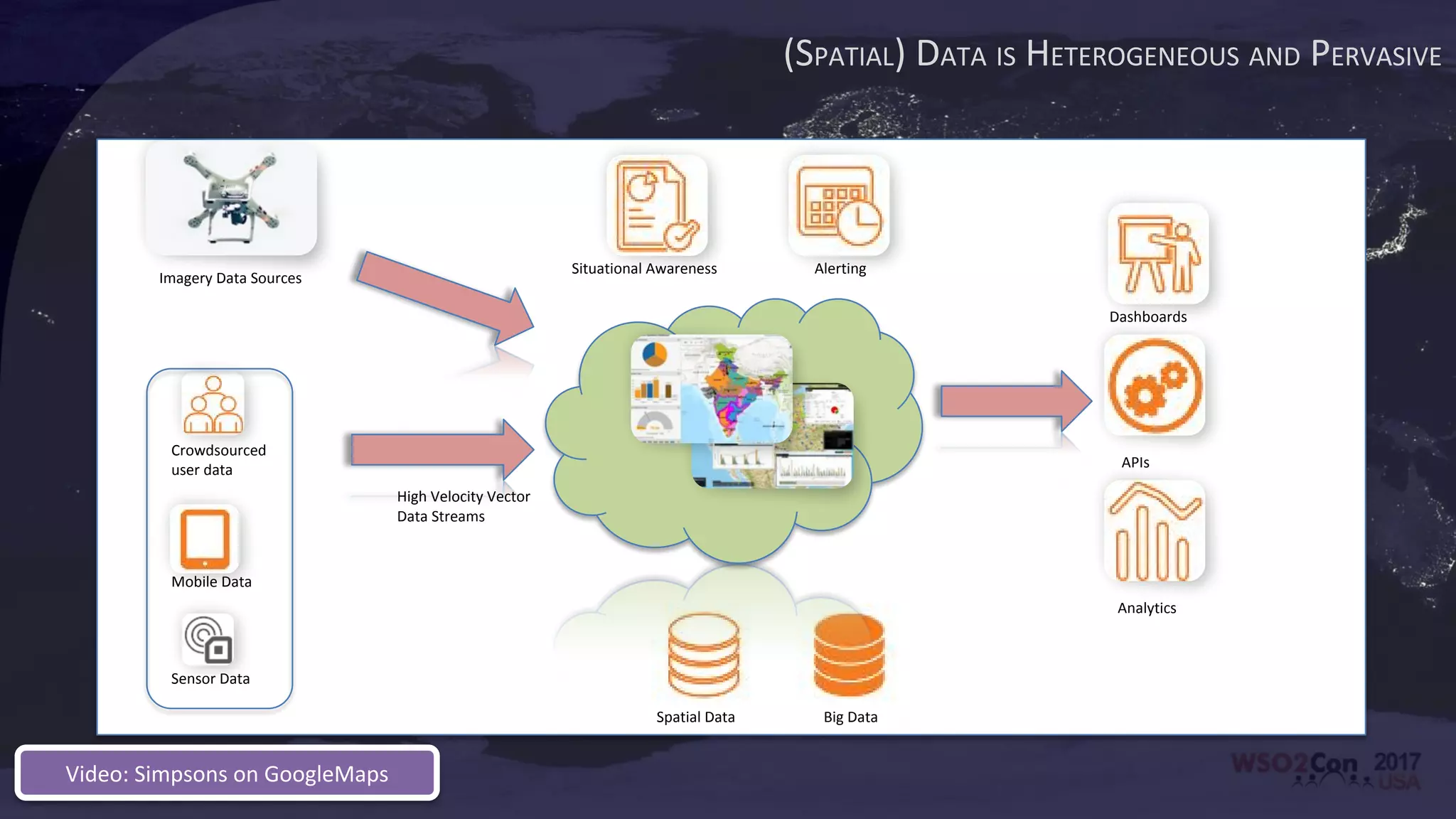
(SPATIAL) DATA IS HETEROGENEOUS AND PERVASIVE
Crowdsourced
user data
Mobile Data
Sensor Data
Big DataSpatial Data
High Velocity Vector
Data Streams
Imagery Data Sources
Dashboards
APIs
Analytics
Situational Awareness Alerting
Video: Simpsons on GoogleMaps
Five GIS Trends Changing the
World
Jack Dangermond, President, ESRI –
2017
• Location as a Service
• Advanced Analytics
• Big Data Analytics
• Real Time GIS
• Mobility
http://geoawesomeness.com/five-gis-trends-chan
ging-world-according-jack-dangermond-president-
esri/
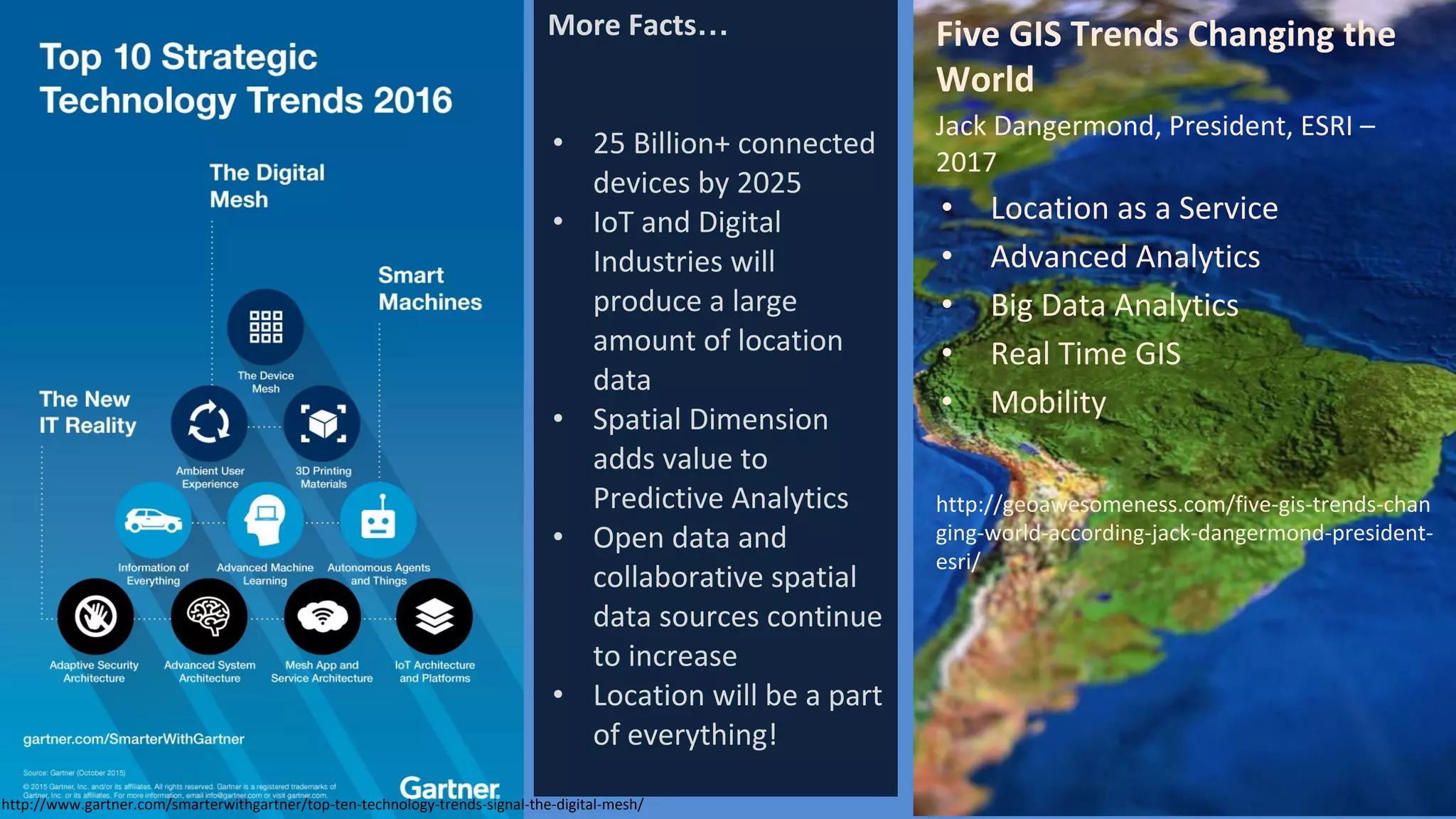
http://www.gartner.com/smarterwithgartner/top-ten-technology-trends-signal-the-digital-mesh/
More Facts…
• 25 Billion+ connected
devices by 2025
• IoT and Digital
Industries will
produce a large
amount of location
data
• Spatial Dimension
adds value to
Predictive Analytics
• Open data and
collaborative spatial
data sources continue
to increase
• Location will be a part
of everything!
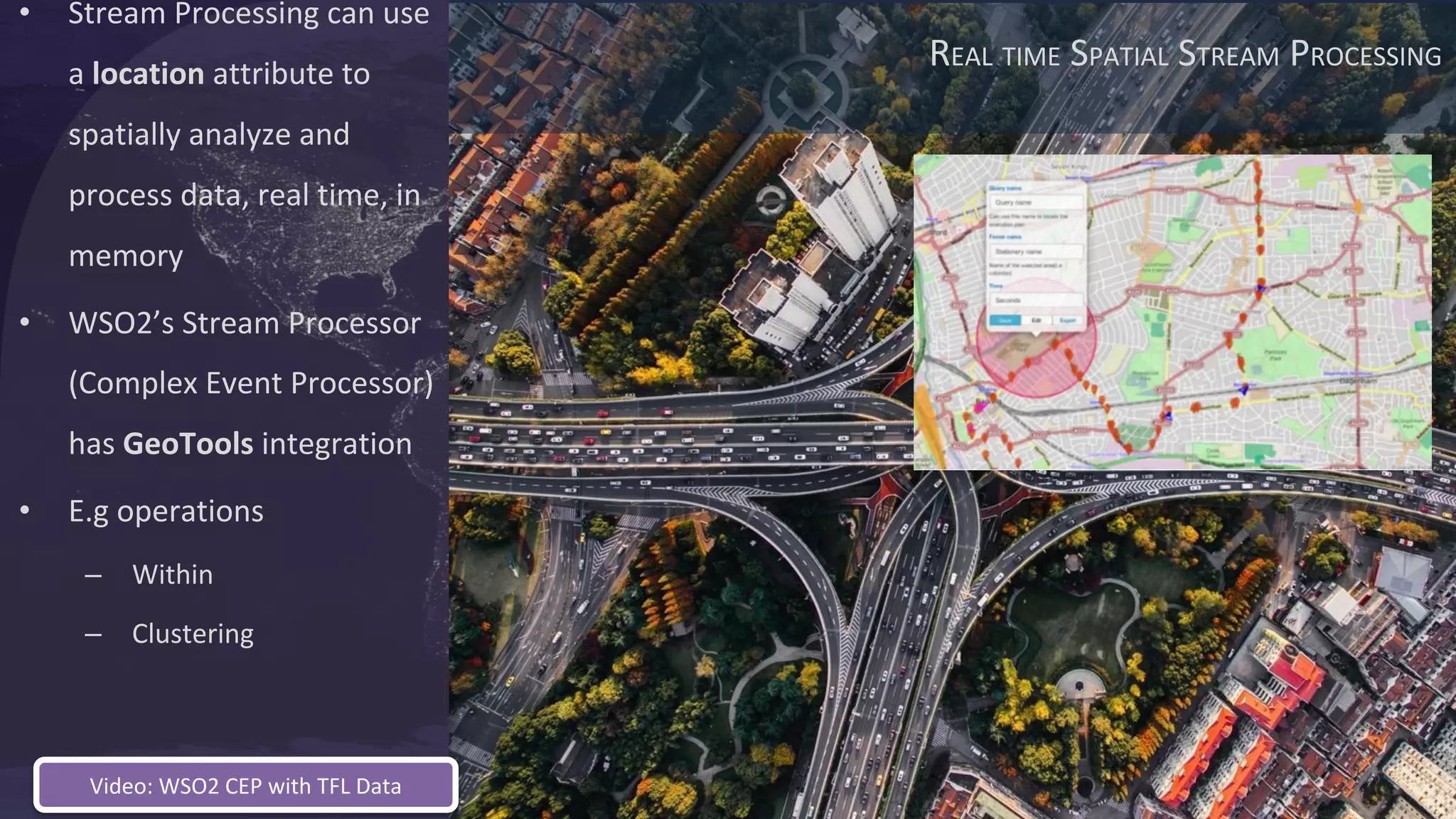
• Stream Processing can use
a location attribute to
spatially analyze and
process data, real time, in
memory
• WSO2’s Stream Processor
(Complex Event Processor)
has GeoTools integration
• E.g operations
– Within
– Clustering
REAL TIME SPATIAL STREAM PROCESSING
Video: WSO2 CEP with TFL Data
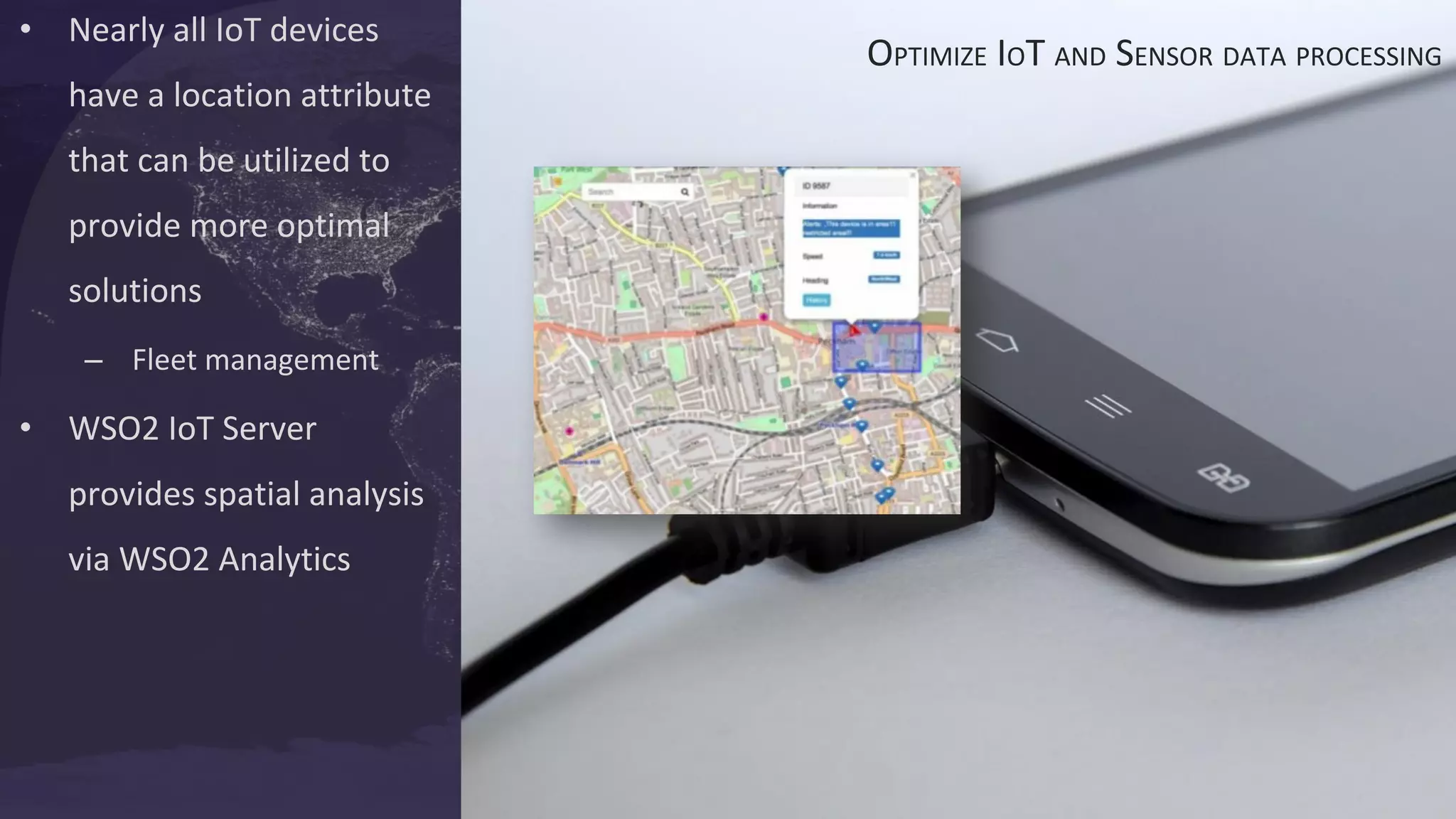
• Nearly all IoT devices
have a location attribute
that can be utilized to
provide more optimal
solutions
– Fleet management
• WSO2 IoT Server
provides spatial analysis
via WSO2 Analytics
OPTIMIZE IOT AND SENSOR DATA PROCESSING
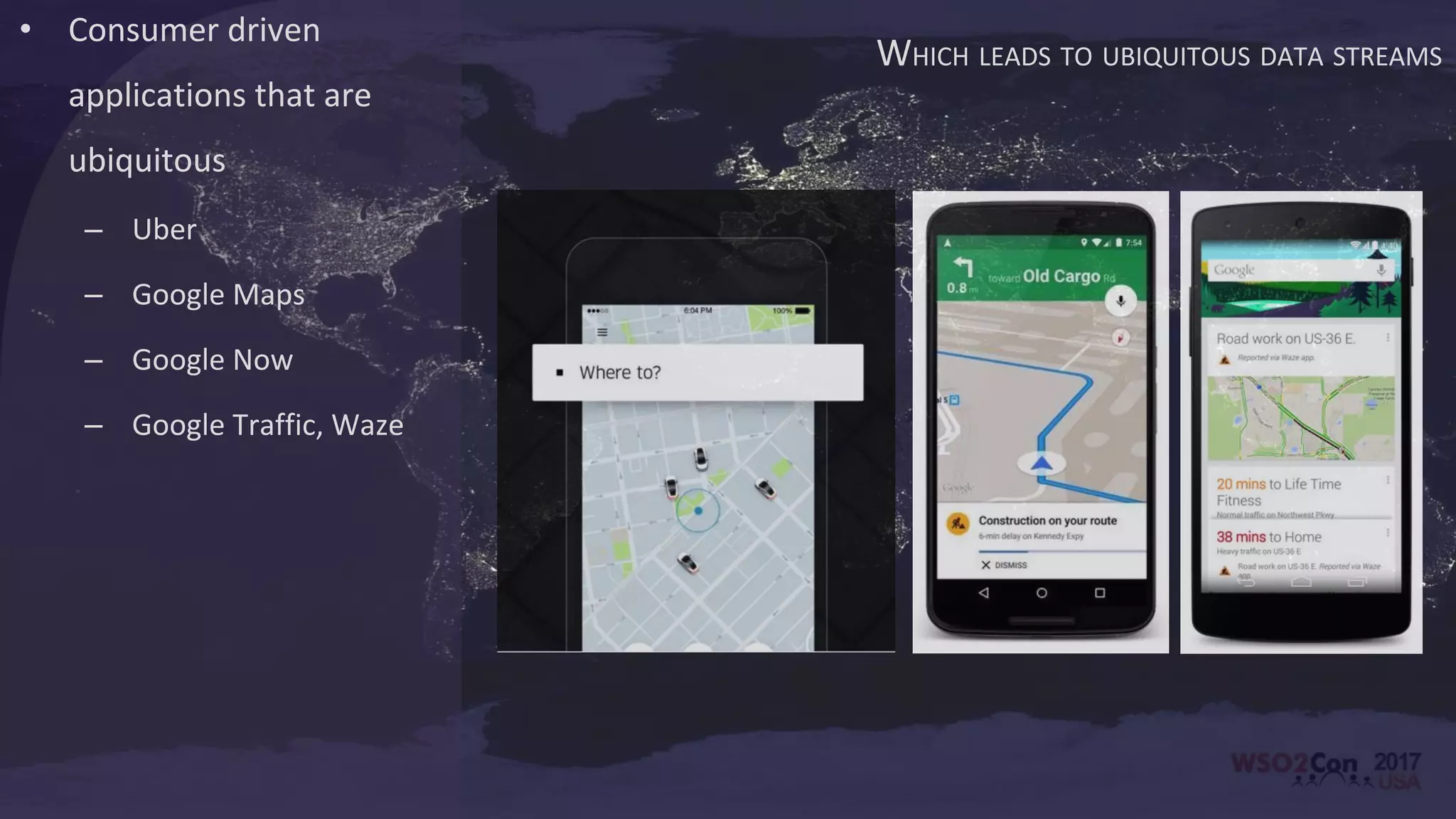
WHICH LEADS TO UBIQUITOUS DATA STREAMS
• Consumer driven
applications that are
ubiquitous
– Uber
– Google Maps
– Google Now
– Google Traffic, Waze
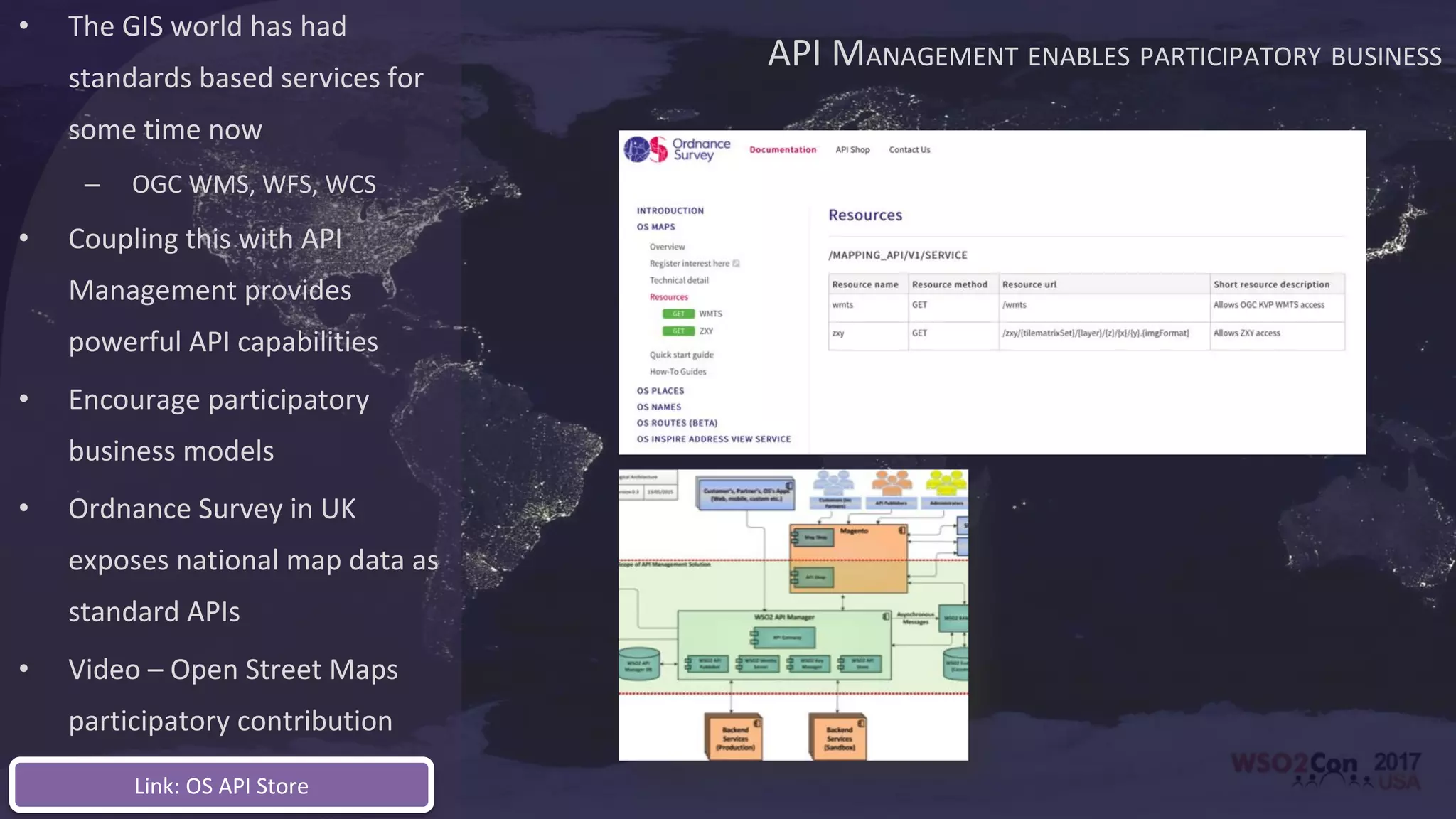
API MANAGEMENT ENABLES PARTICIPATORY BUSINESS
• The GIS world has had
standards based services for
some time now
– OGC WMS, WFS, WCS
• Coupling this with API
Management provides
powerful API capabilities
• Encourage participatory
business models
• Ordnance Survey in UK
exposes national map data as
standard APIs
• Video – Open Street Maps
participatory contribution
Link: OS API Store
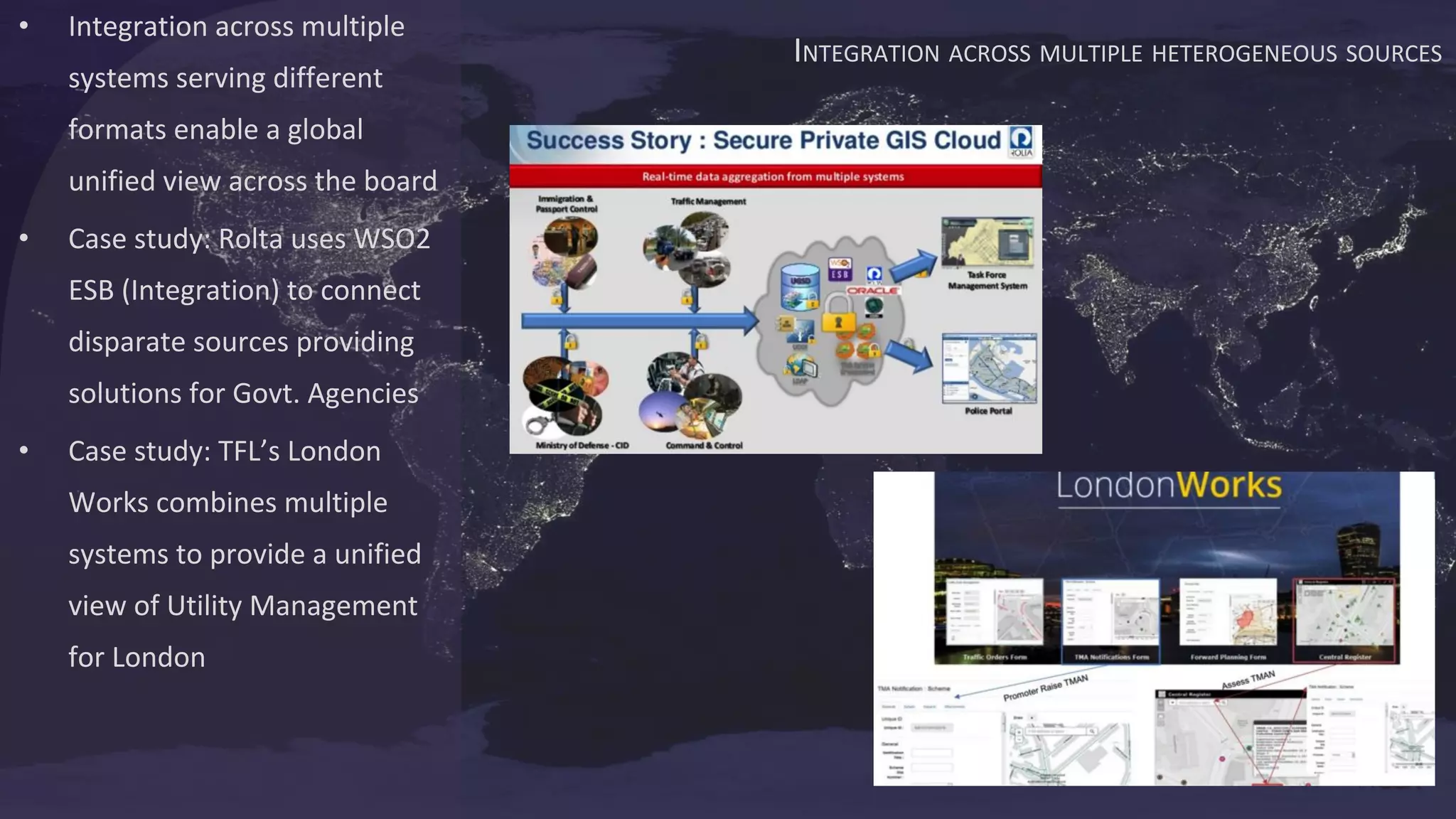
INTEGRATION ACROSS MULTIPLE HETEROGENEOUS SOURCES
• Integration across multiple
systems serving different
formats enable a global
unified view across the board
• Case study: Rolta uses WSO2
ESB (Integration) to connect
disparate sources providing
solutions for Govt. Agencies
• Case study: TFL’s London
Works combines multiple
systems to provide a unified
view of Utility Management
for London
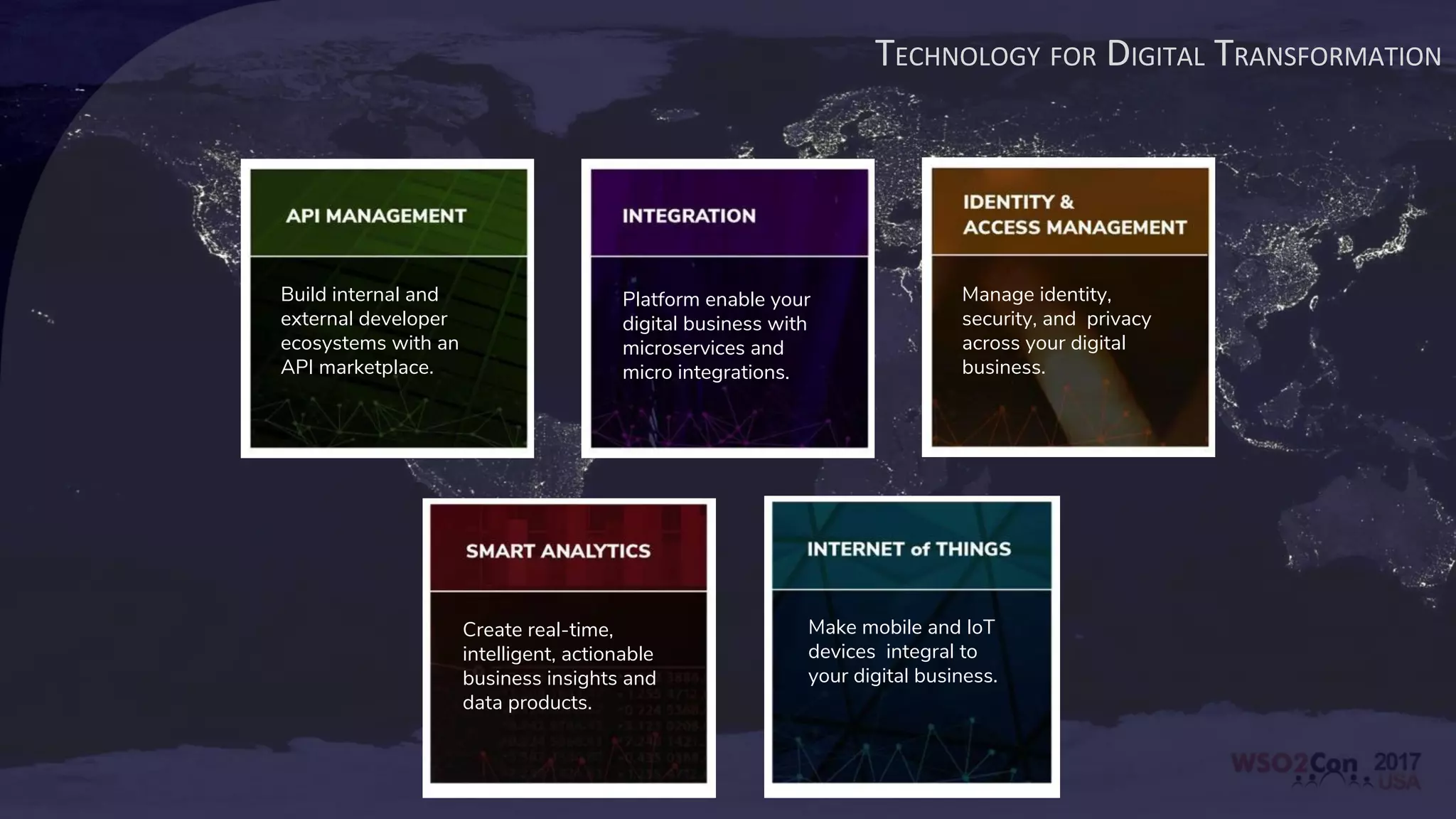
TECHNOLOGY FOR DIGITAL TRANSFORMATION
Build internal and
external developer
ecosystems with an
API marketplace.
Platform enable your
digital business with
microservices and
micro integrations.
Manage identity,
security, and privacy
across your digital
business.
Create real-time,
intelligent, actionable
business insights and
data products.
Make mobile and IoT
devices integral to
your digital business.
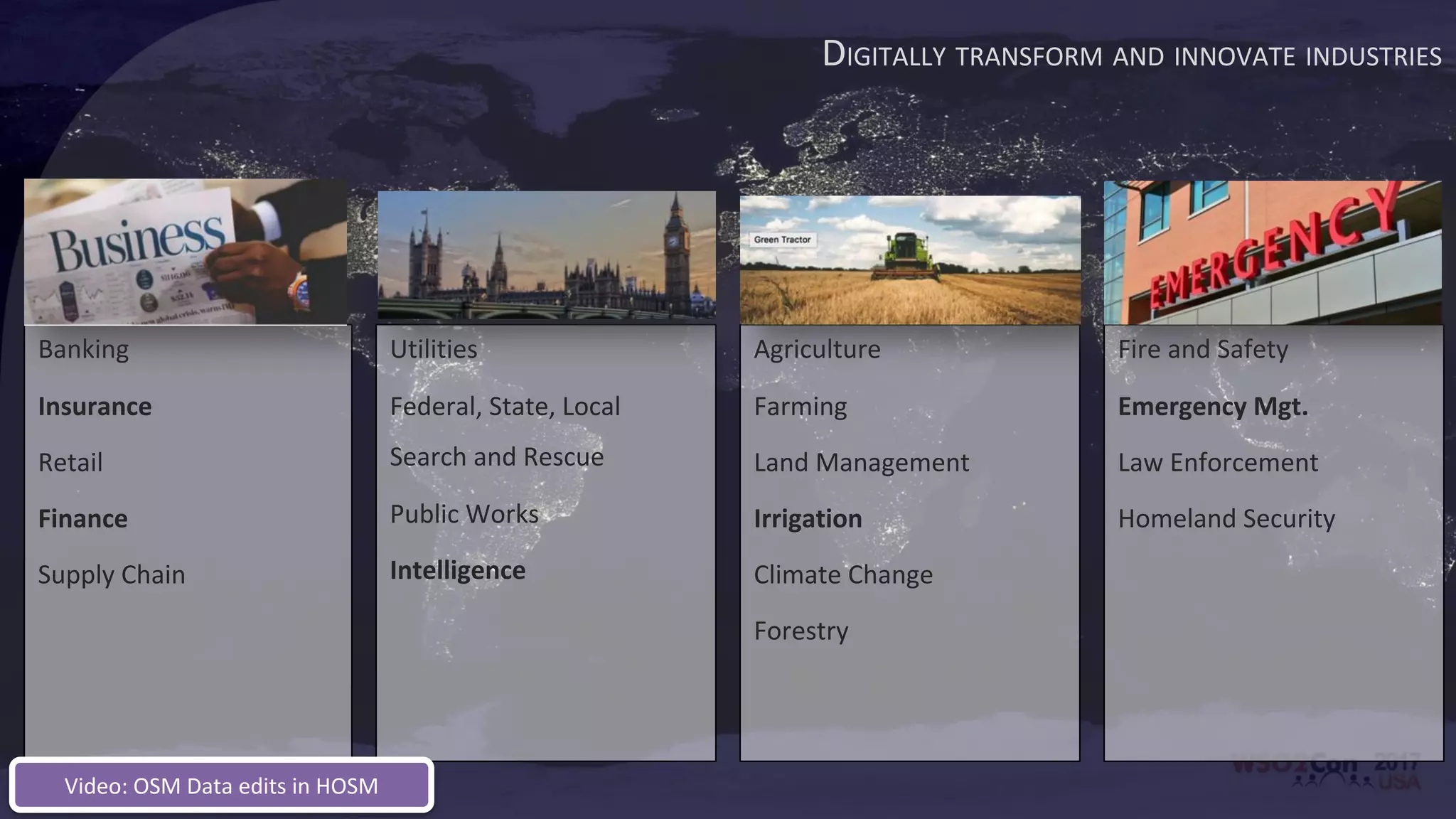
DIGITALLY TRANSFORM AND INNOVATE INDUSTRIES
Banking
Insurance
Retail
Finance
Supply Chain
Utilities
Federal, State, Local
Search and Rescue
Public Works
Intelligence
Agriculture
Farming
Land Management
Irrigation
Climate Change
Forestry
Fire and Safety
Emergency Mgt.
Law Enforcement
Homeland Security
Video: OSM Data edits in HOSM
Thank You!
I believe we need a "Digital Earth". A multi-resolution, three-dimensional
representation of the planet, into which we can embed vast quantities of
geo-referenced data.
Al Gore, “Digital Earth – Understanding our planet in the 21st
Century”,
California, 1998

WSO2Con USA 2017: Geospatial Big Data – Location Intelligence in Digital Transformation

  • 1.
    Geospatial Big Data LocationIntelligence in Digital Transformation Mifan Careem Director, Solution Architecture WSO2
  • 2.
    “As geospatial technologybecomes more pervasive across a multitude of applications, it is becoming harder to quantify it as a discrete sector, as opposed to part of the broader IT industry” Dr. Vanessa Lawrence, Director General, Ordnance Survey, “Investigation into spatial capability of Australia”
  • 3.
    GEOGRAPHICAL INFORMATION SYSTEMS(GIS) - EVOLUTION Paper Maps ESRI (1969) Google Maps (2005)Google Earth (2001) OSM (2006) Google Maps Mobile (2012) Google Traffic (2013) Link: Simpsons @ Springfield
  • 4.
    (SPATIAL) DATA ISHETEROGENEOUS AND PERVASIVE Crowdsourced user data Mobile Data Sensor Data Big DataSpatial Data High Velocity Vector Data Streams Imagery Data Sources Dashboards APIs Analytics Situational Awareness Alerting Video: Simpsons on GoogleMaps
  • 5.
    Five GIS TrendsChanging the World Jack Dangermond, President, ESRI – 2017 • Location as a Service • Advanced Analytics • Big Data Analytics • Real Time GIS • Mobility http://geoawesomeness.com/five-gis-trends-chan ging-world-according-jack-dangermond-president- esri/ http://www.gartner.com/smarterwithgartner/top-ten-technology-trends-signal-the-digital-mesh/ More Facts… • 25 Billion+ connected devices by 2025 • IoT and Digital Industries will produce a large amount of location data • Spatial Dimension adds value to Predictive Analytics • Open data and collaborative spatial data sources continue to increase • Location will be a part of everything!
  • 6.
    • Stream Processingcan use a location attribute to spatially analyze and process data, real time, in memory • WSO2’s Stream Processor (Complex Event Processor) has GeoTools integration • E.g operations – Within – Clustering REAL TIME SPATIAL STREAM PROCESSING Video: WSO2 CEP with TFL Data
  • 7.
    • Nearly allIoT devices have a location attribute that can be utilized to provide more optimal solutions – Fleet management • WSO2 IoT Server provides spatial analysis via WSO2 Analytics OPTIMIZE IOT AND SENSOR DATA PROCESSING
  • 8.
    WHICH LEADS TOUBIQUITOUS DATA STREAMS • Consumer driven applications that are ubiquitous – Uber – Google Maps – Google Now – Google Traffic, Waze
  • 9.
    API MANAGEMENT ENABLESPARTICIPATORY BUSINESS • The GIS world has had standards based services for some time now – OGC WMS, WFS, WCS • Coupling this with API Management provides powerful API capabilities • Encourage participatory business models • Ordnance Survey in UK exposes national map data as standard APIs • Video – Open Street Maps participatory contribution Link: OS API Store
  • 10.
    INTEGRATION ACROSS MULTIPLEHETEROGENEOUS SOURCES • Integration across multiple systems serving different formats enable a global unified view across the board • Case study: Rolta uses WSO2 ESB (Integration) to connect disparate sources providing solutions for Govt. Agencies • Case study: TFL’s London Works combines multiple systems to provide a unified view of Utility Management for London
  • 11.
    TECHNOLOGY FOR DIGITALTRANSFORMATION Build internal and external developer ecosystems with an API marketplace. Platform enable your digital business with microservices and micro integrations. Manage identity, security, and privacy across your digital business. Create real-time, intelligent, actionable business insights and data products. Make mobile and IoT devices integral to your digital business.
  • 12.
    DIGITALLY TRANSFORM ANDINNOVATE INDUSTRIES Banking Insurance Retail Finance Supply Chain Utilities Federal, State, Local Search and Rescue Public Works Intelligence Agriculture Farming Land Management Irrigation Climate Change Forestry Fire and Safety Emergency Mgt. Law Enforcement Homeland Security Video: OSM Data edits in HOSM
  • 13.
    Thank You! I believewe need a "Digital Earth". A multi-resolution, three-dimensional representation of the planet, into which we can embed vast quantities of geo-referenced data. Al Gore, “Digital Earth – Understanding our planet in the 21st Century”, California, 1998