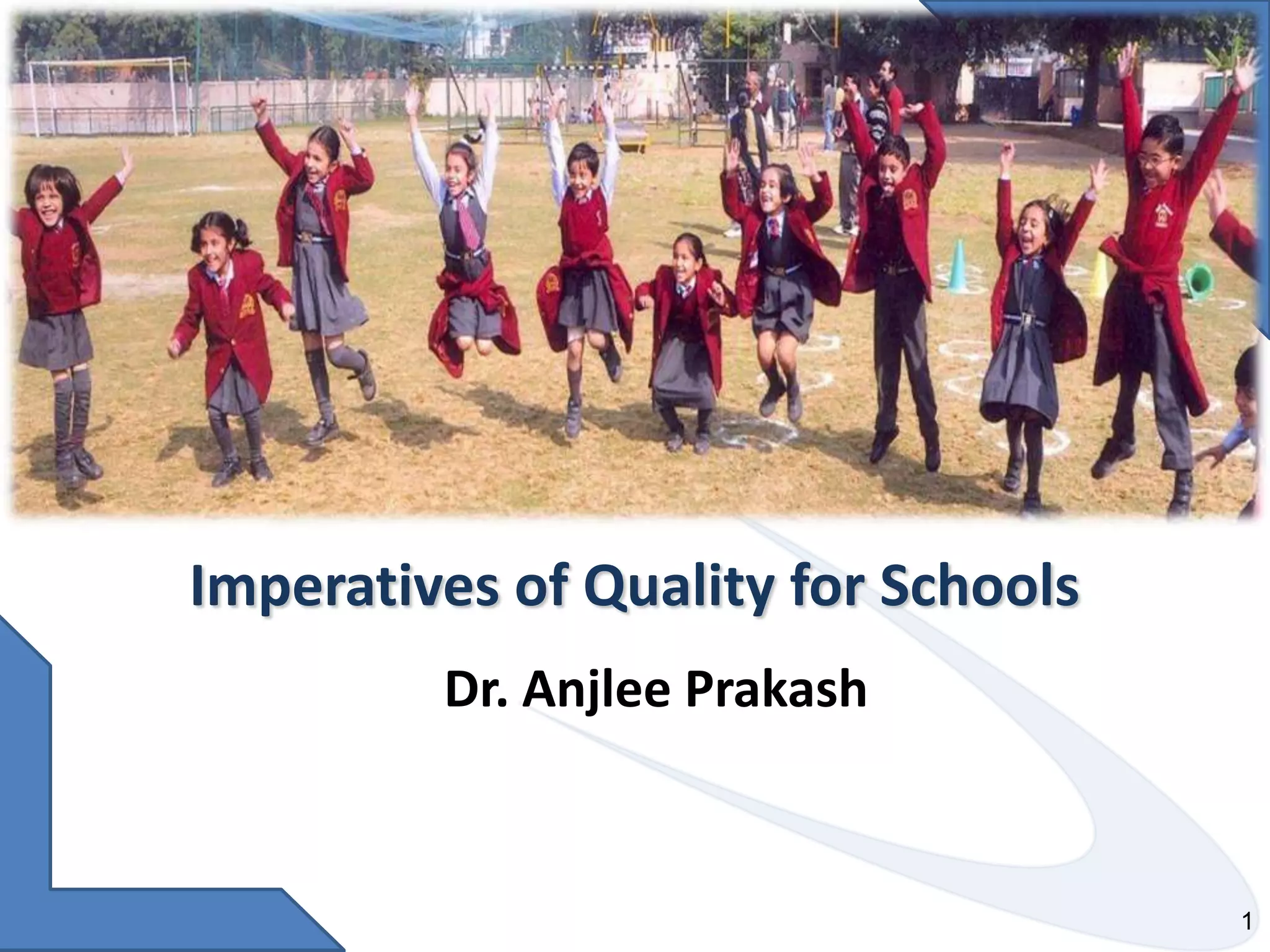
Imperatives of Quality for Schools Dr. Anjlee Prakash1
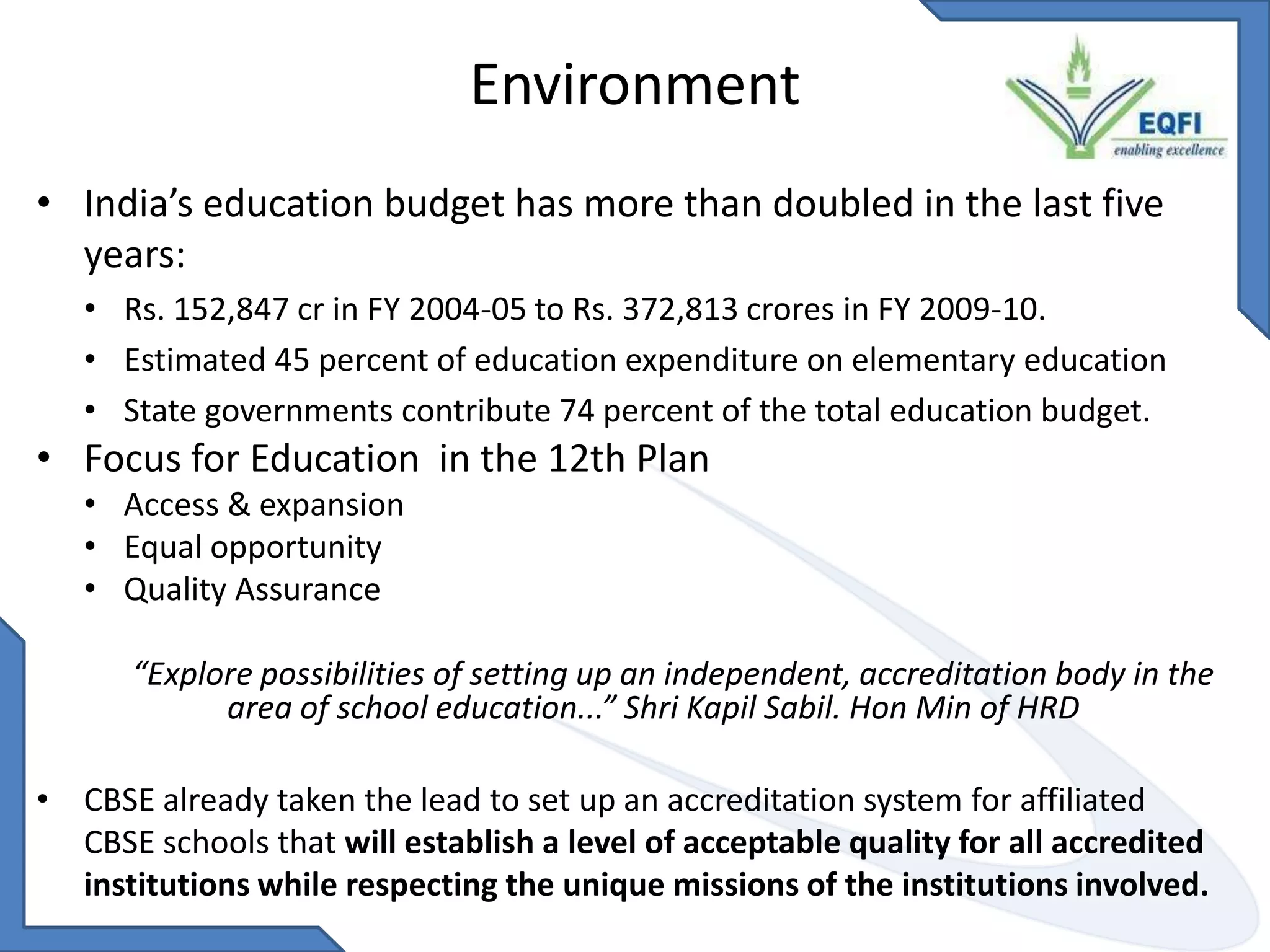
Environment  India’s education budget has more than doubled in the last five years: Rs. 152,847 cr in FY 2004-05 to Rs. 372,813 crores in FY 2009-10.
Estimated 45 percent of education expenditure on elementary education
State governments contribute 74 percent of the total education budget.Focus for Education  in the 12th PlanAccess & expansion
Equal opportunity
Quality Assurance “Explore possibilities of setting up an independent, accreditation body in the area of school education...” ShriKapilSabil. Hon Min of HRDCBSE already taken the lead to set up an accreditation system for affiliated CBSE schools that will establish a level of acceptable quality for all accredited institutions while respecting the unique missions of the institutions involved.
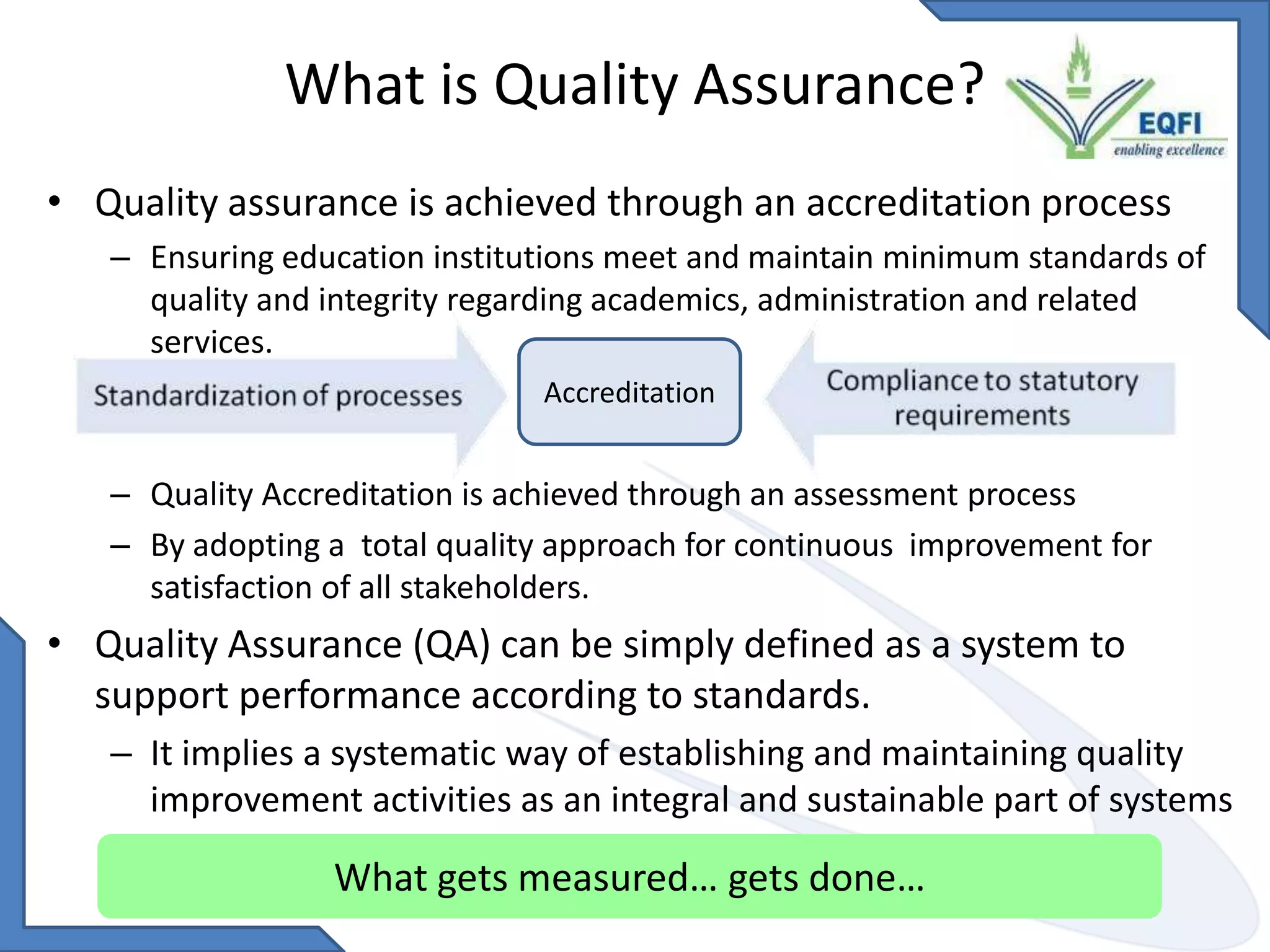
What is Quality Assurance? Quality assurance is achieved through an accreditation processEnsuring education institutions meet and maintain minimum standards of quality and integrity regarding academics, administration and related services. Quality Accreditation is achieved through an assessment processBy adopting a  total quality approach for continuous  improvement for satisfaction of all stakeholders. Quality Assurance (QA) can be simply defined as a system to support performance according to standards. It implies a systematic way of establishing and maintaining quality improvement activities as an integral and sustainable part of systemsAccreditation What gets measured… gets done…
Framework of Quality Accreditation supported by  an approach to Assessment
Framework of Quality AssessmentPolicy prescription as indicators for accreditationQSAS standards are based on policy prescription of state/ boardsEvidence basedAccreditation process is based on observable parameters alone
These evidences are related to deeply rooted processes in schoolSystemic processQuality is never by accident ,it is always  a result of systemic   interventionBased on randomization principleRandom records are taken as evidence
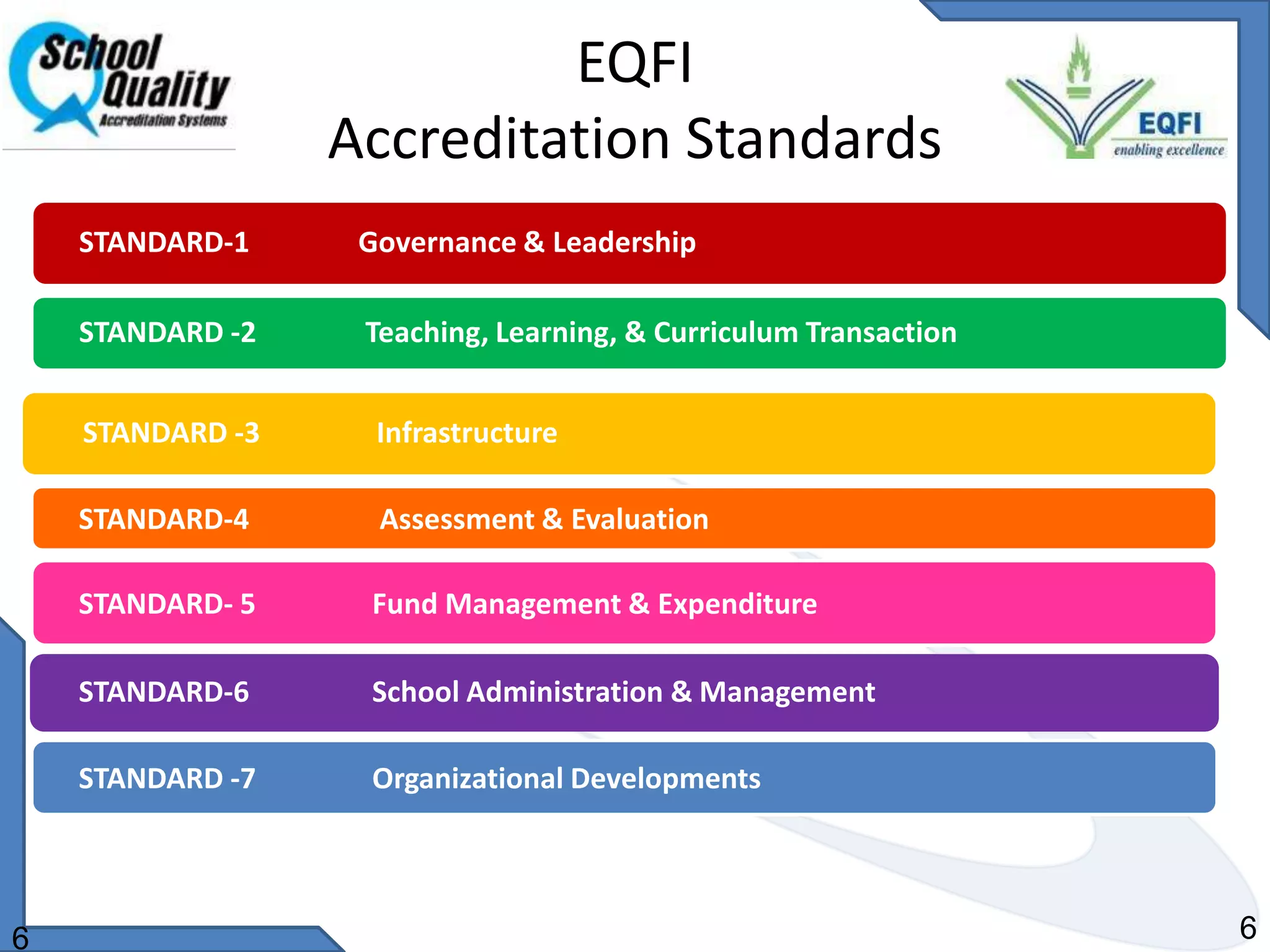
Selection is to eliminate the risk of bias and errorTransparentAll parties relevant to the process are involved;  i.e.  The assessment agency, the assessor and  the schoolSTANDARD-1   Governance & LeadershipSTANDARD -3                InfrastructureSTANDARD-4                  Assessment & Evaluation EQFI Accreditation StandardsSTANDARD-6                 School Administration & Management STANDARD -7                Organizational DevelopmentsSTANDARD -2               Teaching, Learning, & Curriculum TransactionSTANDARD- 5                Fund Management & Expenditure 66

Dr Anjalee Prakash

  • 1.
    Imperatives of Qualityfor Schools Dr. Anjlee Prakash1
  • 2.
    Environment India’seducation budget has more than doubled in the last five years: Rs. 152,847 cr in FY 2004-05 to Rs. 372,813 crores in FY 2009-10.
  • 3.
    Estimated 45 percentof education expenditure on elementary education
  • 4.
    State governments contribute74 percent of the total education budget.Focus for Education in the 12th PlanAccess & expansion
  • 5.
  • 6.
    Quality Assurance “Explorepossibilities of setting up an independent, accreditation body in the area of school education...” ShriKapilSabil. Hon Min of HRDCBSE already taken the lead to set up an accreditation system for affiliated CBSE schools that will establish a level of acceptable quality for all accredited institutions while respecting the unique missions of the institutions involved.
  • 7.
    What is QualityAssurance? Quality assurance is achieved through an accreditation processEnsuring education institutions meet and maintain minimum standards of quality and integrity regarding academics, administration and related services. Quality Accreditation is achieved through an assessment processBy adopting a total quality approach for continuous improvement for satisfaction of all stakeholders. Quality Assurance (QA) can be simply defined as a system to support performance according to standards. It implies a systematic way of establishing and maintaining quality improvement activities as an integral and sustainable part of systemsAccreditation What gets measured… gets done…
  • 8.
    Framework of QualityAccreditation supported by an approach to Assessment
  • 9.
    Framework of QualityAssessmentPolicy prescription as indicators for accreditationQSAS standards are based on policy prescription of state/ boardsEvidence basedAccreditation process is based on observable parameters alone
  • 10.
    These evidences arerelated to deeply rooted processes in schoolSystemic processQuality is never by accident ,it is always a result of systemic interventionBased on randomization principleRandom records are taken as evidence
  • 11.
    Selection is toeliminate the risk of bias and errorTransparentAll parties relevant to the process are involved; i.e. The assessment agency, the assessor and the schoolSTANDARD-1 Governance & LeadershipSTANDARD -3 InfrastructureSTANDARD-4 Assessment & Evaluation EQFI Accreditation StandardsSTANDARD-6 School Administration & Management STANDARD -7 Organizational DevelopmentsSTANDARD -2 Teaching, Learning, & Curriculum TransactionSTANDARD- 5 Fund Management & Expenditure 66
  • 12.
    Quality is neveran accident; it is always the result of high intention, sincere effort, intelligent direction and skillful executionWilliam A. Foster
  • 13.
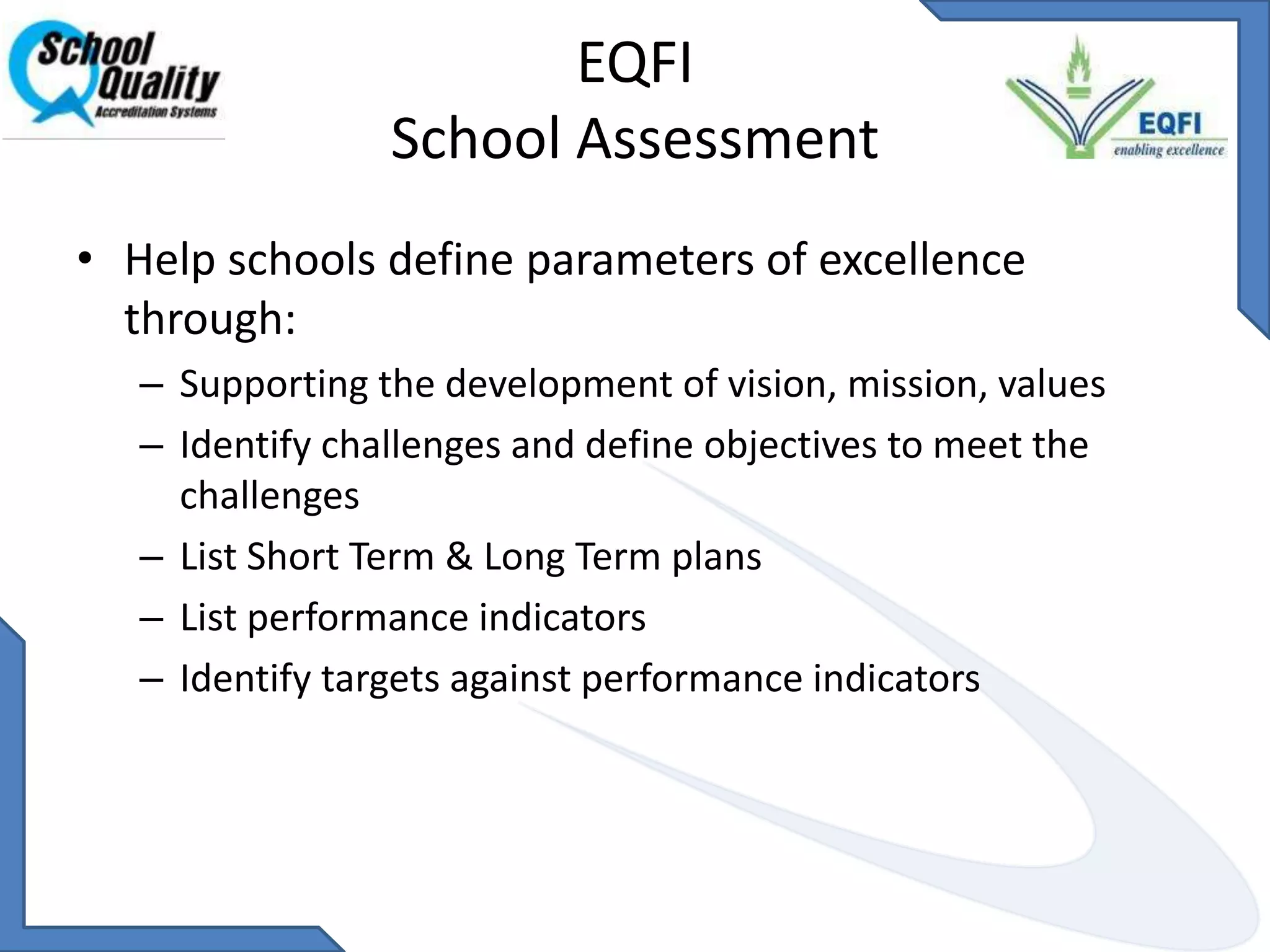
    Development of QualityToolsEQFI School AssessmentHelp schools define parameters of excellence through: Supporting the development of vision, mission, values Identify challenges and define objectives to meet the challenges List Short Term & Long Term plans List performance indicators Identify targets against performance indicators
  • 14.
  • 15.
  • 16.