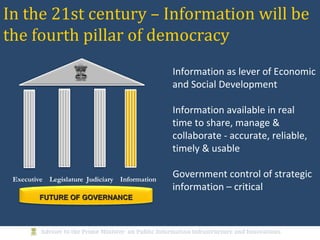

In the 21st century – Information will be
the fourth pillar of democracy
2
Executive Legislature InformationJudiciary
FUTURE OF GOVERNANCEFUTURE OF GOVERNANCE
Information as lever of Economic
and Social Development
Information available in real
time to share, manage &
collaborate - accurate, reliable,
timely & usable
Government control of strategic
information – critical
INFORMATION
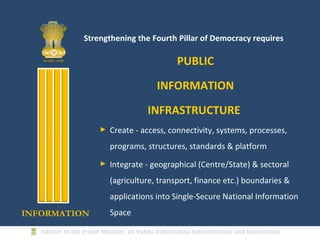
Strengthening the Fourth Pillar of Democracy requires
PUBLIC
INFORMATION
INFRASTRUCTURE
► Create - access, connectivity, systems, processes,
programs, structures, standards & platform
► Integrate - geographical (Centre/State) & sectoral
(agriculture, transport, finance etc.) boundaries &
applications into Single-Secure National Information
Space
Democratising Information through PII
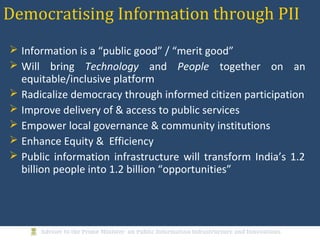
 Information is a “public good” / “merit good”
 Will bring Technology and People together on an
equitable/inclusive platform
 Radicalize democracy through informed citizen participation
 Improve delivery of & access to public services
 Empower local governance & community institutions
 Enhance Equity & Efficiency
 Public information infrastructure will transform India’s 1.2
billion people into 1.2 billion “opportunities”
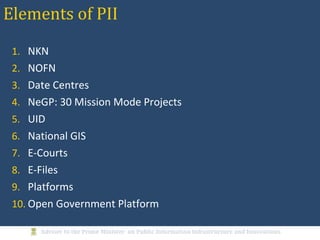
1. NKN
2. NOFN
3. Date Centres
4. NeGP: 30 Mission Mode Projects
5. UID
6. National GIS
7. E-Courts
8. E-Files
9. Platforms
10. Open Government Platform
Elements of PII
5
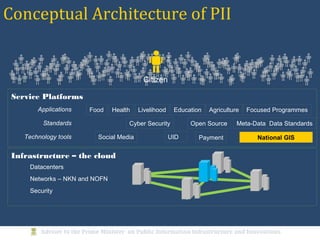
Conceptual Architecture of PII
Service Platforms
Applications
Standards
Technology tools
Food Health Livelihood Education Agriculture Focused Programmes
Meta-Data Data StandardsCyber Security Open Source
Social Media UID Payment National GIS
Networks – NKN and NOFN
Security
Infrastructure – the cloud
Datacenters
Citizen
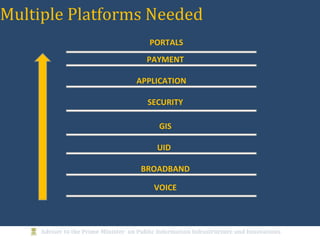
Multiple Platforms Needed
VOICE
BROADBAND
UID
SECURITY
GIS
APPLICATION
PAYMENT
PORTALS
Adviser to the Prime Minister on Public Information Infrastructure and Innovations
National Knowledge Network
 Government is building an IP Network with gigabit capabilities to
connect 1500 plus nodes across the country for Education and
Research to expand, excel & collaborate
 All universities will be included in this
 NKN is operational with 2.5 gigabits and over 1001 institutions are
connected today
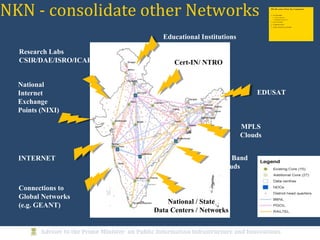
 NKN to consolidate multiple networks in the country
 NKN to provide new virtual network facilities
 NKN to be the backbone for the Education, health, Research and
multiple applications for the future
NKN - consolidate other Networks
Educational Institutions
Research Labs
CSIR/DAE/ISRO/ICAR
INTERNET
Connections to
Global Networks
(e.g. GEANT)
EDUSAT
MPLS
Clouds
Broad Band
Clouds
National / State
Data Centers / Networks
National
Internet
Exchange
Points (NIXI)
Cert-IN/ NTRO
Adviser to the Prime Minister on Public Information Infrastructure and Innovations
Increasing Connectivity for Innovation: Rural
Broadband
 Rural broadband to connect all 250,000 panchayats in two years for
democratising information, openness, connectivity, transparency and
accountability
 Transformational potential in governance
 Delivery of public services
 Real time feedback
 Monitoring G to G transactions
 Training of panchayat and other grassroots functionaries
 Skilling the community
 Empowering the community through e-library/reading room
 Crowd sourcing feedback and suggestions
 Larger goal: Radicalising democracy through information
 Government has approved the proposal to connect all 250,000 Panchayats
through optic fiber on 25th
October 2011
 59 pilots completed in Rajasthan, Andhra Pradesh, Tripura. Applications being
tried out
 Deadline for connectivity to all Panchayats is early 2014
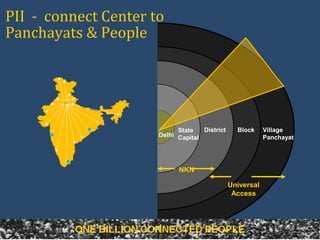
PII - connect Center to
Panchayats & People
State
Capital
District Block Village
Panchayat
NKN
Universal
Access
Delhi
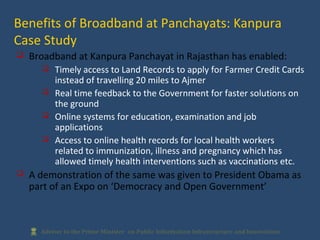
 Broadband at Kanpura Panchayat in Rajasthan has enabled:
 Timely access to Land Records to apply for Farmer Credit Cards
instead of travelling 20 miles to Ajmer
 Real time feedback to the Government for faster solutions on
the ground
 Online systems for education, examination and job
applications
 Access to online health records for local health workers
related to immunization, illness and pregnancy which has
allowed timely health interventions such as vaccinations etc.
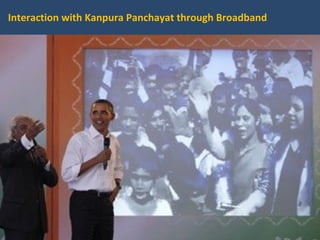
 A demonstration of the same was given to President Obama as
part of an Expo on ‘Democracy and Open Government’
Benefits of Broadband at Panchayats: Kanpura
Case Study
Interaction with Kanpura Panchayat through Broadband
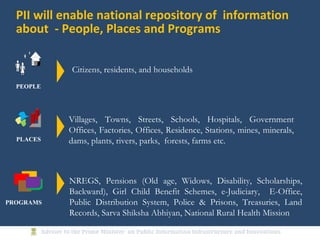
PII will enable national repository of information
about - People, Places and Programs
Citizens, residents, and households
PLACES
Villages, Towns, Streets, Schools, Hospitals, Government
Offices, Factories, Offices, Residence, Stations, mines, minerals,
dams, plants, rivers, parks, forests, farms etc.
PROGRAMS
PEOPLE
NREGS, Pensions (Old age, Widows, Disability, Scholarships,
Backward), Girl Child Benefit Schemes, e-Judiciary, E-Office,
Public Distribution System, Police & Prisons, Treasuries, Land
Records, Sarva Shiksha Abhiyan, National Rural Health Mission
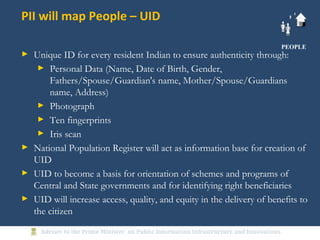
PII will map People – UID
► Unique ID for every resident Indian to ensure authenticity through:
► Personal Data (Name, Date of Birth, Gender,
Fathers/Spouse/Guardian's name, Mother/Spouse/Guardians
name, Address)
► Photograph
► Ten fingerprints
► Iris scan
► National Population Register will act as information base for creation of
UID
► UID to become a basis for orientation of schemes and programs of
Central and State governments and for identifying right beneficiaries
► UID will increase access, quality, and equity in the delivery of benefits to
the citizen
PEOPLE
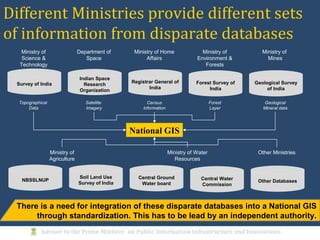
Different Ministries provide different sets
of information from disparate databases
16
Survey of India
Topographical
Data
Ministry of
Science &
Technology
Indian Space
Research
Organization
Satellite
Imagery
Department of
Space
Registrar General of
India
Census
Information
Ministry of Home
Affairs
Forest Survey of
India
Forest
Layer
Ministry of
Environment &
Forests
Geological Survey
of India
Geological
Mineral data
Ministry of
Mines
National GIS
NBSSLNUP
Ministry of
Agriculture
Soil Land Use
Survey of India
Central Ground
Water board
Central Water
Commission
Other Databases
Ministry of Water
Resources
Other Ministries
There is a need for integration of these disparate databases into a National GIS
through standardization. This has to be lead by an independent authority.
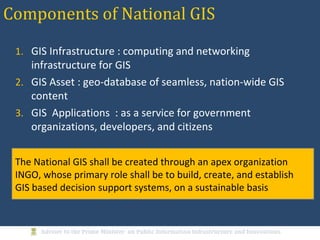
1. GIS Infrastructure : computing and networking
infrastructure for GIS
2. GIS Asset : geo-database of seamless, nation-wide GIS
content
3. GIS Applications : as a service for government
organizations, developers, and citizens
Components of National GIS
17
The National GIS shall be created through an apex organization
INGO, whose primary role shall be to build, create, and establish
GIS based decision support systems, on a sustainable basis
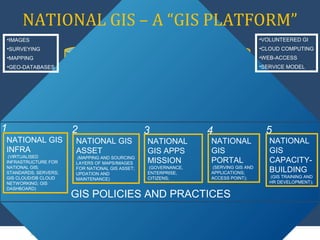
NATIONAL GISNATIONAL GIS
* GIS ASSET * GIS APPLICATIONS* GIS ASSET * GIS APPLICATIONS
GOVERNANCEGOVERNANCE ENTERPRISEENTERPRISE CITIZENSCITIZENS
NATIONAL GIS
INFRA
(VIRTUALISED
INFRASTRUCTURE FOR
NATIONAL GIS;
STANDARDS; SERVERS;
GIS CLOUD/DB CLOUD
NETWORKING; GIS
DASHBOARD)
NATIONAL GIS
ASSET
(MAPPING AND SOURCING
LAYERS OF MAPS/IMAGES
FOR NATIONAL GIS ASSET;
UPDATION AND
MAINTENANCE)
NATIONAL
GIS APPS
MISSION
(GOVERNANCE,
ENTERPRISE,
CITIZENS;
NATIONAL
GIS
PORTAL
(SERVING GIS AND
APPLICATIONS;
ACCESS POINT);
NATIONAL
GIS
CAPACITY-
BUILDING
(GIS TRAINING AND
HR DEVELOPMENT);
1 2 3 4 5
GIS POLICIES AND PRACTICES
NATIONAL GIS – A “GIS PLATFORM”
18
•VOLUNTEERED GI
•CLOUD COMPUTING
•WEB-ACCESS
•SERVICE MODEL
•IMAGES
•SURVEYING
•MAPPING
•GEO-DATABASES
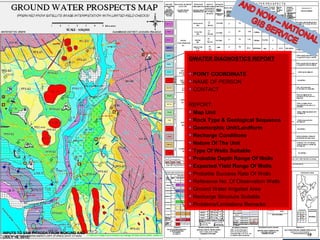
WATER DIVINNG / DOWSING
•LOCATION-SPECIFIC
•SCIENTIFICALLY “DOUBTFUL”
HYDROLOGICAL MAPPING
•RESISITIVITY SURVEYS
•SCIENTIFIC AREA-SURVEYS
•GROUNDWATER MAPS
GWATER DIAGNOSTICS REPORT
• POINT COORDINATE
• NAME OF PERSON
• CONTACT
REPORT:
• Map Unit
• Rock Type & Geological Sequence
• Geomorphic Unit/Landform
• Recharge Conditions
• Nature Of The Unit
• Type Of Wells Suitable
• Probable Depth Range Of Wells
• Expected Yield Range Of Wells
• Probable Success Rate Of Wells
• Reference No. Of Observation Wells
• Ground Water Irrigated Area
• Recharge Structure Suitable
• Problems/Limitations Remarks
19INPUTS TO SAM PITRODA FROM MUKUND RAO
(JULY 16, 2012)
Adviser to the Prime Minister on Public Information Infrastructure and Innovations
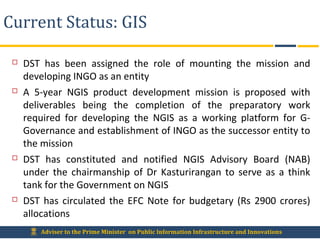
Current Status: GIS
 DST has been assigned the role of mounting the mission and
developing INGO as an entity
 A 5-year NGIS product development mission is proposed with
deliverables being the completion of the preparatory work
required for developing the NGIS as a working platform for G-
Governance and establishment of INGO as the successor entity to
the mission
 DST has constituted and notified NGIS Advisory Board (NAB)
under the chairmanship of Dr Kasturirangan to serve as a think
tank for the Government on NGIS
 DST has circulated the EFC Note for budgetary (Rs 2900 crores)
allocations
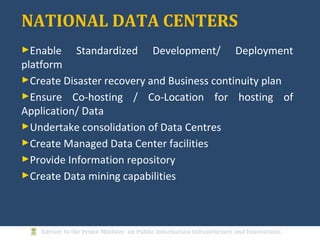
NATIONAL DATA CENTERS
►Enable Standardized Development/ Deployment
platform
►Create Disaster recovery and Business continuity plan
►Ensure Co-hosting / Co-Location for hosting of
Application/ Data
►Undertake consolidation of Data Centres
►Create Managed Data Center facilities
►Provide Information repository
►Create Data mining capabilities
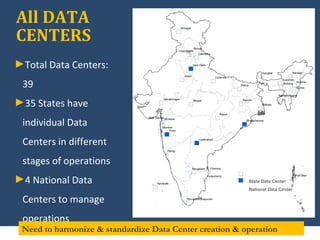
All DATA
CENTERS
National Data Center
State Data Center
►Total Data Centers:
39
►35 States have
individual Data
Centers in different
stages of operations
►4 National Data
Centers to manage
operations
Need to harmonize & standardize Data Center creation & operation
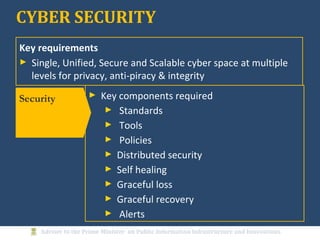
CYBER SECURITY
► Key components required
► Standards
► Tools
► Policies
► Distributed security
► Self healing
► Graceful loss
► Graceful recovery
► Alerts
Security
Key requirements
► Single, Unified, Secure and Scalable cyber space at multiple
levels for privacy, anti-piracy & integrity
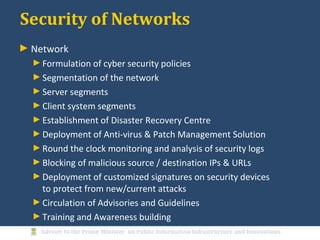
Security of Networks
► Network
►Formulation of cyber security policies
►Segmentation of the network
►Server segments
►Client system segments
►Establishment of Disaster Recovery Centre
►Deployment of Anti-virus & Patch Management Solution
►Round the clock monitoring and analysis of security logs
►Blocking of malicious source / destination IPs & URLs
►Deployment of customized signatures on security devices
to protect from new/current attacks
►Circulation of Advisories and Guidelines
►Training and Awareness building
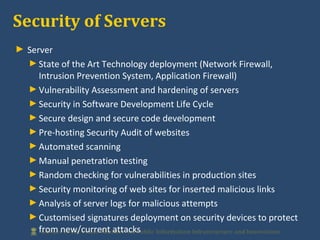
► Server
►State of the Art Technology deployment (Network Firewall,
Intrusion Prevention System, Application Firewall)
►Vulnerability Assessment and hardening of servers
►Security in Software Development Life Cycle
►Secure design and secure code development
►Pre-hosting Security Audit of websites
►Automated scanning
►Manual penetration testing
►Random checking for vulnerabilities in production sites
►Security monitoring of web sites for inserted malicious links
►Analysis of server logs for malicious attempts
►Customised signatures deployment on security devices to protect
from new/current attacks
Security of Servers
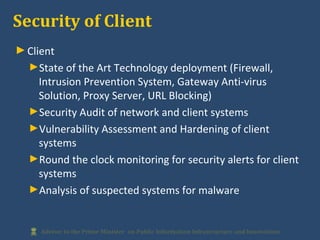
►Client
►State of the Art Technology deployment (Firewall,
Intrusion Prevention System, Gateway Anti-virus
Solution, Proxy Server, URL Blocking)
►Security Audit of network and client systems
►Vulnerability Assessment and Hardening of client
systems
►Round the clock monitoring for security alerts for client
systems
►Analysis of suspected systems for malware
Security of Client
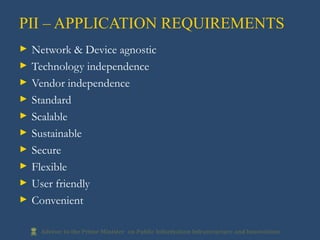
PII – APPLICATION REQUIREMENTS
► Network & Device agnostic
► Technology independence
► Vendor independence
► Standard
► Scalable
► Sustainable
► Secure
► Flexible
► User friendly
► Convenient

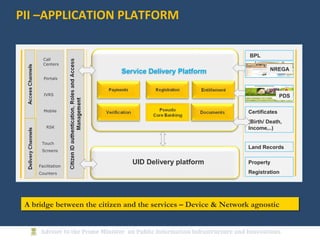
PII –APPLICATION PLATFORM
A bridge between the citizen and the services – Device & Network agnosticA bridge between the citizen and the services – Device & Network agnostic
Service Delivery Platform
Call
Centers
Portals
Mobile
RSK
Touch
Screens
Facilitation
Counters
IVRS
BPL
Certificates
(Birth/ Death,
Income,..)
Land Records
Property
Registration
UID Delivery platform
NREGA
PDS
PII IN ACTION
30
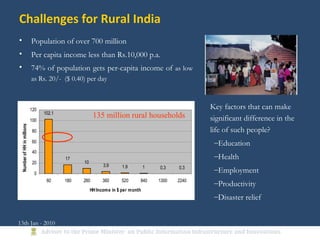
• Population of over 700 million
• Per capita income less than Rs.10,000 p.a.
• 74% of population gets per-capita income of as low
as Rs. 20/- ($ 0.40) per day
102.1
17
10
3.9 1.9 1 0.3 0.3
0
20
40
60
80
100
120
60 180 260 360 520 840 1300 2240
HHIncome in $ per month
NumberofHHinmillions
135 million rural households
Key factors that can make
significant difference in the
life of such people?
–Education
–Health
–Employment
–Productivity
–Disaster relief
Challenges for Rural India
13th Jan - 2010
31
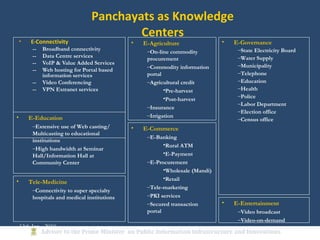
• E-Connectivity
-- Broadband connectivity
-- Data Centre services
-- VoIP & Value Added Services
-- Web hosting for Portal based
information services
-- Video Conferencing
-- VPN Extranet services
Panchayats as Knowledge
Centers
• E-Agriculture
–On-line commodity
procurement
–Commodity information
portal
–Agricultural credit
•Pre-harvest
•Post-harvest
–Insurance
–Irrigation
• E-Governance
–State Electricity Board
–Water Supply
–Municipality
–Telephone
–Education
–Health
–Police
–Labor Department
–Election office
–Census office
• E-Commerce
–E-Banking
•Rural ATM
•E-Payment
–E-Procurement
•Wholesale (Mandi)
•Retail
–Tele-marketing
–PKI services
–Secured transaction
portal
• E-Education
–Extensive use of Web casting/
Multicasting to educational
institutions
–High bandwidth at Seminar
Hall/Information Hall at
Community Center
• Tele-Medicine
–Connectivity to super specialty
hospitals and medical institutions
• E-Entertainment
–Video broadcast
–Video-on-demand
13th Jan - 2010
Adviser to the Prime Minister on Public Information Infrastructure and Innovations
E-Office
 e-Office has been designed by NIC for the need for an effective and
transparent Governance and for the Next Generation Government
needs.
 e-Office is a suite of applications comprising of eFile, Knowledge
Management System and many other features to make Government
interface more efficient.
 Based on Open architecture Framework
 Implemented at 55 locations including various Ministries, Central
and State Government Departments like Cabinet Secretariat, Prime
Minister’s Office (PMO), Ministry of HRD (MoHRD), Dept of
Electronics & Information Technology(DeitY), Chief Minister’s Office,
Government of Maharashtra, State Planning Board, Government of
Kerala
32
Adviser to the Prime Minister on Public Information Infrastructure and Innovations
E-Legal: ICT in Justice Delivery
 Courts of Tomorrow: An initiative to give effect to the extensive
computerisation plan as laid down by the e-courts Mission Mode
Project
 To act as a force multiplier to the on-going ICT enablement
initiatives of the Judiciary, Courts and the Government
 Delhi High Court is the best example of e-court implementation in
the country
 Developed a working paper on ‘Courts of Tomorrow’ in
consultation with Delhi and Bombay High Courts, Ministry of Law
and Justice, and NIC
 Madhya Pradesh State wide pilot initiated
 A proposal on integration of criminal justice system proposed to
the Law Ministry
Adviser to the Prime Minister on Public Information Infrastructure and Innovations
Open Government Platform
 India and the US have developed an Open Government Platform
(OGPL) to promote transparency and citizen engagement
 OGPL will make government data, documents, tools and
processes publicly available in useful machine-readable formats
to develop new applications for citizen benefit. (www.data.gov.in)
 OGPL combines and augments best features of US Data.Gov and
India’s ‘Data.gov.in’ sites and will be offered to interested third
country Governments.
 OGPL will enhance access and use of Government data to foster
innovation, improve delivery of Government services, and
promote government accountability and transparency.
 Currently Data.gov.in is operational and has 2000 datasets
Adviser to the Prime Minister on Public Information Infrastructure and Innovations
Websites & Portals
Websites
Adviser to the Prime Minister: www.iii.gov.in
National Innovation Council: www.innovationcouncil.gov.in
National Knowledge Commission: www.knowledgecommission.gov.in
Global Innovation roundtable:
www.globalinnovationroundtable.gov.in
National Knowledge Network: http://www.nkn.in/
India Smart Grid Task Force: www.isgtf.in
Modernization of Indian Railways: www.railwaymodernisation.gov.in
Adviser to the Prime Minister on Public Information Infrastructure and Innovations
Websites & Portals
Portals
 National Innovation Portal: www.innovation.gov.in
 India Biodiversity Portal: www.indiabiodiversity.org
 Teachers of India: www.teachersofindia.org
 India Environment Portal:
www.indiaenvironmentportal.org.in
 India Energy Portal: www.indiaenergyportal.org
 India Water Portal: www.indiawaterportal.org
Adviser to the Prime Minister on Public Information Infrastructure and Innovations
Websites & Portals
Social Media:
 Facebook: http://www.facebook.com/pages/New-Delhi-
India/Adviser-to-the-PM-on-Public-Information-
Infrastructure-and-Innovations/100738043327407?
v=wall
 Youtube: http://www.youtube.com/iii
 Wikipedia: http://en.wikipedia.org/wiki/Sam_Pitroda
 Flickr: http://www.flickr.com/photos/71175052@N04/
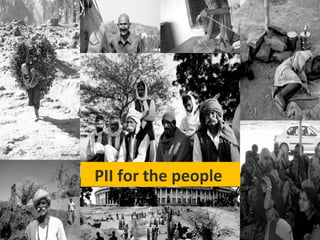
PII for the people

Public Information Infrastructure

  • 2.
    In the 21stcentury – Information will be the fourth pillar of democracy 2 Executive Legislature InformationJudiciary FUTURE OF GOVERNANCEFUTURE OF GOVERNANCE Information as lever of Economic and Social Development Information available in real time to share, manage & collaborate - accurate, reliable, timely & usable Government control of strategic information – critical
  • 3.
    INFORMATION Strengthening the FourthPillar of Democracy requires PUBLIC INFORMATION INFRASTRUCTURE ► Create - access, connectivity, systems, processes, programs, structures, standards & platform ► Integrate - geographical (Centre/State) & sectoral (agriculture, transport, finance etc.) boundaries & applications into Single-Secure National Information Space
  • 4.
    Democratising Information throughPII  Information is a “public good” / “merit good”  Will bring Technology and People together on an equitable/inclusive platform  Radicalize democracy through informed citizen participation  Improve delivery of & access to public services  Empower local governance & community institutions  Enhance Equity & Efficiency  Public information infrastructure will transform India’s 1.2 billion people into 1.2 billion “opportunities”
  • 5.
    1. NKN 2. NOFN 3.Date Centres 4. NeGP: 30 Mission Mode Projects 5. UID 6. National GIS 7. E-Courts 8. E-Files 9. Platforms 10. Open Government Platform Elements of PII 5
  • 6.
    Conceptual Architecture ofPII Service Platforms Applications Standards Technology tools Food Health Livelihood Education Agriculture Focused Programmes Meta-Data Data StandardsCyber Security Open Source Social Media UID Payment National GIS Networks – NKN and NOFN Security Infrastructure – the cloud Datacenters Citizen
  • 7.
  • 8.
    Adviser to thePrime Minister on Public Information Infrastructure and Innovations National Knowledge Network  Government is building an IP Network with gigabit capabilities to connect 1500 plus nodes across the country for Education and Research to expand, excel & collaborate  All universities will be included in this  NKN is operational with 2.5 gigabits and over 1001 institutions are connected today  NKN to consolidate multiple networks in the country  NKN to provide new virtual network facilities  NKN to be the backbone for the Education, health, Research and multiple applications for the future
  • 9.
    NKN - consolidateother Networks Educational Institutions Research Labs CSIR/DAE/ISRO/ICAR INTERNET Connections to Global Networks (e.g. GEANT) EDUSAT MPLS Clouds Broad Band Clouds National / State Data Centers / Networks National Internet Exchange Points (NIXI) Cert-IN/ NTRO
  • 10.
    Adviser to thePrime Minister on Public Information Infrastructure and Innovations Increasing Connectivity for Innovation: Rural Broadband  Rural broadband to connect all 250,000 panchayats in two years for democratising information, openness, connectivity, transparency and accountability  Transformational potential in governance  Delivery of public services  Real time feedback  Monitoring G to G transactions  Training of panchayat and other grassroots functionaries  Skilling the community  Empowering the community through e-library/reading room  Crowd sourcing feedback and suggestions  Larger goal: Radicalising democracy through information  Government has approved the proposal to connect all 250,000 Panchayats through optic fiber on 25th October 2011  59 pilots completed in Rajasthan, Andhra Pradesh, Tripura. Applications being tried out  Deadline for connectivity to all Panchayats is early 2014
  • 11.
    PII - connectCenter to Panchayats & People State Capital District Block Village Panchayat NKN Universal Access Delhi
  • 12.
     Broadband atKanpura Panchayat in Rajasthan has enabled:  Timely access to Land Records to apply for Farmer Credit Cards instead of travelling 20 miles to Ajmer  Real time feedback to the Government for faster solutions on the ground  Online systems for education, examination and job applications  Access to online health records for local health workers related to immunization, illness and pregnancy which has allowed timely health interventions such as vaccinations etc.  A demonstration of the same was given to President Obama as part of an Expo on ‘Democracy and Open Government’ Benefits of Broadband at Panchayats: Kanpura Case Study
  • 13.
    Interaction with KanpuraPanchayat through Broadband
  • 14.
    PII will enablenational repository of information about - People, Places and Programs Citizens, residents, and households PLACES Villages, Towns, Streets, Schools, Hospitals, Government Offices, Factories, Offices, Residence, Stations, mines, minerals, dams, plants, rivers, parks, forests, farms etc. PROGRAMS PEOPLE NREGS, Pensions (Old age, Widows, Disability, Scholarships, Backward), Girl Child Benefit Schemes, e-Judiciary, E-Office, Public Distribution System, Police & Prisons, Treasuries, Land Records, Sarva Shiksha Abhiyan, National Rural Health Mission
  • 15.
    PII will mapPeople – UID ► Unique ID for every resident Indian to ensure authenticity through: ► Personal Data (Name, Date of Birth, Gender, Fathers/Spouse/Guardian's name, Mother/Spouse/Guardians name, Address) ► Photograph ► Ten fingerprints ► Iris scan ► National Population Register will act as information base for creation of UID ► UID to become a basis for orientation of schemes and programs of Central and State governments and for identifying right beneficiaries ► UID will increase access, quality, and equity in the delivery of benefits to the citizen PEOPLE
  • 16.
    Different Ministries providedifferent sets of information from disparate databases 16 Survey of India Topographical Data Ministry of Science & Technology Indian Space Research Organization Satellite Imagery Department of Space Registrar General of India Census Information Ministry of Home Affairs Forest Survey of India Forest Layer Ministry of Environment & Forests Geological Survey of India Geological Mineral data Ministry of Mines National GIS NBSSLNUP Ministry of Agriculture Soil Land Use Survey of India Central Ground Water board Central Water Commission Other Databases Ministry of Water Resources Other Ministries There is a need for integration of these disparate databases into a National GIS through standardization. This has to be lead by an independent authority.
  • 17.
    1. GIS Infrastructure: computing and networking infrastructure for GIS 2. GIS Asset : geo-database of seamless, nation-wide GIS content 3. GIS Applications : as a service for government organizations, developers, and citizens Components of National GIS 17 The National GIS shall be created through an apex organization INGO, whose primary role shall be to build, create, and establish GIS based decision support systems, on a sustainable basis
  • 18.
    NATIONAL GISNATIONAL GIS *GIS ASSET * GIS APPLICATIONS* GIS ASSET * GIS APPLICATIONS GOVERNANCEGOVERNANCE ENTERPRISEENTERPRISE CITIZENSCITIZENS NATIONAL GIS INFRA (VIRTUALISED INFRASTRUCTURE FOR NATIONAL GIS; STANDARDS; SERVERS; GIS CLOUD/DB CLOUD NETWORKING; GIS DASHBOARD) NATIONAL GIS ASSET (MAPPING AND SOURCING LAYERS OF MAPS/IMAGES FOR NATIONAL GIS ASSET; UPDATION AND MAINTENANCE) NATIONAL GIS APPS MISSION (GOVERNANCE, ENTERPRISE, CITIZENS; NATIONAL GIS PORTAL (SERVING GIS AND APPLICATIONS; ACCESS POINT); NATIONAL GIS CAPACITY- BUILDING (GIS TRAINING AND HR DEVELOPMENT); 1 2 3 4 5 GIS POLICIES AND PRACTICES NATIONAL GIS – A “GIS PLATFORM” 18 •VOLUNTEERED GI •CLOUD COMPUTING •WEB-ACCESS •SERVICE MODEL •IMAGES •SURVEYING •MAPPING •GEO-DATABASES
  • 19.
    WATER DIVINNG /DOWSING •LOCATION-SPECIFIC •SCIENTIFICALLY “DOUBTFUL” HYDROLOGICAL MAPPING •RESISITIVITY SURVEYS •SCIENTIFIC AREA-SURVEYS •GROUNDWATER MAPS GWATER DIAGNOSTICS REPORT • POINT COORDINATE • NAME OF PERSON • CONTACT REPORT: • Map Unit • Rock Type & Geological Sequence • Geomorphic Unit/Landform • Recharge Conditions • Nature Of The Unit • Type Of Wells Suitable • Probable Depth Range Of Wells • Expected Yield Range Of Wells • Probable Success Rate Of Wells • Reference No. Of Observation Wells • Ground Water Irrigated Area • Recharge Structure Suitable • Problems/Limitations Remarks 19INPUTS TO SAM PITRODA FROM MUKUND RAO (JULY 16, 2012)
  • 20.
    Adviser to thePrime Minister on Public Information Infrastructure and Innovations Current Status: GIS  DST has been assigned the role of mounting the mission and developing INGO as an entity  A 5-year NGIS product development mission is proposed with deliverables being the completion of the preparatory work required for developing the NGIS as a working platform for G- Governance and establishment of INGO as the successor entity to the mission  DST has constituted and notified NGIS Advisory Board (NAB) under the chairmanship of Dr Kasturirangan to serve as a think tank for the Government on NGIS  DST has circulated the EFC Note for budgetary (Rs 2900 crores) allocations
  • 21.
    NATIONAL DATA CENTERS ►EnableStandardized Development/ Deployment platform ►Create Disaster recovery and Business continuity plan ►Ensure Co-hosting / Co-Location for hosting of Application/ Data ►Undertake consolidation of Data Centres ►Create Managed Data Center facilities ►Provide Information repository ►Create Data mining capabilities
  • 22.
    All DATA CENTERS National DataCenter State Data Center ►Total Data Centers: 39 ►35 States have individual Data Centers in different stages of operations ►4 National Data Centers to manage operations Need to harmonize & standardize Data Center creation & operation
  • 23.
    CYBER SECURITY ► Keycomponents required ► Standards ► Tools ► Policies ► Distributed security ► Self healing ► Graceful loss ► Graceful recovery ► Alerts Security Key requirements ► Single, Unified, Secure and Scalable cyber space at multiple levels for privacy, anti-piracy & integrity
  • 24.
    Security of Networks ►Network ►Formulation of cyber security policies ►Segmentation of the network ►Server segments ►Client system segments ►Establishment of Disaster Recovery Centre ►Deployment of Anti-virus & Patch Management Solution ►Round the clock monitoring and analysis of security logs ►Blocking of malicious source / destination IPs & URLs ►Deployment of customized signatures on security devices to protect from new/current attacks ►Circulation of Advisories and Guidelines ►Training and Awareness building
  • 25.
    ► Server ►State ofthe Art Technology deployment (Network Firewall, Intrusion Prevention System, Application Firewall) ►Vulnerability Assessment and hardening of servers ►Security in Software Development Life Cycle ►Secure design and secure code development ►Pre-hosting Security Audit of websites ►Automated scanning ►Manual penetration testing ►Random checking for vulnerabilities in production sites ►Security monitoring of web sites for inserted malicious links ►Analysis of server logs for malicious attempts ►Customised signatures deployment on security devices to protect from new/current attacks Security of Servers
  • 26.
    ►Client ►State of theArt Technology deployment (Firewall, Intrusion Prevention System, Gateway Anti-virus Solution, Proxy Server, URL Blocking) ►Security Audit of network and client systems ►Vulnerability Assessment and Hardening of client systems ►Round the clock monitoring for security alerts for client systems ►Analysis of suspected systems for malware Security of Client
  • 27.
    PII – APPLICATIONREQUIREMENTS ► Network & Device agnostic ► Technology independence ► Vendor independence ► Standard ► Scalable ► Sustainable ► Secure ► Flexible ► User friendly ► Convenient 
  • 28.
    PII –APPLICATION PLATFORM Abridge between the citizen and the services – Device & Network agnosticA bridge between the citizen and the services – Device & Network agnostic Service Delivery Platform Call Centers Portals Mobile RSK Touch Screens Facilitation Counters IVRS BPL Certificates (Birth/ Death, Income,..) Land Records Property Registration UID Delivery platform NREGA PDS
  • 29.
  • 30.
    30 • Population ofover 700 million • Per capita income less than Rs.10,000 p.a. • 74% of population gets per-capita income of as low as Rs. 20/- ($ 0.40) per day 102.1 17 10 3.9 1.9 1 0.3 0.3 0 20 40 60 80 100 120 60 180 260 360 520 840 1300 2240 HHIncome in $ per month NumberofHHinmillions 135 million rural households Key factors that can make significant difference in the life of such people? –Education –Health –Employment –Productivity –Disaster relief Challenges for Rural India 13th Jan - 2010
  • 31.
    31 • E-Connectivity -- Broadbandconnectivity -- Data Centre services -- VoIP & Value Added Services -- Web hosting for Portal based information services -- Video Conferencing -- VPN Extranet services Panchayats as Knowledge Centers • E-Agriculture –On-line commodity procurement –Commodity information portal –Agricultural credit •Pre-harvest •Post-harvest –Insurance –Irrigation • E-Governance –State Electricity Board –Water Supply –Municipality –Telephone –Education –Health –Police –Labor Department –Election office –Census office • E-Commerce –E-Banking •Rural ATM •E-Payment –E-Procurement •Wholesale (Mandi) •Retail –Tele-marketing –PKI services –Secured transaction portal • E-Education –Extensive use of Web casting/ Multicasting to educational institutions –High bandwidth at Seminar Hall/Information Hall at Community Center • Tele-Medicine –Connectivity to super specialty hospitals and medical institutions • E-Entertainment –Video broadcast –Video-on-demand 13th Jan - 2010
  • 32.
    Adviser to thePrime Minister on Public Information Infrastructure and Innovations E-Office  e-Office has been designed by NIC for the need for an effective and transparent Governance and for the Next Generation Government needs.  e-Office is a suite of applications comprising of eFile, Knowledge Management System and many other features to make Government interface more efficient.  Based on Open architecture Framework  Implemented at 55 locations including various Ministries, Central and State Government Departments like Cabinet Secretariat, Prime Minister’s Office (PMO), Ministry of HRD (MoHRD), Dept of Electronics & Information Technology(DeitY), Chief Minister’s Office, Government of Maharashtra, State Planning Board, Government of Kerala 32
  • 33.
    Adviser to thePrime Minister on Public Information Infrastructure and Innovations E-Legal: ICT in Justice Delivery  Courts of Tomorrow: An initiative to give effect to the extensive computerisation plan as laid down by the e-courts Mission Mode Project  To act as a force multiplier to the on-going ICT enablement initiatives of the Judiciary, Courts and the Government  Delhi High Court is the best example of e-court implementation in the country  Developed a working paper on ‘Courts of Tomorrow’ in consultation with Delhi and Bombay High Courts, Ministry of Law and Justice, and NIC  Madhya Pradesh State wide pilot initiated  A proposal on integration of criminal justice system proposed to the Law Ministry
  • 34.
    Adviser to thePrime Minister on Public Information Infrastructure and Innovations Open Government Platform  India and the US have developed an Open Government Platform (OGPL) to promote transparency and citizen engagement  OGPL will make government data, documents, tools and processes publicly available in useful machine-readable formats to develop new applications for citizen benefit. (www.data.gov.in)  OGPL combines and augments best features of US Data.Gov and India’s ‘Data.gov.in’ sites and will be offered to interested third country Governments.  OGPL will enhance access and use of Government data to foster innovation, improve delivery of Government services, and promote government accountability and transparency.  Currently Data.gov.in is operational and has 2000 datasets
  • 35.
    Adviser to thePrime Minister on Public Information Infrastructure and Innovations Websites & Portals Websites Adviser to the Prime Minister: www.iii.gov.in National Innovation Council: www.innovationcouncil.gov.in National Knowledge Commission: www.knowledgecommission.gov.in Global Innovation roundtable: www.globalinnovationroundtable.gov.in National Knowledge Network: http://www.nkn.in/ India Smart Grid Task Force: www.isgtf.in Modernization of Indian Railways: www.railwaymodernisation.gov.in
  • 36.
    Adviser to thePrime Minister on Public Information Infrastructure and Innovations Websites & Portals Portals  National Innovation Portal: www.innovation.gov.in  India Biodiversity Portal: www.indiabiodiversity.org  Teachers of India: www.teachersofindia.org  India Environment Portal: www.indiaenvironmentportal.org.in  India Energy Portal: www.indiaenergyportal.org  India Water Portal: www.indiawaterportal.org
  • 37.
    Adviser to thePrime Minister on Public Information Infrastructure and Innovations Websites & Portals Social Media:  Facebook: http://www.facebook.com/pages/New-Delhi- India/Adviser-to-the-PM-on-Public-Information- Infrastructure-and-Innovations/100738043327407? v=wall  Youtube: http://www.youtube.com/iii  Wikipedia: http://en.wikipedia.org/wiki/Sam_Pitroda  Flickr: http://www.flickr.com/photos/71175052@N04/
  • 38.

Editor's Notes

  • #20 A unique GI for societal application is the targeting of ground-water in villages and using images and GIS integration to spot those targets and prepare a unique database solution for the rural areas. This has been quite successful and is a major activity in India. Evaluation from almost 20,000 sites in India has shown that when sites are identified using RS and GIS techniques the probability of success rate of striking good-yield source is almost 95% and higher - compared to about 45% when sites are identified just based on conventional methods.