Elementary Education: Perspectives and Challenges Dinesh Kumar  Kendriya Vidyalaya Sangathan
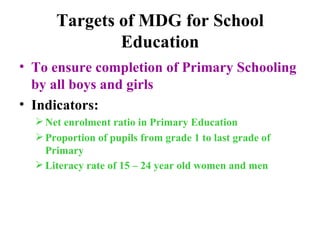
Targets of MDG for School Education To ensure completion of Primary Schooling by all boys and girls Indicators:  Net enrolment ratio in Primary Education Proportion of pupils from grade 1 to last grade of Primary Literacy rate of 15 – 24 year old women and men
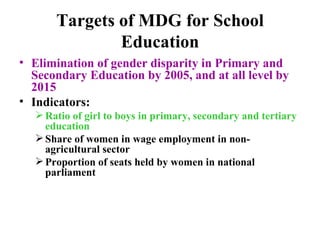
Targets of MDG for School Education Elimination of gender disparity in Primary and Secondary Education by 2005, and at all level by 2015 Indicators: Ratio of girl to boys in primary, secondary and tertiary education Share of women in wage employment in non-agricultural sector Proportion of seats held by women in national parliament
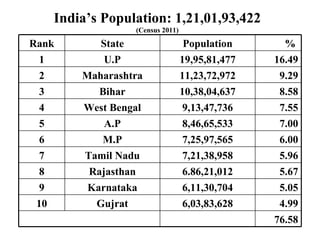
India’s Population: 1,21,01,93,422 (Census 2011) Rank State Population %  1 U.P 19,95,81,477 16.49 2 Maharashtra 11,23,72,972 9.29 3 Bihar 10,38,04,637 8.58 4 West Bengal 9,13,47,736 7.55 5 A.P 8,46,65,533 7.00 6 M.P 7,25,97,565 6.00 7 Tamil Nadu 7,21,38,958 5.96 8 Rajasthan 6.86,21,012 5.67 9 Karnataka 6,11,30,704 5.05 10 Gujrat 6,03,83,628 4.99 76.58
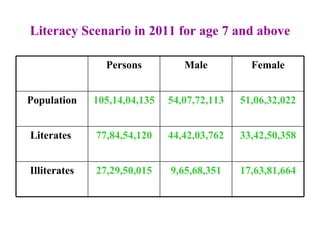
Literacy Scenario in 2011 for age 7 and above Persons Male Female Population 105,14,04,135 54,07,72,113 51,06,32,022 Literates  77,84,54,120 44,42,03,762 33,42,50,358 Illiterates 27,29,50,015 9,65,68,351 17,63,81,664
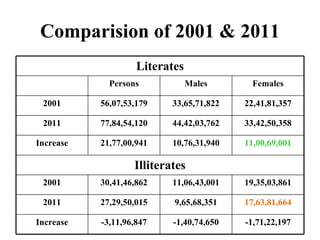
Comparision of 2001 & 2011 Literates Persons Males Females 2001 56,07,53,179 33,65,71,822 22,41,81,357 2011 77,84,54,120 44,42,03,762 33,42,50,358 Increase 21,77,00,941 10,76,31,940 11,00,69,001 Illiterates 2001 30,41,46,862 11,06,43,001 19,35,03,861 2011 27,29,50,015 9,65,68,351 17,63,81,664 Increase -3,11,96,847 -1,40,74,650 -1,71,22,197
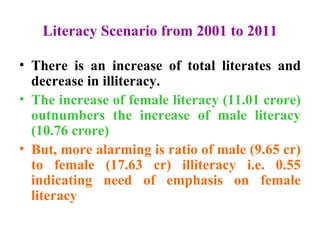
Literacy Scenario from 2001 to 2011 There is an increase of total literates and decrease in illiteracy. The increase of female literacy (11.01 crore) outnumbers the increase of male literacy (10.76 crore) But, more alarming is ratio of male (9.65 cr) to female (17.63 cr) illiteracy i.e. 0.55 indicating need of emphasis on female literacy
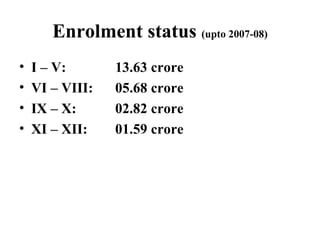
Enrolment status  (upto 2007-08) I – V:  13.63 crore VI – VIII: 05.68 crore IX – X: 02.82 crore XI – XII: 01.59 crore
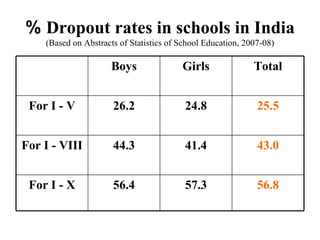
%  Dropout rates in schools in India (Based on Abstracts of Statistics of School Education, 2007-08) Boys Girls Total For I - V 26.2 24.8 25.5 For I - VIII 44.3 41.4 43.0 For I - X 56.4 57.3 56.8
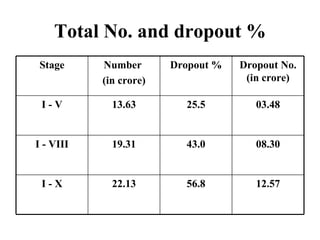
Total No. and dropout % Stage Number  (in crore) Dropout % Dropout No. (in crore) I - V 13.63 25.5 03.48 I - VIII 19.31 43.0 08.30 I - X 22.13 56.8 12.57
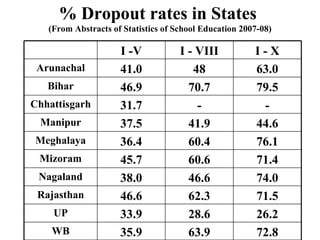
% Dropout rates in States  (From Abstracts of Statistics of School Education 2007-08) I -V I - VIII I - X Arunachal 41.0 48 63.0 Bihar 46.9 70.7 79.5 Chhattisgarh 31.7 - - Manipur 37.5 41.9 44.6 Meghalaya 36.4 60.4 76.1 Mizoram 45.7 60.6 71.4 Nagaland 38.0 46.6 74.0 Rajasthan 46.6 62.3 71.5 UP 33.9 28.6 26.2 WB 35.9 63.9 72.8
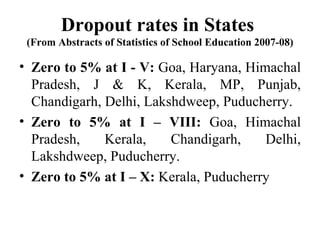
Dropout rates in States  (From Abstracts of Statistics of School Education 2007-08) Zero to 5% at I - V:  Goa, Haryana, Himachal Pradesh, J & K, Kerala, MP, Punjab, Chandigarh, Delhi, Lakshdweep, Puducherry. Zero to 5% at I – VIII:  Goa, Himachal Pradesh, Kerala, Chandigarh, Delhi, Lakshdweep, Puducherry. Zero to 5% at I – X:  Kerala, Puducherry
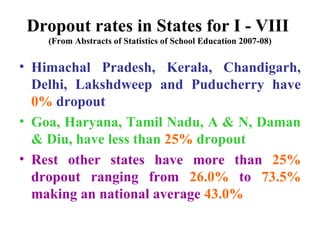
Dropout rates in States for I - VIII  (From Abstracts of Statistics of School Education 2007-08) Himachal Pradesh, Kerala, Chandigarh, Delhi, Lakshdweep and Puducherry have  0%  dropout Goa, Haryana, Tamil Nadu, A & N, Daman & Diu, have less than  25%  dropout Rest other states have more than  25%  dropout ranging from  26.0%  to  73.5%  making an national average  43.0%
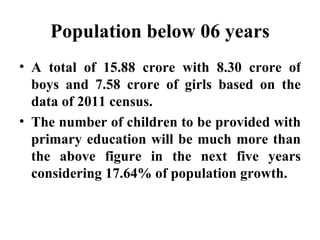
Population below 06 years A total of 15.88 crore with 8.30 crore of boys and 7.58 crore of girls based on the data of 2011 census. The number of children to be provided with primary education will be much more than the above figure in the next five years considering 17.64% of population growth.
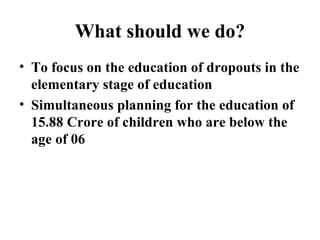
What should we do? To focus on the education of dropouts in the elementary stage of education Simultaneous planning for the education of  15.88 Crore of children who are below the age of 06
Important Concerns  Reduction in dropouts Increasing in access to school Increased emphasis on girl education Emphasis on skill development Quality of education and not mere literacy
Governments initiatives SSA Right of Children to Free and Compulsory Education Act, 2009 National Programme for Girls Education at Elementary Level (NPEGEL) Kasturba Gandhi Balika Vidyalaya (KGBV) Education Guarantee Scheme (EGS) and Alternative and Innovative Education (AIE) Centres
Time target under RTE Establishing neighboring school:  31.03.2013 School Infrastructure:  31.03.2013 Teachers as per PTR:  31.03.2013 Training of untrained teachers:  31.03.2015 There is a need to act fast.
Budget under RTE/SSA Provision of  Rs.231233 Crore  for the plan period 2010-11 to 2014-15 Annual requirement for central and state governments are approximately  Rs.40000  and  Rs.49000 Crore  respectively
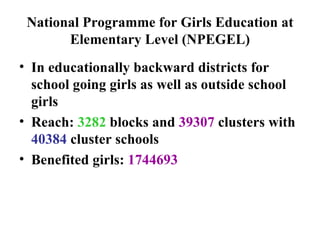
National Programme for Girls Education at Elementary Level (NPEGEL) In educationally backward districts for school going girls as well as outside school girls Reach:  3282  blocks and  39307  clusters with  40384  cluster schools Benefited girls:  1744693
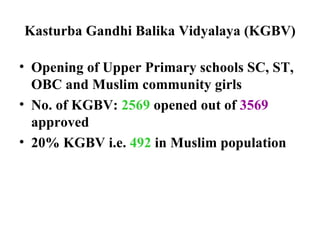
Kasturba Gandhi Balika Vidyalaya (KGBV) Opening of Upper Primary schools SC, ST, OBC and Muslim community girls No. of KGBV:  2569  opened out of  3569  approved 20% KGBV i.e.  492  in Muslim population
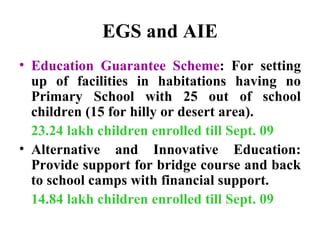
EGS and AIE Education Guarantee Scheme : For setting up of facilities in habitations having no Primary School with 25 out of school children (15 for hilly or desert area).  23.24 lakh children enrolled till Sept. 09 Alternative and Innovative Education: Provide support for bridge course and back to school camps with financial support.  14.84 lakh children enrolled till Sept. 09
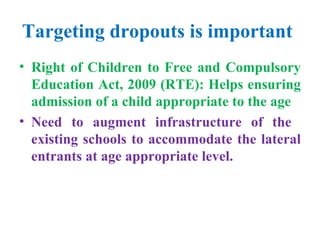
Targeting dropouts is important   Right of Children to Free and Compulsory Education Act, 2009 (RTE): Helps ensuring admission of a child appropriate to the age Need to augment infrastructure of the  existing schools to accommodate the lateral entrants at age appropriate level.
Targeting dropouts is important Developing modules for bridging the learning gaps of the child  Need to address the experience of the child Appropriate training of teachers to address such issues Strategies for rural, urban and marginalized  group’s children Flexibility in academic calendar and school timings
Infrastructure: Access to School and Facilities   Despite robust budget provision and launch of number of projects the target of ensuring Primary schooling for all boys and girls and complete literacy of 15 – 24 year old women and men by 2015 looks difficult. Need of maximum utilization of  of the available infra structure in the area of school education
Infrastructure: Access to School and Facilities Flexible timing addresses the convenience of both rural and urban students of all sections due to obvious reasons Opening of new schools needs huge investment which is always a constraint for the Government.  Running the schools in shifts may be one of the solutions for access to school by the deprived
Infrastructure: Access to School and Facilities Opening of Schools in PPP model More involvement of local bodies especially in rural areas Promotion of NGOs an VOs
Teacher Problem of shortage of teachers (Not a priority career option) Need of giving appropriate emphasis on Secondary, Higher Secondary and Higher education with an aim to fulfill the increasing demand of teachers  Shortage of the Pre-service training institutes for teachers Uniform Standard and monitoring the quality of teachers training institutes Sense of belongingness: Need to address adhocism
Teacher’s training Emphasis of training the untrained teachers In-service teacher’s training – needs to be more structured Every educational organisations in centre and state to actively take up in-service training of teachers Periodicity of training of teachers to upgrade their knowledge and skill in the changing paradigm of education
Vocationalisation in school education Emphasis has now been shifted towards it and to infuse in the curriculum National Vocational Qualification Framework for Schools Freedom of states to take up vocationalisation in schools as per needs and necessity
Problems in vocationalisation Perception of inferiority about vocational courses No direct linkage with job even (Need of partnerships with industry and corporate) Difficulty in pursuing Higher Education (Need of linkage)
Thankyou

Dinesh Kumar

  • 1.
    Elementary Education: Perspectivesand Challenges Dinesh Kumar Kendriya Vidyalaya Sangathan
  • 2.
    Targets of MDGfor School Education To ensure completion of Primary Schooling by all boys and girls Indicators: Net enrolment ratio in Primary Education Proportion of pupils from grade 1 to last grade of Primary Literacy rate of 15 – 24 year old women and men
  • 3.
    Targets of MDGfor School Education Elimination of gender disparity in Primary and Secondary Education by 2005, and at all level by 2015 Indicators: Ratio of girl to boys in primary, secondary and tertiary education Share of women in wage employment in non-agricultural sector Proportion of seats held by women in national parliament
  • 4.
    India’s Population: 1,21,01,93,422(Census 2011) Rank State Population % 1 U.P 19,95,81,477 16.49 2 Maharashtra 11,23,72,972 9.29 3 Bihar 10,38,04,637 8.58 4 West Bengal 9,13,47,736 7.55 5 A.P 8,46,65,533 7.00 6 M.P 7,25,97,565 6.00 7 Tamil Nadu 7,21,38,958 5.96 8 Rajasthan 6.86,21,012 5.67 9 Karnataka 6,11,30,704 5.05 10 Gujrat 6,03,83,628 4.99 76.58
  • 5.
    Literacy Scenario in2011 for age 7 and above Persons Male Female Population 105,14,04,135 54,07,72,113 51,06,32,022 Literates 77,84,54,120 44,42,03,762 33,42,50,358 Illiterates 27,29,50,015 9,65,68,351 17,63,81,664
  • 6.
    Comparision of 2001& 2011 Literates Persons Males Females 2001 56,07,53,179 33,65,71,822 22,41,81,357 2011 77,84,54,120 44,42,03,762 33,42,50,358 Increase 21,77,00,941 10,76,31,940 11,00,69,001 Illiterates 2001 30,41,46,862 11,06,43,001 19,35,03,861 2011 27,29,50,015 9,65,68,351 17,63,81,664 Increase -3,11,96,847 -1,40,74,650 -1,71,22,197
  • 7.
    Literacy Scenario from2001 to 2011 There is an increase of total literates and decrease in illiteracy. The increase of female literacy (11.01 crore) outnumbers the increase of male literacy (10.76 crore) But, more alarming is ratio of male (9.65 cr) to female (17.63 cr) illiteracy i.e. 0.55 indicating need of emphasis on female literacy
  • 8.
    Enrolment status (upto 2007-08) I – V: 13.63 crore VI – VIII: 05.68 crore IX – X: 02.82 crore XI – XII: 01.59 crore
  • 9.
    % Dropoutrates in schools in India (Based on Abstracts of Statistics of School Education, 2007-08) Boys Girls Total For I - V 26.2 24.8 25.5 For I - VIII 44.3 41.4 43.0 For I - X 56.4 57.3 56.8
  • 10.
    Total No. anddropout % Stage Number (in crore) Dropout % Dropout No. (in crore) I - V 13.63 25.5 03.48 I - VIII 19.31 43.0 08.30 I - X 22.13 56.8 12.57
  • 11.
    % Dropout ratesin States (From Abstracts of Statistics of School Education 2007-08) I -V I - VIII I - X Arunachal 41.0 48 63.0 Bihar 46.9 70.7 79.5 Chhattisgarh 31.7 - - Manipur 37.5 41.9 44.6 Meghalaya 36.4 60.4 76.1 Mizoram 45.7 60.6 71.4 Nagaland 38.0 46.6 74.0 Rajasthan 46.6 62.3 71.5 UP 33.9 28.6 26.2 WB 35.9 63.9 72.8
  • 12.
    Dropout rates inStates (From Abstracts of Statistics of School Education 2007-08) Zero to 5% at I - V: Goa, Haryana, Himachal Pradesh, J & K, Kerala, MP, Punjab, Chandigarh, Delhi, Lakshdweep, Puducherry. Zero to 5% at I – VIII: Goa, Himachal Pradesh, Kerala, Chandigarh, Delhi, Lakshdweep, Puducherry. Zero to 5% at I – X: Kerala, Puducherry
  • 13.
    Dropout rates inStates for I - VIII (From Abstracts of Statistics of School Education 2007-08) Himachal Pradesh, Kerala, Chandigarh, Delhi, Lakshdweep and Puducherry have 0% dropout Goa, Haryana, Tamil Nadu, A & N, Daman & Diu, have less than 25% dropout Rest other states have more than 25% dropout ranging from 26.0% to 73.5% making an national average 43.0%
  • 14.
    Population below 06years A total of 15.88 crore with 8.30 crore of boys and 7.58 crore of girls based on the data of 2011 census. The number of children to be provided with primary education will be much more than the above figure in the next five years considering 17.64% of population growth.
  • 15.
    What should wedo? To focus on the education of dropouts in the elementary stage of education Simultaneous planning for the education of 15.88 Crore of children who are below the age of 06
  • 16.
    Important Concerns Reduction in dropouts Increasing in access to school Increased emphasis on girl education Emphasis on skill development Quality of education and not mere literacy
  • 17.
    Governments initiatives SSARight of Children to Free and Compulsory Education Act, 2009 National Programme for Girls Education at Elementary Level (NPEGEL) Kasturba Gandhi Balika Vidyalaya (KGBV) Education Guarantee Scheme (EGS) and Alternative and Innovative Education (AIE) Centres
  • 18.
    Time target underRTE Establishing neighboring school: 31.03.2013 School Infrastructure: 31.03.2013 Teachers as per PTR: 31.03.2013 Training of untrained teachers: 31.03.2015 There is a need to act fast.
  • 19.
    Budget under RTE/SSAProvision of Rs.231233 Crore for the plan period 2010-11 to 2014-15 Annual requirement for central and state governments are approximately Rs.40000 and Rs.49000 Crore respectively
  • 20.
    National Programme forGirls Education at Elementary Level (NPEGEL) In educationally backward districts for school going girls as well as outside school girls Reach: 3282 blocks and 39307 clusters with 40384 cluster schools Benefited girls: 1744693
  • 21.
    Kasturba Gandhi BalikaVidyalaya (KGBV) Opening of Upper Primary schools SC, ST, OBC and Muslim community girls No. of KGBV: 2569 opened out of 3569 approved 20% KGBV i.e. 492 in Muslim population
  • 22.
    EGS and AIEEducation Guarantee Scheme : For setting up of facilities in habitations having no Primary School with 25 out of school children (15 for hilly or desert area). 23.24 lakh children enrolled till Sept. 09 Alternative and Innovative Education: Provide support for bridge course and back to school camps with financial support. 14.84 lakh children enrolled till Sept. 09
  • 23.
    Targeting dropouts isimportant Right of Children to Free and Compulsory Education Act, 2009 (RTE): Helps ensuring admission of a child appropriate to the age Need to augment infrastructure of the existing schools to accommodate the lateral entrants at age appropriate level.
  • 24.
    Targeting dropouts isimportant Developing modules for bridging the learning gaps of the child Need to address the experience of the child Appropriate training of teachers to address such issues Strategies for rural, urban and marginalized group’s children Flexibility in academic calendar and school timings
  • 25.
    Infrastructure: Access toSchool and Facilities Despite robust budget provision and launch of number of projects the target of ensuring Primary schooling for all boys and girls and complete literacy of 15 – 24 year old women and men by 2015 looks difficult. Need of maximum utilization of of the available infra structure in the area of school education
  • 26.
    Infrastructure: Access toSchool and Facilities Flexible timing addresses the convenience of both rural and urban students of all sections due to obvious reasons Opening of new schools needs huge investment which is always a constraint for the Government. Running the schools in shifts may be one of the solutions for access to school by the deprived
  • 27.
    Infrastructure: Access toSchool and Facilities Opening of Schools in PPP model More involvement of local bodies especially in rural areas Promotion of NGOs an VOs
  • 28.
    Teacher Problem ofshortage of teachers (Not a priority career option) Need of giving appropriate emphasis on Secondary, Higher Secondary and Higher education with an aim to fulfill the increasing demand of teachers Shortage of the Pre-service training institutes for teachers Uniform Standard and monitoring the quality of teachers training institutes Sense of belongingness: Need to address adhocism
  • 29.
    Teacher’s training Emphasisof training the untrained teachers In-service teacher’s training – needs to be more structured Every educational organisations in centre and state to actively take up in-service training of teachers Periodicity of training of teachers to upgrade their knowledge and skill in the changing paradigm of education
  • 30.
    Vocationalisation in schooleducation Emphasis has now been shifted towards it and to infuse in the curriculum National Vocational Qualification Framework for Schools Freedom of states to take up vocationalisation in schools as per needs and necessity
  • 31.
    Problems in vocationalisationPerception of inferiority about vocational courses No direct linkage with job even (Need of partnerships with industry and corporate) Difficulty in pursuing Higher Education (Need of linkage)
  • 32.