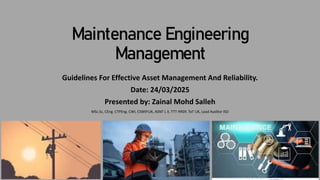
Maintenance Engineering
Management
Guidelines For Effective Asset Management And Reliability.
Date: 24/03/2025
Presented by: Zainal Mohd Salleh
MSc.Sc, CEng. CTPEng. CWI, CSWIP.UK, ASNT L II, TTT HRDF, ToT UK, Lead Auditor ISO
Maintenance Engineering and Management
Maintenance Engineering is the discipline and profession of applying
engineering concepts for the:
➢Optimization of equipment,
➢Procedures, and
➢Departmental budgets to achieve better maintainability, reliability,
and availability of equipment.
Definition.
• Maintenance Management is the process of coordinating various
maintenance activities and resources for effective asset management
and reliability.
• It involves the effective utilisation of resources to achieve the
company’s objective in terms of asset reliability.
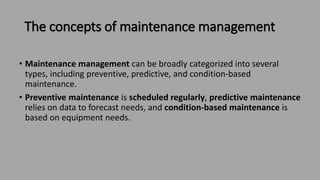
The concepts of maintenance management
• Maintenance management can be broadly categorized into several
types, including preventive, predictive, and condition-based
maintenance.
• Preventive maintenance is scheduled regularly, predictive maintenance
relies on data to forecast needs, and condition-based maintenance is
based on equipment needs.
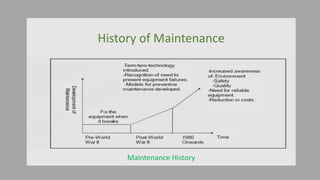
History of Maintenance
Maintenance History
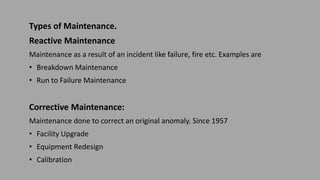
Types of Maintenance.
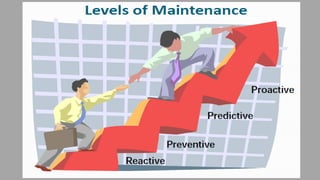
Reactive Maintenance
Maintenance as a result of an incident like failure, fire etc. Examples are
• Breakdown Maintenance
• Run to Failure Maintenance
Corrective Maintenance:
Maintenance done to correct an original anomaly. Since 1957
• Facility Upgrade
• Equipment Redesign
• Calibration
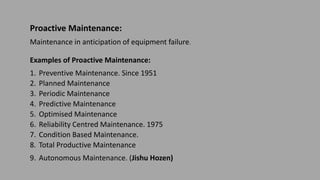
Proactive Maintenance:
Maintenance in anticipation of equipment failure.
Examples of Proactive Maintenance:
1. Preventive Maintenance. Since 1951
2. Planned Maintenance
3. Periodic Maintenance
4. Predictive Maintenance
5. Optimised Maintenance
6. Reliability Centred Maintenance. 1975
7. Condition Based Maintenance.
8. Total Productive Maintenance
9. Autonomous Maintenance. (Jishu Hozen)
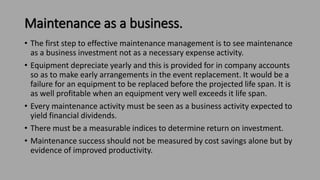
Maintenance as a business.
• The first step to effective maintenance management is to see maintenance
as a business investment not as a necessary expense activity.
• Equipment depreciate yearly and this is provided for in company accounts
so as to make early arrangements in the event replacement. It would be a
failure for an equipment to be replaced before the projected life span. It is
as well profitable when an equipment very well exceeds it life span.
• Every maintenance activity must be seen as a business activity expected to
yield financial dividends.
• There must be a measurable indices to determine return on investment.
• Maintenance success should not be measured by cost savings alone but by
evidence of improved productivity.
Maintenance Management Process
• Maintenance management process is driven by a maintenance
management system components of which are
• A maintenance policy
• Maintenance objectives and targets.
• A process manual
• A maintenance plan
• A maintenance schedule
• A maintenance budget
Issues to Take Note Of For Effective Maintenance.
Establishing the Foundation
• First, stop the bleeding if any.
• Understand how reliability drives your business
• Tactics of successful organizations
• Leveraging the leadership
• The hidden costs of deferring proactive processes
• Pitfalls to avoid
• Assessment, gap analysis
• Plan of improvement
• Education for all -
It’s not simply a maintenance thing!
• The mission and vision
• Developing partnerships and
commitment
• Building the Business Case (return on
investment)
• Management’s view - Show me the
money!
• Understanding this is really culture
change
Engaging the People
• Managing people is about building
relationships
• What’s in it for me?
• Creating a strong vibrant workplace
• Supervision and leadership
• Leading vs. Managing
• Roles of the supervisor
• Creating a learning organization
• Training for tomorrow
Leading the Change
• Aligning the organization
• Roles and responsibilities
• Utilizing our resources
• Work management
• Planning and scheduling
• Materials and storeroom management
• Overcome the “Hem” & “Haw”
Establishing Metrics
• We measure what we treasure
• We get what we inspect
• Typical key performance indicators
• Critical metrics for success
• Leading and lagging
• Sources for KPI data
• Costing information
Processes and Procedures
• Mapping the business processes
• Required and supporting workflows
• Loss elimination
• Auditing
• Checklists and SOP’s
• Continuous improvement
• Operator basic care
• Lubrication practices
• Who’s responsible?
Direct Maintenance Costs
• Maintenance Labour
• Maintenance Materials
• Maintenance Overhead
Indirect Maintenance Costs
• Equipment Availability
• Lost Capacity
• Equipment Life Cycle Cost
• Production Overtime
• Idle Production Personnel
• Scrap and Rework
• Expedited Shipments
• Late Deliveries
• Lost Customers
The Hidden Cost of Poor Maintenance
• Equipment Availability
• Lost Capacity
• Equipment Life Cycle Cost
• Production Overtime
• Idle Personnel
• Scrap and Rework
• Late Deliveries
• Lost Customers
Reduce Costs Through Maintenance Benchmarking
• To determine your opportunity for improvement you need to know
where you are today. Maintenance Benchmarking addresses the
following areas:
• Organization
• Procedures
• Planning and Scheduling
• Planned Maintenance and Lubrication
• Equipment Records and CMMS
• MRO Inventory
• Training
• Maintenance Costs
• Maintenance Performance Measurement (KPI’s)
Tools for Proactivity
• The role of the CMMS/EAM
• Introduction to implementation
• Equipment history
• Intro to reliability-centred maintenance
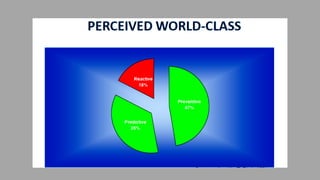
World-Class Maintenance Best Practices
• Planned Maintenance Work > 90%
• Breakdown/Crisis Work < 3%
• Maintenance Schedule Compliance > 90%
• Technicians per Supervisor = 15 to 20
• Maintenance Overtime < 5%
• Maintenance Direct Work > 65%
• MRO Inventory Turns > 3 per year
• Accurate Data
• Annual Maintenance Cost < 2.5% of ERC (Estimated Replacement Cost )
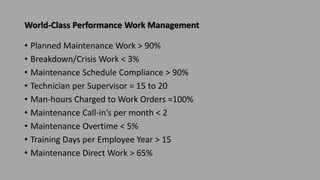
World-Class Performance Work Management
• Planned Maintenance Work > 90%
• Breakdown/Crisis Work < 3%
• Maintenance Schedule Compliance > 90%
• Technician per Supervisor = 15 to 20
• Man-hours Charged to Work Orders =100%
• Maintenance Call-in’s per month < 2
• Maintenance Overtime < 5%
• Training Days per Employee Year > 15
• Maintenance Direct Work > 65%
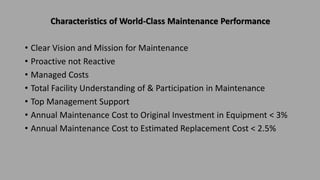
Characteristics of World-Class Maintenance Performance
• Clear Vision and Mission for Maintenance
• Proactive not Reactive
• Managed Costs
• Total Facility Understanding of & Participation in Maintenance
• Top Management Support
• Annual Maintenance Cost to Original Investment in Equipment < 3%
• Annual Maintenance Cost to Estimated Replacement Cost < 2.5%
None Core Skills
• Legal Awareness
• IT Savvy
• Project/Time Management
• People Skills
• Cross Networking
• Promote Sustainability
• Emergency Reflexes
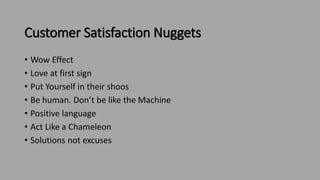
Customer Satisfaction Nuggets
• Wow Effect
• Love at first sign
• Put Yourself in their shoos
• Be human. Don’t be like the Machine
• Positive language
• Act Like a Chameleon
• Solutions not excuses
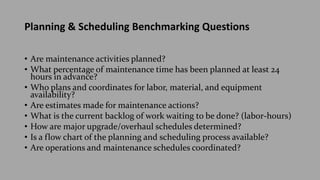
Planning & Scheduling Benchmarking Questions
• Are maintenance activities planned?
• What percentage of maintenance time has been planned at least 24
hours in advance?
• Who plans and coordinates for labor, material, and equipment
availability?
• Are estimates made for maintenance actions?
• What is the current backlog of work waiting to be done? (labor-hours)
• How are major upgrade/overhaul schedules determined?
• Is a flow chart of the planning and scheduling process available?
• Are operations and maintenance schedules coordinated?
Summary of maintenance management
• Maintenance management involves keeping track of assets and parts.
• The purpose is to ensure that production proceeds efficiently and the
minimum amount of resources are wasted.
• This is generally accomplished by a tailored combination of software,
practices, and personnel that focus on achieving these goals.
Thank You
Guidelines For Effective Asset Management And Reliability.
Date: 24/03/2025
Presented by: Zainal Mohd Salleh
MSc.Sc, CEng. CTPEng. CWI, CSWIP.UK, ASNT L II, TTT HRDF, ToT UK, Lead Auditor ISO

Slides Maintenance_Management,,,,,,_pptx.pdf

  • 1.
    Maintenance Engineering Management Guidelines ForEffective Asset Management And Reliability. Date: 24/03/2025 Presented by: Zainal Mohd Salleh MSc.Sc, CEng. CTPEng. CWI, CSWIP.UK, ASNT L II, TTT HRDF, ToT UK, Lead Auditor ISO
  • 2.
    Maintenance Engineering andManagement Maintenance Engineering is the discipline and profession of applying engineering concepts for the: ➢Optimization of equipment, ➢Procedures, and ➢Departmental budgets to achieve better maintainability, reliability, and availability of equipment.
  • 3.
    Definition. • Maintenance Managementis the process of coordinating various maintenance activities and resources for effective asset management and reliability. • It involves the effective utilisation of resources to achieve the company’s objective in terms of asset reliability.
  • 4.
    The concepts ofmaintenance management • Maintenance management can be broadly categorized into several types, including preventive, predictive, and condition-based maintenance. • Preventive maintenance is scheduled regularly, predictive maintenance relies on data to forecast needs, and condition-based maintenance is based on equipment needs.
  • 6.
  • 7.
    Types of Maintenance. ReactiveMaintenance Maintenance as a result of an incident like failure, fire etc. Examples are • Breakdown Maintenance • Run to Failure Maintenance Corrective Maintenance: Maintenance done to correct an original anomaly. Since 1957 • Facility Upgrade • Equipment Redesign • Calibration
  • 8.
    Proactive Maintenance: Maintenance inanticipation of equipment failure. Examples of Proactive Maintenance: 1. Preventive Maintenance. Since 1951 2. Planned Maintenance 3. Periodic Maintenance 4. Predictive Maintenance 5. Optimised Maintenance 6. Reliability Centred Maintenance. 1975 7. Condition Based Maintenance. 8. Total Productive Maintenance 9. Autonomous Maintenance. (Jishu Hozen)
  • 11.
    Maintenance as abusiness. • The first step to effective maintenance management is to see maintenance as a business investment not as a necessary expense activity. • Equipment depreciate yearly and this is provided for in company accounts so as to make early arrangements in the event replacement. It would be a failure for an equipment to be replaced before the projected life span. It is as well profitable when an equipment very well exceeds it life span. • Every maintenance activity must be seen as a business activity expected to yield financial dividends. • There must be a measurable indices to determine return on investment. • Maintenance success should not be measured by cost savings alone but by evidence of improved productivity.
  • 12.
    Maintenance Management Process •Maintenance management process is driven by a maintenance management system components of which are • A maintenance policy • Maintenance objectives and targets. • A process manual • A maintenance plan • A maintenance schedule • A maintenance budget
  • 13.
    Issues to TakeNote Of For Effective Maintenance. Establishing the Foundation • First, stop the bleeding if any. • Understand how reliability drives your business • Tactics of successful organizations • Leveraging the leadership • The hidden costs of deferring proactive processes • Pitfalls to avoid • Assessment, gap analysis • Plan of improvement • Education for all - It’s not simply a maintenance thing!
  • 15.
    • The missionand vision • Developing partnerships and commitment • Building the Business Case (return on investment) • Management’s view - Show me the money! • Understanding this is really culture change Engaging the People • Managing people is about building relationships • What’s in it for me? • Creating a strong vibrant workplace • Supervision and leadership • Leading vs. Managing • Roles of the supervisor • Creating a learning organization • Training for tomorrow
  • 16.
    Leading the Change •Aligning the organization • Roles and responsibilities • Utilizing our resources • Work management • Planning and scheduling • Materials and storeroom management • Overcome the “Hem” & “Haw”
  • 17.
    Establishing Metrics • Wemeasure what we treasure • We get what we inspect • Typical key performance indicators • Critical metrics for success • Leading and lagging • Sources for KPI data • Costing information
  • 18.
    Processes and Procedures •Mapping the business processes • Required and supporting workflows • Loss elimination • Auditing • Checklists and SOP’s • Continuous improvement • Operator basic care • Lubrication practices • Who’s responsible?
  • 19.
    Direct Maintenance Costs •Maintenance Labour • Maintenance Materials • Maintenance Overhead Indirect Maintenance Costs • Equipment Availability • Lost Capacity • Equipment Life Cycle Cost • Production Overtime • Idle Production Personnel • Scrap and Rework • Expedited Shipments • Late Deliveries • Lost Customers
  • 20.
    The Hidden Costof Poor Maintenance • Equipment Availability • Lost Capacity • Equipment Life Cycle Cost • Production Overtime • Idle Personnel • Scrap and Rework • Late Deliveries • Lost Customers
  • 21.
    Reduce Costs ThroughMaintenance Benchmarking • To determine your opportunity for improvement you need to know where you are today. Maintenance Benchmarking addresses the following areas: • Organization • Procedures • Planning and Scheduling • Planned Maintenance and Lubrication • Equipment Records and CMMS • MRO Inventory • Training • Maintenance Costs • Maintenance Performance Measurement (KPI’s)
  • 22.
    Tools for Proactivity •The role of the CMMS/EAM • Introduction to implementation • Equipment history • Intro to reliability-centred maintenance
  • 23.
    World-Class Maintenance BestPractices • Planned Maintenance Work > 90% • Breakdown/Crisis Work < 3% • Maintenance Schedule Compliance > 90% • Technicians per Supervisor = 15 to 20 • Maintenance Overtime < 5% • Maintenance Direct Work > 65% • MRO Inventory Turns > 3 per year • Accurate Data • Annual Maintenance Cost < 2.5% of ERC (Estimated Replacement Cost )
  • 24.
    World-Class Performance WorkManagement • Planned Maintenance Work > 90% • Breakdown/Crisis Work < 3% • Maintenance Schedule Compliance > 90% • Technician per Supervisor = 15 to 20 • Man-hours Charged to Work Orders =100% • Maintenance Call-in’s per month < 2 • Maintenance Overtime < 5% • Training Days per Employee Year > 15 • Maintenance Direct Work > 65%
  • 25.
    Characteristics of World-ClassMaintenance Performance • Clear Vision and Mission for Maintenance • Proactive not Reactive • Managed Costs • Total Facility Understanding of & Participation in Maintenance • Top Management Support • Annual Maintenance Cost to Original Investment in Equipment < 3% • Annual Maintenance Cost to Estimated Replacement Cost < 2.5%
  • 26.
    None Core Skills •Legal Awareness • IT Savvy • Project/Time Management • People Skills • Cross Networking • Promote Sustainability • Emergency Reflexes
  • 27.
    Customer Satisfaction Nuggets •Wow Effect • Love at first sign • Put Yourself in their shoos • Be human. Don’t be like the Machine • Positive language • Act Like a Chameleon • Solutions not excuses
  • 28.
    Planning & SchedulingBenchmarking Questions • Are maintenance activities planned? • What percentage of maintenance time has been planned at least 24 hours in advance? • Who plans and coordinates for labor, material, and equipment availability? • Are estimates made for maintenance actions? • What is the current backlog of work waiting to be done? (labor-hours) • How are major upgrade/overhaul schedules determined? • Is a flow chart of the planning and scheduling process available? • Are operations and maintenance schedules coordinated?
  • 29.
    Summary of maintenancemanagement • Maintenance management involves keeping track of assets and parts. • The purpose is to ensure that production proceeds efficiently and the minimum amount of resources are wasted. • This is generally accomplished by a tailored combination of software, practices, and personnel that focus on achieving these goals.
  • 30.
    Thank You Guidelines ForEffective Asset Management And Reliability. Date: 24/03/2025 Presented by: Zainal Mohd Salleh MSc.Sc, CEng. CTPEng. CWI, CSWIP.UK, ASNT L II, TTT HRDF, ToT UK, Lead Auditor ISO