Effective Spare Parts
Management: 8 Rules
Tomas Hladik
Logio s.r.o., Prague, CZ
www.logio.cz
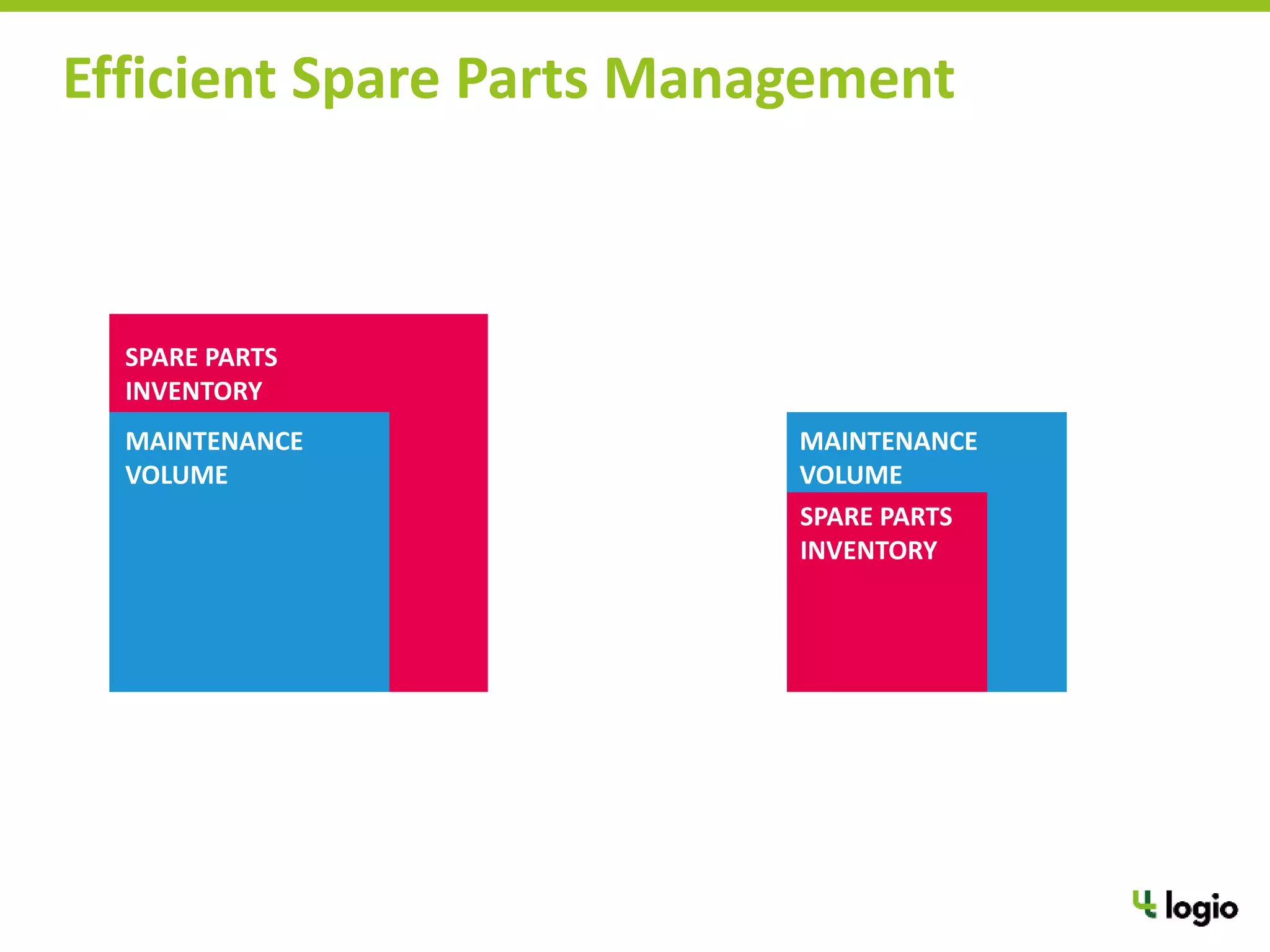
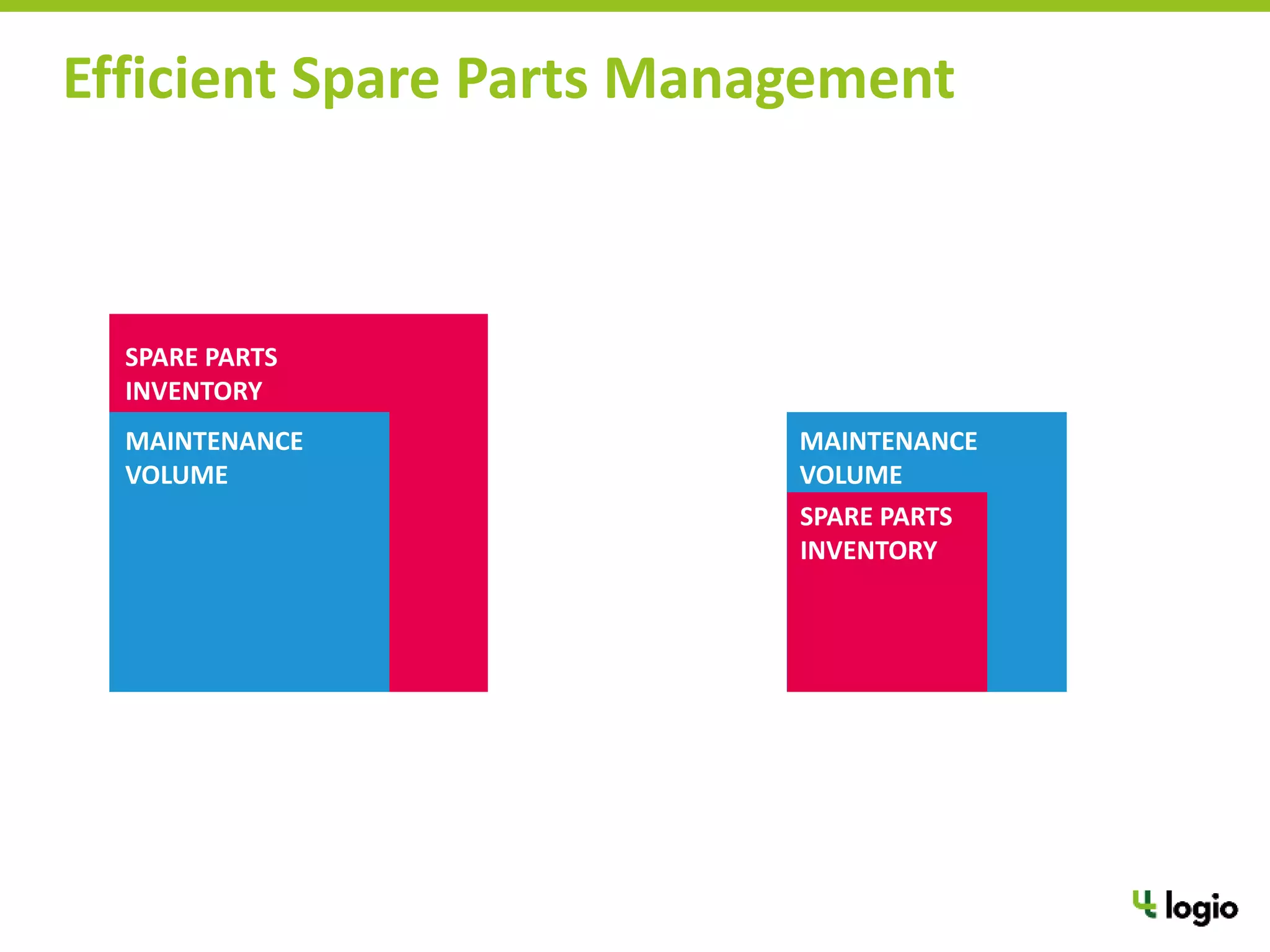
Efficient Spare Parts Management
MAINTENANCE
VOLUME
SPARE PARTS
INVENTORY
MAINTENANCE
VOLUME
SPARE PARTS
INVENTORY
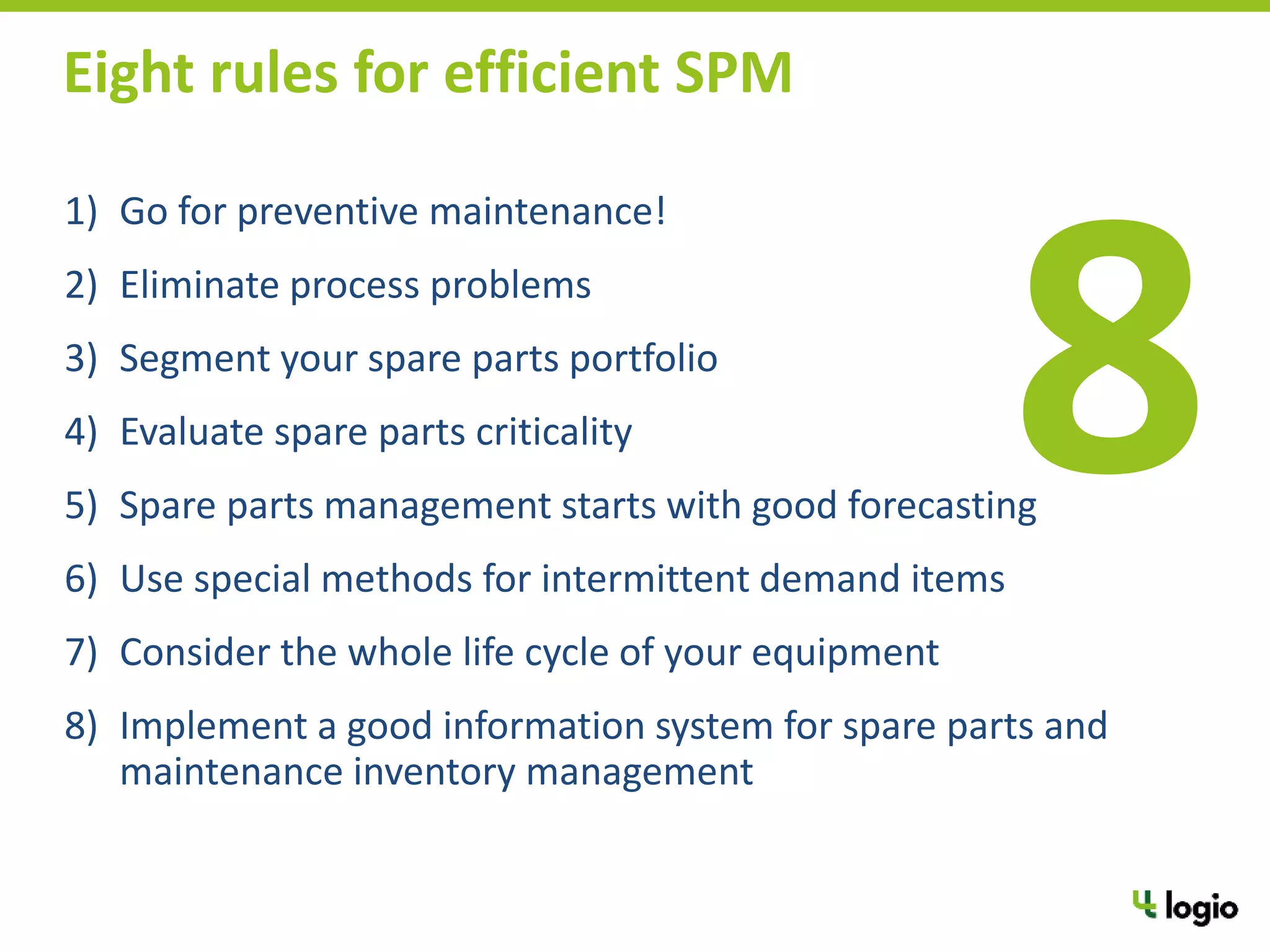
1) Go for preventive maintenance!
2) Eliminate process problems
3) Segment your spare parts portfolio
4) Evaluate spare parts criticality
5) Spare parts management starts with good forecasting
6) Use special methods for intermittent demand items
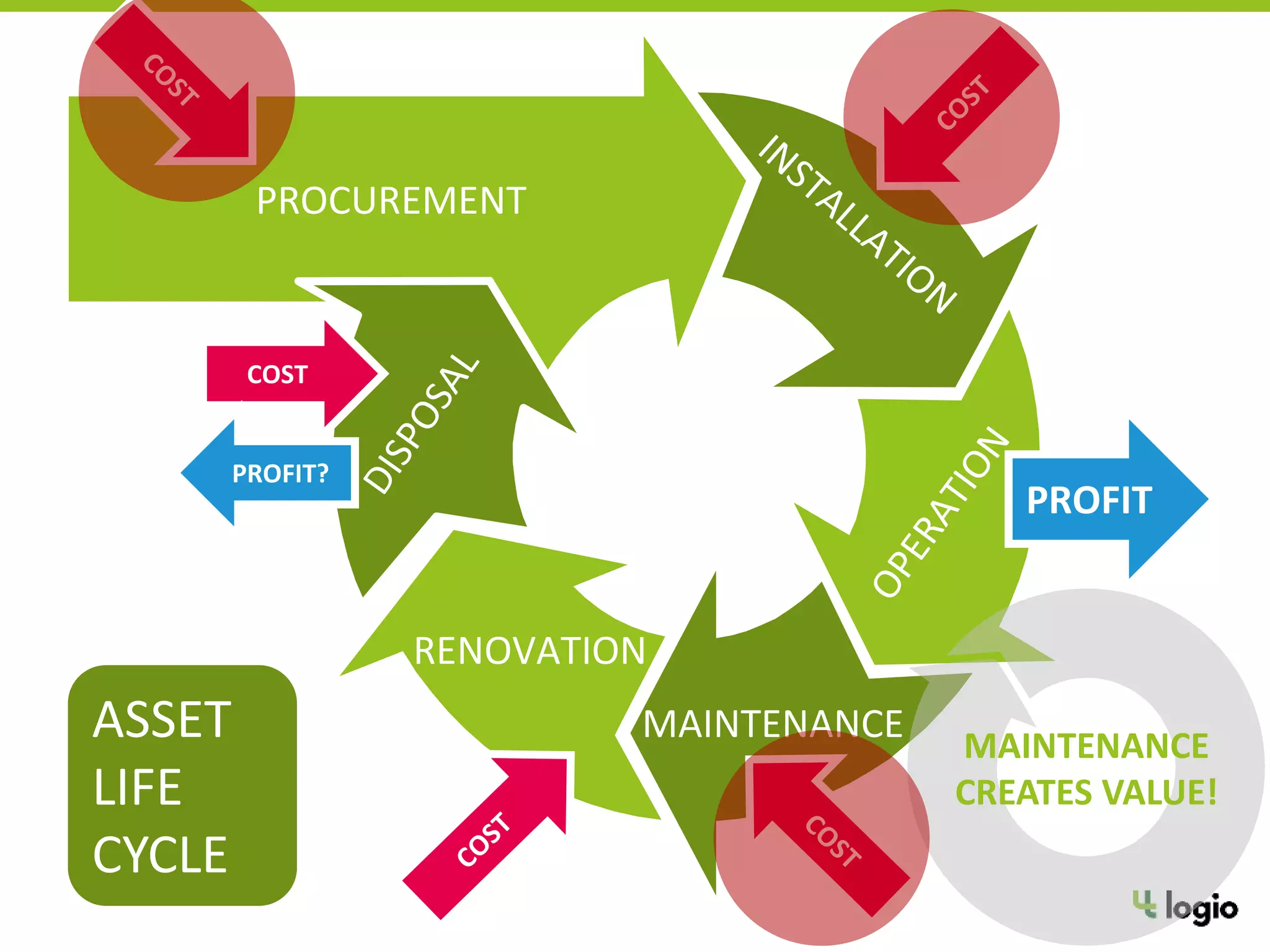
7) Consider the whole life cycle of your equipment
8) Implement a good information system for spare parts and
maintenance inventory management
Eight rules for efficient SPM
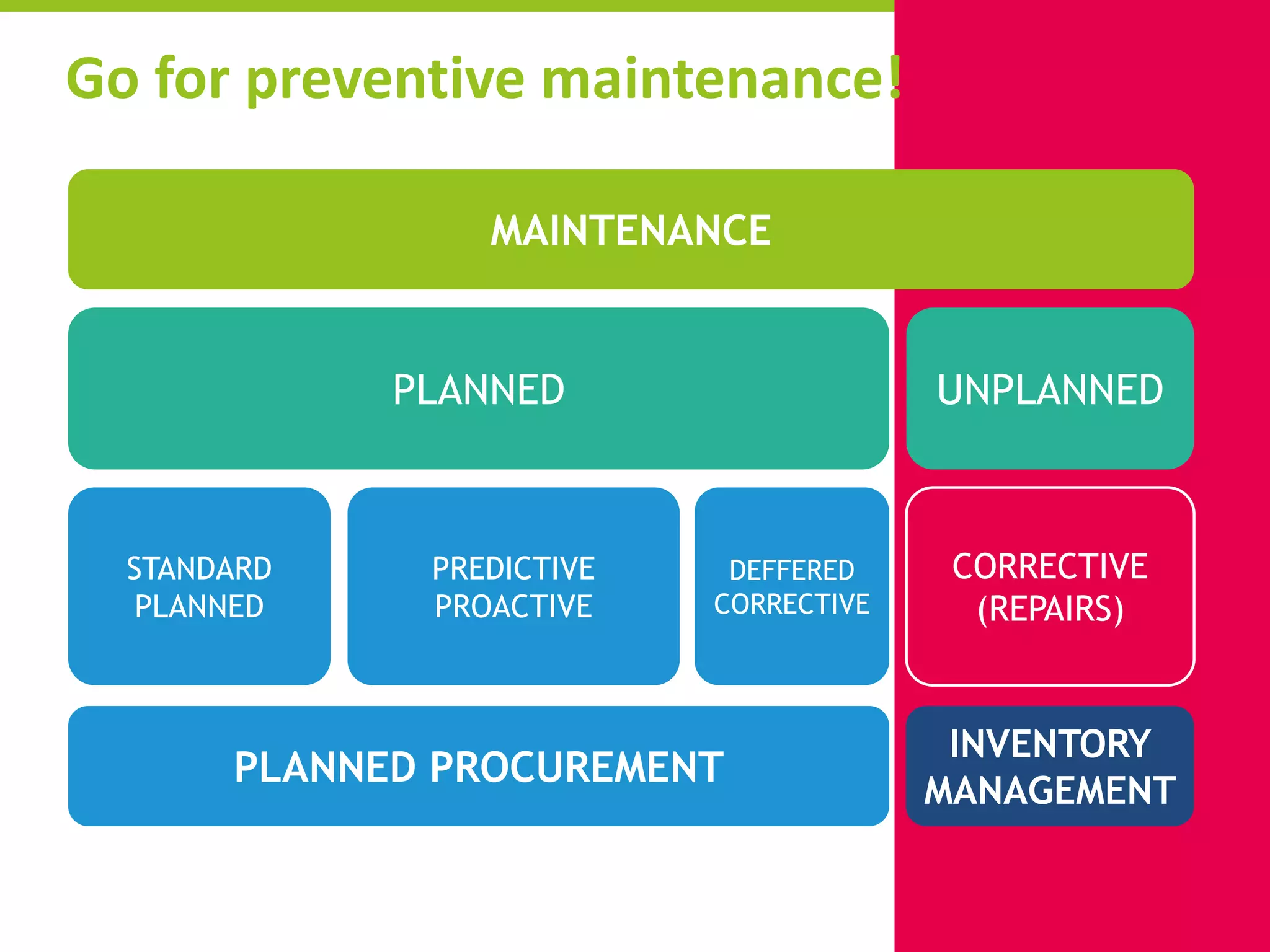
Go for preventive maintenance
STANDARD
PLANNED
PLANNED
MAINTENANCE
CORRECTIVE
(REPAIRS)
UNPLANNED
PREDICTIVE
PROACTIVE
DEFFERED
CORRECTIVE
PLANNED PROCUREMENT
INVENTORY
MANAGEMENT
Go for preventive maintenance!
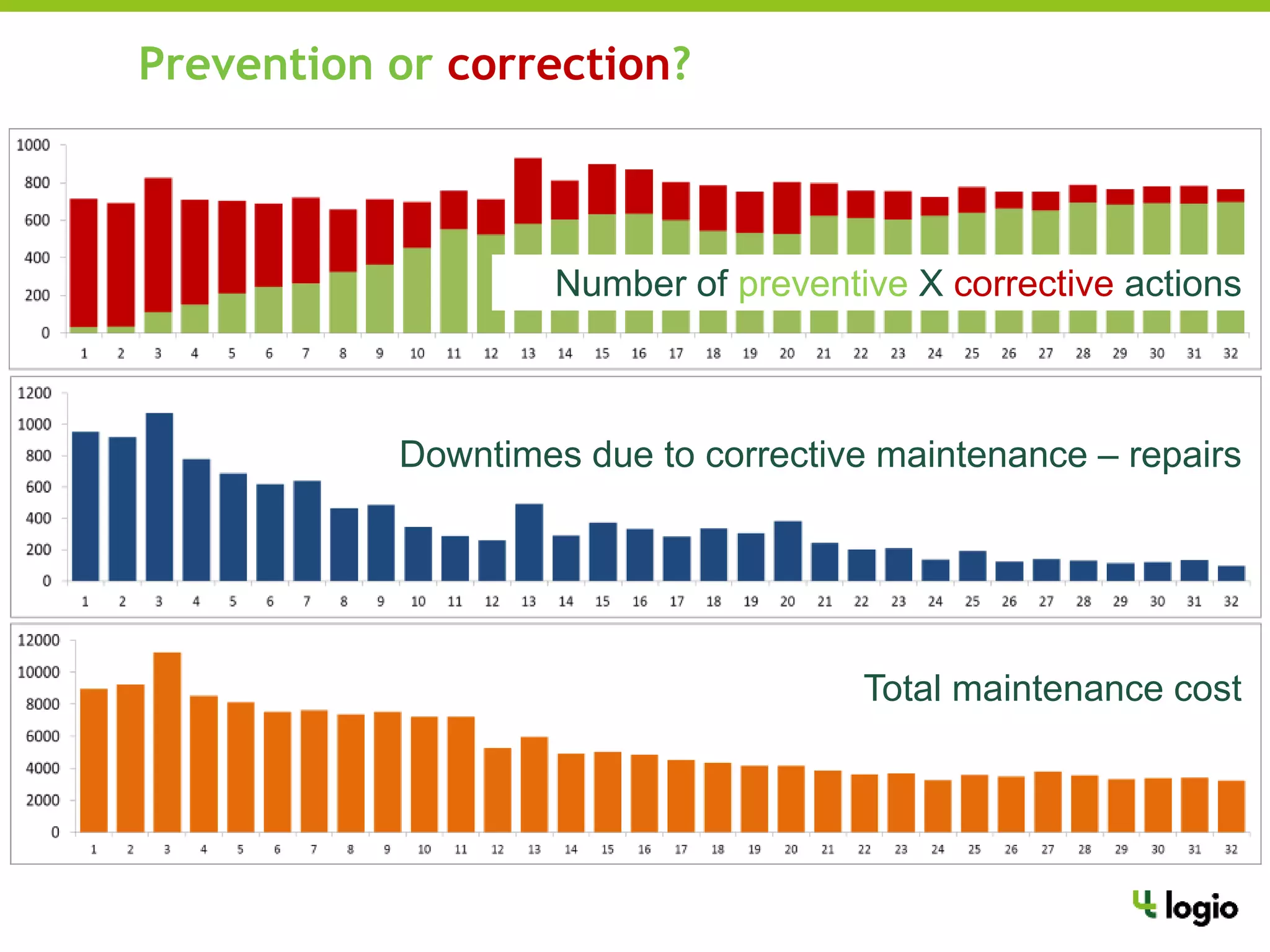
Prevention or correction?
Number of preventive X corrective actions
Downtimes due to corrective maintenance – repairs
Total maintenance cost
Eliminate process problems
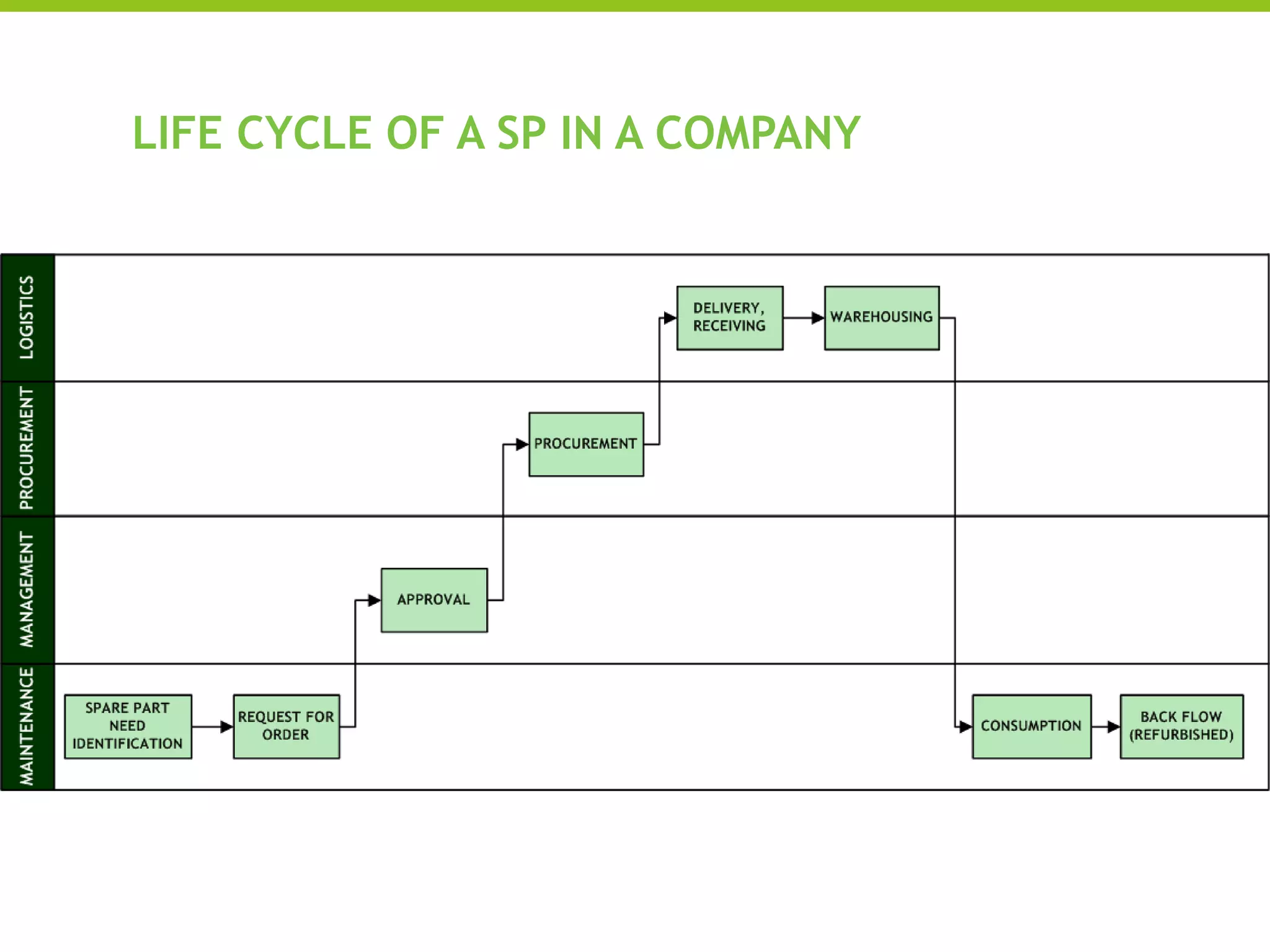
LIFE CYCLE OF A SP IN A COMPANY
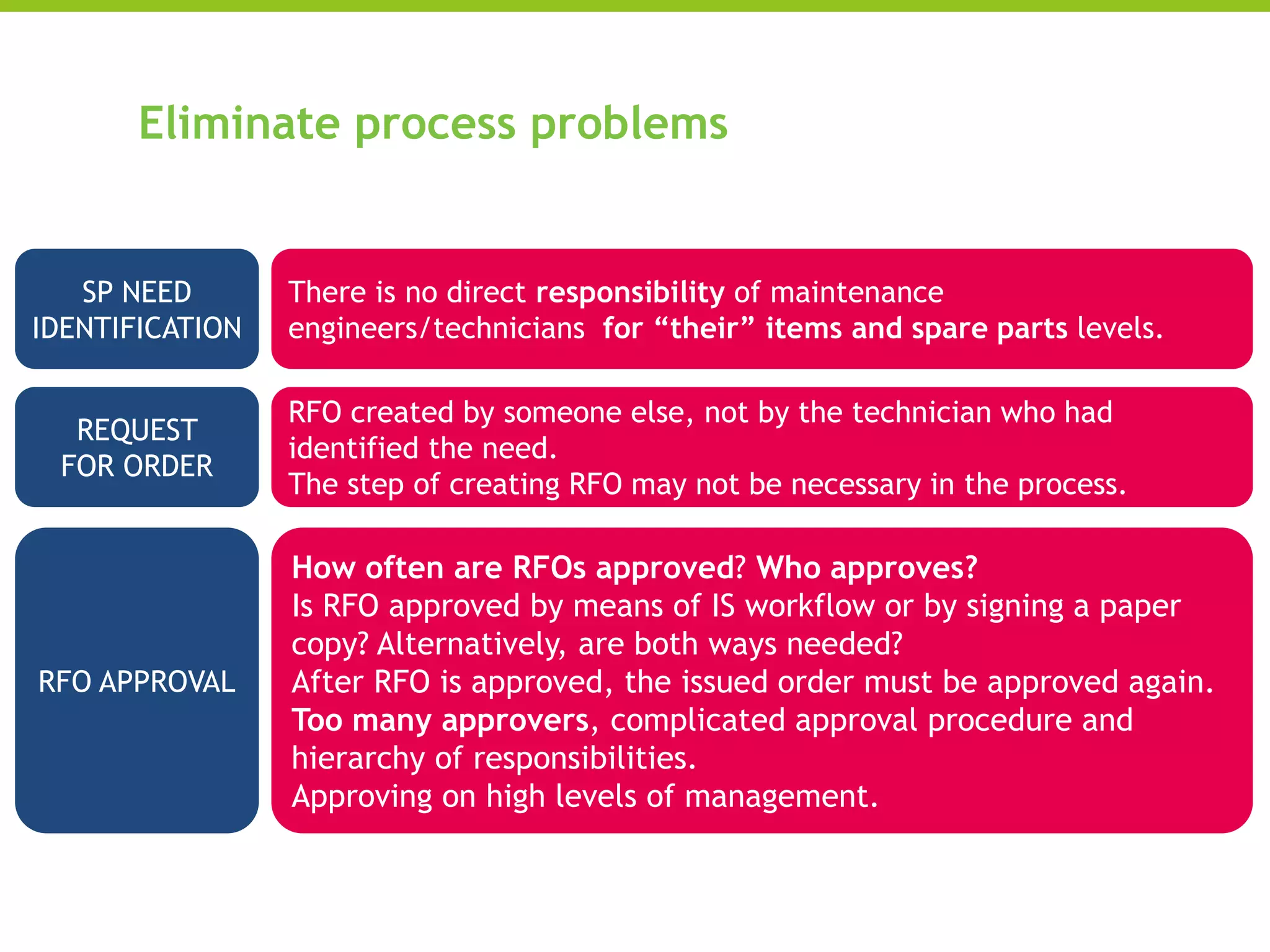
Eliminate process problems
SP NEED
IDENTIFICATION
There is no direct responsibility of maintenance
engineers/technicians for “their” items and spare parts levels.
REQUEST
FOR ORDER
RFO created by someone else, not by the technician who had
identified the need.
The step of creating RFO may not be necessary in the process.
RFO APPROVAL
How often are RFOs approved? Who approves?
Is RFO approved by means of IS workflow or by signing a paper
copy? Alternatively, are both ways needed?
After RFO is approved, the issued order must be approved again.
Too many approvers, complicated approval procedure and
hierarchy of responsibilities.
Approving on high levels of management.
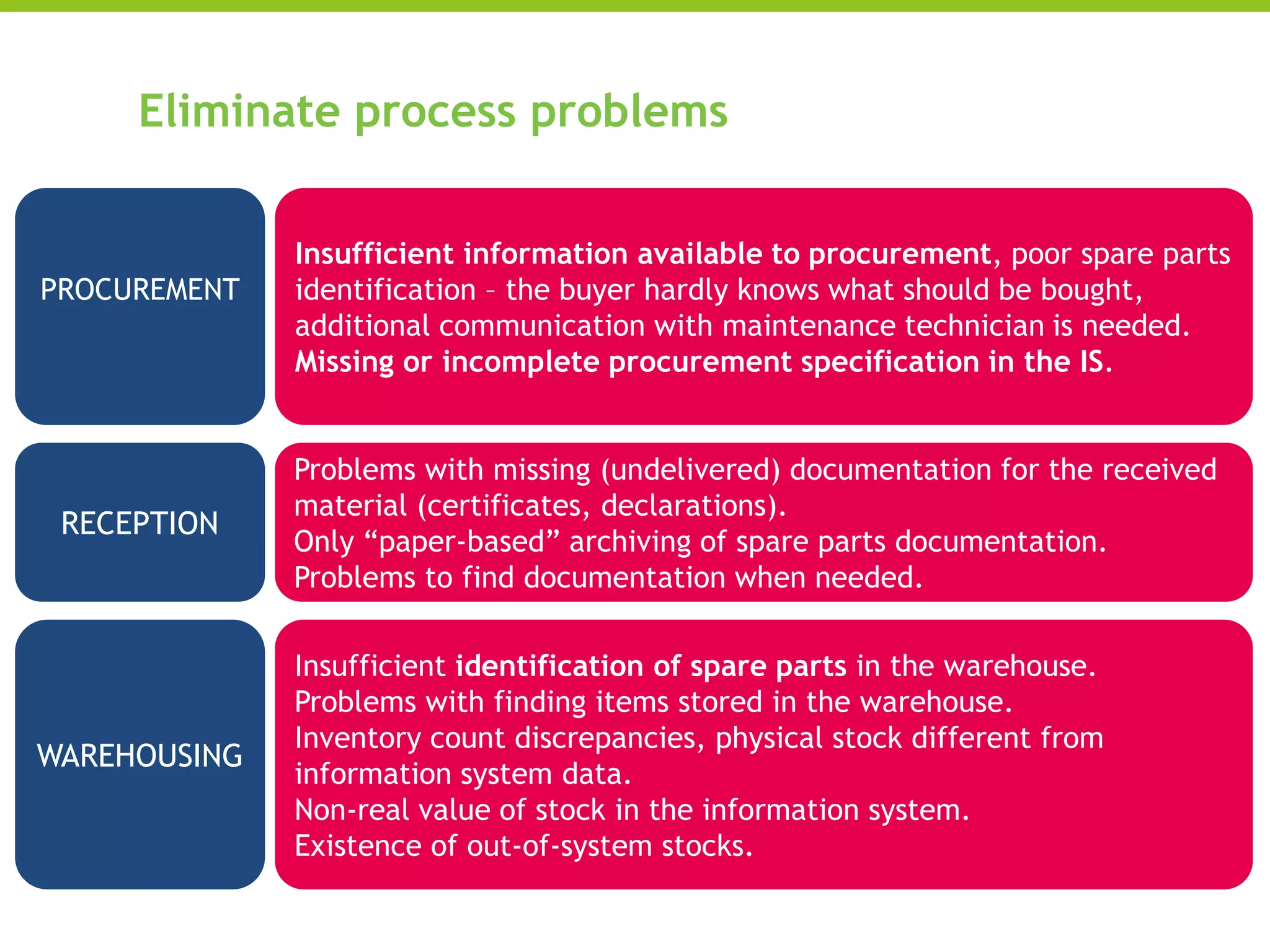
Eliminate process problems
PROCUREMENT
Insufficient information available to procurement, poor spare parts
identification – the buyer hardly knows what should be bought,
additional communication with maintenance technician is needed.
Missing or incomplete procurement specification in the IS.
RECEPTION
Problems with missing (undelivered) documentation for the received
material (certificates, declarations).
Only “paper-based” archiving of spare parts documentation.
Problems to find documentation when needed.
WAREHOUSING
Insufficient identification of spare parts in the warehouse.
Problems with finding items stored in the warehouse.
Inventory count discrepancies, physical stock different from
information system data.
Non-real value of stock in the information system.
Existence of out-of-system stocks.
Eliminate process problems
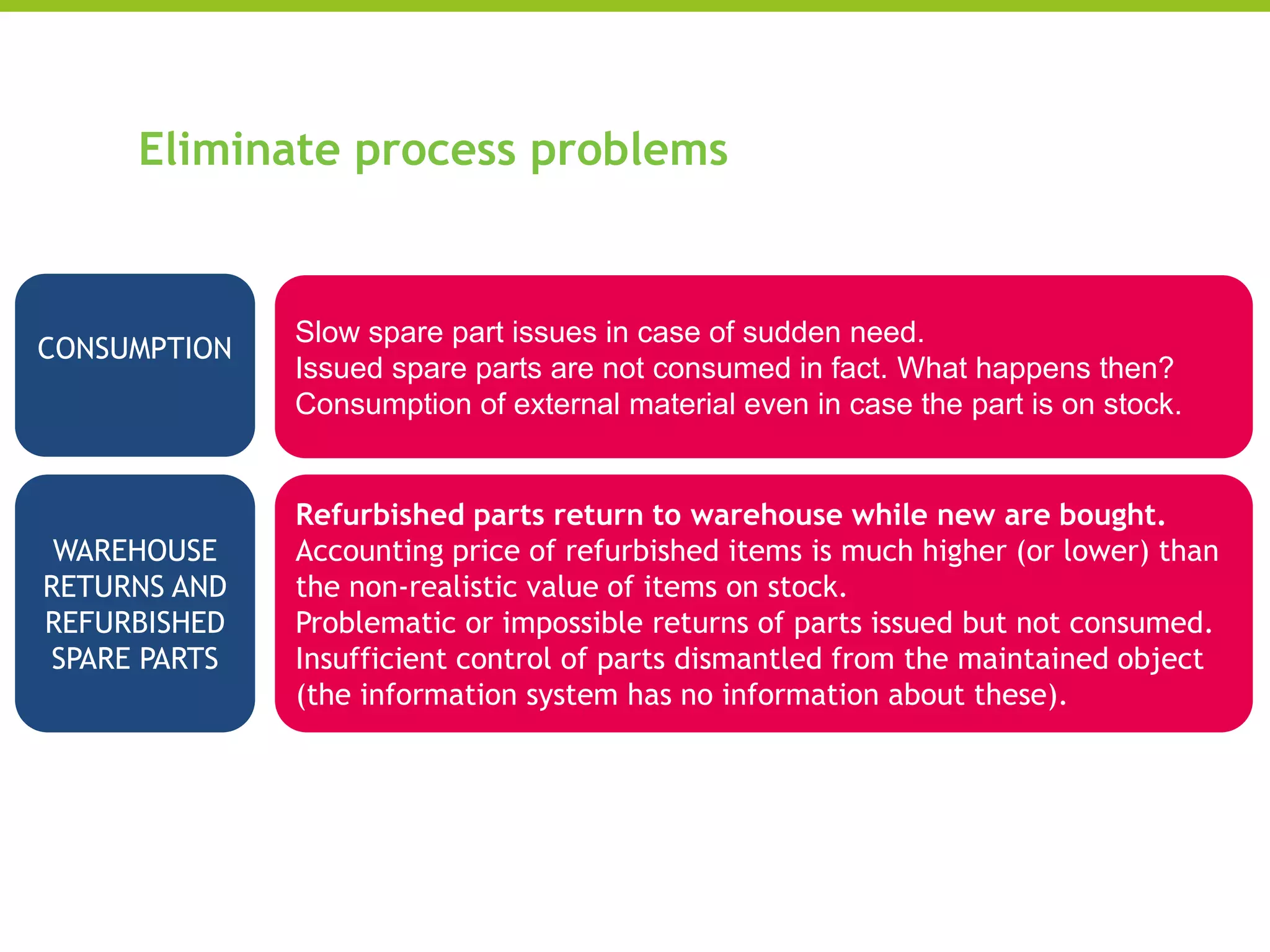
CONSUMPTION
Slow spare part issues in case of sudden need.
Issued spare parts are not consumed in fact. What happens then?
Consumption of external material even in case the part is on stock.
WAREHOUSE
RETURNS AND
REFURBISHED
SPARE PARTS
Refurbished parts return to warehouse while new are bought.
Accounting price of refurbished items is much higher (or lower) than
the non-realistic value of items on stock.
Problematic or impossible returns of parts issued but not consumed.
Insufficient control of parts dismantled from the maintained object
(the information system has no information about these).
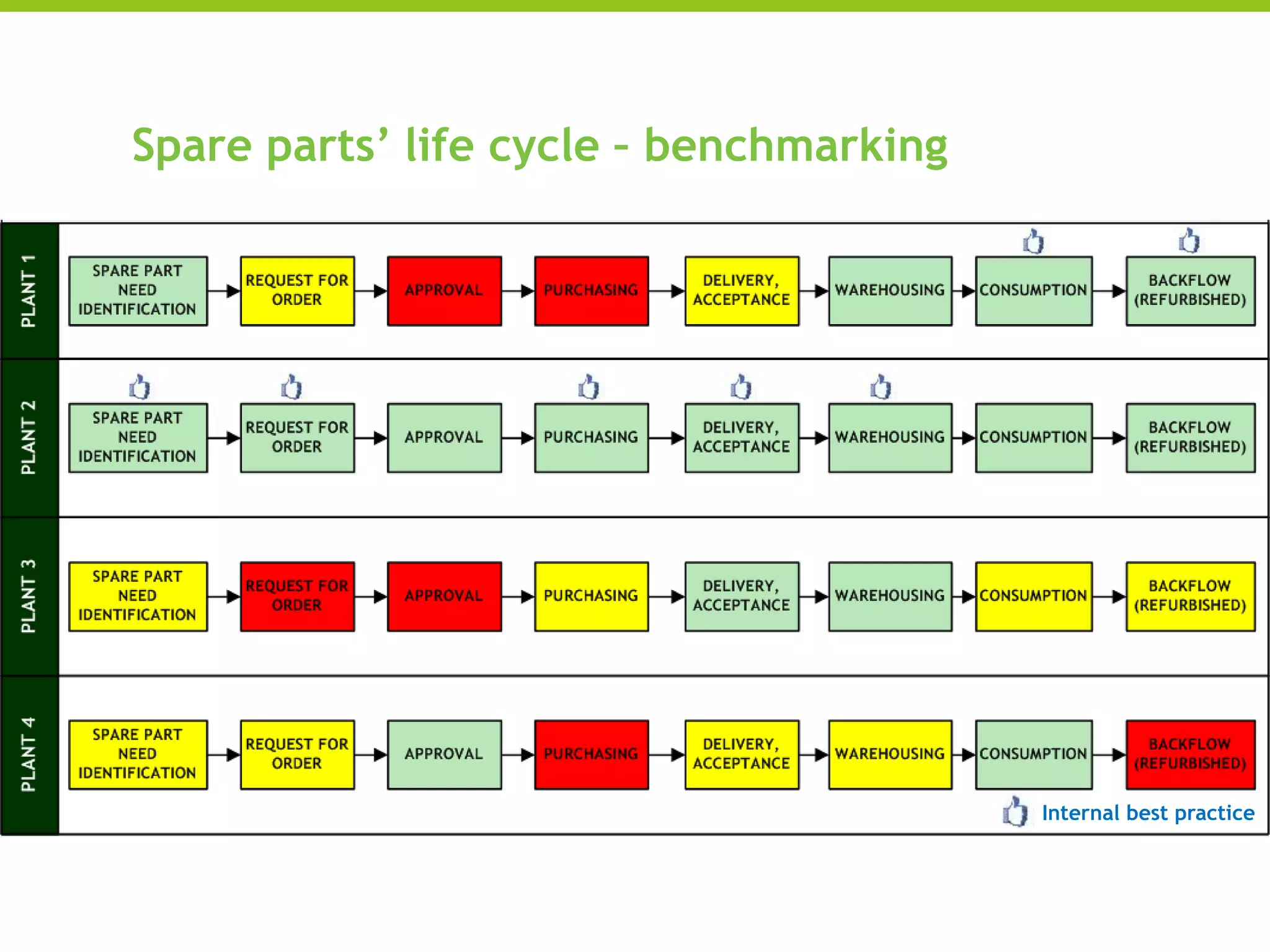
Spare parts’ life cycle – benchmarking
Internal best practice
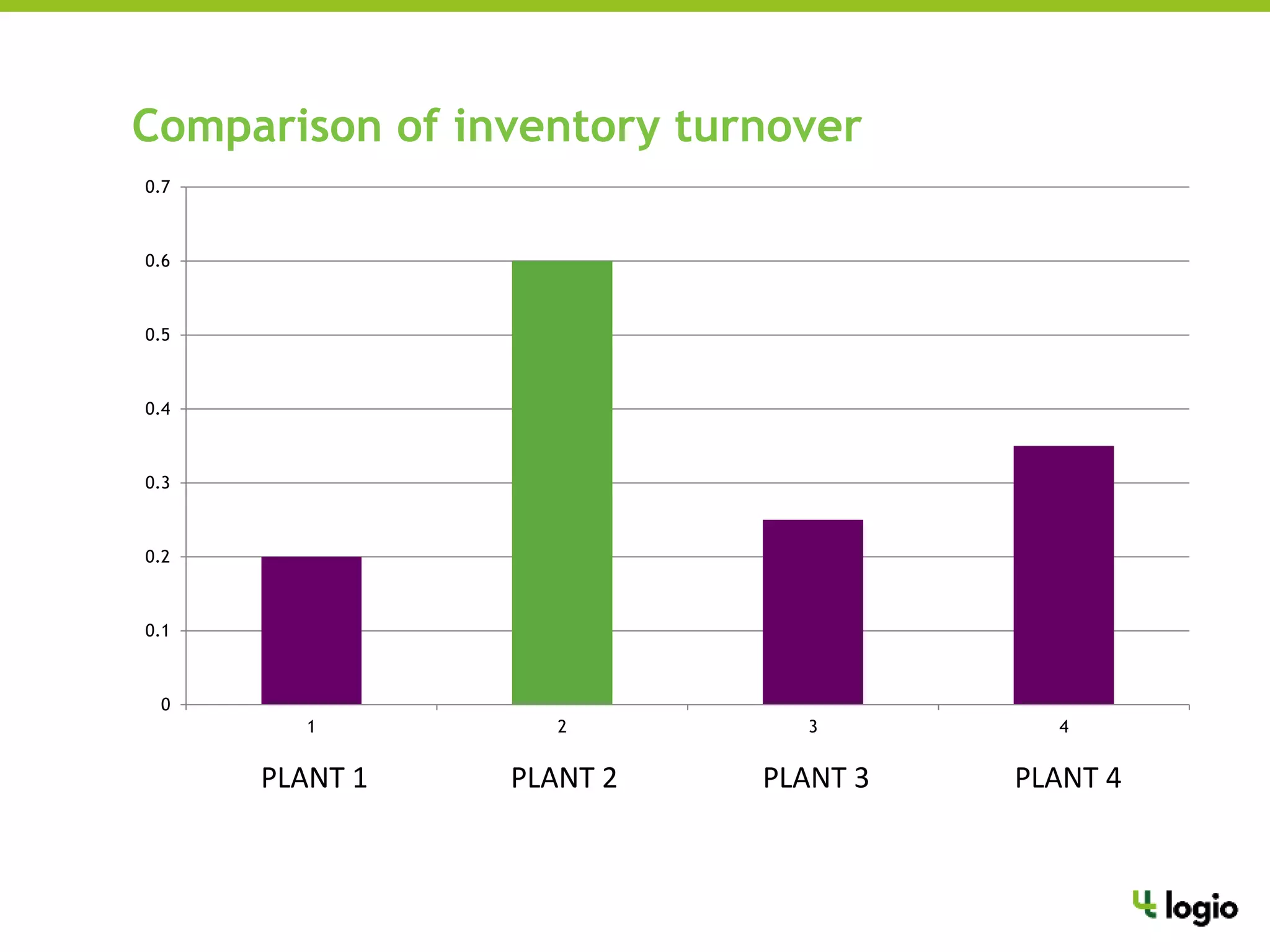
PLANT 1 PLANT 2 PLANT 3 PLANT 4
0
0.1
0.2
0.3
0.4
0.5
0.6
0.7
1 2 3 4
Comparison of inventory turnover
Segment your spare parts portfolio
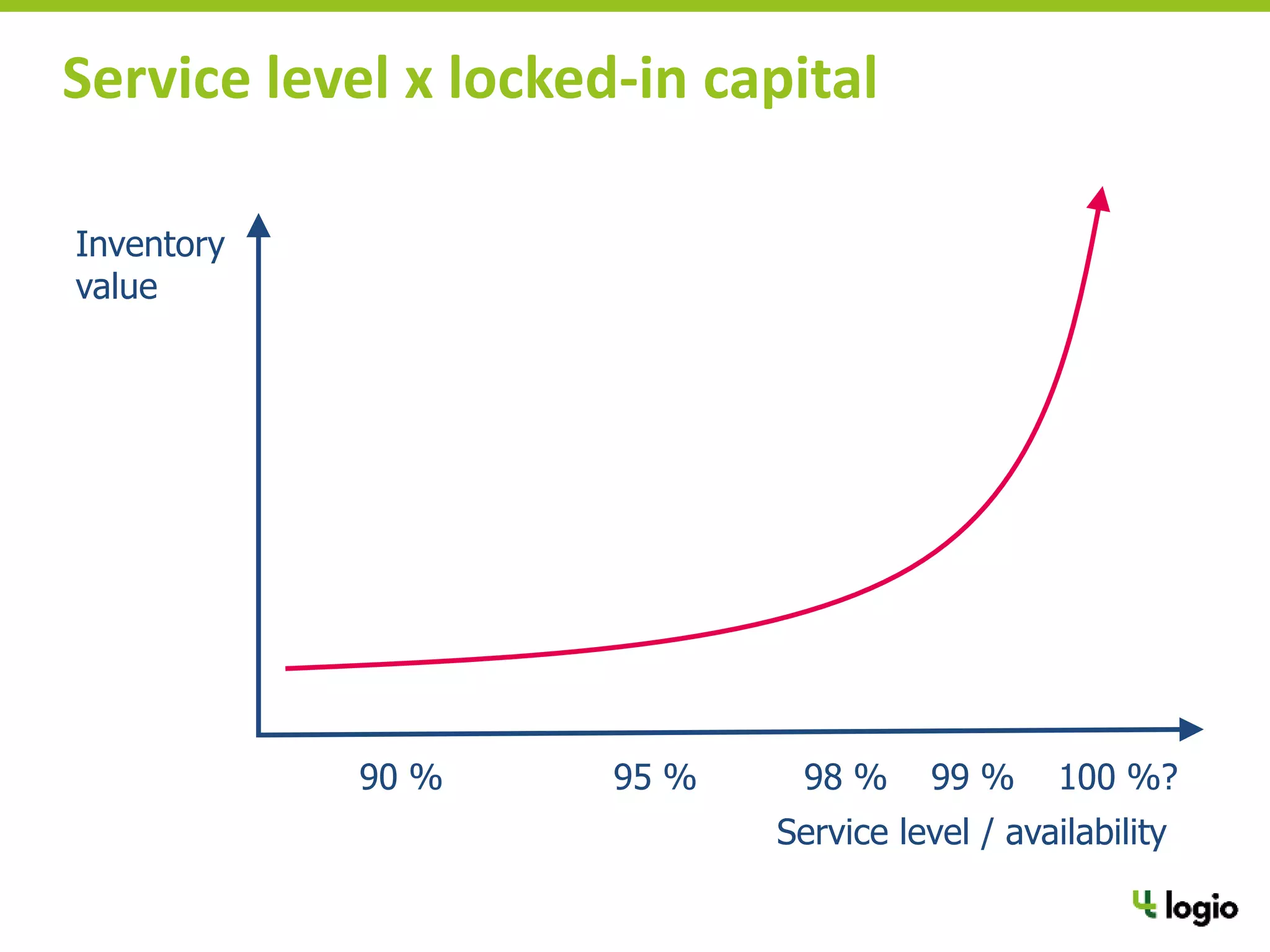
Service level x locked-in capital
Inventory
value
90 % 95 % 98 % 99 % 100 %?
Service level / availability
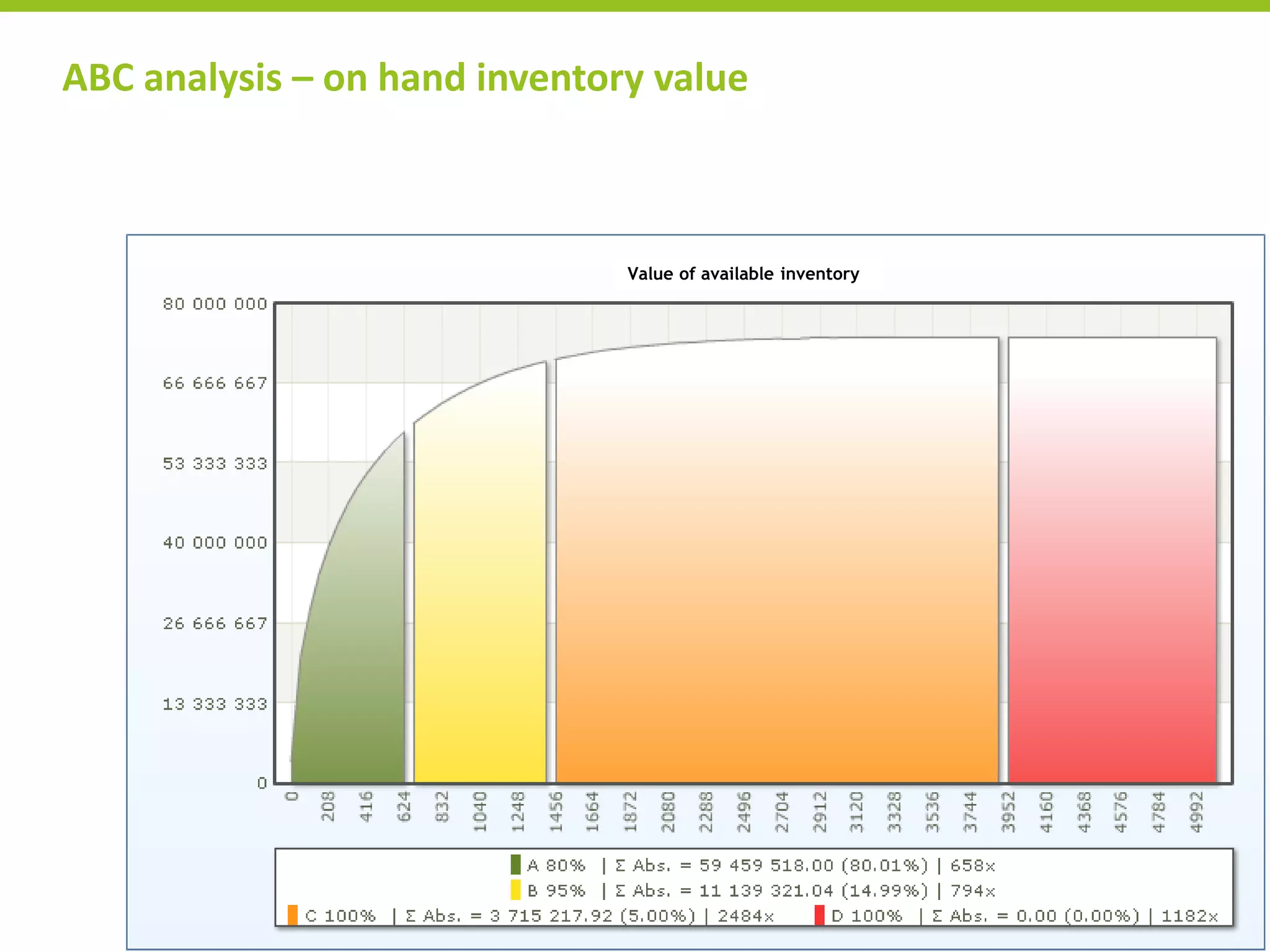
ABC analysis – on hand inventory value
Value of available inventory
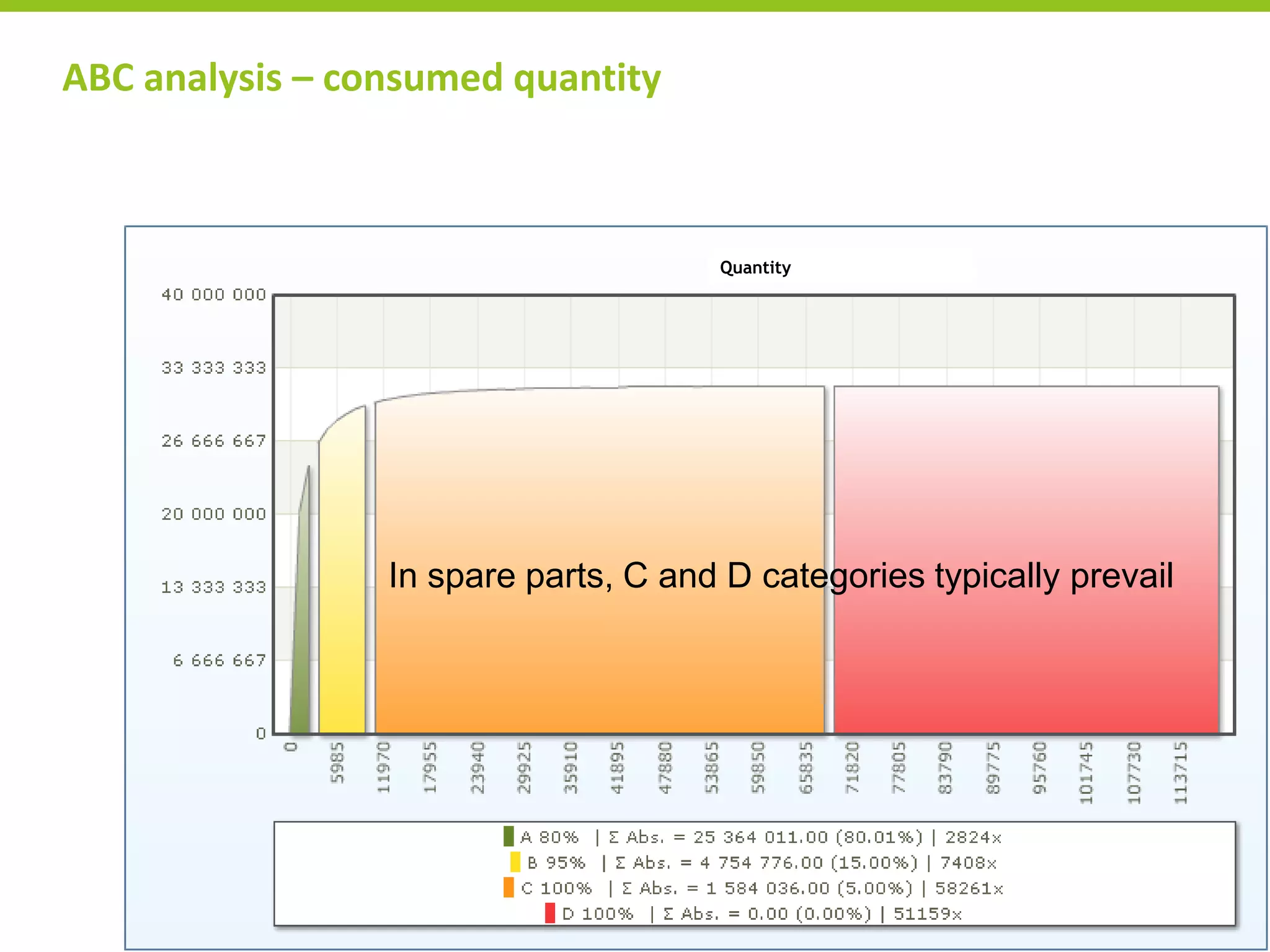
ABC analysis – consumed quantity
In spare parts, C and D categories typically prevail
Quantity
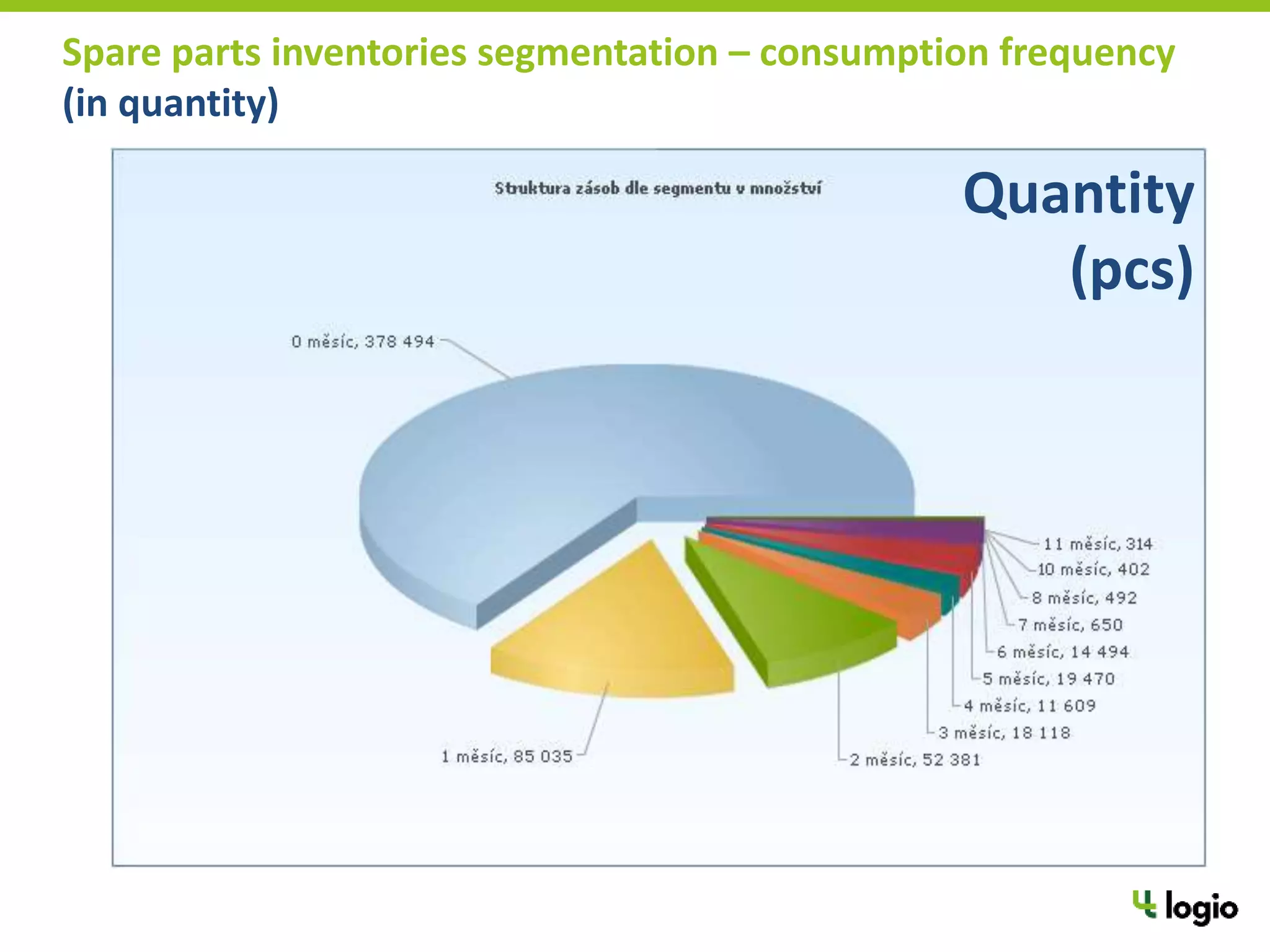
Spare parts inventories segmentation – consumption frequency
(in quantity)
Quantity
(pcs)
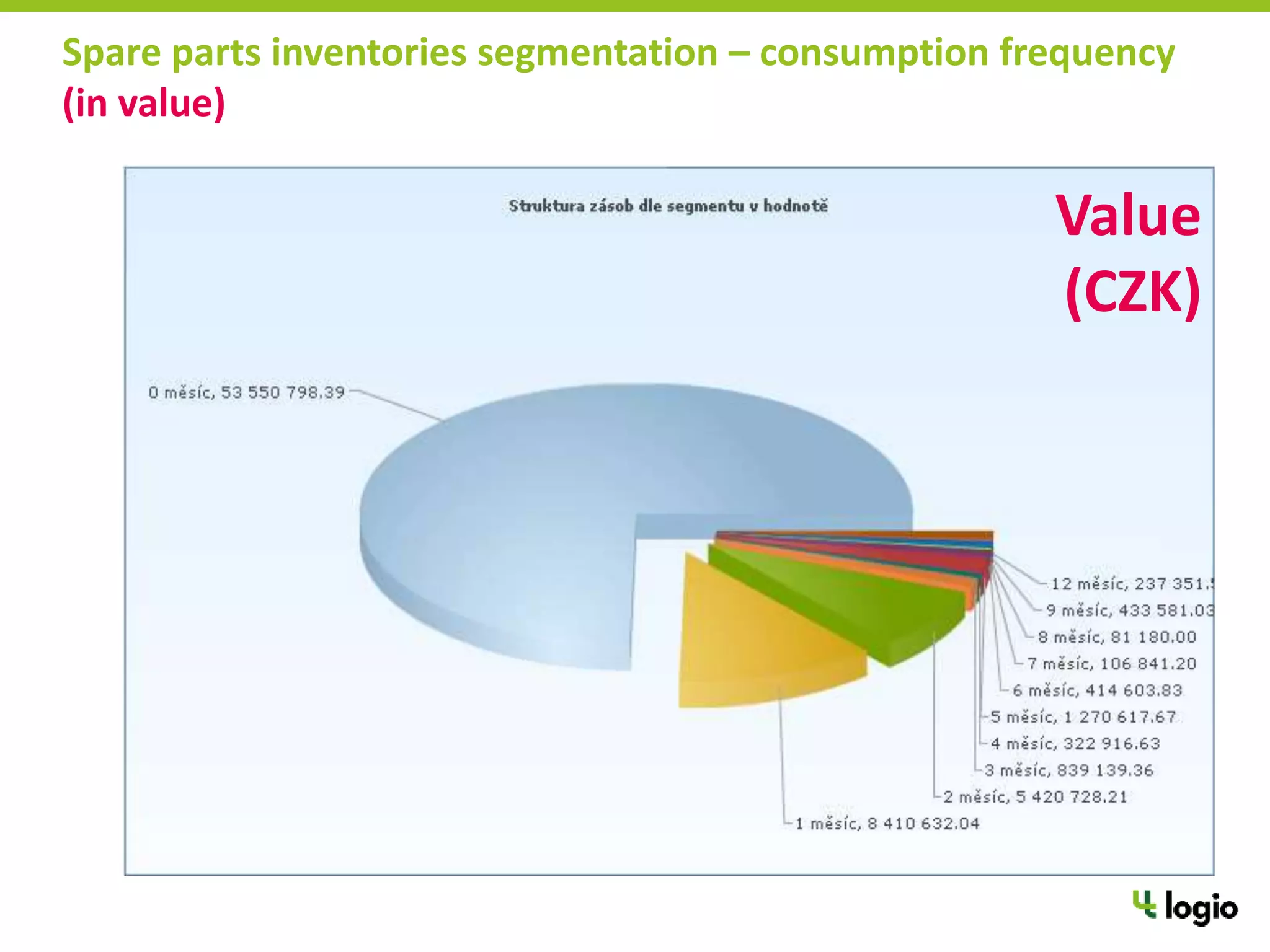
Spare parts inventories segmentation – consumption frequency
(in value)
Value
(CZK)
WHEN?
HOW MANY?
WHEN?
HOW MANY?
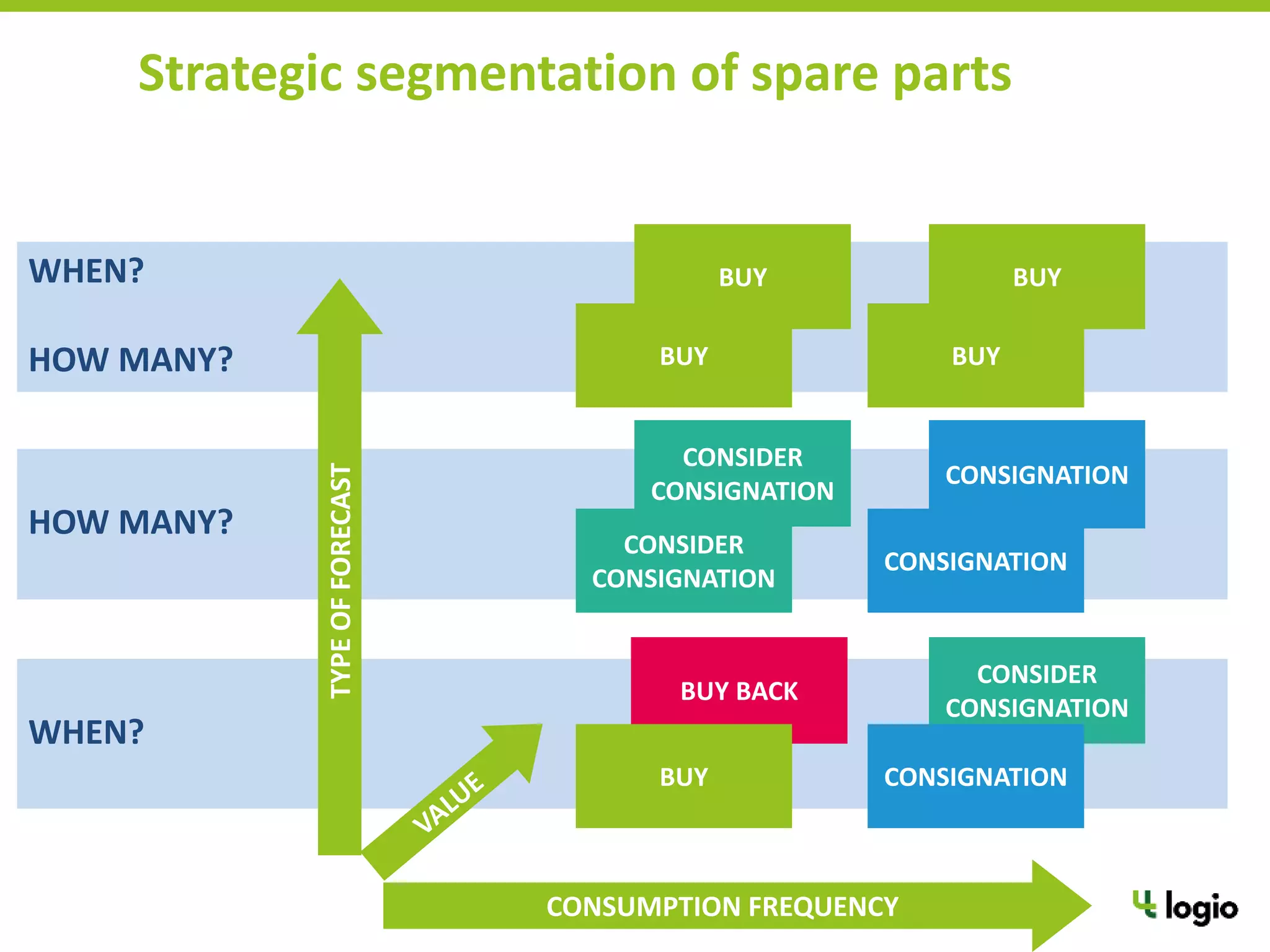
Strategic segmentation of spare parts
CONSIGNATION
CONSIGNATION
CONSIDER
CONSIGNATION
CONSIDER
CONSIGNATION
BUY
BUY
BUY
BUY
CONSIDER
CONSIGNATION
CONSIGNATION
BUY BACK
BUY
TYPEOFFORECAST
CONSUMPTION FREQUENCY
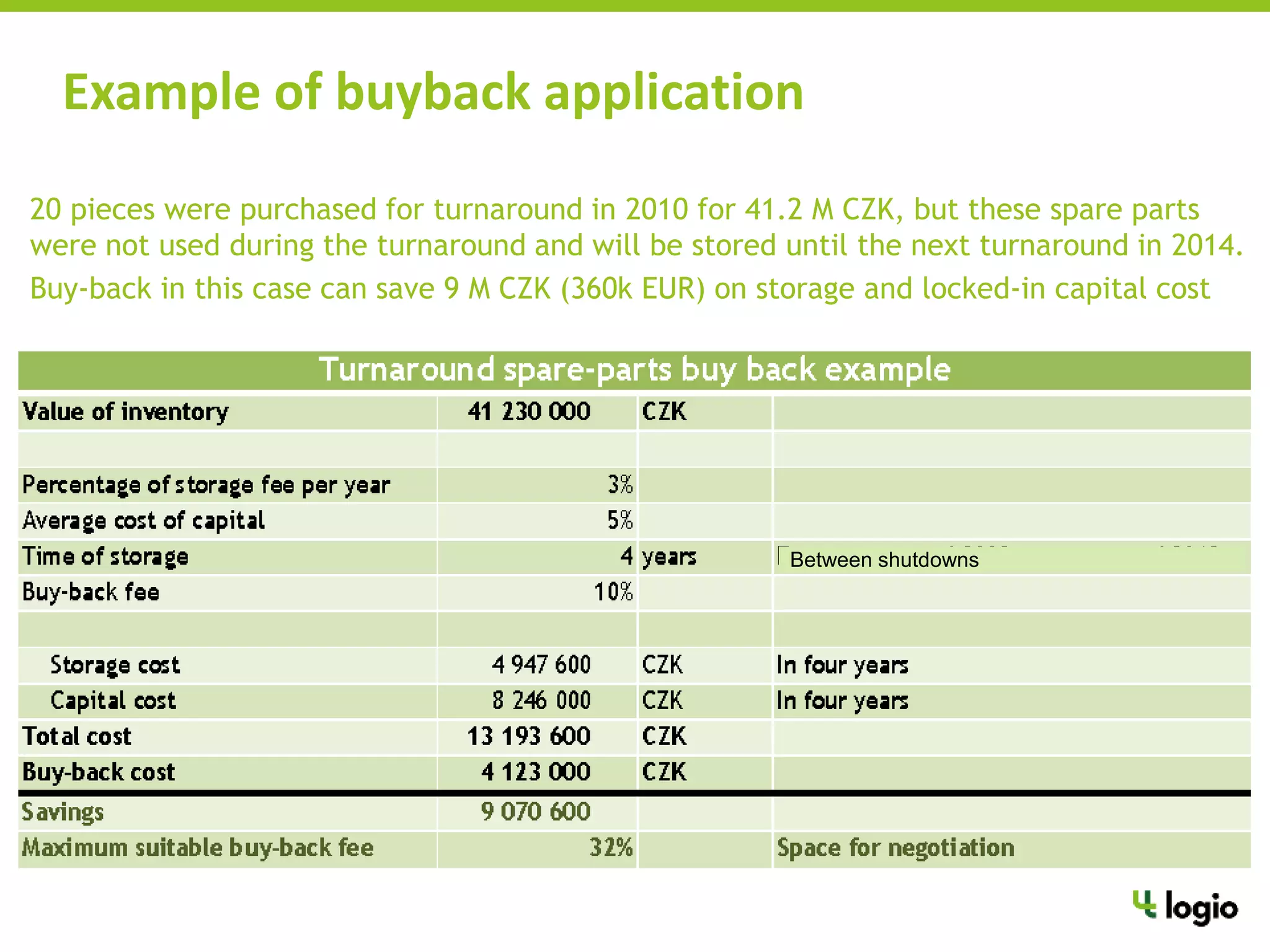
Example of buyback application
20 pieces were purchased for turnaround in 2010 for 41.2 M CZK, but these spare parts
were not used during the turnaround and will be stored until the next turnaround in 2014.
Buy-back in this case can save 9 M CZK (360k EUR) on storage and locked-in capital cost
Between shutdowns
Evaluate spare parts criticality
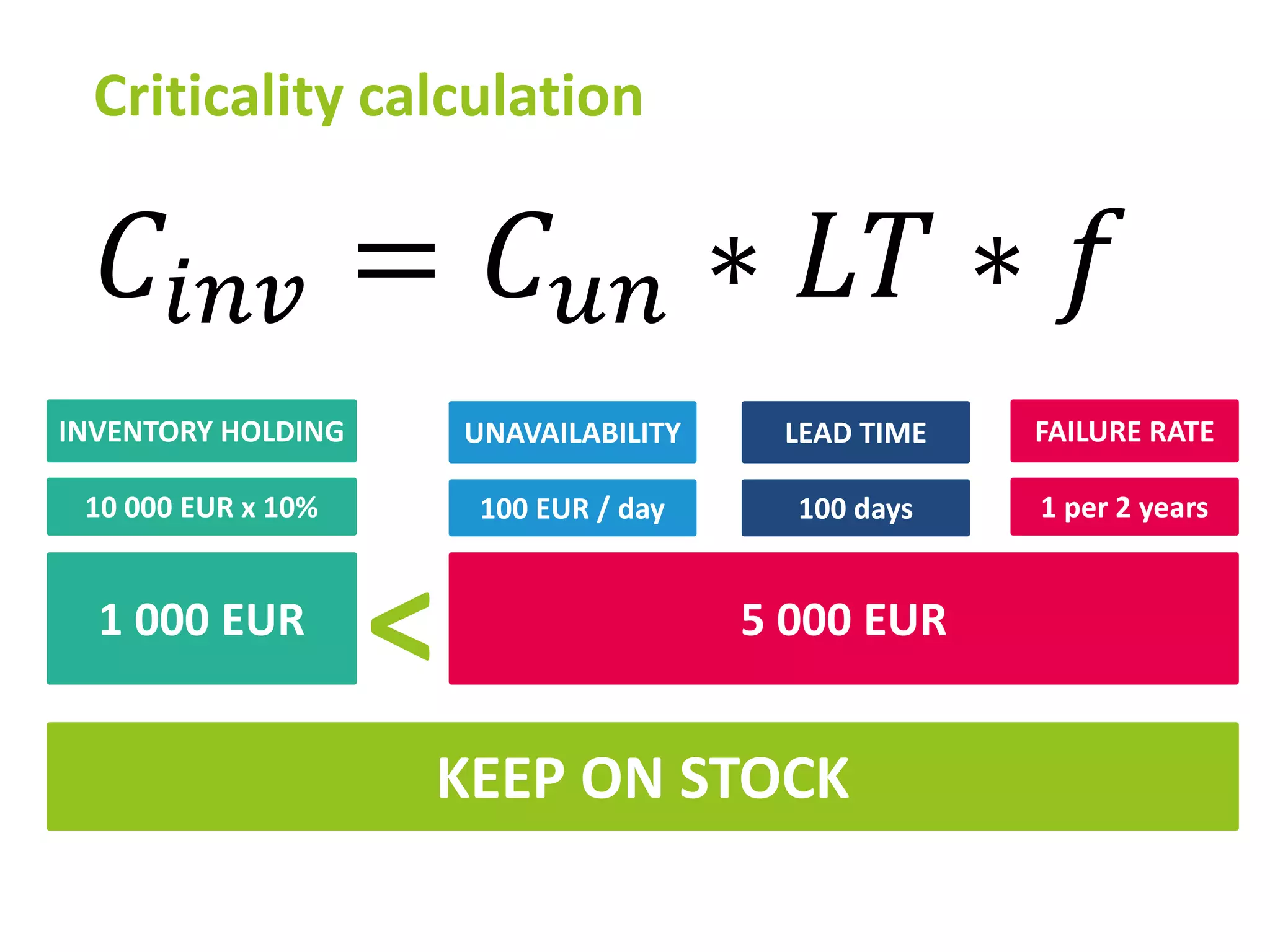
𝐶𝑖𝑛𝑣 = 𝐶 𝑢𝑛 ∗ 𝐿𝑇 ∗ 𝑓
10 000 EUR x 10% 100 EUR / day 100 days 1 per 2 years
1 000 EUR 5 000 EUR
KEEP ON STOCK
<
Criticality calculation
INVENTORY HOLDING UNAVAILABILITY LEAD TIME FAILURE RATE
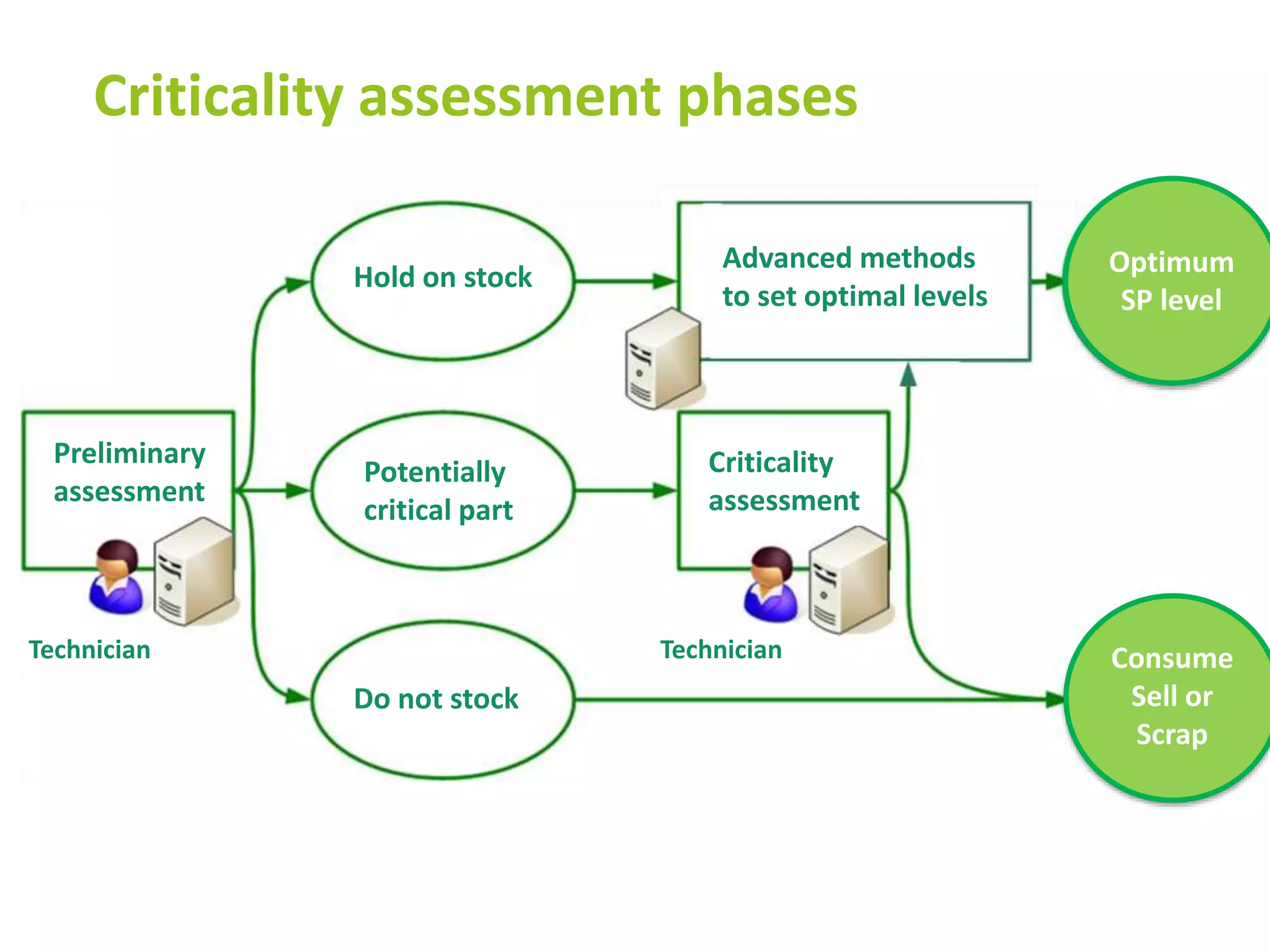
Criticality assessment phases
Preliminary
assessment
Technician
Hold on stock
Potentially
critical part
Do not stock
Advanced methods
to set optimal levels
Criticality
assessment
Technician Consume
Sell or
Scrap
Optimum
SP level
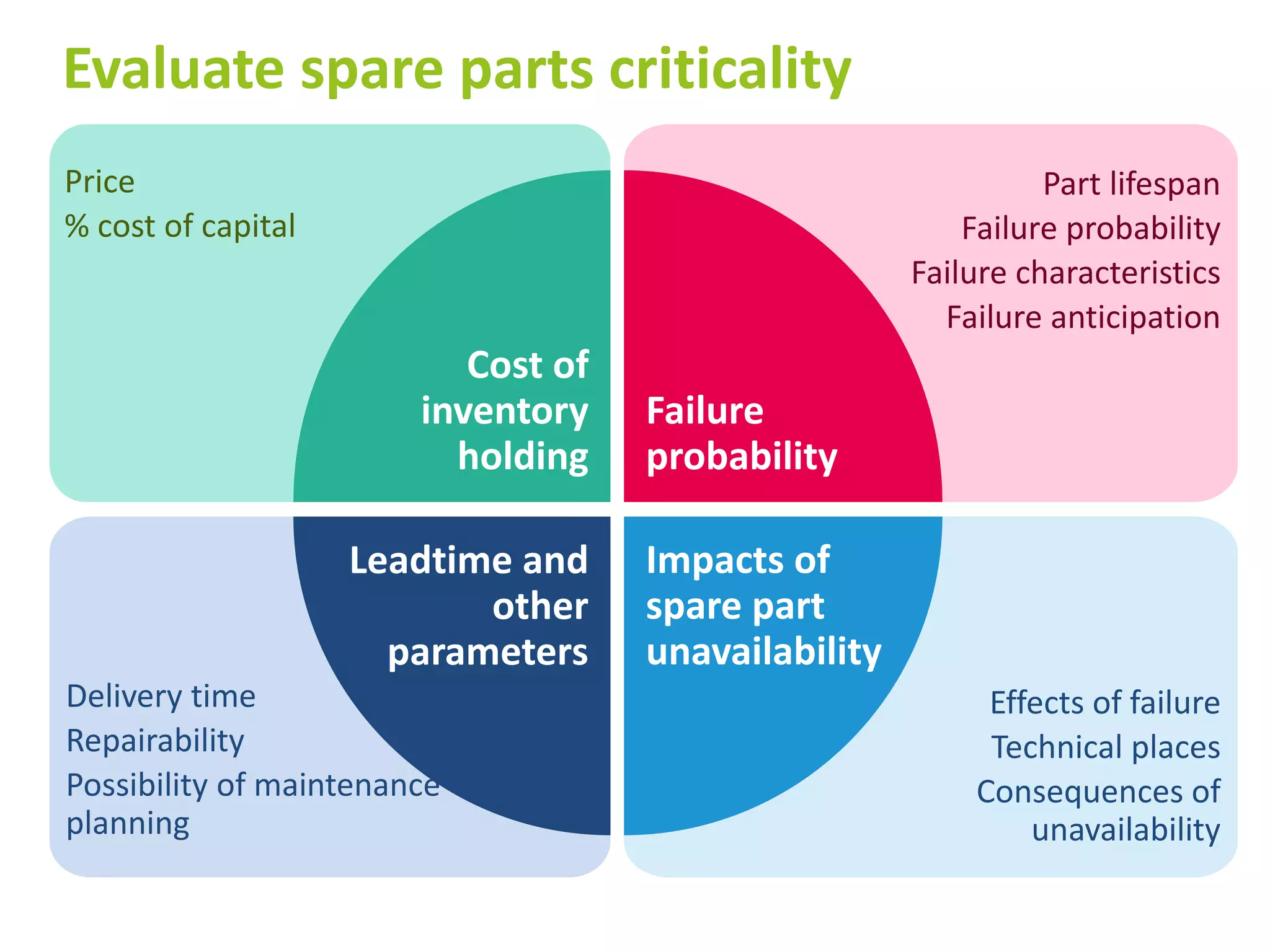
Effects of failure
Technical places
Consequences of
unavailability
Delivery time
Repairability
Possibility of maintenance
planning
Part lifespan
Failure probability
Failure characteristics
Failure anticipation
Price
% cost of capital
Cost of
inventory
holding
Failure
probability
Impacts of
spare part
unavailability
Leadtime and
other
parameters
Evaluate spare parts criticality
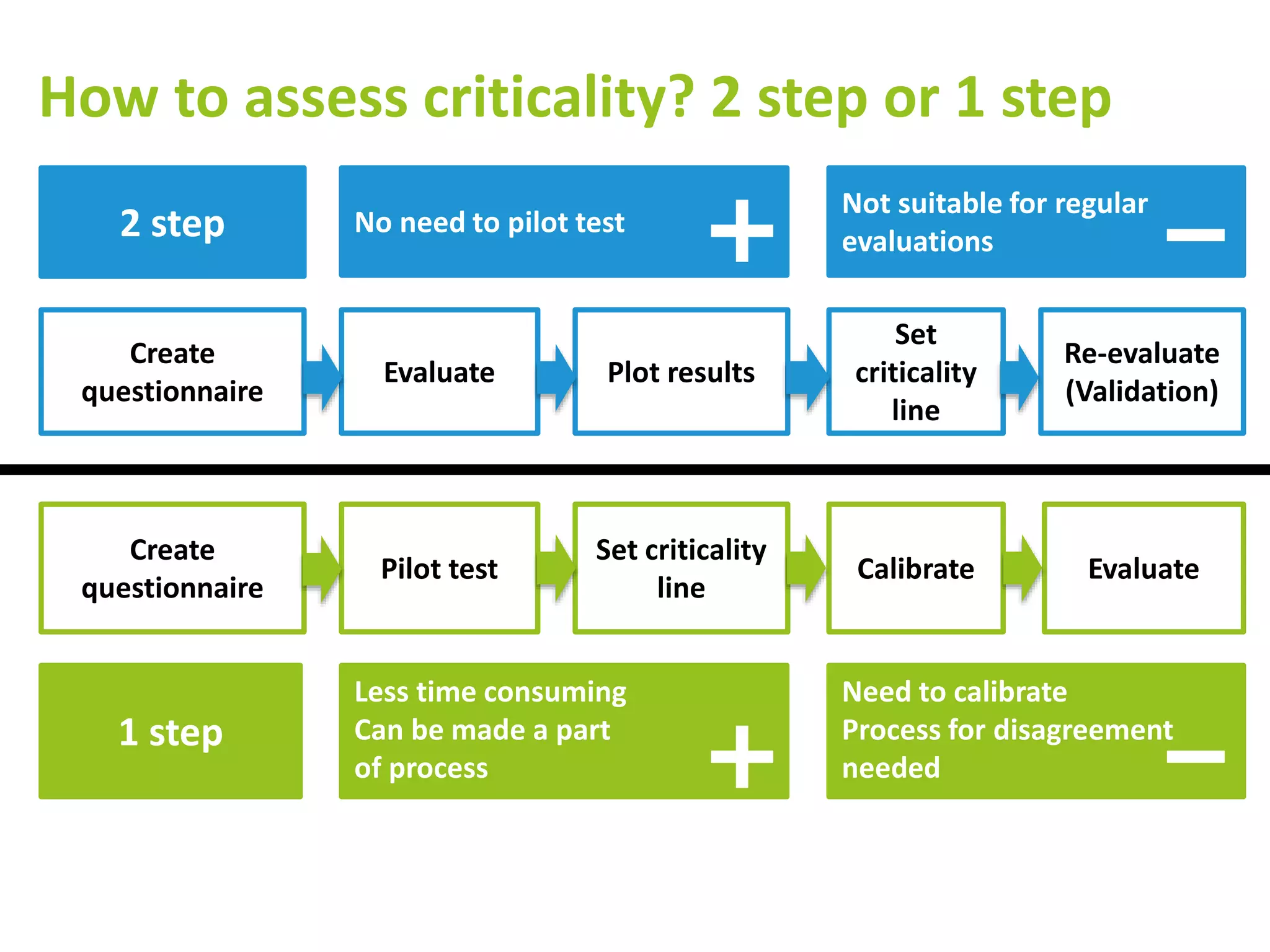
No need to pilot test
How to assess criticality? 2 step or 1 step
Create
questionnaire
Pilot test
Plot results
Set
criticality
line
Create
questionnaire
Evaluate
Set criticality
line
Calibrate Evaluate
Re-evaluate
(Validation)
Not suitable for regular
evaluations
Less time consuming
Can be made a part
of process
Need to calibrate
Process for disagreement
needed
1 step
2 step
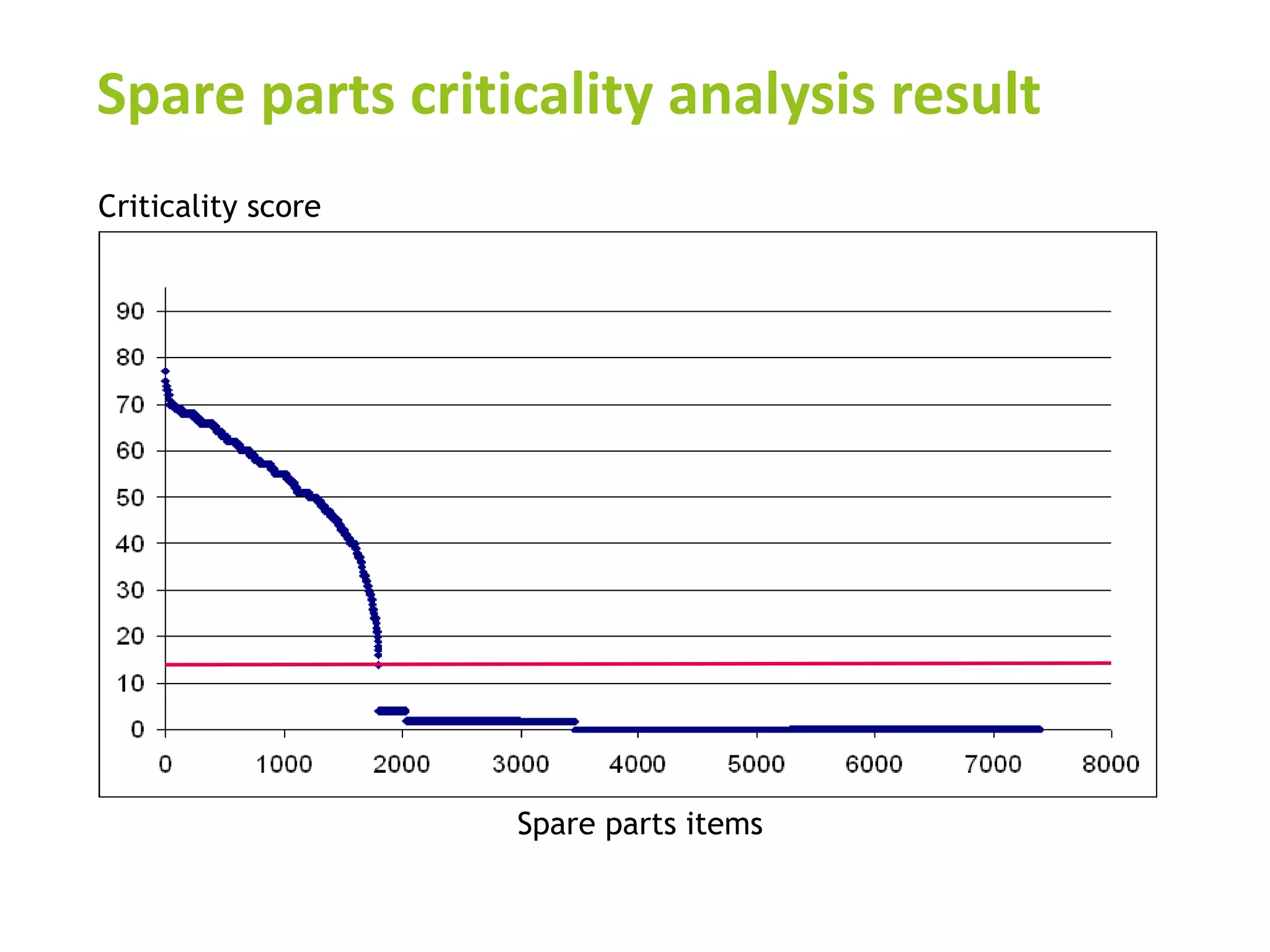
Spare parts criticality analysis result
Criticality score
Spare parts items
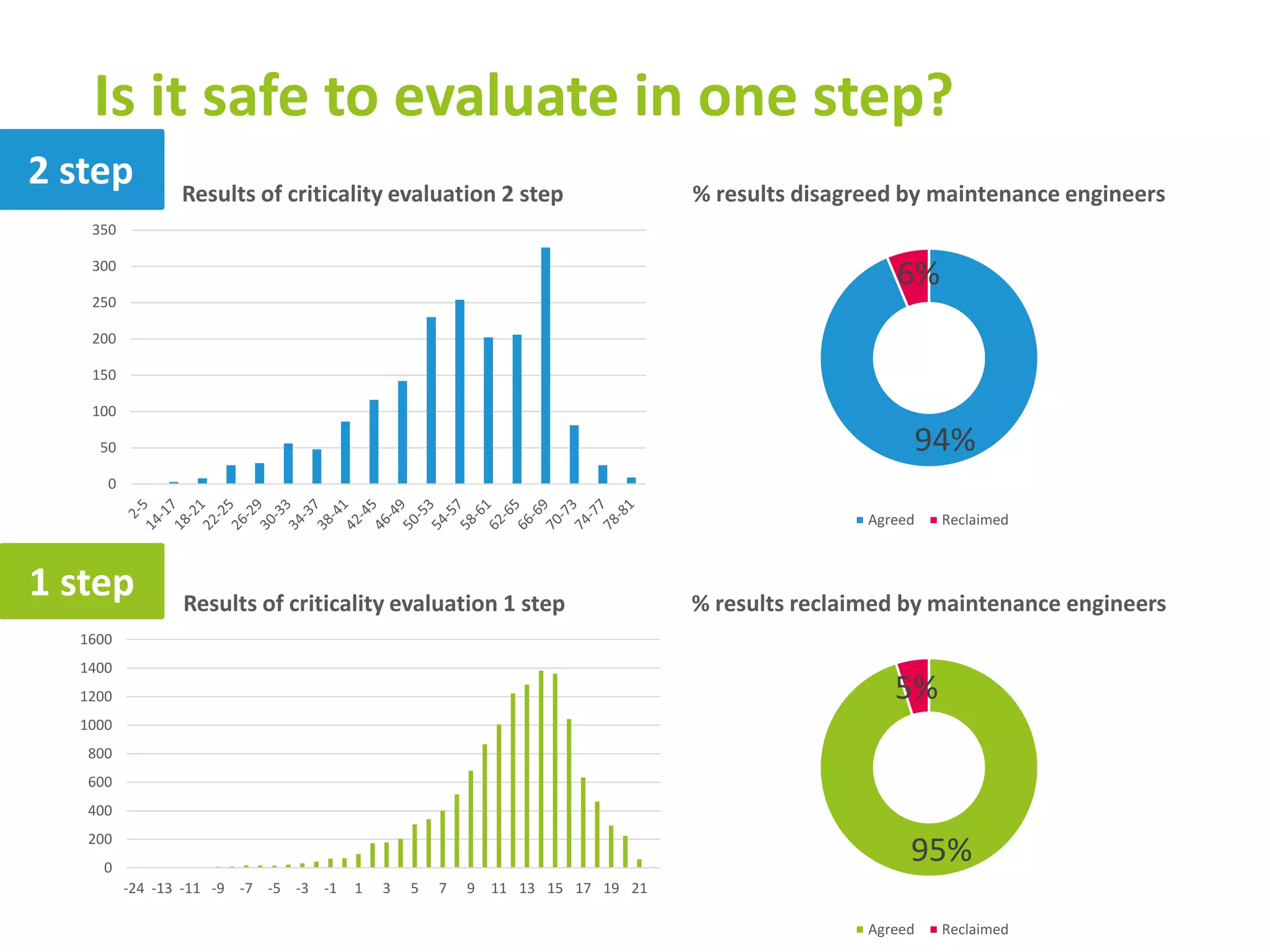
Is it safe to evaluate in one step?
95%
5%
% results reclaimed by maintenance engineers
Agreed Reclaimed
0
200
400
600
800
1000
1200
1400
1600
-24 -13 -11 -9 -7 -5 -3 -1 1 3 5 7 9 11 13 15 17 19 21
Results of criticality evaluation 1 step
0
50
100
150
200
250
300
350
Results of criticality evaluation 2 step
94%
6%
% results disagreed by maintenance engineers
Agreed Reclaimed
2 step
1 step
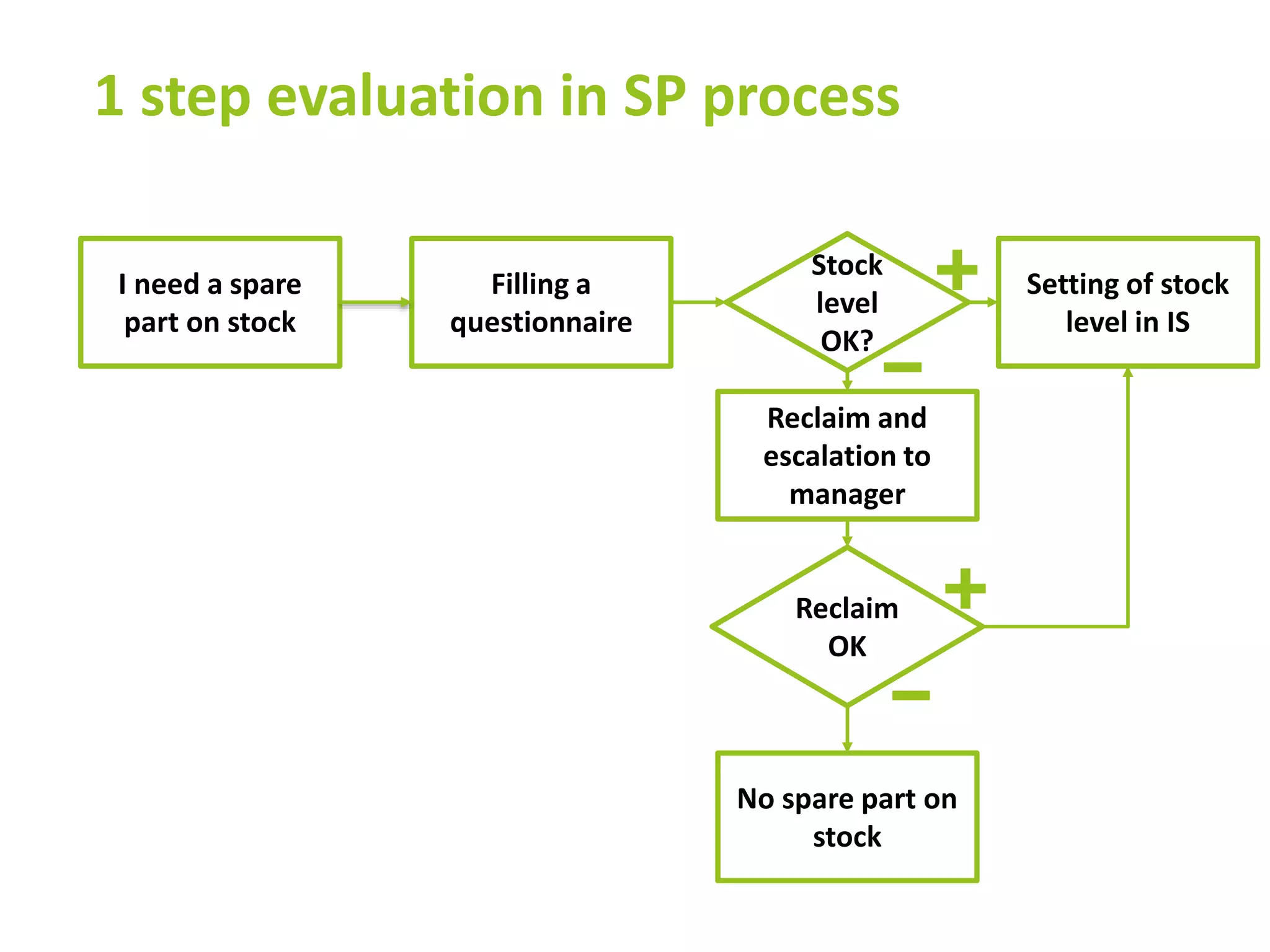
1 step evaluation in SP process
I need a spare
part on stock
Filling a
questionnaire
Stock
level
OK?
Reclaim and
escalation to
manager
Reclaim
OK
Setting of stock
level in IS
No spare part on
stock
How much time is needed?
16 minutes or less
in 80% of cases
Time
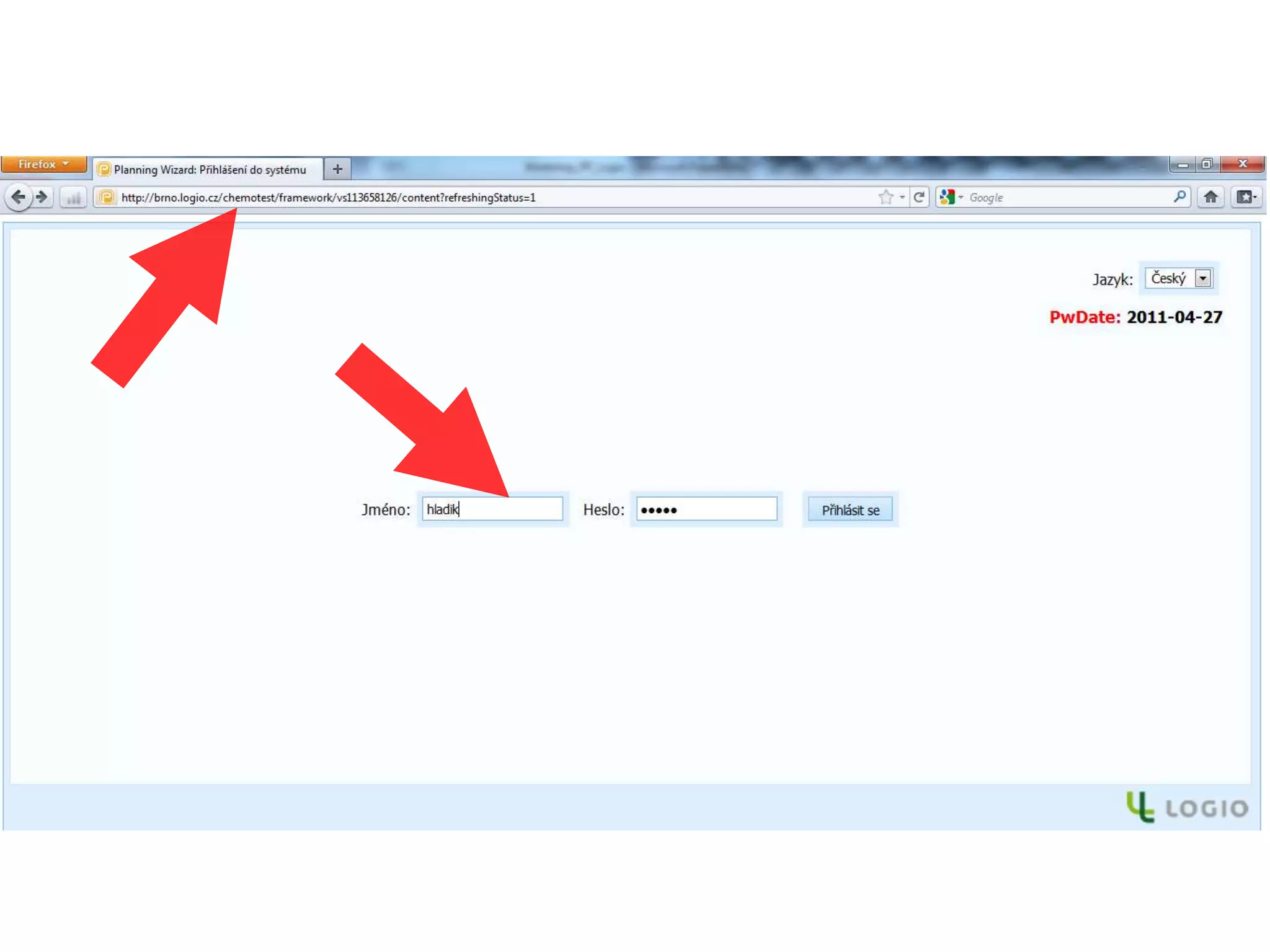
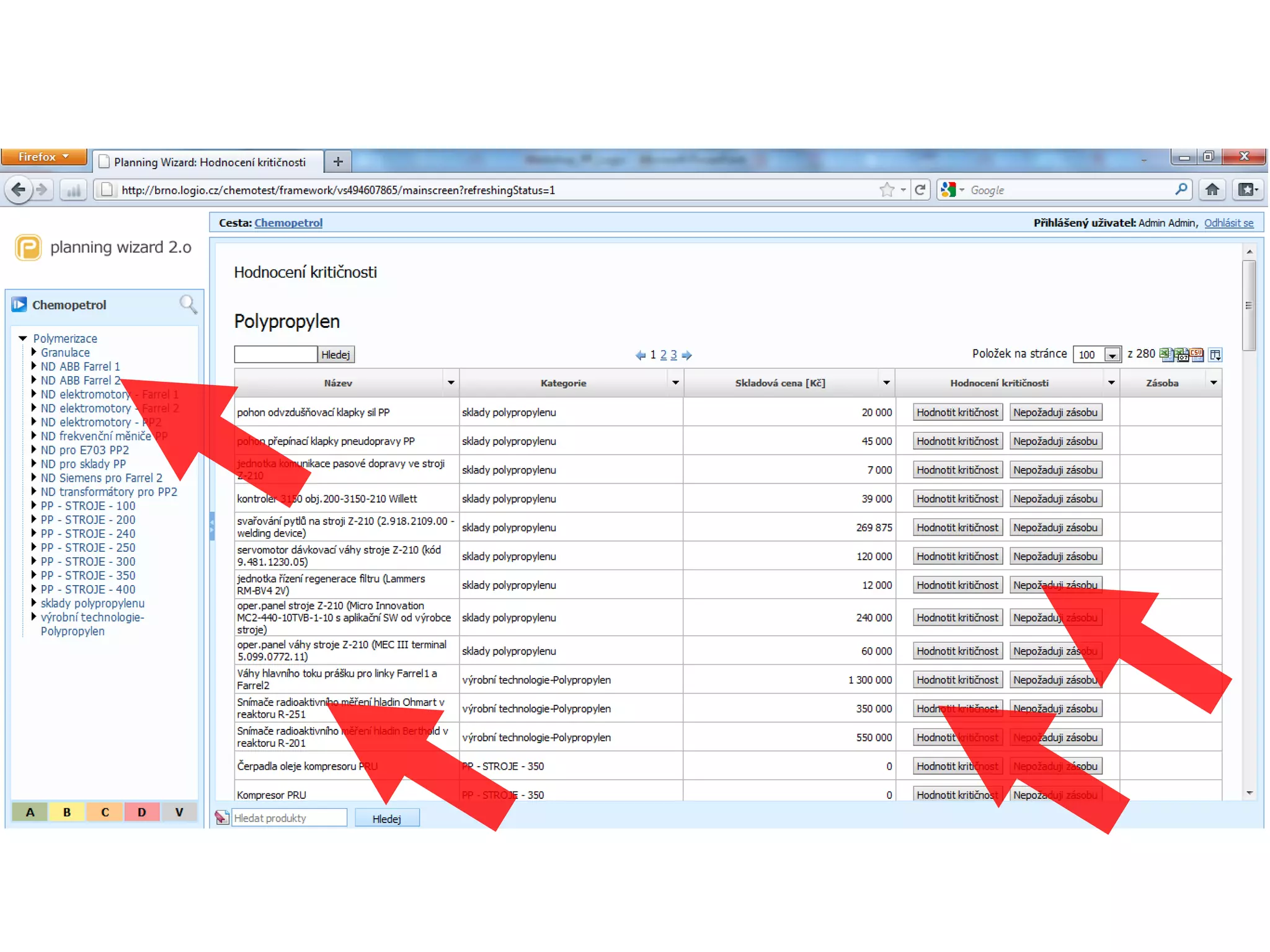
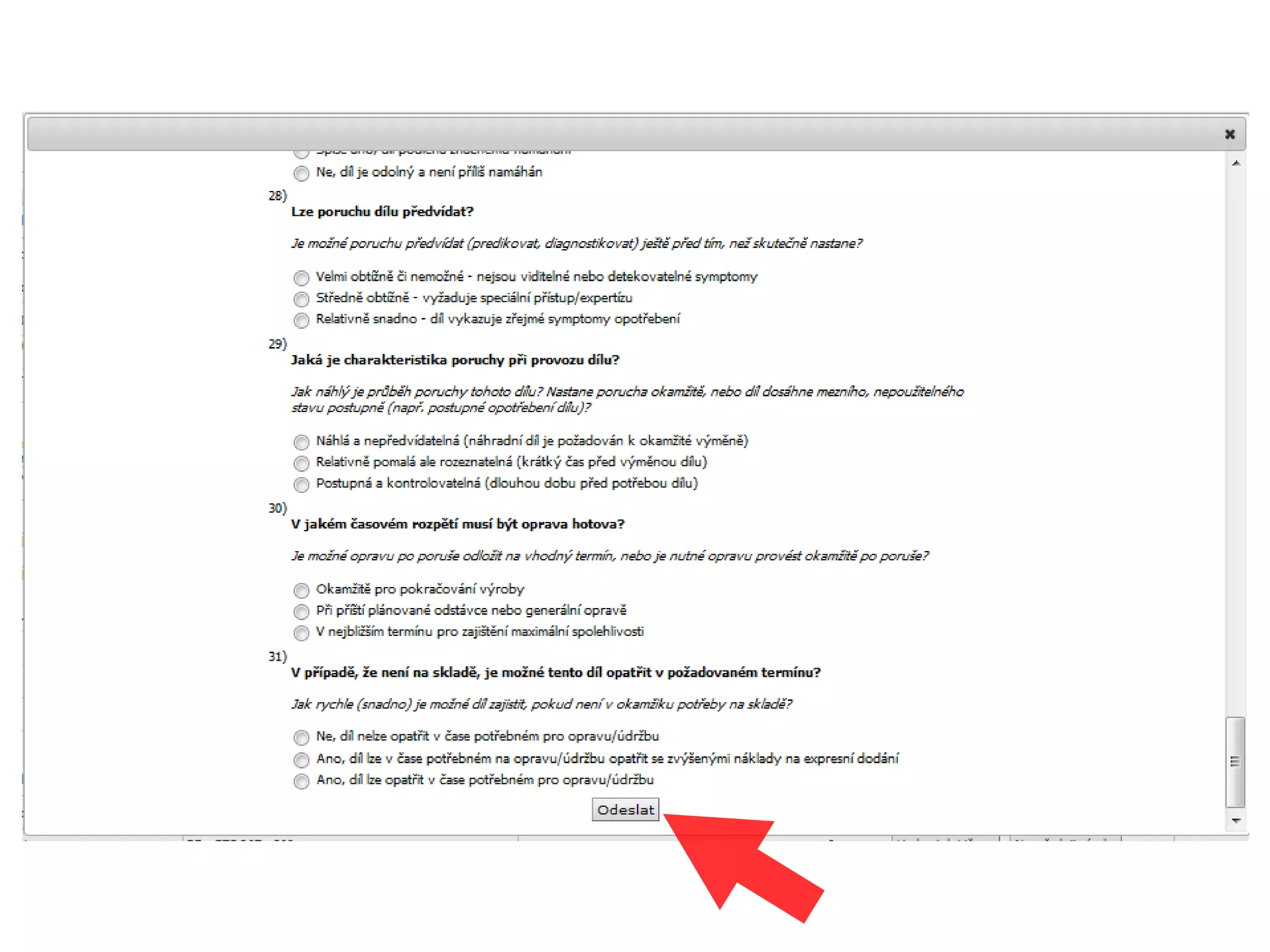
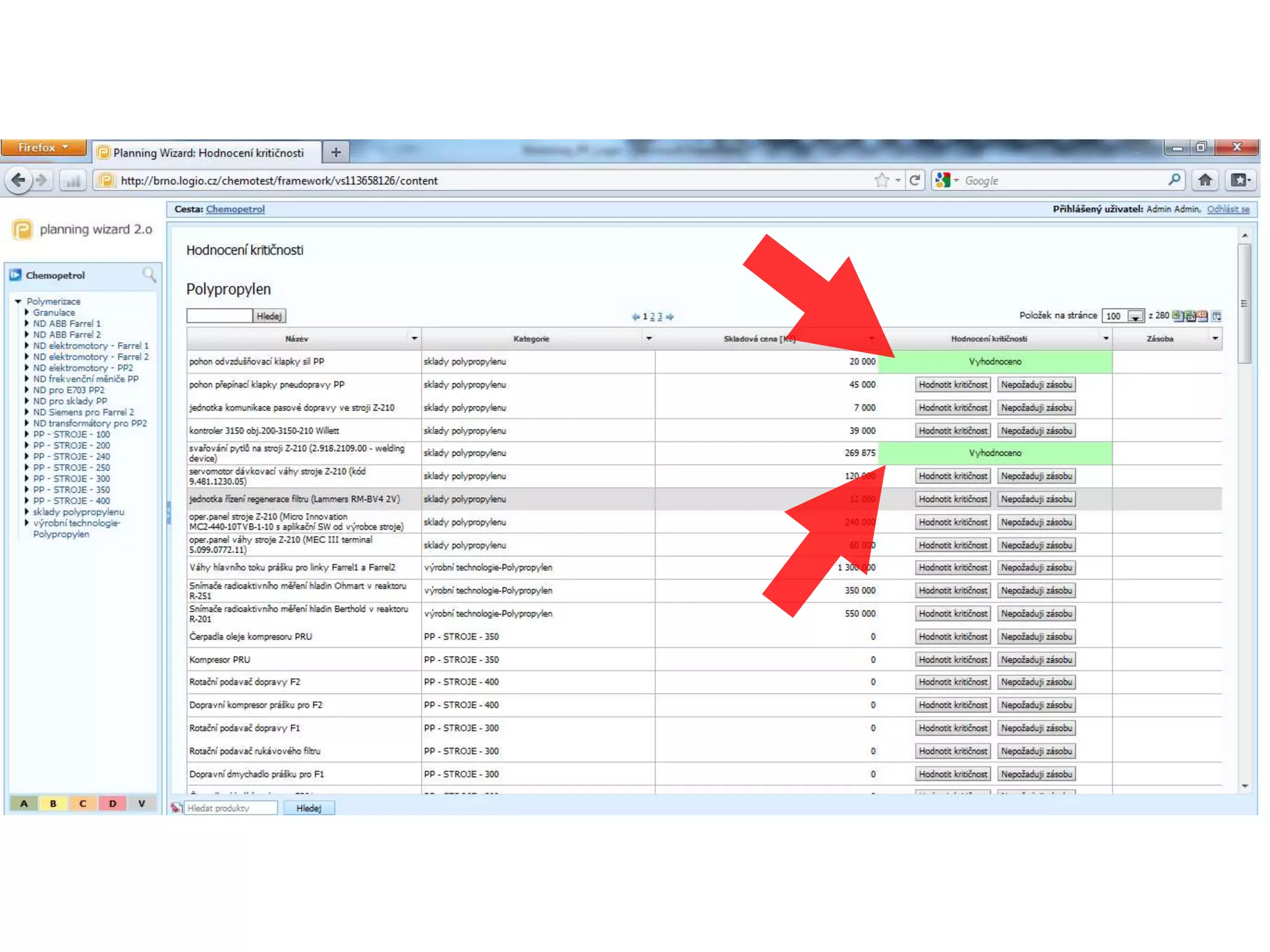
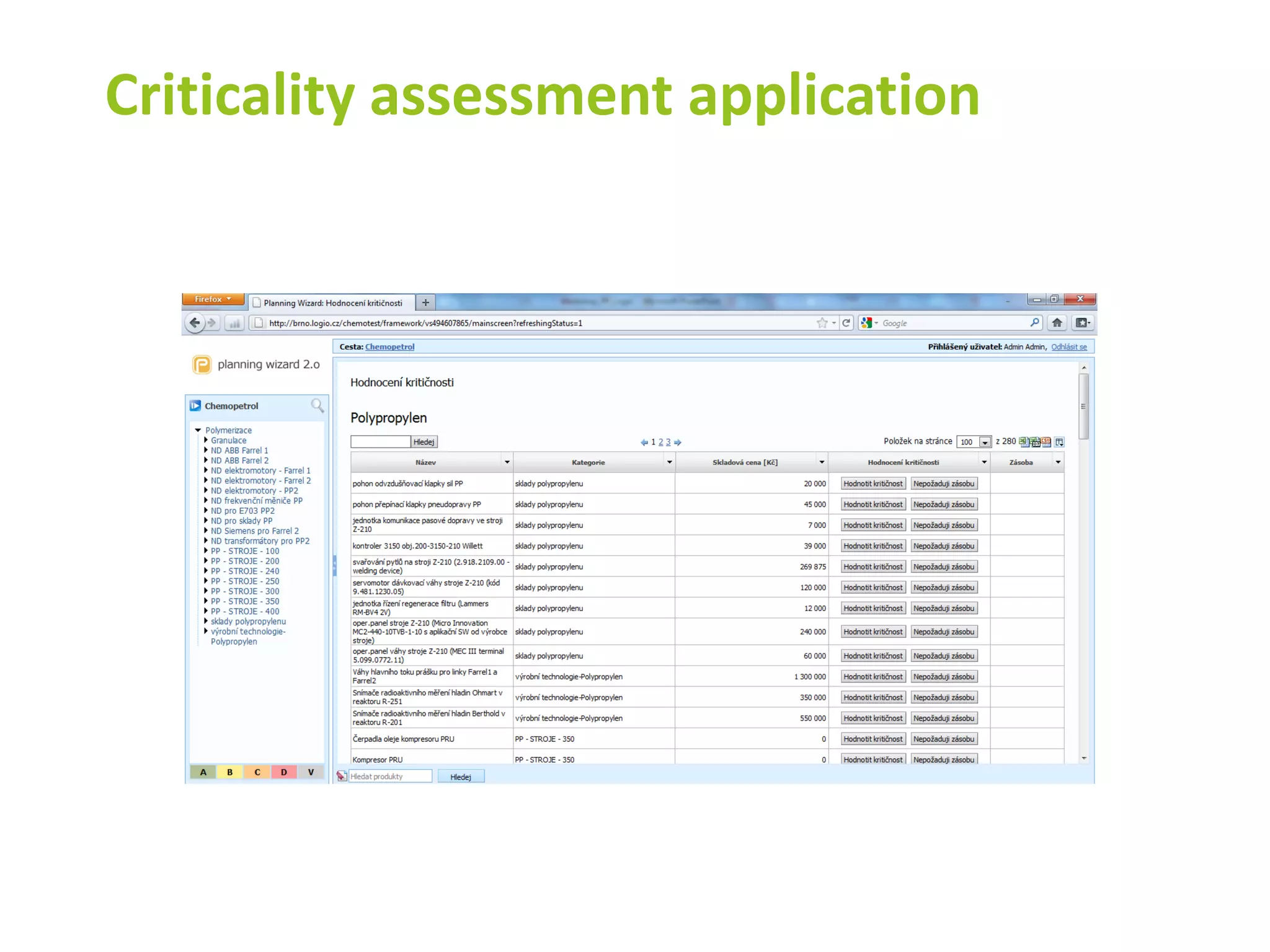
Criticality assessment application
Login = Příjmení
Heslo = Jméno
Příklad:
tokac miroslav
Login a heslo
Postupné hodnocení kritičnosti
Spare parts management starts
with good forecasting
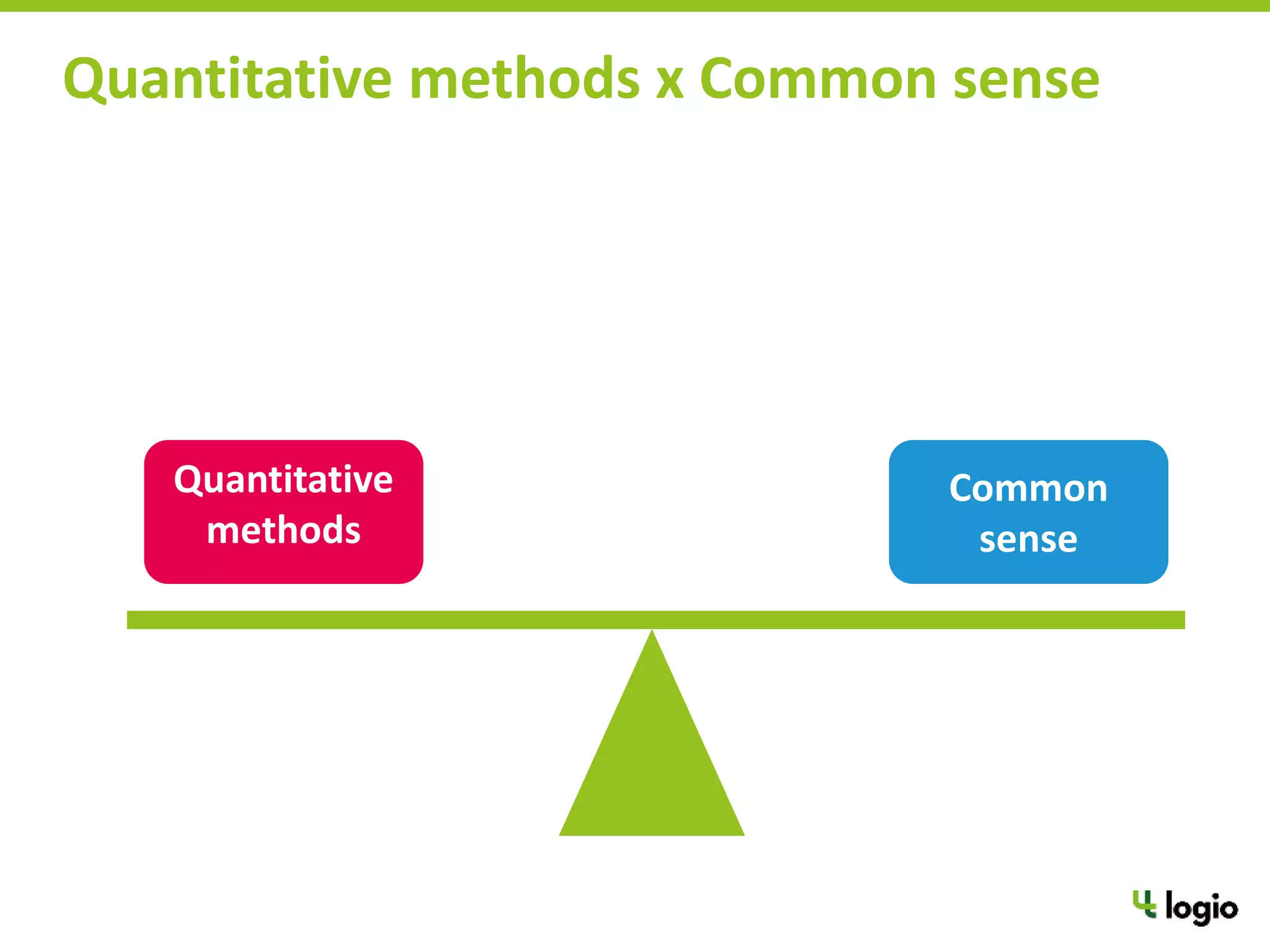
Quantitative methods x Common sense
Quantitative
methods
Common
sense
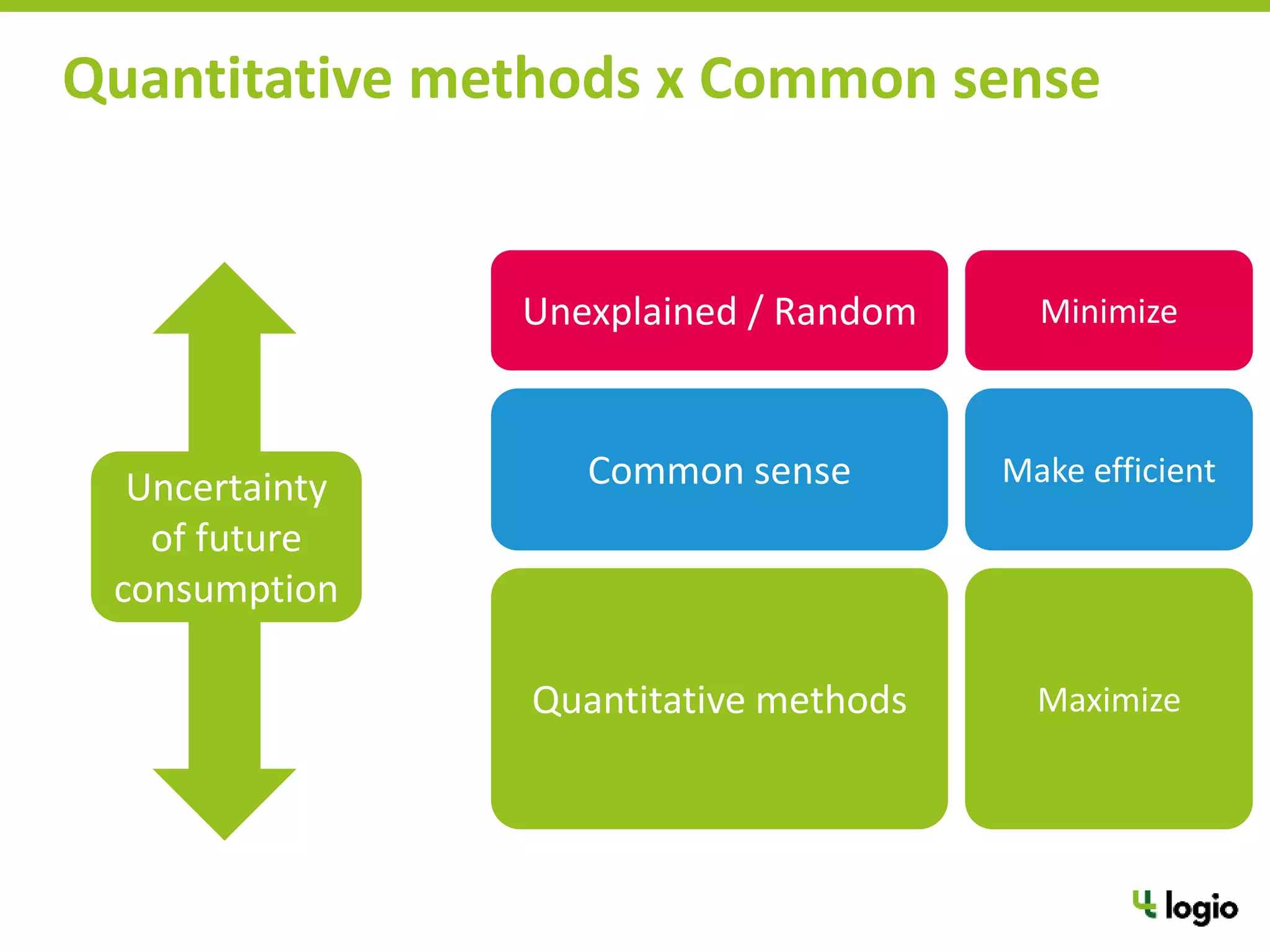
Quantitative methods x Common sense
Quantitative methods
Common sense
Unexplained / Random
Uncertainty
of future
consumption
Maximize
Make efficient
Minimize
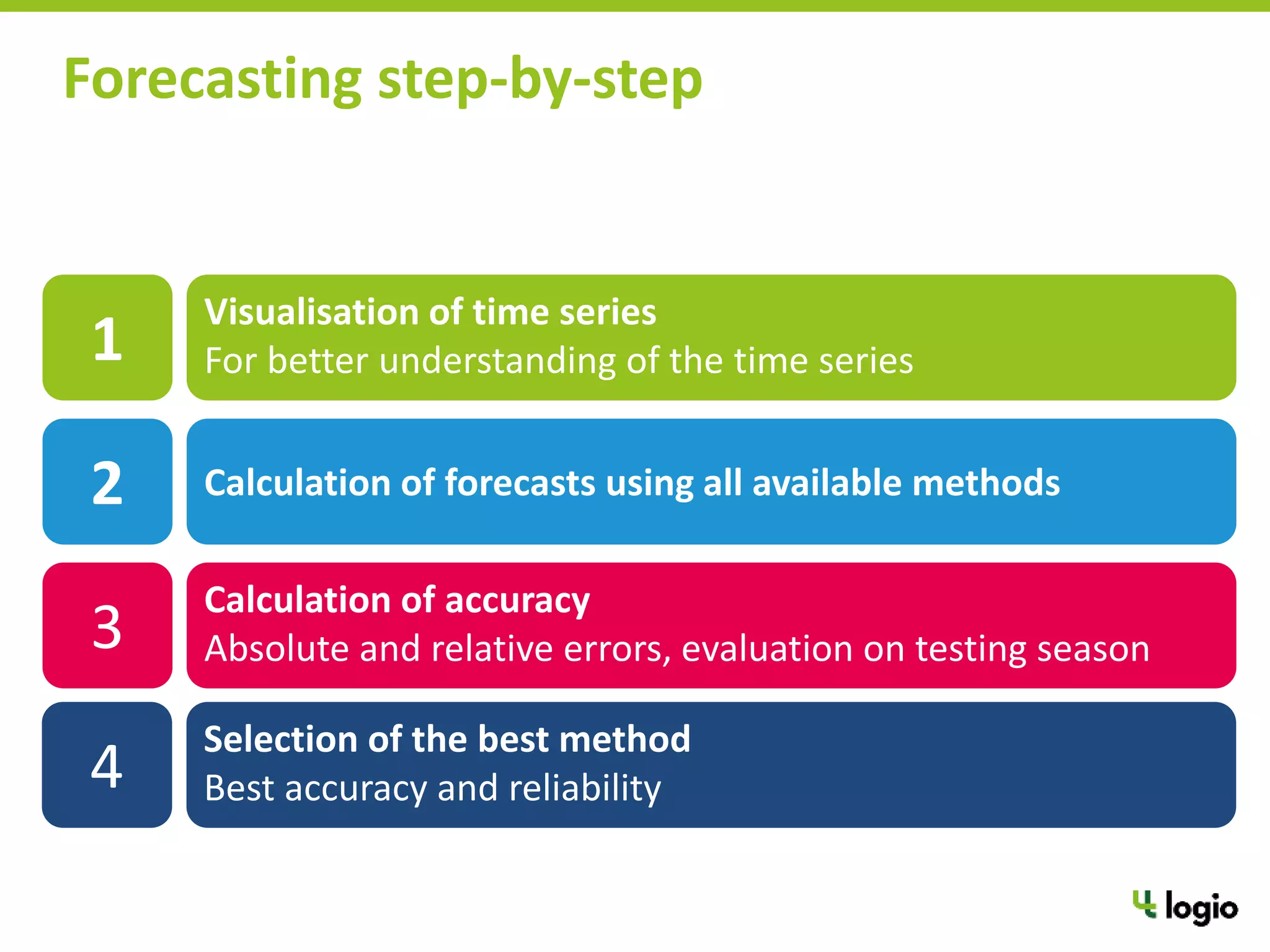
Forecasting step-by-step
Visualisation of time series
For better understanding of the time series
Calculation of accuracy
Absolute and relative errors, evaluation on testing season
Calculation of forecasts using all available methods
Selection of the best method
Best accuracy and reliability
1
3
2
4
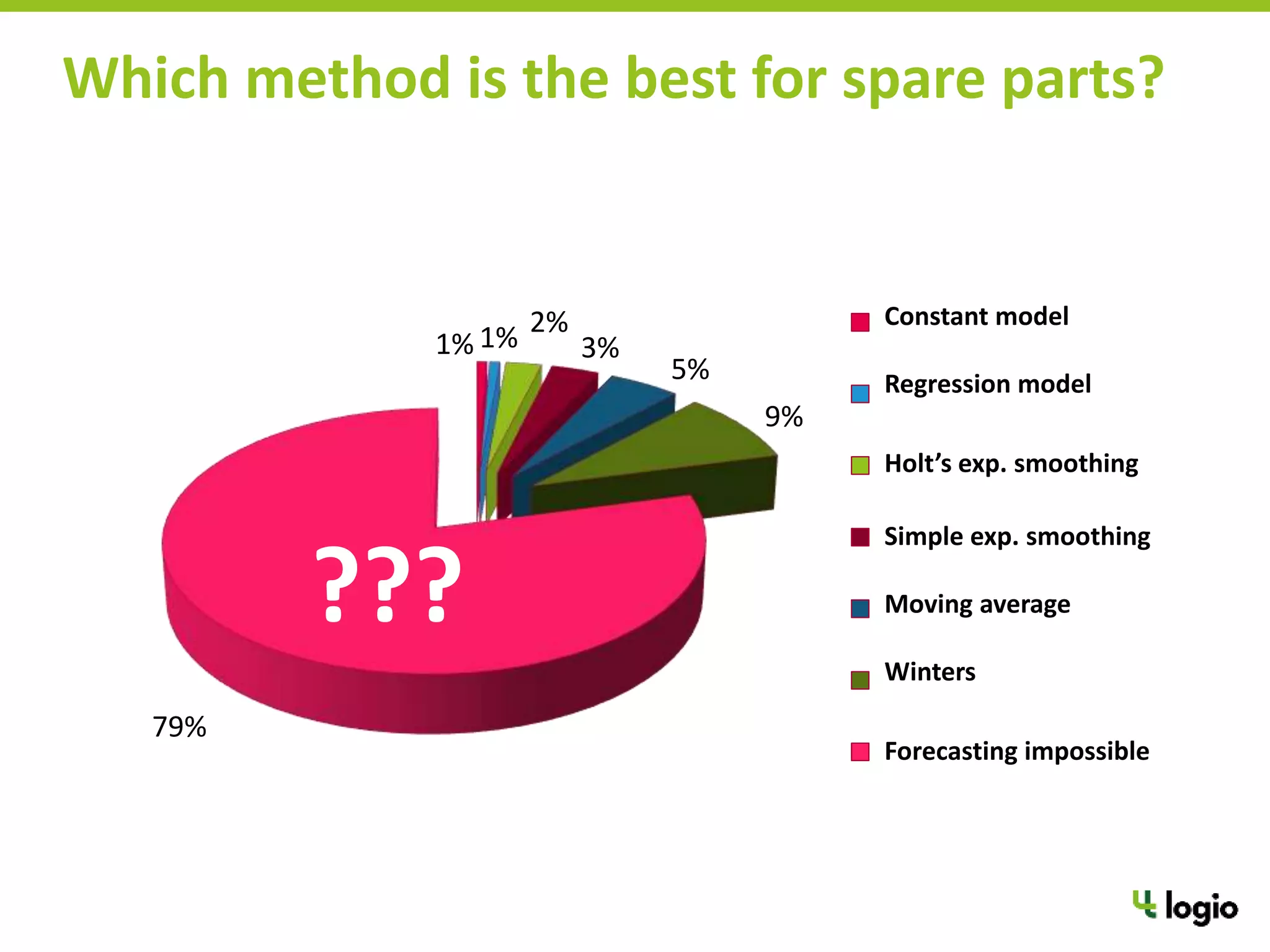
Which method is the best for spare parts?
1% 1% 2%
3%
5%
9%
79%
Konstantní model
Regresní model
Holtovo exp. vyrovnání
Jednoduché exp.
vyrovnání
Klouzavý průměr
Winters
Forecasting není možný
Constant model
Regression model
Holt’s exp. smoothing
Simple exp. smoothing
Moving average
Winters
Forecasting impossible
???
Use special methods for
intermittent demand items
TýdenníspotřebyND
Historie týdenních spotřeb (týdny)
4 13 17 30
0
1
2
3
4
81 18 25 27
26
32
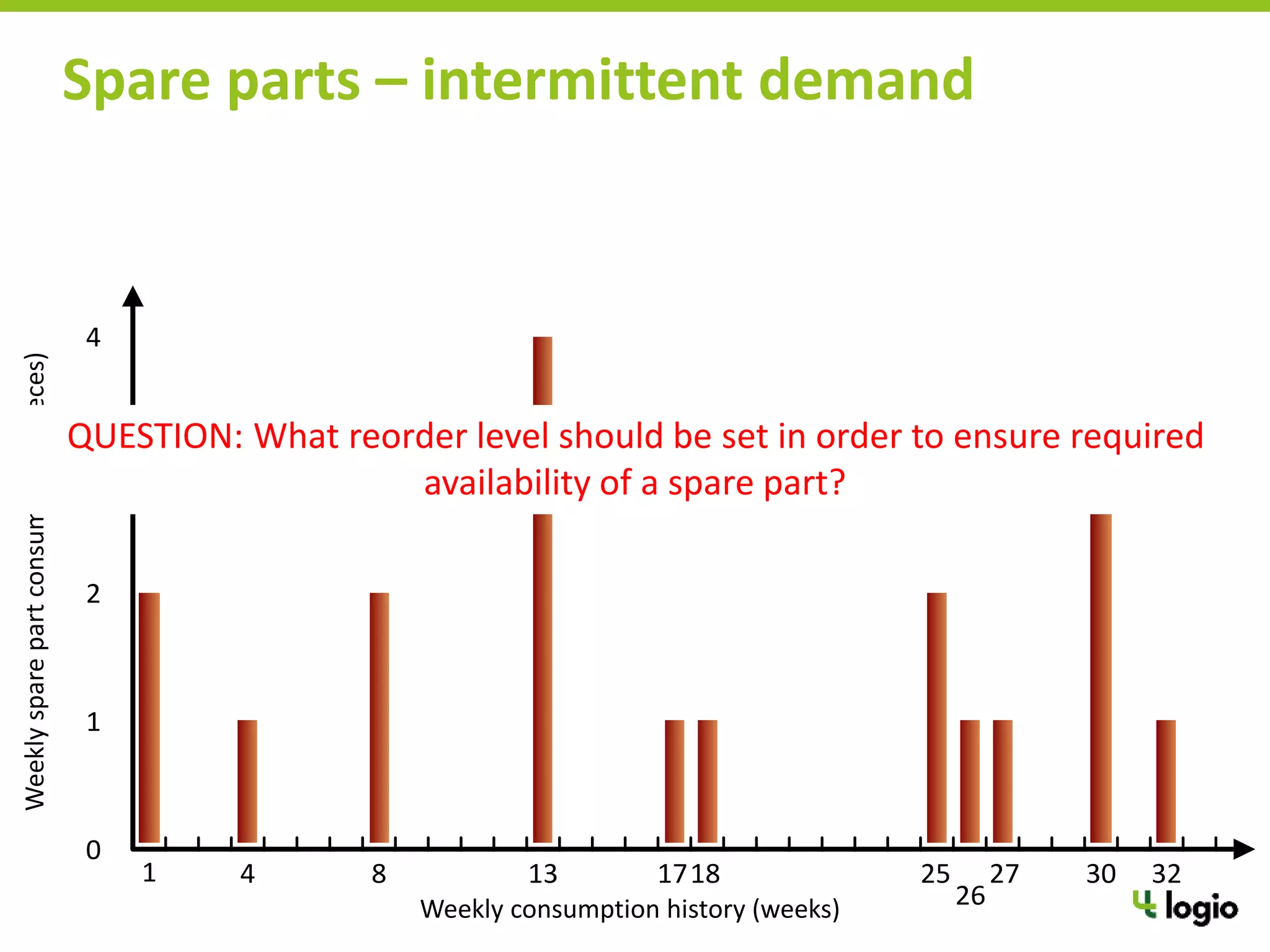
Spare parts – intermittent demand
Weekly consumption history (weeks)
Weeklysparepartconsumption(pieces)
QUESTION: What reorder level should be set in order to ensure required
availability of a spare part?
TýdenníspotřebyND
Historie týdenních spotřeb (týdny)
4 13 17 30
0
1
2
3
4
81 18 25 27
26
32
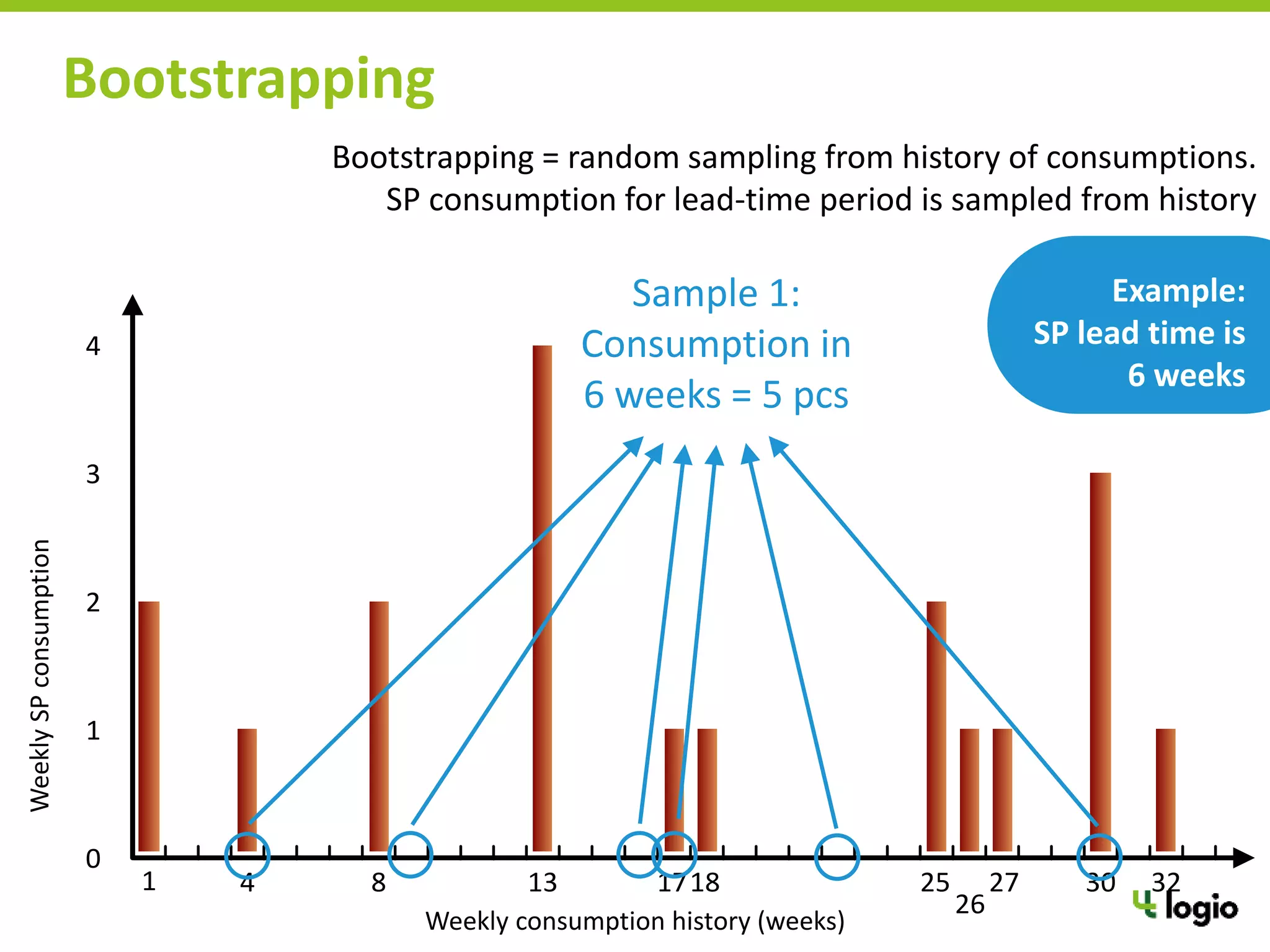
Bootstrapping
Bootstrapping = random sampling from history of consumptions.
SP consumption for lead-time period is sampled from history
Sample 1:
Consumption in
6 weeks = 5 pcs
WeeklySPconsumption
Weekly consumption history (weeks)
Example:
SP lead time is
6 weeks
Bootstrapping
Vzorek 2: Spotřeba
za
6 týdnů = 0 ks
TýdenníspotřebyND
Historie týdenních spotřeb (týdny)
4 13 17 30
0
1
2
3
4
81 18 25 27
26
32
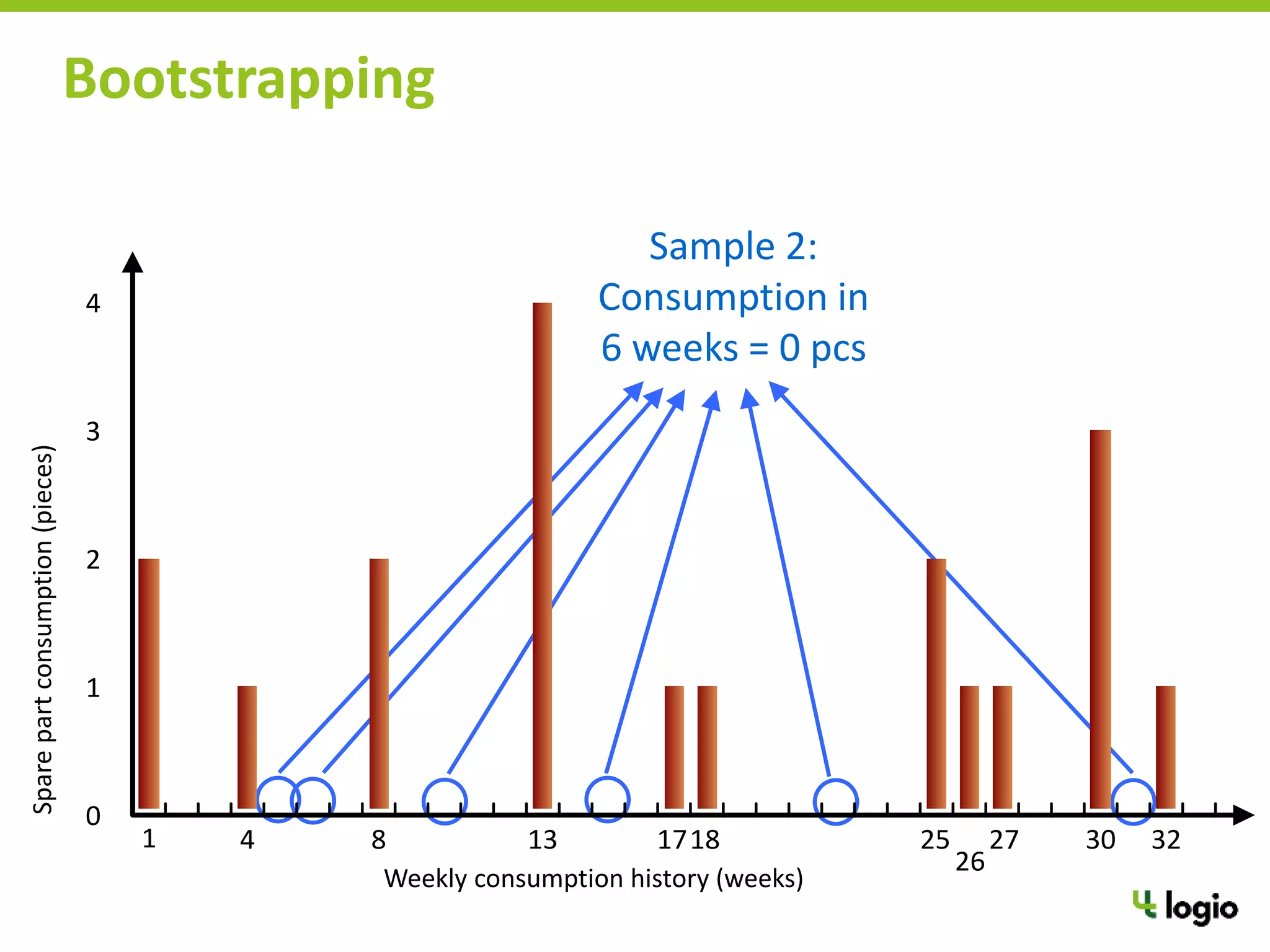
Sample 2:
Consumption in
6 weeks = 0 pcs
Weekly consumption history (weeks)
Sparepartconsumption(pieces)
Bootstrapping
Vzorek 3:
Spotřeba za
6 týdnů = 12 ks
TýdenníspotřebyND
Historie týdenních spotřeb (týdny)
4 13 17 30
0
1
2
3
4
81 18 25 27
26
32
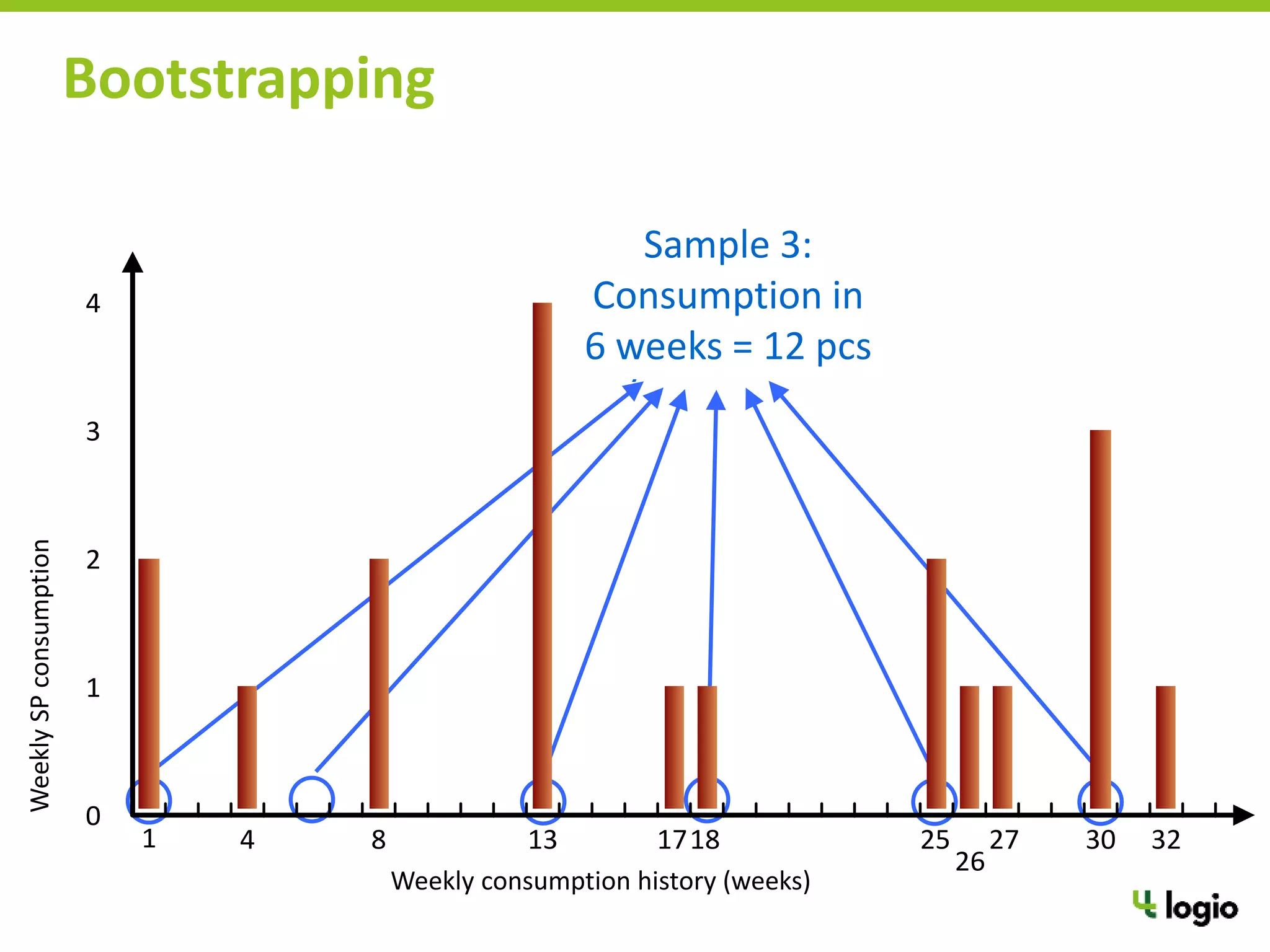
Sample 3:
Consumption in
6 weeks = 12 pcs
Weekly consumption history (weeks)
WeeklySPconsumption
Bootstrapping
Vzorek 4:
Spotřeba za
6 týdnů = 2 ks
TýdenníspotřebyND
Historie týdenních spotřeb (týdny)
4 13 17 30
0
1
2
3
4
81 18 25 27
26
32
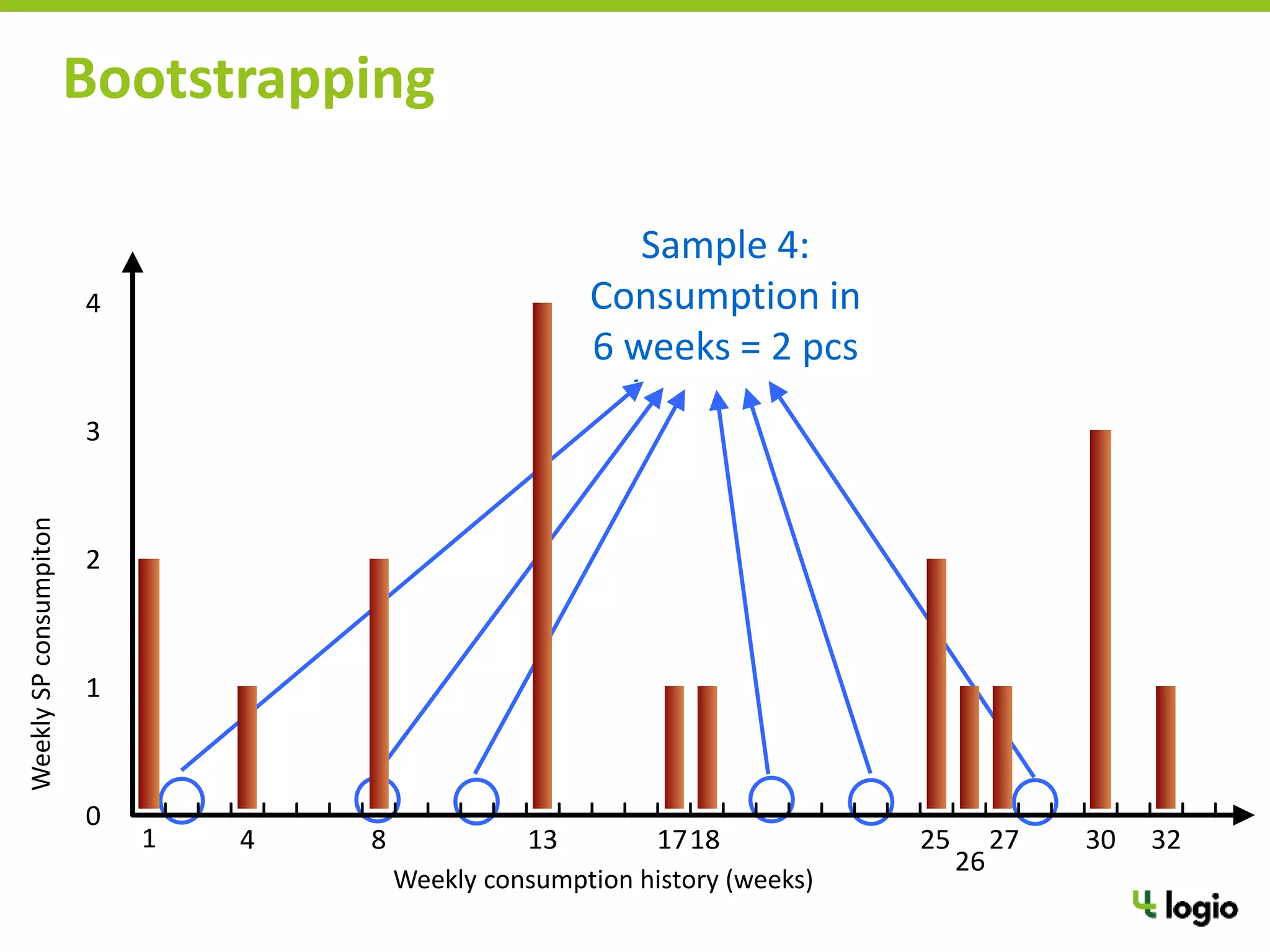
Sample 4:
Consumption in
6 weeks = 2 pcs
Weekly consumption history (weeks)
WeeklySPconsumpiton
Četnostispotřebvjednotlivýchintervalech
(zesimulace)
Spotřeba během LT – intervaly (ks)
0 5 10 15
60 000
0
30 000
Kumulativnípravděpodobnostspotřeby
100 %
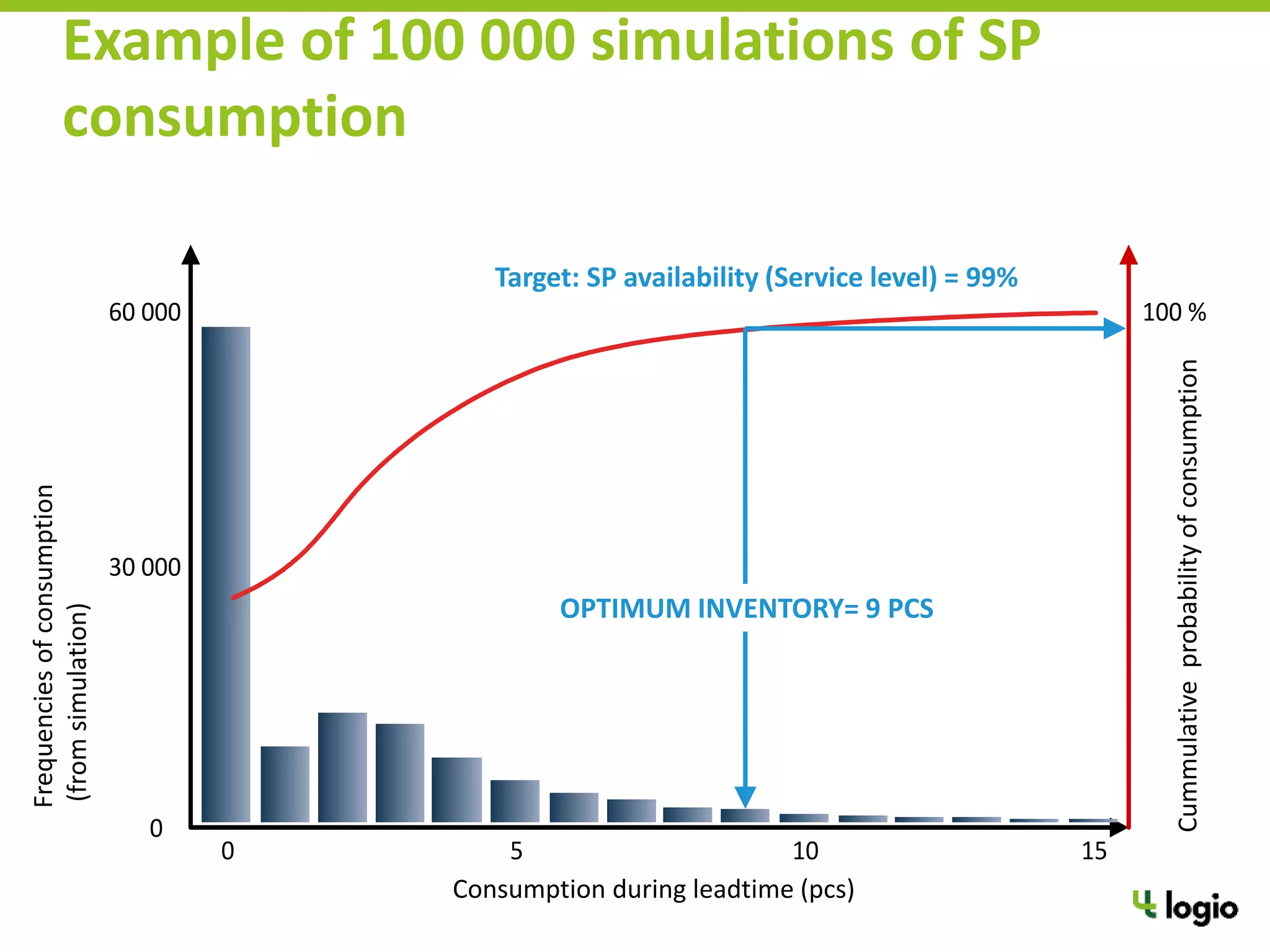
Example of 100 000 simulations of SP
consumption
Target: SP availability (Service level) = 99%
OPTIMUM INVENTORY= 9 PCS
Consumption during leadtime (pcs)
Cummulativeprobabilityofconsumption
Frequenciesofconsumption
(fromsimulation)
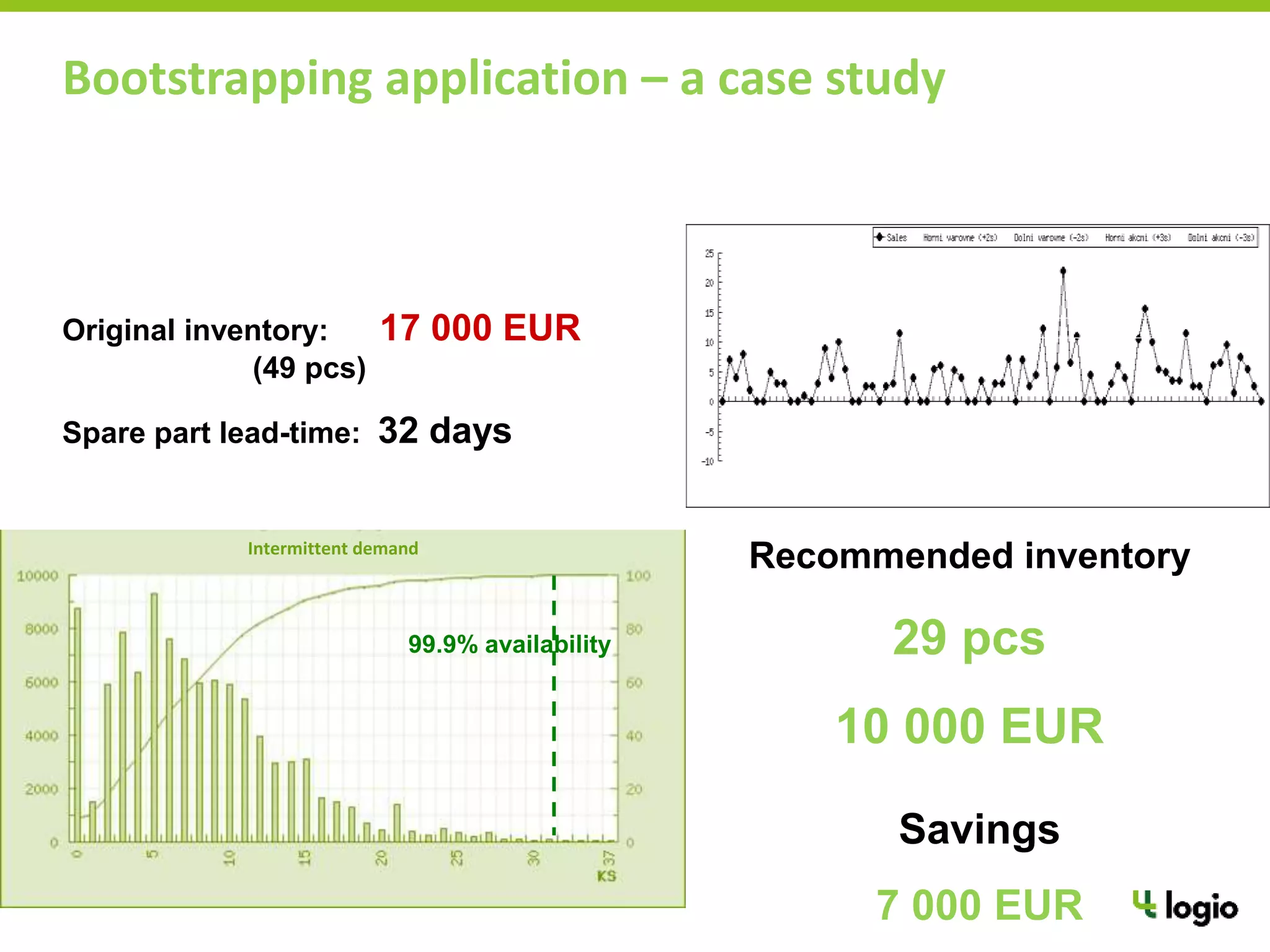
Bootstrapping application – a case study
99.9% availability
Original inventory: 17 000 EUR
(49 pcs)
Spare part lead-time: 32 days
Recommended inventory
29 pcs
10 000 EUR
Savings
7 000 EUR
Intermittent demand
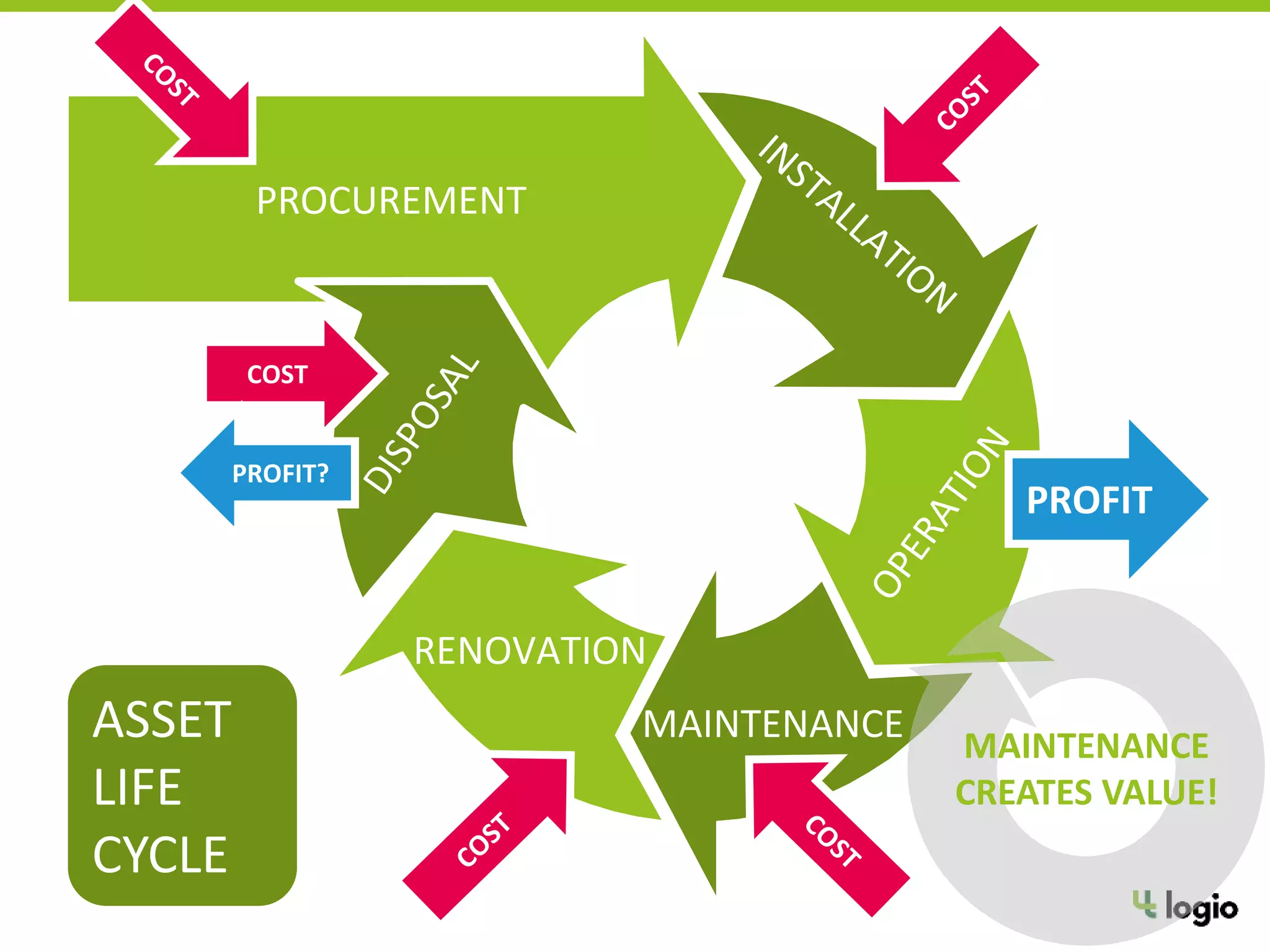
Life cycle thinking:
Consider the whole life cycle of your assets
Life cycle thinking:
Consider the whole life cycle of your assets
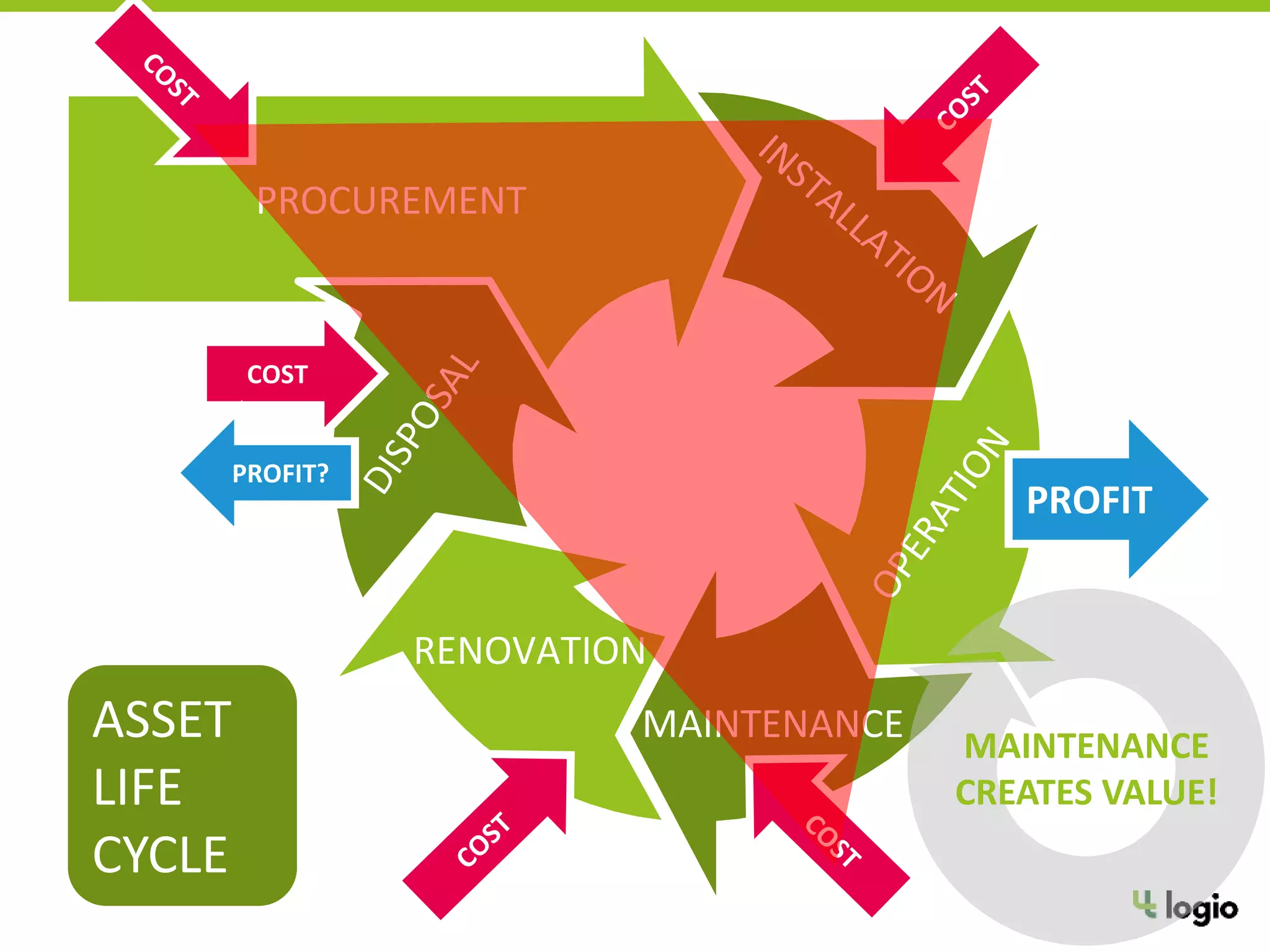
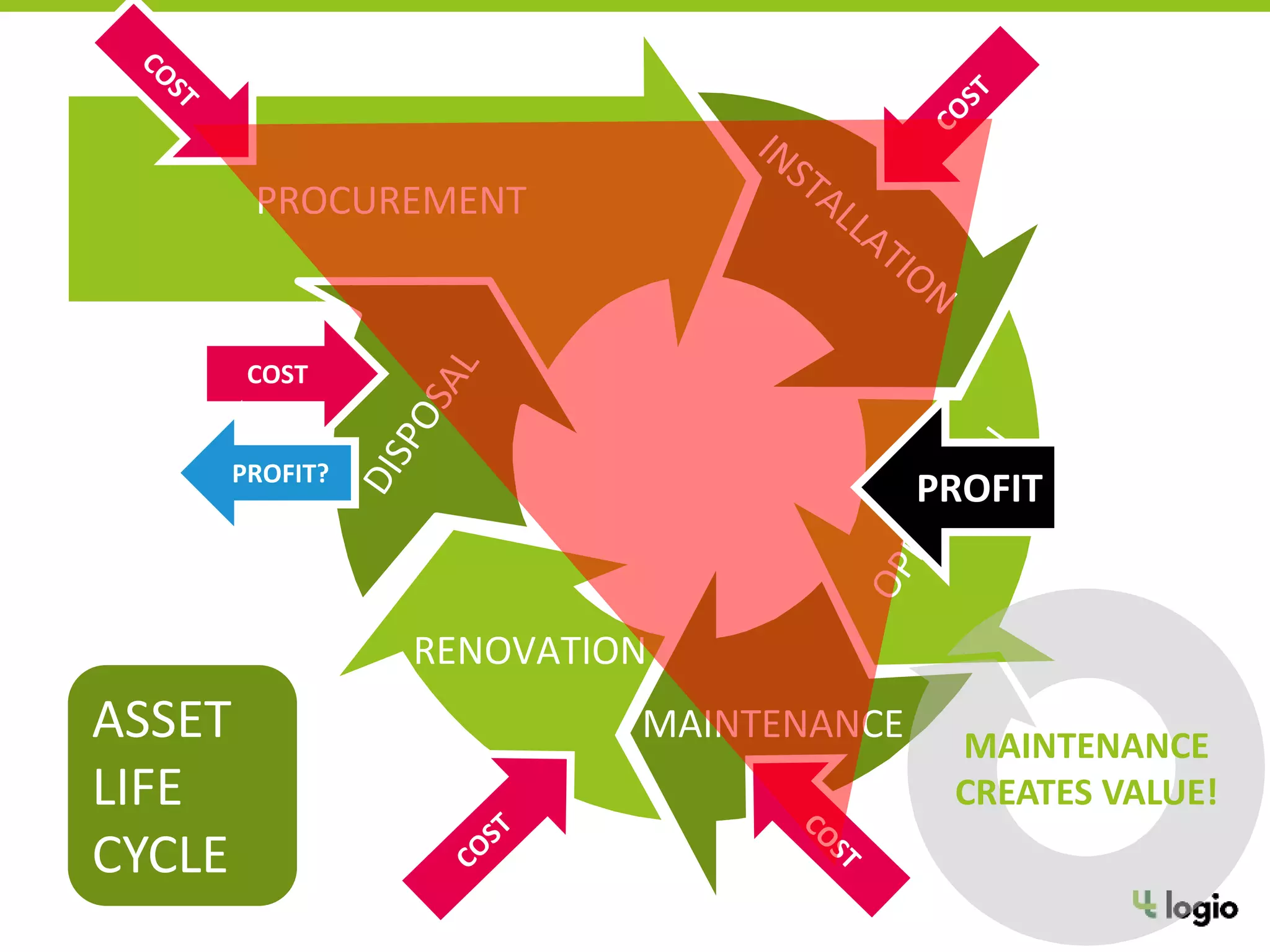
Bermuda
triangle of asset
management
Life cycle thinking:
Consider the whole life cycle of your assets
PROCUREMENT
MAINTENANCE
RENOVATION
COST
PROFIT?
PROFIT
MAINTENANCE
CREATES VALUE!
ASSET
LIFE
CYCLE
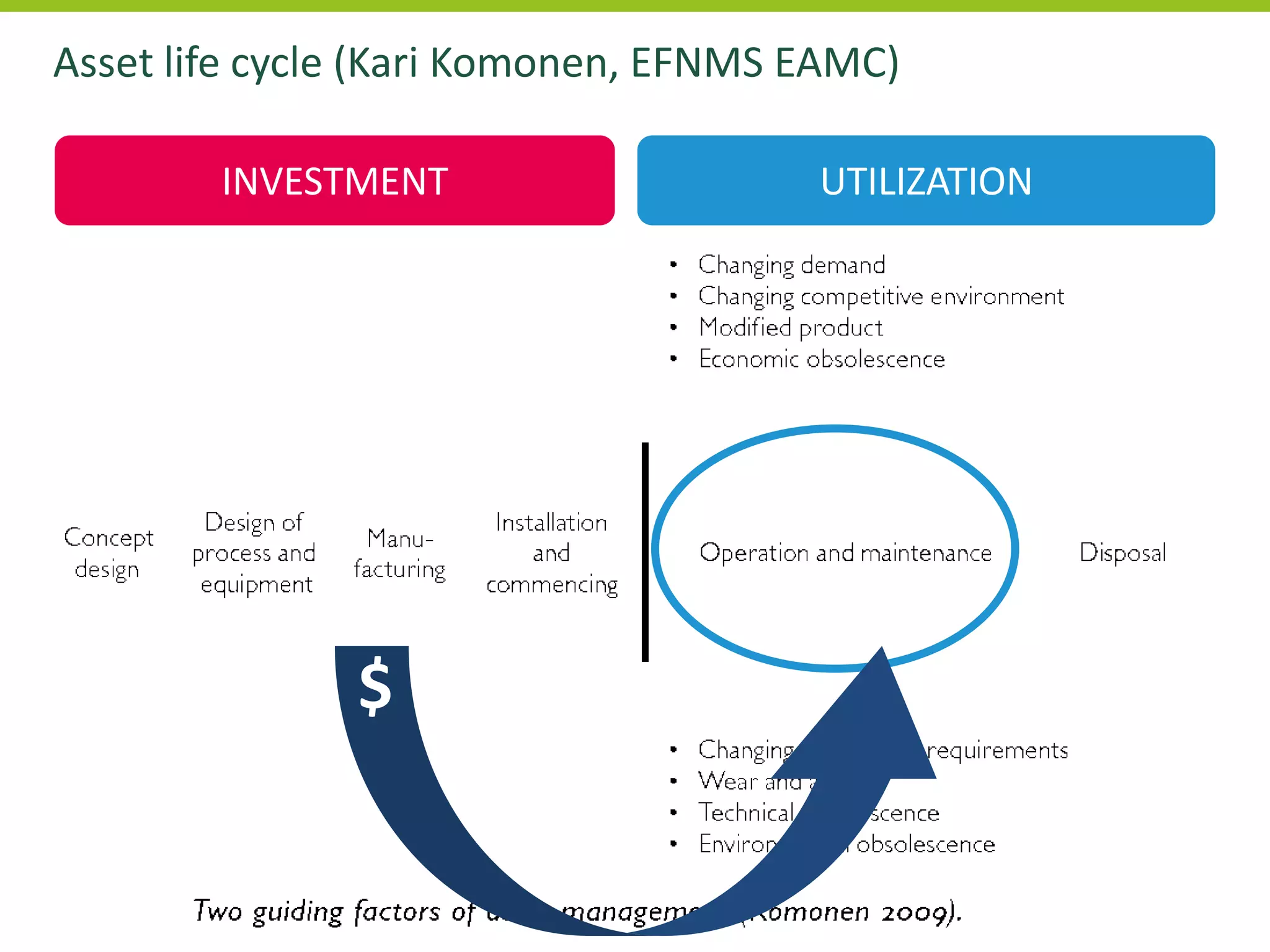
Asset life cycle (Kari Komonen, EFNMS EAMC)
INVESTMENT UTILIZATION
$$
PROCUREMENT
MAINTENANCE
RENOVATION
COST
PROFIT?
PROFIT
MAINTENANCE
CREATES VALUE!
ASSET
LIFE
CYCLE
PROCUREMENT
MAINTENANCE
RENOVATION
COST
PROFIT?
PROFIT
MAINTENANCE
CREATES VALUE!
ASSET
LIFE
CYCLE
PROCUREMENT
MAINTENANCE
RENOVATION
COST
PROFIT?
MAINTENANCE
CREATES VALUE!
ASSET
LIFE
CYCLE
PROFIT
Efficient spare parts management
Conclusions
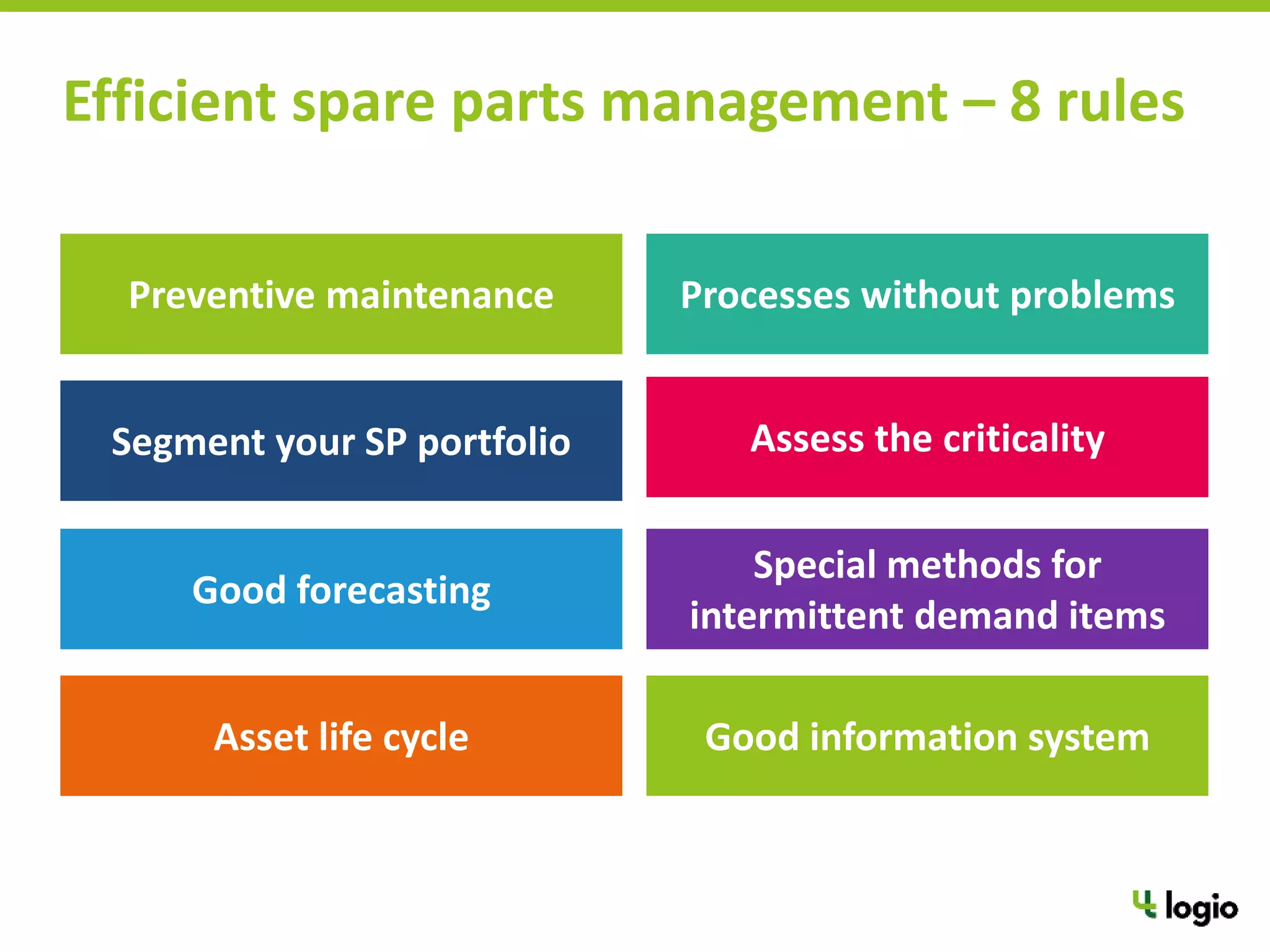
Efficient spare parts management – 8 rules
Preventive maintenance Processes without problems
Segment your SP portfolio Assess the criticality
Good forecasting
Special methods for
intermittent demand items
Asset life cycle Good information system
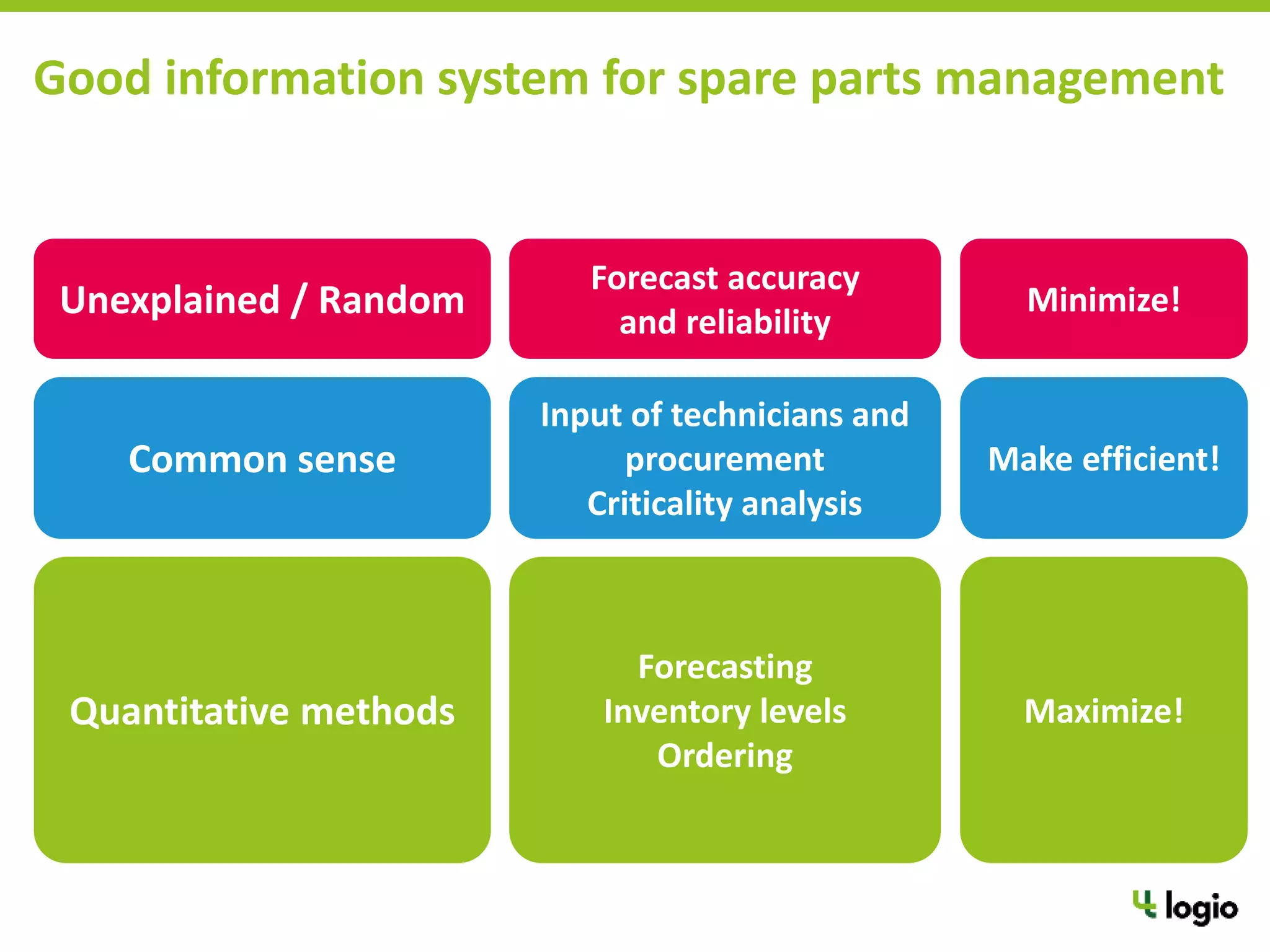
Good information system for spare parts management
Quantitative methods
Common sense
Unexplained / Random
Maximize!
Make efficient!
Minimize!
Forecasting
Inventory levels
Ordering
Input of technicians and
procurement
Criticality analysis
Forecast accuracy
and reliability
Efficient Spare Parts Management
MAINTENANCE
VOLUME
SPARE PARTS
INVENTORY
MAINTENANCE
VOLUME
SPARE PARTS
INVENTORY
Thank you
Tomas Hladik
Logio s.r.o.
Prague, Czech Republic
www.logio.cz
hladik@logio.cz
+420 731 151 276

Effective Spare Parts Management - 8 rules

  • 1.
    Effective Spare Parts Management:8 Rules Tomas Hladik Logio s.r.o., Prague, CZ www.logio.cz
  • 2.
    Efficient Spare PartsManagement MAINTENANCE VOLUME SPARE PARTS INVENTORY MAINTENANCE VOLUME SPARE PARTS INVENTORY
  • 3.
    1) Go forpreventive maintenance! 2) Eliminate process problems 3) Segment your spare parts portfolio 4) Evaluate spare parts criticality 5) Spare parts management starts with good forecasting 6) Use special methods for intermittent demand items 7) Consider the whole life cycle of your equipment 8) Implement a good information system for spare parts and maintenance inventory management Eight rules for efficient SPM
  • 4.
    Go for preventivemaintenance
  • 5.
  • 6.
    Prevention or correction? Numberof preventive X corrective actions Downtimes due to corrective maintenance – repairs Total maintenance cost
  • 7.
  • 8.
    LIFE CYCLE OFA SP IN A COMPANY
  • 9.
    Eliminate process problems SPNEED IDENTIFICATION There is no direct responsibility of maintenance engineers/technicians for “their” items and spare parts levels. REQUEST FOR ORDER RFO created by someone else, not by the technician who had identified the need. The step of creating RFO may not be necessary in the process. RFO APPROVAL How often are RFOs approved? Who approves? Is RFO approved by means of IS workflow or by signing a paper copy? Alternatively, are both ways needed? After RFO is approved, the issued order must be approved again. Too many approvers, complicated approval procedure and hierarchy of responsibilities. Approving on high levels of management.
  • 10.
    Eliminate process problems PROCUREMENT Insufficientinformation available to procurement, poor spare parts identification – the buyer hardly knows what should be bought, additional communication with maintenance technician is needed. Missing or incomplete procurement specification in the IS. RECEPTION Problems with missing (undelivered) documentation for the received material (certificates, declarations). Only “paper-based” archiving of spare parts documentation. Problems to find documentation when needed. WAREHOUSING Insufficient identification of spare parts in the warehouse. Problems with finding items stored in the warehouse. Inventory count discrepancies, physical stock different from information system data. Non-real value of stock in the information system. Existence of out-of-system stocks.
  • 19.
    Eliminate process problems CONSUMPTION Slowspare part issues in case of sudden need. Issued spare parts are not consumed in fact. What happens then? Consumption of external material even in case the part is on stock. WAREHOUSE RETURNS AND REFURBISHED SPARE PARTS Refurbished parts return to warehouse while new are bought. Accounting price of refurbished items is much higher (or lower) than the non-realistic value of items on stock. Problematic or impossible returns of parts issued but not consumed. Insufficient control of parts dismantled from the maintained object (the information system has no information about these).
  • 20.
    Spare parts’ lifecycle – benchmarking Internal best practice
  • 21.
    PLANT 1 PLANT2 PLANT 3 PLANT 4 0 0.1 0.2 0.3 0.4 0.5 0.6 0.7 1 2 3 4 Comparison of inventory turnover
  • 22.
    Segment your spareparts portfolio
  • 23.
    Service level xlocked-in capital Inventory value 90 % 95 % 98 % 99 % 100 %? Service level / availability
  • 24.
    ABC analysis –on hand inventory value Value of available inventory
  • 25.
    ABC analysis –consumed quantity In spare parts, C and D categories typically prevail Quantity
  • 26.
    Spare parts inventoriessegmentation – consumption frequency (in quantity) Quantity (pcs)
  • 27.
    Spare parts inventoriessegmentation – consumption frequency (in value) Value (CZK)
  • 28.
    WHEN? HOW MANY? WHEN? HOW MANY? Strategicsegmentation of spare parts CONSIGNATION CONSIGNATION CONSIDER CONSIGNATION CONSIDER CONSIGNATION BUY BUY BUY BUY CONSIDER CONSIGNATION CONSIGNATION BUY BACK BUY TYPEOFFORECAST CONSUMPTION FREQUENCY
  • 29.
    Example of buybackapplication 20 pieces were purchased for turnaround in 2010 for 41.2 M CZK, but these spare parts were not used during the turnaround and will be stored until the next turnaround in 2014. Buy-back in this case can save 9 M CZK (360k EUR) on storage and locked-in capital cost Between shutdowns
  • 30.
  • 31.
    𝐶𝑖𝑛𝑣 = 𝐶𝑢𝑛 ∗ 𝐿𝑇 ∗ 𝑓 10 000 EUR x 10% 100 EUR / day 100 days 1 per 2 years 1 000 EUR 5 000 EUR KEEP ON STOCK < Criticality calculation INVENTORY HOLDING UNAVAILABILITY LEAD TIME FAILURE RATE
  • 32.
    Criticality assessment phases Preliminary assessment Technician Holdon stock Potentially critical part Do not stock Advanced methods to set optimal levels Criticality assessment Technician Consume Sell or Scrap Optimum SP level
  • 33.
    Effects of failure Technicalplaces Consequences of unavailability Delivery time Repairability Possibility of maintenance planning Part lifespan Failure probability Failure characteristics Failure anticipation Price % cost of capital Cost of inventory holding Failure probability Impacts of spare part unavailability Leadtime and other parameters Evaluate spare parts criticality
  • 34.
    No need topilot test How to assess criticality? 2 step or 1 step Create questionnaire Pilot test Plot results Set criticality line Create questionnaire Evaluate Set criticality line Calibrate Evaluate Re-evaluate (Validation) Not suitable for regular evaluations Less time consuming Can be made a part of process Need to calibrate Process for disagreement needed 1 step 2 step
  • 35.
    Spare parts criticalityanalysis result Criticality score Spare parts items
  • 36.
    Is it safeto evaluate in one step? 95% 5% % results reclaimed by maintenance engineers Agreed Reclaimed 0 200 400 600 800 1000 1200 1400 1600 -24 -13 -11 -9 -7 -5 -3 -1 1 3 5 7 9 11 13 15 17 19 21 Results of criticality evaluation 1 step 0 50 100 150 200 250 300 350 Results of criticality evaluation 2 step 94% 6% % results disagreed by maintenance engineers Agreed Reclaimed 2 step 1 step
  • 37.
    1 step evaluationin SP process I need a spare part on stock Filling a questionnaire Stock level OK? Reclaim and escalation to manager Reclaim OK Setting of stock level in IS No spare part on stock
  • 38.
    How much timeis needed? 16 minutes or less in 80% of cases Time
  • 39.
  • 40.
    Login = Příjmení Heslo= Jméno Příklad: tokac miroslav Login a heslo
  • 41.
  • 44.
    Spare parts managementstarts with good forecasting
  • 45.
    Quantitative methods xCommon sense Quantitative methods Common sense
  • 46.
    Quantitative methods xCommon sense Quantitative methods Common sense Unexplained / Random Uncertainty of future consumption Maximize Make efficient Minimize
  • 47.
    Forecasting step-by-step Visualisation oftime series For better understanding of the time series Calculation of accuracy Absolute and relative errors, evaluation on testing season Calculation of forecasts using all available methods Selection of the best method Best accuracy and reliability 1 3 2 4
  • 48.
    Which method isthe best for spare parts? 1% 1% 2% 3% 5% 9% 79% Konstantní model Regresní model Holtovo exp. vyrovnání Jednoduché exp. vyrovnání Klouzavý průměr Winters Forecasting není možný Constant model Regression model Holt’s exp. smoothing Simple exp. smoothing Moving average Winters Forecasting impossible ???
  • 49.
    Use special methodsfor intermittent demand items
  • 50.
    TýdenníspotřebyND Historie týdenních spotřeb(týdny) 4 13 17 30 0 1 2 3 4 81 18 25 27 26 32 Spare parts – intermittent demand Weekly consumption history (weeks) Weeklysparepartconsumption(pieces) QUESTION: What reorder level should be set in order to ensure required availability of a spare part?
  • 51.
    TýdenníspotřebyND Historie týdenních spotřeb(týdny) 4 13 17 30 0 1 2 3 4 81 18 25 27 26 32 Bootstrapping Bootstrapping = random sampling from history of consumptions. SP consumption for lead-time period is sampled from history Sample 1: Consumption in 6 weeks = 5 pcs WeeklySPconsumption Weekly consumption history (weeks) Example: SP lead time is 6 weeks
  • 52.
    Bootstrapping Vzorek 2: Spotřeba za 6týdnů = 0 ks TýdenníspotřebyND Historie týdenních spotřeb (týdny) 4 13 17 30 0 1 2 3 4 81 18 25 27 26 32 Sample 2: Consumption in 6 weeks = 0 pcs Weekly consumption history (weeks) Sparepartconsumption(pieces)
  • 53.
    Bootstrapping Vzorek 3: Spotřeba za 6týdnů = 12 ks TýdenníspotřebyND Historie týdenních spotřeb (týdny) 4 13 17 30 0 1 2 3 4 81 18 25 27 26 32 Sample 3: Consumption in 6 weeks = 12 pcs Weekly consumption history (weeks) WeeklySPconsumption
  • 54.
    Bootstrapping Vzorek 4: Spotřeba za 6týdnů = 2 ks TýdenníspotřebyND Historie týdenních spotřeb (týdny) 4 13 17 30 0 1 2 3 4 81 18 25 27 26 32 Sample 4: Consumption in 6 weeks = 2 pcs Weekly consumption history (weeks) WeeklySPconsumpiton
  • 55.
    Četnostispotřebvjednotlivýchintervalech (zesimulace) Spotřeba během LT– intervaly (ks) 0 5 10 15 60 000 0 30 000 Kumulativnípravděpodobnostspotřeby 100 % Example of 100 000 simulations of SP consumption Target: SP availability (Service level) = 99% OPTIMUM INVENTORY= 9 PCS Consumption during leadtime (pcs) Cummulativeprobabilityofconsumption Frequenciesofconsumption (fromsimulation)
  • 56.
    Bootstrapping application –a case study 99.9% availability Original inventory: 17 000 EUR (49 pcs) Spare part lead-time: 32 days Recommended inventory 29 pcs 10 000 EUR Savings 7 000 EUR Intermittent demand
  • 58.
    Life cycle thinking: Considerthe whole life cycle of your assets
  • 59.
    Life cycle thinking: Considerthe whole life cycle of your assets
  • 60.
    Bermuda triangle of asset management Lifecycle thinking: Consider the whole life cycle of your assets
  • 61.
  • 62.
    Asset life cycle(Kari Komonen, EFNMS EAMC) INVESTMENT UTILIZATION $$
  • 63.
  • 64.
  • 65.
  • 66.
    Efficient spare partsmanagement Conclusions
  • 67.
    Efficient spare partsmanagement – 8 rules Preventive maintenance Processes without problems Segment your SP portfolio Assess the criticality Good forecasting Special methods for intermittent demand items Asset life cycle Good information system
  • 68.
    Good information systemfor spare parts management Quantitative methods Common sense Unexplained / Random Maximize! Make efficient! Minimize! Forecasting Inventory levels Ordering Input of technicians and procurement Criticality analysis Forecast accuracy and reliability
  • 69.
    Efficient Spare PartsManagement MAINTENANCE VOLUME SPARE PARTS INVENTORY MAINTENANCE VOLUME SPARE PARTS INVENTORY
  • 70.
    Thank you Tomas Hladik Logios.r.o. Prague, Czech Republic www.logio.cz hladik@logio.cz +420 731 151 276