MAINTENANCE
ENGINEERING
UNIT-I
PRINCIPLES AND PRACTICES OF
MAINTENANCE PLANNING
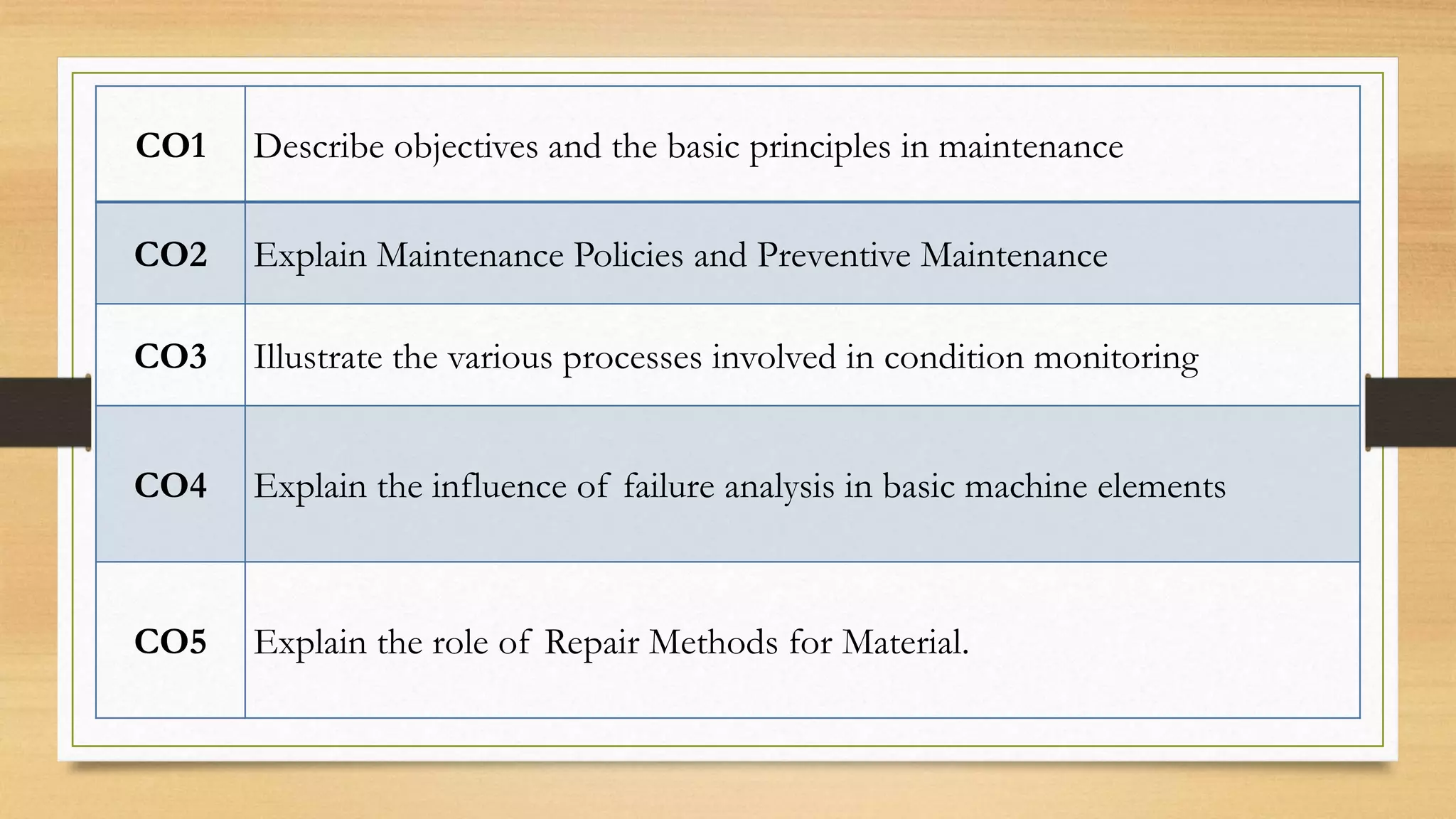
CO1 Describe objectives and the basic principles in maintenance
CO2 Explain Maintenance Policies and Preventive Maintenance
CO3 Illustrate the various processes involved in condition monitoring
CO4 Explain the influence of failure analysis in basic machine elements
CO5 Explain the role of Repair Methods for Material.
• Basic Principles of maintenance planning
• Objectives and principles of planned maintenance
activity
• Importance and benefits of sound Maintenance
systems
• Reliability and Machine availability
• MTBF, MTTR and MWT
• Factors of availability
• Maintenance organization
• Maintenance economics.
Maintenance engineering : Maintenance engineering is
the activity of applying engineering concepts to the
optimization of equipment, procedure and departmental
budgets to achieve better maintainability, reliability and
availability of equipment.
Planning: Planning ensures the smooth operation of the
system. Planning defines what is to be done and how it is to
be done. It specifies the materials, tool, equipment and
skills required to perform the work.
Main classification of planning in engineering system are as follows,
1. Long range planning
2. Short range planning
3. Planning for immediate activity
1.Long Range planning : For a period of five years at least. Involves capital
budgeting, strategies and operational programmers.
2. Short range: up to one year. Made to achieve short term goals.
3. Immediate Activity Planning : it is done frequently whenever required.
Objectives of Planned Maintenance Activity
 To achieve minimum breakdown and to keep the plant in good working condition at the lowest
possible cost.
 To ensure the availability of machines and services in an optimum working condition.
 To keep machines and other facilities in a condition to be used to achieve the maximum profit without
any interruption.
 To keep the time schedule of delivery to customers.
 To meet the availability requirements for critical equipment.
 To keep the maintenance costs as low as possible for non-critical equipment.
 To control the effective and trained supervision.
 To meet the quality requirements of the product.
 To increase the profits of production systems.
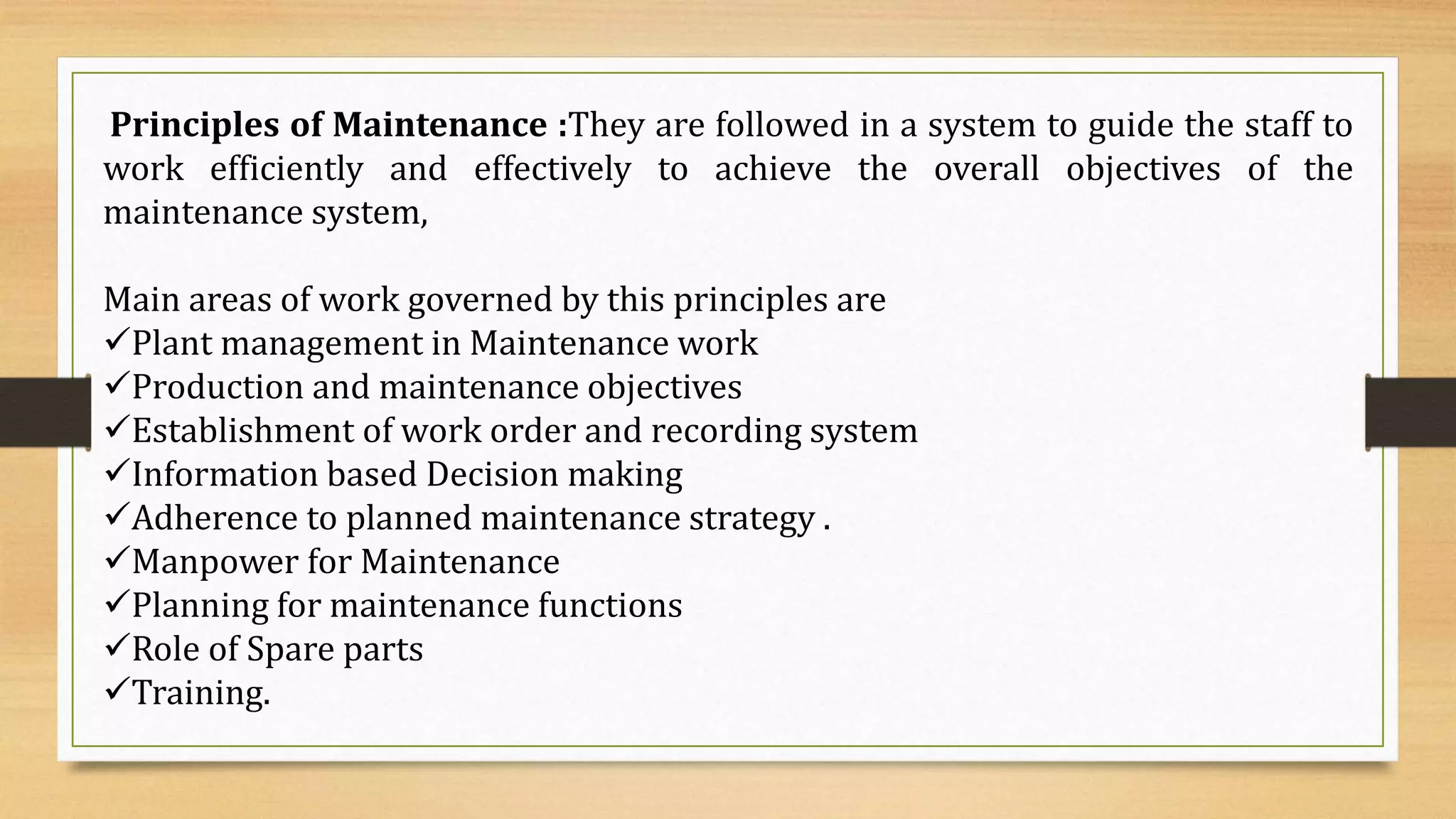
Principles of Maintenance :They are followed in a system to guide the staff to
work efficiently and effectively to achieve the overall objectives of the
maintenance system,
Main areas of work governed by this principles are
Plant management in Maintenance work
Production and maintenance objectives
Establishment of work order and recording system
Information based Decision making
Adherence to planned maintenance strategy .
Manpower for Maintenance
Planning for maintenance functions
Role of Spare parts
Training.
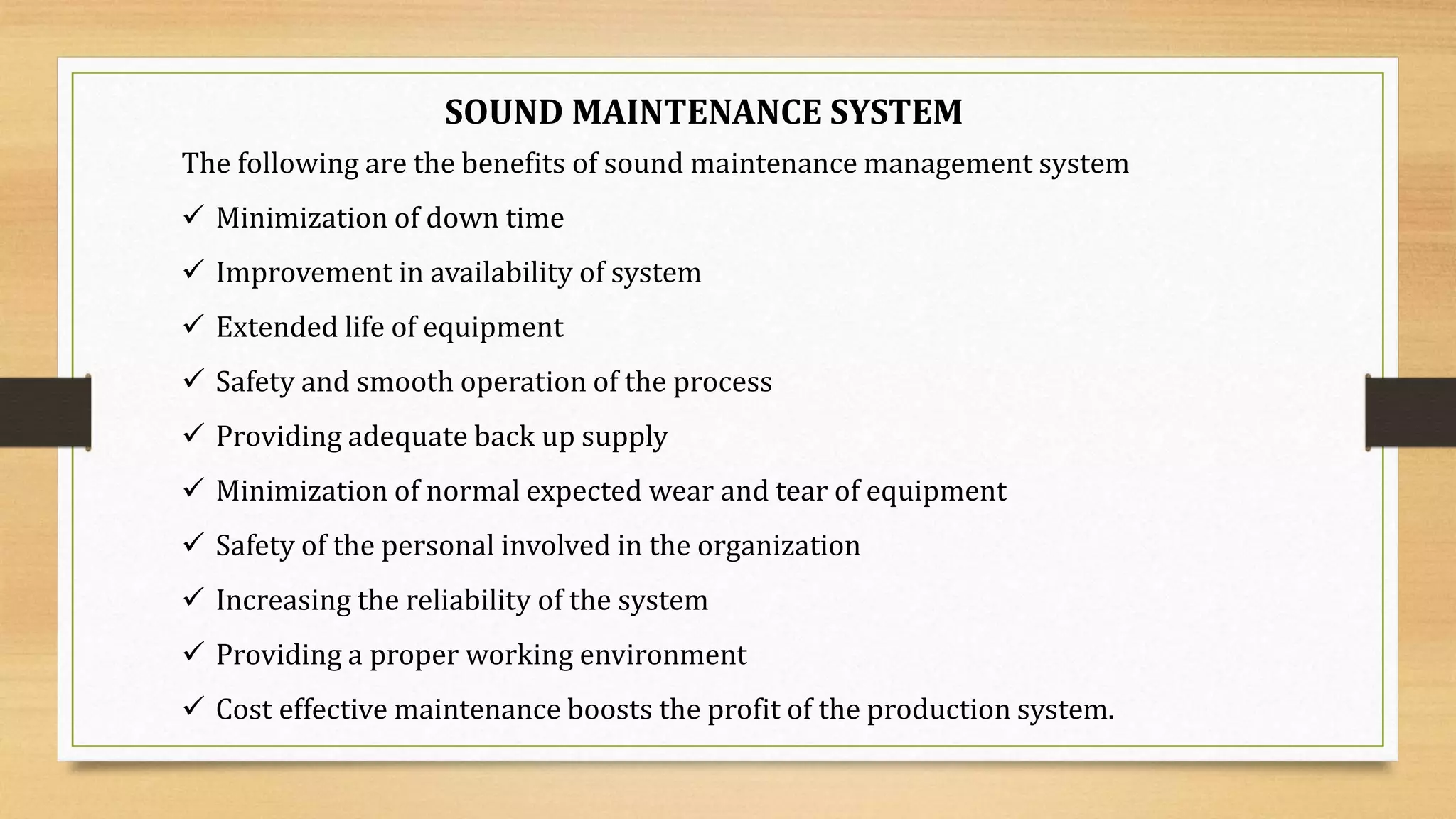
SOUND MAINTENANCE SYSTEM
The following are the benefits of sound maintenance management system
 Minimization of down time
 Improvement in availability of system
 Extended life of equipment
 Safety and smooth operation of the process
 Providing adequate back up supply
 Minimization of normal expected wear and tear of equipment
 Safety of the personal involved in the organization
 Increasing the reliability of the system
 Providing a proper working environment
 Cost effective maintenance boosts the profit of the production system.
Reliability: Reliability is the probability that a component/system when
operating under given condition will perform its intended functions adequately
for a specified period of time.
RELIABILITY
Achievable Reliability
Its depends on maintenance and
operation of the equipment
Inherent Reliability
It is associated with the quality of the
material and design of machine parts
Equipment lifecycle: Reliability engineering is dependability in the life cycle management of
product. The failure pattern of equipment over its life cycle can be represented as bath-tub curve.
Mean Time To Failure(MTTF):Mean Time To Failure (MTTF) is a very basic measure of
reliability used for non-repairable systems. It represents the length of time that an item is expected to
last in operation until it fails.
Mean Time Between Failures(MTBF): The term MTBF is used for repairable systems, but it does not
take into account units that are shut down for routine scheduled maintenance
Mean Time To Repair (MTTR):It refers to the amount of time required to repair a system and
restore it to full functionality. The MTTR clock starts ticking when the repairs start and it goes on
until operations are restored. This includes repair time, testing period, and return to the normal
operating condition.
General Organization Structure of Maintenance Department
Maintenance economics: Life-cycle
cost analysis (LCCA) is a tool to
determine the most cost-effective
option among different competing
alternatives to purchase, own, operate,
maintain and, finally, dispose of an
object or process, when each is equally
appropriate to be implemented on
technical grounds
Estimation of economic life of
equipment: its depends on the
maintenance and repair cost, availability
and operational efficiency.
Reliability costs :Reliability
costs are the business costs of
unreliable systems.
Maintenance costs :Maintenance
costs are the cost of doing
maintenance; be that reactive or
preventive maintenance.
Unit-1 ME 6012

Unit-1 ME 6012

  • 1.
  • 2.
    CO1 Describe objectivesand the basic principles in maintenance CO2 Explain Maintenance Policies and Preventive Maintenance CO3 Illustrate the various processes involved in condition monitoring CO4 Explain the influence of failure analysis in basic machine elements CO5 Explain the role of Repair Methods for Material.
  • 3.
    • Basic Principlesof maintenance planning • Objectives and principles of planned maintenance activity • Importance and benefits of sound Maintenance systems • Reliability and Machine availability • MTBF, MTTR and MWT • Factors of availability • Maintenance organization • Maintenance economics.
  • 4.
    Maintenance engineering :Maintenance engineering is the activity of applying engineering concepts to the optimization of equipment, procedure and departmental budgets to achieve better maintainability, reliability and availability of equipment. Planning: Planning ensures the smooth operation of the system. Planning defines what is to be done and how it is to be done. It specifies the materials, tool, equipment and skills required to perform the work.
  • 5.
    Main classification ofplanning in engineering system are as follows, 1. Long range planning 2. Short range planning 3. Planning for immediate activity 1.Long Range planning : For a period of five years at least. Involves capital budgeting, strategies and operational programmers. 2. Short range: up to one year. Made to achieve short term goals. 3. Immediate Activity Planning : it is done frequently whenever required.
  • 6.
    Objectives of PlannedMaintenance Activity  To achieve minimum breakdown and to keep the plant in good working condition at the lowest possible cost.  To ensure the availability of machines and services in an optimum working condition.  To keep machines and other facilities in a condition to be used to achieve the maximum profit without any interruption.  To keep the time schedule of delivery to customers.  To meet the availability requirements for critical equipment.  To keep the maintenance costs as low as possible for non-critical equipment.  To control the effective and trained supervision.  To meet the quality requirements of the product.  To increase the profits of production systems.
  • 7.
    Principles of Maintenance:They are followed in a system to guide the staff to work efficiently and effectively to achieve the overall objectives of the maintenance system, Main areas of work governed by this principles are Plant management in Maintenance work Production and maintenance objectives Establishment of work order and recording system Information based Decision making Adherence to planned maintenance strategy . Manpower for Maintenance Planning for maintenance functions Role of Spare parts Training.
  • 8.
    SOUND MAINTENANCE SYSTEM Thefollowing are the benefits of sound maintenance management system  Minimization of down time  Improvement in availability of system  Extended life of equipment  Safety and smooth operation of the process  Providing adequate back up supply  Minimization of normal expected wear and tear of equipment  Safety of the personal involved in the organization  Increasing the reliability of the system  Providing a proper working environment  Cost effective maintenance boosts the profit of the production system.
  • 9.
    Reliability: Reliability isthe probability that a component/system when operating under given condition will perform its intended functions adequately for a specified period of time. RELIABILITY Achievable Reliability Its depends on maintenance and operation of the equipment Inherent Reliability It is associated with the quality of the material and design of machine parts
  • 10.
    Equipment lifecycle: Reliabilityengineering is dependability in the life cycle management of product. The failure pattern of equipment over its life cycle can be represented as bath-tub curve.
  • 11.
    Mean Time ToFailure(MTTF):Mean Time To Failure (MTTF) is a very basic measure of reliability used for non-repairable systems. It represents the length of time that an item is expected to last in operation until it fails.
  • 12.
    Mean Time BetweenFailures(MTBF): The term MTBF is used for repairable systems, but it does not take into account units that are shut down for routine scheduled maintenance
  • 13.
    Mean Time ToRepair (MTTR):It refers to the amount of time required to repair a system and restore it to full functionality. The MTTR clock starts ticking when the repairs start and it goes on until operations are restored. This includes repair time, testing period, and return to the normal operating condition.
  • 14.
    General Organization Structureof Maintenance Department
  • 15.
    Maintenance economics: Life-cycle costanalysis (LCCA) is a tool to determine the most cost-effective option among different competing alternatives to purchase, own, operate, maintain and, finally, dispose of an object or process, when each is equally appropriate to be implemented on technical grounds Estimation of economic life of equipment: its depends on the maintenance and repair cost, availability and operational efficiency.
  • 16.
    Reliability costs :Reliability costsare the business costs of unreliable systems. Maintenance costs :Maintenance costs are the cost of doing maintenance; be that reactive or preventive maintenance.