Introduction 
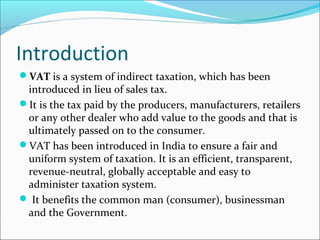
ď‚—VAT is a system of indirect taxation, which has been 
introduced in lieu of sales tax. 
ď‚—It is the tax paid by the producers, manufacturers, retailers 
or any other dealer who add value to the goods and that is 
ultimately passed on to the consumer. 
ď‚—VAT has been introduced in India to ensure a fair and 
uniform system of taxation. It is an efficient, transparent, 
revenue-neutral, globally acceptable and easy to 
administer taxation system. 
ď‚— It benefits the common man (consumer), businessman 
and the Government.
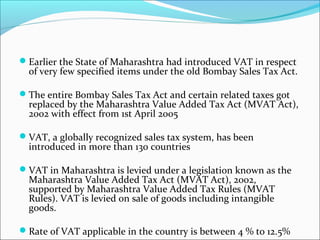
ď‚—Earlier the State of Maharashtra had introduced VAT in respect 
of very few specified items under the old Bombay Sales Tax Act. 
ď‚—The entire Bombay Sales Tax Act and certain related taxes got 
replaced by the Maharashtra Value Added Tax Act (MVAT Act), 
2002 with effect from 1st April 2005 
ď‚—VAT, a globally recognized sales tax system, has been 
introduced in more than 130 countries 
ď‚—VAT in Maharashtra is levied under a legislation known as the 
Maharashtra Value Added Tax Act (MVAT Act), 2002, 
supported by Maharashtra Value Added Tax Rules (MVAT 
Rules). VAT is levied on sale of goods including intangible 
goods. 
ď‚—Rate of VAT applicable in the country is between 4 % to 12.5%
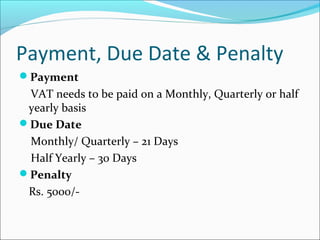
Payment, Due Date & Penalty 
ď‚—Payment 
VAT needs to be paid on a Monthly, Quarterly or half 
yearly basis 
ď‚—Due Date 
Monthly/ Quarterly – 21 Days 
Half Yearly – 30 Days 
ď‚—Penalty 
Rs. 5000/-
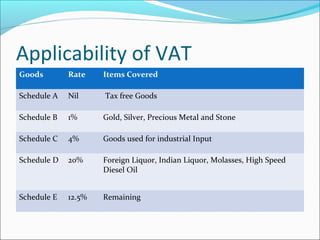
Applicability of VAT 
Goods Rate Items Covered 
Schedule A Nil Tax free Goods 
Schedule B 1% Gold, Silver, Precious Metal and Stone 
Schedule C 4% Goods used for industrial Input 
Schedule D 20% Foreign Liquor, Indian Liquor, Molasses, High Speed 
Diesel Oil 
Schedule E 12.5% Remaining
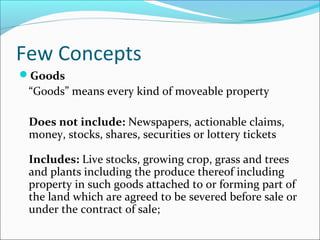
Few Concepts 
ď‚—Goods 
“Goods” means every kind of moveable property 
Does not include: Newspapers, actionable claims, 
money, stocks, shares, securities or lottery tickets 
Includes: Live stocks, growing crop, grass and trees 
and plants including the produce thereof including 
property in such goods attached to or forming part of 
the land which are agreed to be severed before sale or 
under the contract of sale;
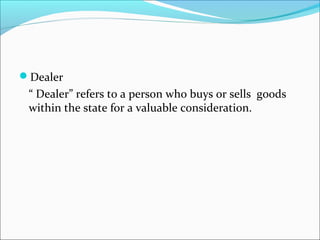
ď‚—Dealer 
“ Dealer” refers to a person who buys or sells goods 
within the state for a valuable consideration.
ď‚—Importer 
“Importer” means a dealer who brings any goods into 
State or to whom any goods are dispatched from any 
place outside State;
ď‚—Purchase Price 
“Purchase Price” means the amount of valuable 
consideration paid or payable by a person for any 
purchase made including any sum charged for 
anything done by the seller in respect of the goods at 
the time of or before delivery thereof, other than the 
cost of insurance for transit or of installation, 
when such cost is separately charged.”
ď‚—Sale 
“Sale” means a sale of goods made within the State for 
cash or deferred payment or other valuable 
consideration but does not include a mortgage, 
hypothecation, charge or pledge.
ď‚—Sales Price 
“Sale Price” means the amount of valuable 
consideration paid or payable to a dealer for any sale 
made including any sum charged for anything done 
by the seller in respect of the goods at the time of or 
before delivery thereof, other than the cost of 
insurance for transit or of installation, when such 
cost is separately charged.
VAT Applicability 
ď‚—Importer 
1. Annual Sales Turnover should be above 1 lakh 
2. In a year the value of the taxable goods sold or 
purchased should be more than Rs. 10,000/-
ď‚—Other 
ď‚—Annual Sales turnover should be more than 5 lakhs 
ď‚—In a year the value of the taxable goods sold or 
purchased should be more than Rs. 10,000/-
E - Registration 
ď‚—Location 
ď‚—Name of Business 
ď‚—Name of Applicant 
ď‚—Status of Applicant 
ď‚—PAN 
ď‚—Select : MVAT , CST Act 
ď‚—Request ID & Retreival
ď‚—Filling the form on-line 
ď‚—Acknowledgement 
ď‚—Physical Submision of Form & Documents 
ď‚—Personal Attendance of Applicant for Photo-sign. 
ď‚—Obtaining TIN Allotment Letter 
ď‚—E-services enrollment & Submission of its 
Acknowledgement.
Filing of MVAT 
E Registration is required 
Download – Forms – Electronic forms – 
ď‚— - e-applications for CST forms 
ď‚—Off-line filling of Forms 
ď‚—E-Application for CST Forms C / F / H / E-I/ E-II 
ď‚—Location of Main POB 
ď‚—CST RC/TIN of Form accepting Dealer 
ď‚—Period of Transaction (for F Forms -Monthly, for 
Others-Quartrerly, Half Yearly) 
ď‚—Total No. of Transactions 
ď‚—Total Value of Transactions 
ď‚—Description of Major Goods
ď‚—Validation of File 
ď‚—If error shows, open Error Sheet and correct the errors 
On Validating again, –Rem.txt file is generated in My 
documents folder 
ď‚—Dealer Login & Password 
ď‚—E-Services - E-CST Declarations 
ď‚—Browsing and uploading 
ď‚—Acknowledgement
Thank You

Maharashtra value added tax ( mvat)

  • 2.
    Introduction ď‚—VAT isa system of indirect taxation, which has been introduced in lieu of sales tax. ď‚—It is the tax paid by the producers, manufacturers, retailers or any other dealer who add value to the goods and that is ultimately passed on to the consumer. ď‚—VAT has been introduced in India to ensure a fair and uniform system of taxation. It is an efficient, transparent, revenue-neutral, globally acceptable and easy to administer taxation system. ď‚— It benefits the common man (consumer), businessman and the Government.
  • 3.
    ď‚—Earlier the Stateof Maharashtra had introduced VAT in respect of very few specified items under the old Bombay Sales Tax Act. ď‚—The entire Bombay Sales Tax Act and certain related taxes got replaced by the Maharashtra Value Added Tax Act (MVAT Act), 2002 with effect from 1st April 2005 ď‚—VAT, a globally recognized sales tax system, has been introduced in more than 130 countries ď‚—VAT in Maharashtra is levied under a legislation known as the Maharashtra Value Added Tax Act (MVAT Act), 2002, supported by Maharashtra Value Added Tax Rules (MVAT Rules). VAT is levied on sale of goods including intangible goods. ď‚—Rate of VAT applicable in the country is between 4 % to 12.5%
  • 4.
    Payment, Due Date& Penalty Payment VAT needs to be paid on a Monthly, Quarterly or half yearly basis Due Date Monthly/ Quarterly – 21 Days Half Yearly – 30 Days Penalty Rs. 5000/-
  • 5.
    Applicability of VAT Goods Rate Items Covered Schedule A Nil Tax free Goods Schedule B 1% Gold, Silver, Precious Metal and Stone Schedule C 4% Goods used for industrial Input Schedule D 20% Foreign Liquor, Indian Liquor, Molasses, High Speed Diesel Oil Schedule E 12.5% Remaining
  • 6.
    Few Concepts Goods “Goods” means every kind of moveable property Does not include: Newspapers, actionable claims, money, stocks, shares, securities or lottery tickets Includes: Live stocks, growing crop, grass and trees and plants including the produce thereof including property in such goods attached to or forming part of the land which are agreed to be severed before sale or under the contract of sale;
  • 7.
    Dealer “ Dealer”refers to a person who buys or sells goods within the state for a valuable consideration.
  • 8.
    Importer “Importer” meansa dealer who brings any goods into State or to whom any goods are dispatched from any place outside State;
  • 9.
    Purchase Price “PurchasePrice” means the amount of valuable consideration paid or payable by a person for any purchase made including any sum charged for anything done by the seller in respect of the goods at the time of or before delivery thereof, other than the cost of insurance for transit or of installation, when such cost is separately charged.”
  • 10.
    Sale “Sale” meansa sale of goods made within the State for cash or deferred payment or other valuable consideration but does not include a mortgage, hypothecation, charge or pledge.
  • 11.
    Sales Price “SalePrice” means the amount of valuable consideration paid or payable to a dealer for any sale made including any sum charged for anything done by the seller in respect of the goods at the time of or before delivery thereof, other than the cost of insurance for transit or of installation, when such cost is separately charged.
  • 12.
    VAT Applicability ď‚—Importer 1. Annual Sales Turnover should be above 1 lakh 2. In a year the value of the taxable goods sold or purchased should be more than Rs. 10,000/-
  • 13.
    ď‚—Other ď‚—Annual Salesturnover should be more than 5 lakhs ď‚—In a year the value of the taxable goods sold or purchased should be more than Rs. 10,000/-
  • 14.
    E - Registration ď‚—Location ď‚—Name of Business ď‚—Name of Applicant ď‚—Status of Applicant ď‚—PAN ď‚—Select : MVAT , CST Act ď‚—Request ID & Retreival
  • 15.
    ď‚—Filling the formon-line ď‚—Acknowledgement ď‚—Physical Submision of Form & Documents ď‚—Personal Attendance of Applicant for Photo-sign. ď‚—Obtaining TIN Allotment Letter ď‚—E-services enrollment & Submission of its Acknowledgement.
  • 16.
    Filing of MVAT E Registration is required Download – Forms – Electronic forms –  - e-applications for CST forms Off-line filling of Forms E-Application for CST Forms C / F / H / E-I/ E-II Location of Main POB CST RC/TIN of Form accepting Dealer Period of Transaction (for F Forms -Monthly, for Others-Quartrerly, Half Yearly) Total No. of Transactions Total Value of Transactions Description of Major Goods
  • 17.
    Validation of File If error shows, open Error Sheet and correct the errors On Validating again, –Rem.txt file is generated in My documents folder Dealer Login & Password E-Services - E-CST Declarations Browsing and uploading Acknowledgement
  • 18.