Salary – Sec 15,16,17 
Lecture 7
What is salary? 
• Salaries mean and include remuneration in 
any form due for personal service as per the 
contract of employment or service. 
• Essential Element for Taxability of Income as 
Salaries is Employer Employee Relationship
• Salary, in simple words, means remuneration of a 
person, which he has received from his employer 
for rendering services to him. But receipts for all 
kinds of services rendered cannot be taxed as 
salary. 
• The remuneration received by professionals like 
doctors, architects, lawyers etc. cannot be 
covered under salary since it is not received from 
their employers but from their clients. So, it is 
taxed under business or profession head.
Characteristic of Salary 
1. The relationship of payer and payee must be of 
employer and employee for an income to be 
categorized as salary income. For example: Salary 
income of a Member of Parliament cannot be specified 
as salary, since it is received from Government of India 
which is not his employer. 
2. The Act makes no distinction between salary and 
wages, though generally salary is paid for non-manual 
work and wages are paid for manual work. 
3. Salary received from employer, whether one or more 
than one is included in this head.
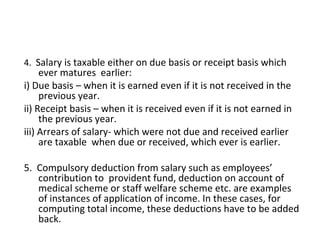
4. Salary is taxable either on due basis or receipt basis which 
ever matures earlier: 
i) Due basis – when it is earned even if it is not received in the 
previous year. 
ii) Receipt basis – when it is received even if it is not earned in 
the previous year. 
iii) Arrears of salary- which were not due and received earlier 
are taxable when due or received, which ever is earlier. 
5. Compulsory deduction from salary such as employees’ 
contribution to provident fund, deduction on account of 
medical scheme or staff welfare scheme etc. are examples 
of instances of application of income. In these cases, for 
computing total income, these deductions have to be added 
back.
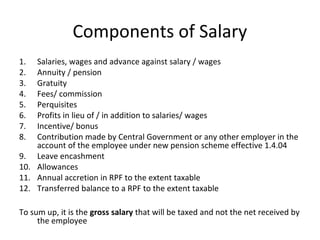
Components of Salary 
1. Salaries, wages and advance against salary / wages 
2. Annuity / pension 
3. Gratuity 
4. Fees/ commission 
5. Perquisites 
6. Profits in lieu of / in addition to salaries/ wages 
7. Incentive/ bonus 
8. Contribution made by Central Government or any other employer in the 
account of the employee under new pension scheme effective 1.4.04 
9. Leave encashment 
10. Allowances 
11. Annual accretion in RPF to the extent taxable 
12. Transferred balance to a RPF to the extent taxable 
To sum up, it is the gross salary that will be taxed and not the net received by 
the employee
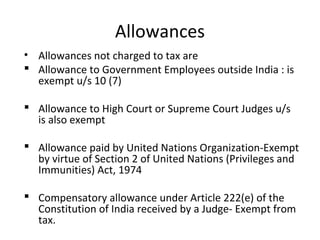
Allowances 
• Allowances not charged to tax are 
 Allowance to Government Employees outside India : is 
exempt u/s 10 (7) 
 Allowance to High Court or Supreme Court Judges u/s 
is also exempt 
 Allowance paid by United Nations Organization-Exempt 
by virtue of Section 2 of United Nations (Privileges and 
Immunities) Act, 1974 
 Compensatory allowance under Article 222(e) of the 
Constitution of India received by a Judge- Exempt from 
tax.
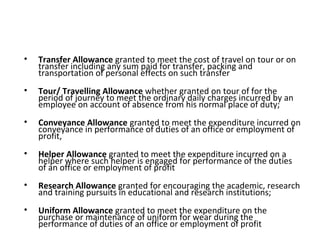
• Transfer Allowance granted to meet the cost of travel on tour or on 
transfer including any sum paid for transfer, packing and 
transportation of personal effects on such transfer 
• Tour/ Travelling Allowance whether granted on tour of for the 
period of journey to meet the ordinary daily charges incurred by an 
employee on account of absence from his normal place of duty; 
• Conveyance Allowance granted to meet the expenditure incurred on 
conveyance in performance of duties of an office or employment of 
profit, 
• Helper Allowance granted to meet the expenditure incurred on a 
helper where such helper is engaged for performance of the duties 
of an office or employment of profit 
• Research Allowance granted for encouraging the academic, research 
and training pursuits in educational and research institutions; 
• Uniform Allowance granted to meet the expenditure on the 
purchase or maintenance of uniform for wear during the 
performance of duties of an office or employment of profit
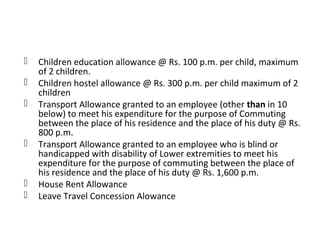
 Children education allowance @ Rs. 100 p.m. per child, maximum 
of 2 children. 
 Children hostel allowance @ Rs. 300 p.m. per child maximum of 2 
children 
 Transport Allowance granted to an employee (other than in 10 
below) to meet his expenditure for the purpose of Commuting 
between the place of his residence and the place of his duty @ Rs. 
800 p.m. 
 Transport Allowance granted to an employee who is blind or 
handicapped with disability of Lower extremities to meet his 
expenditure for the purpose of commuting between the place of 
his residence and the place of his duty @ Rs. 1,600 p.m. 
 House Rent Allowance 
 Leave Travel Concession Alowance
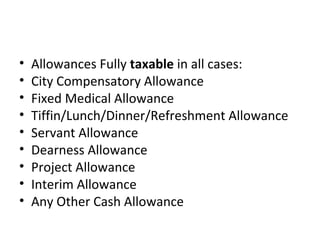
• Allowances Fully taxable in all cases: 
• City Compensatory Allowance 
• Fixed Medical Allowance 
• Tiffin/Lunch/Dinner/Refreshment Allowance 
• Servant Allowance 
• Dearness Allowance 
• Project Allowance 
• Interim Allowance 
• Any Other Cash Allowance
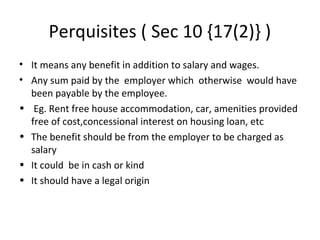
Perquisites ( Sec 10 {17(2)} ) 
• It means any benefit in addition to salary and wages. 
• Any sum paid by the employer which otherwise would have 
been payable by the employee. 
• Eg. Rent free house accommodation, car, amenities provided 
free of cost,concessional interest on housing loan, etc 
• The benefit should be from the employer to be charged as 
salary 
• It could be in cash or kind 
• It should have a legal origin
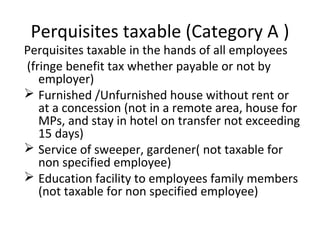
Perquisites taxable (Category A ) 
Perquisites taxable in the hands of all employees 
(fringe benefit tax whether payable or not by 
employer) 
 Furnished /Unfurnished house without rent or 
at a concession (not in a remote area, house for 
MPs, and stay in hotel on transfer not exceeding 
15 days) 
 Service of sweeper, gardener( not taxable for 
non specified employee) 
 Education facility to employees family members 
(not taxable for non specified employee)
Contribution by employer to effect an 
assurance on the life of the employee or to 
effect an annuity 
Interest free loan( exempted for loan not 
exeeding Rs.20000, or loan for medical 
treatment) 
Use of Employers movable assets are taxable 
except laptop, desktop & car
Perquisites taxable (Category B) 
B1. Car or other automotive conveyance ( not 
taxable for non specified employee) 
B2. Transport facility by a Transport 
undertaking( not railways & airlines) 
B3 Traveling touring accomodation 
B4 Free Food & Beverage ( Rs.50 within office 
hours exempted) 
B5 Gift voucher beyond Rs.5000 
B6 Club Membership & credit Card
Specified Employee 
• A director is a specified employee 
• An employee who holds 20% or more voting 
power (called substantial interest) 
• Where an employee is drawing salary of more 
than Rs.50,000 per year ( without considering 
non monetary benefit and exemptions like 
HRA) but , since the minimum exemption limit 
is Rs.1,10,000, practically all tax payers are 
specified employees.
PROFIT IN LIEU OF SALARY 
[ U/S 17(3) ] includes 
• Any compensation due or received in connection with the termination 
of the employment of due to modification of the terms and conditions 
of his employment. 
• Payments from an employer or former employer from provident fund or 
such other funds, excluding the amounts exempt from tax under Section 
10 and excluding the amounts of contribution made by the assessee and 
the interest thereon 
• Any sum received under a Keyman Insurance Policy including the sum 
allocated by way of Bonus on such policy. 
• Amounts due to or received, whether in Lumpsum or otherwise by any 
assessee from any person.
Deductions from salary (Section 16) 
• Professional Tax paid in this year 
• Entertainment allowance: available only for 
Government employees 
Least of the following is Exempt 
a) 1/5 of Basic Salary 
b) Rs 5,000 
c) Amount Received as Entertainment 
Allowance during the year.
Leave Encashment 
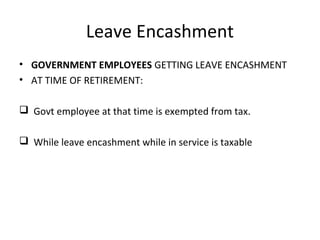
• GOVERNMENT EMPLOYEES GETTING LEAVE ENCASHMENT 
• AT TIME OF RETIREMENT: 
 Govt employee at that time is exempted from tax. 
 While leave encashment while in service is taxable
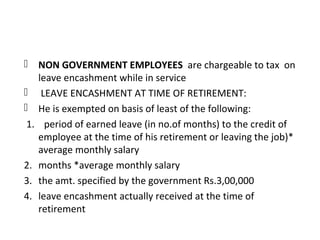
 NON GOVERNMENT EMPLOYEES are chargeable to tax on 
leave encashment while in service 
 LEAVE ENCASHMENT AT TIME OF RETIREMENT: 
 He is exempted on basis of least of the following: 
1. period of earned leave (in no.of months) to the credit of 
employee at the time of his retirement or leaving the job)* 
average monthly salary 
2. months *average monthly salary 
3. the amt. specified by the government Rs.3,00,000 
4. leave encashment actually received at the time of 
retirement
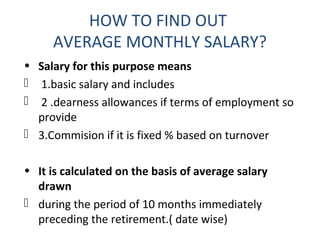
HOW TO FIND OUT 
AVERAGE MONTHLY SALARY? 
• Salary for this purpose means 
 1.basic salary and includes 
 2 .dearness allowances if terms of employment so 
provide 
 3.Commision if it is fixed % based on turnover 
• It is calculated on the basis of average salary 
drawn 
 during the period of 10 months immediately 
preceding the retirement.( date wise)
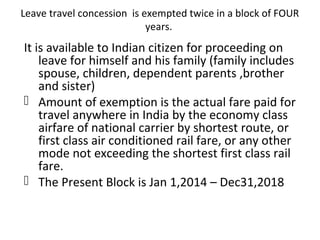
Leave travel concession is exempted twice in a block of FOUR 
years. 
It is available to Indian citizen for proceeding on 
leave for himself and his family (family includes 
spouse, children, dependent parents ,brother 
and sister) 
 Amount of exemption is the actual fare paid for 
travel anywhere in India by the economy class 
airfare of national carrier by shortest route, or 
first class air conditioned rail fare, or any other 
mode not exceeding the shortest first class rail 
fare. 
 The Present Block is Jan 1,2014 – Dec31,2018
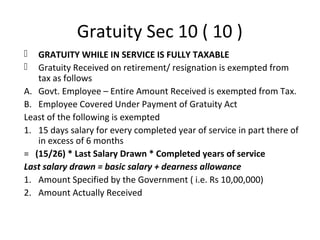
Gratuity Sec 10 ( 10 ) 
 GRATUITY WHILE IN SERVICE IS FULLY TAXABLE 
 Gratuity Received on retirement/ resignation is exempted from 
tax as follows 
A. Govt. Employee – Entire Amount Received is exempted from Tax. 
B. Employee Covered Under Payment of Gratuity Act 
Least of the following is exempted 
1. 15 days salary for every completed year of service in part there of 
in excess of 6 months 
= (15/26) * Last Salary Drawn * Completed years of service 
Last salary drawn = basic salary + dearness allowance 
1. Amount Specified by the Government ( i.e. Rs 10,00,000) 
2. Amount Actually Received
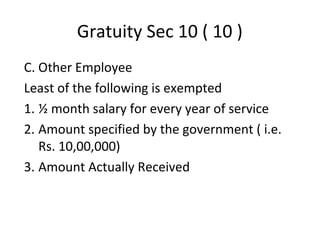
Gratuity Sec 10 ( 10 ) 
C. Other Employee 
Least of the following is exempted 
1. ½ month salary for every year of service 
2. Amount specified by the government ( i.e. 
Rs. 10,00,000) 
3. Amount Actually Received
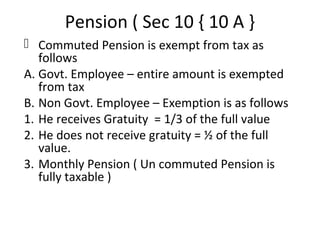
Pension ( Sec 10 { 10 A } 
 Commuted Pension is exempt from tax as 
follows 
A. Govt. Employee – entire amount is exempted 
from tax 
B. Non Govt. Employee – Exemption is as follows 
1. He receives Gratuity = 1/3 of the full value 
2. He does not receive gratuity = ½ of the full 
value. 
3. Monthly Pension ( Un commuted Pension is 
fully taxable )
THANK YOU

Lecture 7 salary

  • 1.
    Salary – Sec15,16,17 Lecture 7
  • 2.
    What is salary? • Salaries mean and include remuneration in any form due for personal service as per the contract of employment or service. • Essential Element for Taxability of Income as Salaries is Employer Employee Relationship
  • 3.
    • Salary, insimple words, means remuneration of a person, which he has received from his employer for rendering services to him. But receipts for all kinds of services rendered cannot be taxed as salary. • The remuneration received by professionals like doctors, architects, lawyers etc. cannot be covered under salary since it is not received from their employers but from their clients. So, it is taxed under business or profession head.
  • 4.
    Characteristic of Salary 1. The relationship of payer and payee must be of employer and employee for an income to be categorized as salary income. For example: Salary income of a Member of Parliament cannot be specified as salary, since it is received from Government of India which is not his employer. 2. The Act makes no distinction between salary and wages, though generally salary is paid for non-manual work and wages are paid for manual work. 3. Salary received from employer, whether one or more than one is included in this head.
  • 5.
    4. Salary istaxable either on due basis or receipt basis which ever matures earlier: i) Due basis – when it is earned even if it is not received in the previous year. ii) Receipt basis – when it is received even if it is not earned in the previous year. iii) Arrears of salary- which were not due and received earlier are taxable when due or received, which ever is earlier. 5. Compulsory deduction from salary such as employees’ contribution to provident fund, deduction on account of medical scheme or staff welfare scheme etc. are examples of instances of application of income. In these cases, for computing total income, these deductions have to be added back.
  • 6.
    Components of Salary 1. Salaries, wages and advance against salary / wages 2. Annuity / pension 3. Gratuity 4. Fees/ commission 5. Perquisites 6. Profits in lieu of / in addition to salaries/ wages 7. Incentive/ bonus 8. Contribution made by Central Government or any other employer in the account of the employee under new pension scheme effective 1.4.04 9. Leave encashment 10. Allowances 11. Annual accretion in RPF to the extent taxable 12. Transferred balance to a RPF to the extent taxable To sum up, it is the gross salary that will be taxed and not the net received by the employee
  • 7.
    Allowances • Allowancesnot charged to tax are  Allowance to Government Employees outside India : is exempt u/s 10 (7)  Allowance to High Court or Supreme Court Judges u/s is also exempt  Allowance paid by United Nations Organization-Exempt by virtue of Section 2 of United Nations (Privileges and Immunities) Act, 1974  Compensatory allowance under Article 222(e) of the Constitution of India received by a Judge- Exempt from tax.
  • 8.
    • Transfer Allowancegranted to meet the cost of travel on tour or on transfer including any sum paid for transfer, packing and transportation of personal effects on such transfer • Tour/ Travelling Allowance whether granted on tour of for the period of journey to meet the ordinary daily charges incurred by an employee on account of absence from his normal place of duty; • Conveyance Allowance granted to meet the expenditure incurred on conveyance in performance of duties of an office or employment of profit, • Helper Allowance granted to meet the expenditure incurred on a helper where such helper is engaged for performance of the duties of an office or employment of profit • Research Allowance granted for encouraging the academic, research and training pursuits in educational and research institutions; • Uniform Allowance granted to meet the expenditure on the purchase or maintenance of uniform for wear during the performance of duties of an office or employment of profit
  • 9.
     Children educationallowance @ Rs. 100 p.m. per child, maximum of 2 children.  Children hostel allowance @ Rs. 300 p.m. per child maximum of 2 children  Transport Allowance granted to an employee (other than in 10 below) to meet his expenditure for the purpose of Commuting between the place of his residence and the place of his duty @ Rs. 800 p.m.  Transport Allowance granted to an employee who is blind or handicapped with disability of Lower extremities to meet his expenditure for the purpose of commuting between the place of his residence and the place of his duty @ Rs. 1,600 p.m.  House Rent Allowance  Leave Travel Concession Alowance
  • 10.
    • Allowances Fullytaxable in all cases: • City Compensatory Allowance • Fixed Medical Allowance • Tiffin/Lunch/Dinner/Refreshment Allowance • Servant Allowance • Dearness Allowance • Project Allowance • Interim Allowance • Any Other Cash Allowance
  • 11.
    Perquisites ( Sec10 {17(2)} ) • It means any benefit in addition to salary and wages. • Any sum paid by the employer which otherwise would have been payable by the employee. • Eg. Rent free house accommodation, car, amenities provided free of cost,concessional interest on housing loan, etc • The benefit should be from the employer to be charged as salary • It could be in cash or kind • It should have a legal origin
  • 12.
    Perquisites taxable (CategoryA ) Perquisites taxable in the hands of all employees (fringe benefit tax whether payable or not by employer)  Furnished /Unfurnished house without rent or at a concession (not in a remote area, house for MPs, and stay in hotel on transfer not exceeding 15 days)  Service of sweeper, gardener( not taxable for non specified employee)  Education facility to employees family members (not taxable for non specified employee)
  • 13.
    Contribution by employerto effect an assurance on the life of the employee or to effect an annuity Interest free loan( exempted for loan not exeeding Rs.20000, or loan for medical treatment) Use of Employers movable assets are taxable except laptop, desktop & car
  • 14.
    Perquisites taxable (CategoryB) B1. Car or other automotive conveyance ( not taxable for non specified employee) B2. Transport facility by a Transport undertaking( not railways & airlines) B3 Traveling touring accomodation B4 Free Food & Beverage ( Rs.50 within office hours exempted) B5 Gift voucher beyond Rs.5000 B6 Club Membership & credit Card
  • 15.
    Specified Employee •A director is a specified employee • An employee who holds 20% or more voting power (called substantial interest) • Where an employee is drawing salary of more than Rs.50,000 per year ( without considering non monetary benefit and exemptions like HRA) but , since the minimum exemption limit is Rs.1,10,000, practically all tax payers are specified employees.
  • 16.
    PROFIT IN LIEUOF SALARY [ U/S 17(3) ] includes • Any compensation due or received in connection with the termination of the employment of due to modification of the terms and conditions of his employment. • Payments from an employer or former employer from provident fund or such other funds, excluding the amounts exempt from tax under Section 10 and excluding the amounts of contribution made by the assessee and the interest thereon • Any sum received under a Keyman Insurance Policy including the sum allocated by way of Bonus on such policy. • Amounts due to or received, whether in Lumpsum or otherwise by any assessee from any person.
  • 17.
    Deductions from salary(Section 16) • Professional Tax paid in this year • Entertainment allowance: available only for Government employees Least of the following is Exempt a) 1/5 of Basic Salary b) Rs 5,000 c) Amount Received as Entertainment Allowance during the year.
  • 18.
    Leave Encashment •GOVERNMENT EMPLOYEES GETTING LEAVE ENCASHMENT • AT TIME OF RETIREMENT:  Govt employee at that time is exempted from tax.  While leave encashment while in service is taxable
  • 19.
     NON GOVERNMENTEMPLOYEES are chargeable to tax on leave encashment while in service  LEAVE ENCASHMENT AT TIME OF RETIREMENT:  He is exempted on basis of least of the following: 1. period of earned leave (in no.of months) to the credit of employee at the time of his retirement or leaving the job)* average monthly salary 2. months *average monthly salary 3. the amt. specified by the government Rs.3,00,000 4. leave encashment actually received at the time of retirement
  • 20.
    HOW TO FINDOUT AVERAGE MONTHLY SALARY? • Salary for this purpose means  1.basic salary and includes  2 .dearness allowances if terms of employment so provide  3.Commision if it is fixed % based on turnover • It is calculated on the basis of average salary drawn  during the period of 10 months immediately preceding the retirement.( date wise)
  • 21.
    Leave travel concessionis exempted twice in a block of FOUR years. It is available to Indian citizen for proceeding on leave for himself and his family (family includes spouse, children, dependent parents ,brother and sister)  Amount of exemption is the actual fare paid for travel anywhere in India by the economy class airfare of national carrier by shortest route, or first class air conditioned rail fare, or any other mode not exceeding the shortest first class rail fare.  The Present Block is Jan 1,2014 – Dec31,2018
  • 22.
    Gratuity Sec 10( 10 )  GRATUITY WHILE IN SERVICE IS FULLY TAXABLE  Gratuity Received on retirement/ resignation is exempted from tax as follows A. Govt. Employee – Entire Amount Received is exempted from Tax. B. Employee Covered Under Payment of Gratuity Act Least of the following is exempted 1. 15 days salary for every completed year of service in part there of in excess of 6 months = (15/26) * Last Salary Drawn * Completed years of service Last salary drawn = basic salary + dearness allowance 1. Amount Specified by the Government ( i.e. Rs 10,00,000) 2. Amount Actually Received
  • 23.
    Gratuity Sec 10( 10 ) C. Other Employee Least of the following is exempted 1. ½ month salary for every year of service 2. Amount specified by the government ( i.e. Rs. 10,00,000) 3. Amount Actually Received
  • 24.
    Pension ( Sec10 { 10 A }  Commuted Pension is exempt from tax as follows A. Govt. Employee – entire amount is exempted from tax B. Non Govt. Employee – Exemption is as follows 1. He receives Gratuity = 1/3 of the full value 2. He does not receive gratuity = ½ of the full value. 3. Monthly Pension ( Un commuted Pension is fully taxable )
  • 25.