SUMMER INTERNSHIP PROGRAMME
2014
PROJECT PRESENTATION
Submitted by:
Madhu Bala
1014
Kirloskar Institute of Advanced Management
Studies
ACADEMIC YEAR 2013-2015
DOCUMENTATION and
PROCEDURE of SALES
TAX(MVAT) in KPCL
Under Supervision of:
 Mr. Ogale S S, DGM
 Mr. Kanade R H, AGM
ACKNOWLEDGEMENTS
Faculty Guide Prof. Dr. V.S Pai
Alumuni Guide: Mr. Sunil Kumar Kataria
SIP Coordinator: Prof. Chetan G K
Objective of the Study
• To study and understand the procedure and
documentation of sales tax with respect to
state of Maharashtra.
• To understand its acts, rules and regulations
and then see whether the same set of rules
and procedures are followed in KPCL or not.
Primary
Objective
• To know reasons why sales tax was replaced
by VAT.
• Comparison between CST 1956, VAT and
SALES Tax act.
Secondary
Objective
Introduction to the Concept
TAX
VAT
MVAT
• Taxes in India.
• Types of taxes.
• Meaning And Concept.
• Advantages of VAT.
• limitation/criticism of VAT.
• Under Government Of
Maharashtra.
• Concept, Acts And Rules.
• Rates and schedules.
TAXES in INDIA
DIRECT
TAX
INCOME
TAX
WEALTH
TAX
INDIRECT TAX
CUSTOMS
SERVICE
TAX
EXCISE
SALES
TAX
CENTRAL
SALES TAX
STATE
TAX
VALUE ADDED TAX (VAT)
VAT is a broad-based commodity tax that is
levied at multiple stages of production.
 Indirect tax on the consumption of the goods,
paid by its original producers upon the change
in goods or upon the transfer of the goods to
its ultimate consumers.
Based on the value of the goods, added by the
transferor. It is the tax in relation to the
difference of the value added by the
transferor and not just a profit.
All over the world, VAT is payable on the goods and services
as they form a part of national GDP. It means every seller of
goods and service provider charges the tax after availing the
input tax credit
It is the form of collecting sales tax under which tax is
collected in each stage on the value added of the goods.
VAT will replace the existing system of inspection by a system
of built-in self-assessment by traders and manufacturers.
The tax structure will become simple and more transparent
and tax compliance will improve significantly
Under VAT revenue is collected throughout the production
process without distorting any production decisions
ADVANTAGES
of VAT
• Simplification
• Transparency
• Fair and equitable
• Computerization.
• procedure of simplification.
• Adjustment of tax paid on
purchased goods.
• Greater reliance on self
assessment and voluntary
compliance by dealers.
LIMITATIONS
of VAT
• Burden on personal end
consumer products.
• Revenue are lower.
• Accounting expenses.
• Increased tax passed to
consumer.
• Vat avoidance.
• Vat fraud.
VAT applies to all types of businesses
IMPORTERS MANUFACTURERS DISTRIBUTORS WHOLESALERS
RETAILERS WORKS
CONTRACTORS
LESSERS
How VAT works
• When a dealer sell goods, the sale price is
made up of two elements; the selling price of
the goods and the tax on the sale.
• The tax is payable to the State Government.
The tax payable on sales is to be calculated on
the selling price.
• The tax paid on purchases supported by a,
valid tax invoice is generally available as set-
off (input, tax credit) while discharging the tax
liability on sales.
EXAMPLE
Company A buys iron
ore and other
consumables and
manufactures stainless
steel utensils
Partnership firm B buys
the utensils in bulk from
Company A and polishes
them
shopkeeper C buys
some of the utensils and
purchases packing,
material from vendor D
Vendor D packages
them and sells the
packed utensils for the
public.
 Maharashtra is one of the 21 States which have
introduced the Value Added Tax (VAT) system of
taxation from 1st April 2005.
 The design of Maharashtra State VAT is generally
guided by the best international practices with
regard to legal framework, as well as operating
procedures.
 The consensus has been arrived at through
the discussions in the Empowered Committee
of State Finance Ministers on implementation
of State level VAT.
 On 1st April 2005, VAT replaced the single
point sales tax.
MVAT replaced 4 existing taxes
1. The Bombay Sales Tax Act, 1959.
2. The Maharashtra Sales Tax on the Transfer of
Right to Use Any Goods For Any Purpose Act,
1985·
3. The Maharashtra Sales Tax on the Transfer of
Property in Goods Involved in the Execution
of Works Contract (re-enacted) Act, 1989·
4. The Bombay Sales of Motor Spirit Taxation
Act, 1958.
Important things in MVAT
TIN
Schedule Rates
Forms Returns
Tax invoice
Audit
TIN
TIN stands for Tax-Payer Identification
Number.
Is unique number allotted by Commercial tax
department of respective State.
 It’s an eleven digit number to be mentioned
in all VAT transactions and correspondence.
Tin registration is must for
Manufacture/Traders /Exporters/Dealers.
Can be done by online.
Schedule Rates in MVAT 2002
SCHEDULE DESCRIPTION RATE
SCHEDULE A Essential Commodities (Tax free) NIL
SCHEDULE B Gold, Silver, Precious Stones, Pearls etc. 1 %
SCHEDULE C Declared Goods and other specified goods 5 %
SCHEDULE D Foreign Liquor, Country Liquor, Motor
Spirits, etc.
SPECIFIED
RATE
SCHEDULE E All other goods (not covered by A to D) 12.5%
RETURNS under MVAT 2002
• Form 704
• Dealers having annual turnover of Rs. 80 lakhs
ANNUAL
RETURNS
• Dealer having tax liability of more than Rs. 10 Lacs in previous
year or
• Dealer having entitlement for refund of more than Rs. 1 Crore
during previous year and
• Retailer opting for Composition Scheme
MONTHLY
RETURNS
• Others to file Quarterly return i.e. Liability of Rs. 1
to 10 Lacs or refund from Rs. 10 Lacs to Rs. 100
Lacs
QUATERLY
RETURNS
• Dealer having tax liability of Rs. 1 Lacs or less in previous year or
• Entitlement for refund is Rs. 10 Lacs or less during previous year
SIX MONTHLY
RETURNS
Tax invoice
A tax invoice can be in any form to suit business requirements.
However, all tax invoices must show –
1. The words `Tax Invoice’ in bold letters either at the top or at a
prominent place
2. A serial number.
3. The date of the transaction/sale/issue.
4. Description of the goods.
5. The quantity or number of goods involved in the transaction.
6. The price of the goods.
7. the amount of VAT charged on the goods (this must be shown
separately)
8. A declaration certificate.
9. Supplier’s name, address and Registration Certificate number.
10. Name and address of buyer.
Business Audit
• Business Audit is a new function of the Sales
Tax Department.
• Conducted by the Sales tax officials ordinarily
at the dealer's place of business.
• Independent from the audit by a Chartered
Accountant.
Business Audit Process
If any of the dealers
business is selected for
an audit, then Sales Tax
Office will inform them
and then fix a suitable
date.
The audit officer will inspect
the books of accounts and
supporting documents.
At that time dealer should
make available any
information or documents
that he may require
tenable him to carry out
the audit effectively and
speedily.
The audit officer may like
to understand dealer’s
business process and
examine their stocks of
goods.
He may also like to
interview the person or its
employees for this.
The audit officer cannot remove
any books of accounts or
documents from their premises.
However, audit officer can
request for copies
RETURN FORMS
• For dealers, other than Composition dealers
executing works contract, engaged in right to use any
goods and under Package scheme of incentive.
FORM NO 231
• Dealers opting for composition scheme excluding
works contractors / dealers opting composition for
part business
FORM NO 232
•Dealers under composition for part business
•Works contractors
•Dealers engaged in activity of transfer of right to use goods
FORM NO 233
• Dealers under Package Scheme of
IncentiveFORM NO 234
• Notified oil companies .FORM NO 235
ABOUT the COMPANY
KIRLOSKAR PNEUMATIC COMPANY LIMITED
Hadapsar Industrial Estate
Hadapsar, Pune 411013
 KPCL is one of the core group companies.
 Incorporated in 1958 under the chairmanship
of Late Shri Shantanurao Kirloskar.
Certified for Integrated Management System
(IMS) Certifications of ISO 9001:2008, ISO
14001:2004, OHSAS 18001:2007, by TUV
NORD.
 Started its operations with the manufacture
of Air Compressors and Pneumatic Tools. New
product lines were then added, including Air
Conditioning and Refrigeration systems,
Marine HVACR, Process Gas systems and
Hydraulic Power Transmission machinery.
MISSION
To demonstrate an
edge to our
stakeholders in our
offerings for
converting/transm
itting energy. We
will strive to make
our company an
employer of choice
VALUES
CUSTOMERS FOCUS:- Our activities / actions
will be focused on enhancing internal /
external customer's satisfaction
COMMITMENT: - We commit to achieve our
targets / goals. We will be responsible /
accountable for our commitment
CONTINUAL IMPROVEMENT:- We will
consciously work to improve our procedures,
processes and systems with an objective to
improve our business processes
ETHICAL BUSINESS PRACTICES: - We will be
fair in our dealings with all our stakeholders.
It will be based on integrity , honesty and
transparency
PRODUCT DIVISION at KPCL
Air
conditioning,
refrigeration
& process
gas division
(ACR & PG)
Transmission
division
(TRM)
Air
compressor
division
(ACD)
Competitors of KPCL
Vs
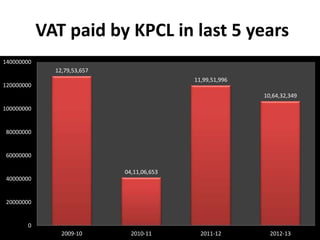
VAT paid by KPCL in last 5 years
12,79,53,657
04,11,06,653
11,99,51,996
10,64,32,349
0
20000000
40000000
60000000
80000000
100000000
120000000
140000000
2009-10 2010-11 2011-12 2012-13
Methodology followed
PERSONAL INTERVIEW
• observe things like how soon after delivery of inventory from various
divisions and subdivisions , invoices are generated, how each and
every invoice is supported by valid tax FORM
DIRECT OBSERVATION
• personally used to ask how and why of things. Say for instance asking
company guide how and why excel I is used in updating sales invoices
and supplier and customer C forms at the end of every quarter
ON THE JOB TRAINING
• At KPCL I used to actually work to get the exposure and experience.
Daily I worked for sales tax department all the major works
Tabulation and Findings
Software's
used in
KPCL
Forms
used in
KPCL
Documents
prepared
in KPCL
Software/system used in KPCL
Microsoft EXCEL
• All forms are updated in excel.
• On daily basis.
ORACLE
• Replaced existing UNIX in 2006.
• When MVAT become electronic.
• Advantageous over UNIX as have ERP.
FORMS used in KPCL
C FORM
for
interstate
sales
E1 FROM
direct
dispatch to
customers
H FORM
for export
sales
2. Documents Prepared in KPCL
 VAT Return
 CST Return
 Sales Tax Payment Position
 C Form Suppliers
 C Form Customers
 VAT Audit
 WCT TDS
 Rectification Of C/ E1
Forms
 C Form Mail Returns
 C Form Letters
 Sales Tax JVS
 ACK CST Application
 CA Certificate
 H Forms
 Covering Letters C Form
Suppliers
 Sales Tax Legal
 Debit Note And Credit Note
 C Form Forwarding Letters
 C FORM supplier forwarding
letters
 WCT TDS Purchases
a). Covering Letters C Form Suppliers
Every c form supplier is supported with a
covering letter containing all the details like
invoice no and value of each item in the c
form and the address and other details of the
suppliers.
b). ACK CST application
ACK stands for acknowledgement. An online
application of C FORM is filed in favour of
suppliers and in return KPCL gets an
acknowledgement copy of the same.
AREA OF RESEARCH
Why VAT is
preferred
over sales
tax?
Difference
between
VAT and CST.
VAT effect
on inflation.
VAT effect
on
economic
growth.
Why VAT is preferred over SALES TAX?
In sales tax, final sales are not covered by the tax
system e.g. due to difficulty of covering all the retailers,
particular commodities may not yield any tax whereas
with VAT some revenue would have been collected
through taxation of earlier transactions, or eliminates
the problem of tax cascading, which often occurs with
sales tax.
Sales tax is often applied again to the sales tax element
of the cost, thus there is a problem of tax on tax. This is
not the case with VAT, which makes it a neutral tax as it
provides the least disturbance to patterns of
production and the generation and use of income.
This is made possible by the fact that one person’s
output is another’s input. As with sales tax imports
are treated the same way as local goods while
exports are zero- rated to avoid anti-export bias.
Difference between VAT & CST
Under the CST Act, the tax is collected at one stage of
purchase or sale of goods. Therefore, the burden of the full
tax bond is borne by only one dealer, either the first or the last
dealer.
The VAT system, the tax burden would be shared by all the
dealers from first to last. Then, such tax would be passed
upon the final consumers.
Under the CST Act, the tax is levied at a single point. Under
the VAT system, the retailers are not subject to tax except for
the retail tax.
Under the CST law, concessional rates are provided on certain
taxes. The VAT regime will do away with such concessions as
it would provide the full credit on the tax that has been paid
earlier.
VAT effect on INFLATION
In considering the introduction of VAT, countries are often
concerned that it would cause an inflationary spiral.
However there is no evidence to suggest that this is true.
Survey of OECD countries that introduced VAT indicated
that VAT had little or no effect on prices.
In cases where there was an effect it was a onetime effect
that simply shifted the trend line of the consumer price
index (CPI).
To guard against any unforeseen price effects the
authorities may consider a tighter monetary policy stance
at the introduction of VAT
VAT effect on Economic Growth
Economic growth can be facilitated through investment by
both government and the private sector. Savings by both
parties are required in order to finance investment in anon-
inflationary manner.
Compared to other broadly based taxes such as income tax
VAT is neutral with respect to choices on whether to
consume now or save for future consumption.
Although VAT reduces the absolute return on saving it
does not reduce the net rate of return on saving.
Income tax reduces the net rate of return as both the
amount saved as well as the return on that saving are
subject to tax.
RECOMMENDATIONS
KPCL Finance Department particularly Sales Tax
Department is maintaining all the documents and
invoices as per the requirement of Department of
Sales Tax under government of Maharashtra.
After the study of Documentation and Procedure of
MVAT in KPCL.
No recommendations as KPCL is doing its work as
per the latest rule sand regulations of
department of sales tax.
Limitations of the study
The project DOCUMENTATION AND PROCEDURE
OF SALES TAX (MVAT)is a topic that revolves
around laws, rules and regulations of the
GOVERNMENT of MAHARASHTRA. Hence, there
was very less scope for practical implementation
and analysis.
It is a very vast domain and in a period of less
than 8 weeks it was not possible to cover all
aspects in details and study each and every law,
procedure or exemption in detail.
Scope for Future Improvement
KPCL Finance Department particularly Sales Tax
Department is maintaining all the documents
and invoices as per the requirement of
Department of Sales Tax under government of
Maharashtra.
All the invoices are updated on daily basis.
Hence no recommendations to KPCL on this
part.
BIBLIOGRAPHY
 http://en.wikipedia.org/wiki/Taxation_in_India
 http://www.archive.india.gov.in/citizen/taxes.php?id=5
 http://www.authorstream.com/Presentation/aSGuest8996
2-890545-mvat-basics/
 http://en.wikipedia.org/wiki/Sales_tax.
 http://kpcl.kirloskar.com/content/our-corporate-philosophy
 http://en.wikipedia.org/wiki/Sales_tax.
 http://mahavat.gov.in/Mahavat/MyFold/DOWNLOADS/FOR
MS/DOWNLOAD_FORMS_MVAT/DOWNLOAD_FORMS_MV
AT_06_03_11_3_46_16PM.pdf
 http://mahavat.gov.in/Mahavat/MyFold/DOWNLOADS/FOR
MS/DOWNLOAD_FORMS_MVAT/Downloads-MVAT.073.pdf
Internal Audit Internship Project 2014

Internal Audit Internship Project 2014

  • 1.
    SUMMER INTERNSHIP PROGRAMME 2014 PROJECTPRESENTATION Submitted by: Madhu Bala 1014 Kirloskar Institute of Advanced Management Studies ACADEMIC YEAR 2013-2015
  • 2.
    DOCUMENTATION and PROCEDURE ofSALES TAX(MVAT) in KPCL Under Supervision of:  Mr. Ogale S S, DGM  Mr. Kanade R H, AGM
  • 3.
    ACKNOWLEDGEMENTS Faculty Guide Prof.Dr. V.S Pai Alumuni Guide: Mr. Sunil Kumar Kataria SIP Coordinator: Prof. Chetan G K
  • 4.
    Objective of theStudy • To study and understand the procedure and documentation of sales tax with respect to state of Maharashtra. • To understand its acts, rules and regulations and then see whether the same set of rules and procedures are followed in KPCL or not. Primary Objective • To know reasons why sales tax was replaced by VAT. • Comparison between CST 1956, VAT and SALES Tax act. Secondary Objective
  • 5.
    Introduction to theConcept TAX VAT MVAT • Taxes in India. • Types of taxes. • Meaning And Concept. • Advantages of VAT. • limitation/criticism of VAT. • Under Government Of Maharashtra. • Concept, Acts And Rules. • Rates and schedules.
  • 6.
    TAXES in INDIA DIRECT TAX INCOME TAX WEALTH TAX INDIRECTTAX CUSTOMS SERVICE TAX EXCISE SALES TAX CENTRAL SALES TAX STATE TAX
  • 7.
    VALUE ADDED TAX(VAT) VAT is a broad-based commodity tax that is levied at multiple stages of production.  Indirect tax on the consumption of the goods, paid by its original producers upon the change in goods or upon the transfer of the goods to its ultimate consumers. Based on the value of the goods, added by the transferor. It is the tax in relation to the difference of the value added by the transferor and not just a profit.
  • 8.
    All over theworld, VAT is payable on the goods and services as they form a part of national GDP. It means every seller of goods and service provider charges the tax after availing the input tax credit It is the form of collecting sales tax under which tax is collected in each stage on the value added of the goods. VAT will replace the existing system of inspection by a system of built-in self-assessment by traders and manufacturers. The tax structure will become simple and more transparent and tax compliance will improve significantly Under VAT revenue is collected throughout the production process without distorting any production decisions
  • 9.
    ADVANTAGES of VAT • Simplification •Transparency • Fair and equitable • Computerization. • procedure of simplification. • Adjustment of tax paid on purchased goods. • Greater reliance on self assessment and voluntary compliance by dealers.
  • 10.
    LIMITATIONS of VAT • Burdenon personal end consumer products. • Revenue are lower. • Accounting expenses. • Increased tax passed to consumer. • Vat avoidance. • Vat fraud.
  • 11.
    VAT applies toall types of businesses IMPORTERS MANUFACTURERS DISTRIBUTORS WHOLESALERS RETAILERS WORKS CONTRACTORS LESSERS
  • 12.
    How VAT works •When a dealer sell goods, the sale price is made up of two elements; the selling price of the goods and the tax on the sale. • The tax is payable to the State Government. The tax payable on sales is to be calculated on the selling price. • The tax paid on purchases supported by a, valid tax invoice is generally available as set- off (input, tax credit) while discharging the tax liability on sales.
  • 13.
    EXAMPLE Company A buysiron ore and other consumables and manufactures stainless steel utensils Partnership firm B buys the utensils in bulk from Company A and polishes them shopkeeper C buys some of the utensils and purchases packing, material from vendor D Vendor D packages them and sells the packed utensils for the public.
  • 15.
     Maharashtra isone of the 21 States which have introduced the Value Added Tax (VAT) system of taxation from 1st April 2005.  The design of Maharashtra State VAT is generally guided by the best international practices with regard to legal framework, as well as operating procedures.  The consensus has been arrived at through the discussions in the Empowered Committee of State Finance Ministers on implementation of State level VAT.  On 1st April 2005, VAT replaced the single point sales tax.
  • 16.
    MVAT replaced 4existing taxes 1. The Bombay Sales Tax Act, 1959. 2. The Maharashtra Sales Tax on the Transfer of Right to Use Any Goods For Any Purpose Act, 1985· 3. The Maharashtra Sales Tax on the Transfer of Property in Goods Involved in the Execution of Works Contract (re-enacted) Act, 1989· 4. The Bombay Sales of Motor Spirit Taxation Act, 1958.
  • 17.
    Important things inMVAT TIN Schedule Rates Forms Returns Tax invoice Audit
  • 18.
    TIN TIN stands forTax-Payer Identification Number. Is unique number allotted by Commercial tax department of respective State.  It’s an eleven digit number to be mentioned in all VAT transactions and correspondence. Tin registration is must for Manufacture/Traders /Exporters/Dealers. Can be done by online.
  • 19.
    Schedule Rates inMVAT 2002 SCHEDULE DESCRIPTION RATE SCHEDULE A Essential Commodities (Tax free) NIL SCHEDULE B Gold, Silver, Precious Stones, Pearls etc. 1 % SCHEDULE C Declared Goods and other specified goods 5 % SCHEDULE D Foreign Liquor, Country Liquor, Motor Spirits, etc. SPECIFIED RATE SCHEDULE E All other goods (not covered by A to D) 12.5%
  • 20.
    RETURNS under MVAT2002 • Form 704 • Dealers having annual turnover of Rs. 80 lakhs ANNUAL RETURNS • Dealer having tax liability of more than Rs. 10 Lacs in previous year or • Dealer having entitlement for refund of more than Rs. 1 Crore during previous year and • Retailer opting for Composition Scheme MONTHLY RETURNS • Others to file Quarterly return i.e. Liability of Rs. 1 to 10 Lacs or refund from Rs. 10 Lacs to Rs. 100 Lacs QUATERLY RETURNS • Dealer having tax liability of Rs. 1 Lacs or less in previous year or • Entitlement for refund is Rs. 10 Lacs or less during previous year SIX MONTHLY RETURNS
  • 21.
    Tax invoice A taxinvoice can be in any form to suit business requirements. However, all tax invoices must show – 1. The words `Tax Invoice’ in bold letters either at the top or at a prominent place 2. A serial number. 3. The date of the transaction/sale/issue. 4. Description of the goods. 5. The quantity or number of goods involved in the transaction. 6. The price of the goods. 7. the amount of VAT charged on the goods (this must be shown separately) 8. A declaration certificate. 9. Supplier’s name, address and Registration Certificate number. 10. Name and address of buyer.
  • 23.
    Business Audit • BusinessAudit is a new function of the Sales Tax Department. • Conducted by the Sales tax officials ordinarily at the dealer's place of business. • Independent from the audit by a Chartered Accountant.
  • 24.
    Business Audit Process Ifany of the dealers business is selected for an audit, then Sales Tax Office will inform them and then fix a suitable date. The audit officer will inspect the books of accounts and supporting documents. At that time dealer should make available any information or documents that he may require tenable him to carry out the audit effectively and speedily. The audit officer may like to understand dealer’s business process and examine their stocks of goods. He may also like to interview the person or its employees for this. The audit officer cannot remove any books of accounts or documents from their premises. However, audit officer can request for copies
  • 25.
    RETURN FORMS • Fordealers, other than Composition dealers executing works contract, engaged in right to use any goods and under Package scheme of incentive. FORM NO 231 • Dealers opting for composition scheme excluding works contractors / dealers opting composition for part business FORM NO 232 •Dealers under composition for part business •Works contractors •Dealers engaged in activity of transfer of right to use goods FORM NO 233 • Dealers under Package Scheme of IncentiveFORM NO 234 • Notified oil companies .FORM NO 235
  • 26.
    ABOUT the COMPANY KIRLOSKARPNEUMATIC COMPANY LIMITED Hadapsar Industrial Estate Hadapsar, Pune 411013
  • 27.
     KPCL isone of the core group companies.  Incorporated in 1958 under the chairmanship of Late Shri Shantanurao Kirloskar. Certified for Integrated Management System (IMS) Certifications of ISO 9001:2008, ISO 14001:2004, OHSAS 18001:2007, by TUV NORD.  Started its operations with the manufacture of Air Compressors and Pneumatic Tools. New product lines were then added, including Air Conditioning and Refrigeration systems, Marine HVACR, Process Gas systems and Hydraulic Power Transmission machinery.
  • 28.
    MISSION To demonstrate an edgeto our stakeholders in our offerings for converting/transm itting energy. We will strive to make our company an employer of choice VALUES CUSTOMERS FOCUS:- Our activities / actions will be focused on enhancing internal / external customer's satisfaction COMMITMENT: - We commit to achieve our targets / goals. We will be responsible / accountable for our commitment CONTINUAL IMPROVEMENT:- We will consciously work to improve our procedures, processes and systems with an objective to improve our business processes ETHICAL BUSINESS PRACTICES: - We will be fair in our dealings with all our stakeholders. It will be based on integrity , honesty and transparency
  • 29.
    PRODUCT DIVISION atKPCL Air conditioning, refrigeration & process gas division (ACR & PG) Transmission division (TRM) Air compressor division (ACD)
  • 30.
  • 31.
    VAT paid byKPCL in last 5 years 12,79,53,657 04,11,06,653 11,99,51,996 10,64,32,349 0 20000000 40000000 60000000 80000000 100000000 120000000 140000000 2009-10 2010-11 2011-12 2012-13
  • 32.
    Methodology followed PERSONAL INTERVIEW •observe things like how soon after delivery of inventory from various divisions and subdivisions , invoices are generated, how each and every invoice is supported by valid tax FORM DIRECT OBSERVATION • personally used to ask how and why of things. Say for instance asking company guide how and why excel I is used in updating sales invoices and supplier and customer C forms at the end of every quarter ON THE JOB TRAINING • At KPCL I used to actually work to get the exposure and experience. Daily I worked for sales tax department all the major works
  • 33.
  • 34.
  • 35.
    Software/system used inKPCL Microsoft EXCEL • All forms are updated in excel. • On daily basis. ORACLE • Replaced existing UNIX in 2006. • When MVAT become electronic. • Advantageous over UNIX as have ERP.
  • 36.
    FORMS used inKPCL C FORM for interstate sales E1 FROM direct dispatch to customers H FORM for export sales
  • 37.
    2. Documents Preparedin KPCL  VAT Return  CST Return  Sales Tax Payment Position  C Form Suppliers  C Form Customers  VAT Audit  WCT TDS  Rectification Of C/ E1 Forms  C Form Mail Returns  C Form Letters  Sales Tax JVS  ACK CST Application  CA Certificate  H Forms  Covering Letters C Form Suppliers  Sales Tax Legal  Debit Note And Credit Note  C Form Forwarding Letters  C FORM supplier forwarding letters  WCT TDS Purchases
  • 38.
    a). Covering LettersC Form Suppliers Every c form supplier is supported with a covering letter containing all the details like invoice no and value of each item in the c form and the address and other details of the suppliers.
  • 40.
    b). ACK CSTapplication ACK stands for acknowledgement. An online application of C FORM is filed in favour of suppliers and in return KPCL gets an acknowledgement copy of the same.
  • 42.
    AREA OF RESEARCH WhyVAT is preferred over sales tax? Difference between VAT and CST. VAT effect on inflation. VAT effect on economic growth.
  • 43.
    Why VAT ispreferred over SALES TAX? In sales tax, final sales are not covered by the tax system e.g. due to difficulty of covering all the retailers, particular commodities may not yield any tax whereas with VAT some revenue would have been collected through taxation of earlier transactions, or eliminates the problem of tax cascading, which often occurs with sales tax. Sales tax is often applied again to the sales tax element of the cost, thus there is a problem of tax on tax. This is not the case with VAT, which makes it a neutral tax as it provides the least disturbance to patterns of production and the generation and use of income. This is made possible by the fact that one person’s output is another’s input. As with sales tax imports are treated the same way as local goods while exports are zero- rated to avoid anti-export bias.
  • 44.
    Difference between VAT& CST Under the CST Act, the tax is collected at one stage of purchase or sale of goods. Therefore, the burden of the full tax bond is borne by only one dealer, either the first or the last dealer. The VAT system, the tax burden would be shared by all the dealers from first to last. Then, such tax would be passed upon the final consumers. Under the CST Act, the tax is levied at a single point. Under the VAT system, the retailers are not subject to tax except for the retail tax. Under the CST law, concessional rates are provided on certain taxes. The VAT regime will do away with such concessions as it would provide the full credit on the tax that has been paid earlier.
  • 45.
    VAT effect onINFLATION In considering the introduction of VAT, countries are often concerned that it would cause an inflationary spiral. However there is no evidence to suggest that this is true. Survey of OECD countries that introduced VAT indicated that VAT had little or no effect on prices. In cases where there was an effect it was a onetime effect that simply shifted the trend line of the consumer price index (CPI). To guard against any unforeseen price effects the authorities may consider a tighter monetary policy stance at the introduction of VAT
  • 46.
    VAT effect onEconomic Growth Economic growth can be facilitated through investment by both government and the private sector. Savings by both parties are required in order to finance investment in anon- inflationary manner. Compared to other broadly based taxes such as income tax VAT is neutral with respect to choices on whether to consume now or save for future consumption. Although VAT reduces the absolute return on saving it does not reduce the net rate of return on saving. Income tax reduces the net rate of return as both the amount saved as well as the return on that saving are subject to tax.
  • 47.
    RECOMMENDATIONS KPCL Finance Departmentparticularly Sales Tax Department is maintaining all the documents and invoices as per the requirement of Department of Sales Tax under government of Maharashtra. After the study of Documentation and Procedure of MVAT in KPCL. No recommendations as KPCL is doing its work as per the latest rule sand regulations of department of sales tax.
  • 48.
    Limitations of thestudy The project DOCUMENTATION AND PROCEDURE OF SALES TAX (MVAT)is a topic that revolves around laws, rules and regulations of the GOVERNMENT of MAHARASHTRA. Hence, there was very less scope for practical implementation and analysis. It is a very vast domain and in a period of less than 8 weeks it was not possible to cover all aspects in details and study each and every law, procedure or exemption in detail.
  • 49.
    Scope for FutureImprovement KPCL Finance Department particularly Sales Tax Department is maintaining all the documents and invoices as per the requirement of Department of Sales Tax under government of Maharashtra. All the invoices are updated on daily basis. Hence no recommendations to KPCL on this part.
  • 50.
    BIBLIOGRAPHY  http://en.wikipedia.org/wiki/Taxation_in_India  http://www.archive.india.gov.in/citizen/taxes.php?id=5 http://www.authorstream.com/Presentation/aSGuest8996 2-890545-mvat-basics/  http://en.wikipedia.org/wiki/Sales_tax.  http://kpcl.kirloskar.com/content/our-corporate-philosophy  http://en.wikipedia.org/wiki/Sales_tax.  http://mahavat.gov.in/Mahavat/MyFold/DOWNLOADS/FOR MS/DOWNLOAD_FORMS_MVAT/DOWNLOAD_FORMS_MV AT_06_03_11_3_46_16PM.pdf  http://mahavat.gov.in/Mahavat/MyFold/DOWNLOADS/FOR MS/DOWNLOAD_FORMS_MVAT/Downloads-MVAT.073.pdf