SEMINAR
MAGNETOHYDRODYNAMICS POWER GENERATION
GUIDED BY
AJOSH ABRAHAM
ASST.PROFESSOR
DEPARTMENT OF ME
PRESENTED BY
AJITH JAYACHANDRAN
R#4
S7 ME-A
MAGNETOHYDRODYNAMICS POWER GENERATION 1
CONTENTS
• Introduction
• Magnetohydrodynamics
• Magnetohydrodynamic power generation
• Advantage of MHD power generation
• MHD generators
• Magnetohydrodynamic propulsion
• MHD propulsion in spacecraft
• Conclusion
• References
MAGNETOHYDRODYNAMICS POWER GENERATION 2
INTRODUCTION
Conventional power generation techniques- thermal, hydel, nuclear etc.
Transition of energy.
The moving parts causes losses, huge capital, maintenance cost.
Direct energy conversion system.
1. photovoltaic generation system
2. magnetohydrodynamic generation
3. fuel cells etc.
MAGNETOHYDRODYNAMICS POWER GENERATION 3
MAGNETOHYDRODYNAMICS
Science of dynamics of matter in electromagnetic field.
Conductors- liquid metals, fluids (in hot ionised gaseous form)
Gained importance in 20th centaury.
Faraday’s experiment in Thames
Faraday's law of electromagnetic conduction.
Charge carriers-electrons and positive ions.
MAGNETOHYDRODYNAMICS POWER GENERATION 4
MAGNETOHYDRODYNAMICS POWER
GENERATION
FARADAYS CURRENT
Ions cut magnetic flux
Hall effect generates electricity
HALL EFFECT CURRENT
Accelerated by faradays current- the loss
Total power generated, W = Kσ𝒖 𝟐
𝑩 𝟐
.
MAGNETOHYDRODYNAMICS POWER GENERATION 5
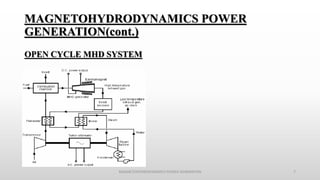
OPEN CYCLE MHD SYSTEM
Conducting fluid – air, oil etc.
Heat source – coal burned at 27000 𝐶 and 12 atm pressure
Seeding chemical- potassium carbonate.
Expanded through nozzle.
Air is moved out through exhaust.
MAGNETOHYDRODYNAMICS POWER GENERATION 6
MAGNETOHYDRODYNAMICS POWER
GENERATION(cont.)
MAGNETOHYDRODYNAMICS POWER
GENERATION(cont.)
OPEN CYCLE MHD SYSTEM
MAGNETOHYDRODYNAMICS POWER GENERATION 7
MAGNETOHYDRODYNAMICS POWER
GENERATION(cont.)
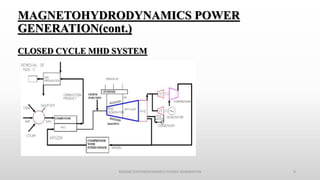
• CLOSED CYCLE MHD SYSTEM
Conducting fluid – inert gas or liquid metal.
High electrical conductivity.
Temperature of heat source needn’t be high
No exhaust system.
MAGNETOHYDRODYNAMICS POWER GENERATION 8
MAGNETOHYDRODYNAMICS POWER
GENERATION(cont.)
CLOSED CYCLE MHD SYSTEM
MAGNETOHYDRODYNAMICS POWER GENERATION 9
ADVANTAGES OF MHD POWER GENERATION
working fluid is circulated, and there are no moving mechanical parts.
The price of MHD generators is much lower than conventional generators.
MHD can have very high efficiency, if a proper system can be developed.
Can be adapted with thermal power plants.
MAGNETOHYDRODYNAMICS POWER GENERATION 10
MHD POWER GENERATORS
• FARADAY GENERATOR
Wedge shape pipe of non conducting material.
Hall effect current loss is high.
MAGNETOHYDRODYNAMICS POWER GENERATION 11
MHD POWER GENERATORS(cont..)
• HALL GENERATOR
Arrays of electrodes are placed on each sides of duct.
First and last electrodes of the array supply load.
Each other electrodes are shorted to electrodes of opposite sides.
Less losses- less shorting of final induced current.
Fluctuation of current is high- misalignment of electrodes with flow
MAGNETOHYDRODYNAMICS POWER GENERATION 12
MHD POWER GENERATORS(cont..)
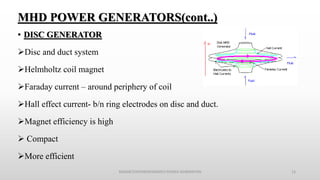
• DISC GENERATOR
Disc and duct system
Helmholtz coil magnet
Faraday current – around periphery of coil
Hall effect current- b/n ring electrodes on disc and duct.
Magnet efficiency is high
 Compact
More efficient
MAGNETOHYDRODYNAMICS POWER GENERATION 13
MAGNETOHYDRODYANMIC PROPULSION
Propeller is replaced with electrodes.
Current is passed through electrodes in presence of magnetic field.
𝑓 = 𝑖[𝑣 × 𝑏]
Water is forced to flow to direction opposite to current flow.
MAGNETOHYDRODYNAMICS POWER GENERATION 14
MHD PROPULSION IN SPACE CRAFT
The vehicle will be powered by a magnetohydrodynamics propulsion
Electrodes will cover each of the vehicle’s surfaces and ionize the
surrounding air into plasma.
The force created by passing an electrical current through this plasma
pushes around the surrounding air, and that swirling air creates lift and
momentum and provides stability against wind gusts.
MAGNETOHYDRODYNAMICS POWER GENERATION 15
CONCLUSION
MHD is a developing power generation technique.
MHD helps in decreasing mechanical losses on its full potential.
Industrial application is low- current produced is low.
It is tedious to ionise fluid conductors.
MAGNETOHYDRODYNAMICS POWER GENERATION 16
REFERENCES
 Ajith Krishnan R, Jinshah B S- “Magnetohydrodynamic (MHD) power generation”- International
Journal of Scientific and Research Publications- June 2013.
 Md Akhtar khan, Kavya vaddadi, Avinash gupta, karrothu vigneshwara – “ Case Study of MHD
Generator for Power Generation and High Speed Propulsion ”- International OPEN ACCESS
Journal Of Modern Engineering Research- Sept. 2014.
Reza Sedaghati, Ali Reza Rajabi, Hossein Sedaghati and Mohsen Momeni Tazangi- “A New
Technology for Power Generation Based on Kinetic Energy of the Plasma”- International Journal
of scientific research and management- 2013
Okey Oseloka Onyejekwe- “Magnetohydrodynamics flow in a tube with centrally placed
electrodes”- International Communications in Heat and Mass Transfer 35 (2008)
• Samuel O. Mathew , Obed C. Dike , Emmanuel U Akabuogu , and Jemima N. Ogwo- Magneto
Hydrodynamics Power Generation Using Salt Water-asian Journal Of Natural & Applied Sciences-
Vol. 1 No. 4, December 2012
M. S. Tillack and N. B. Morley- “MAGNETOHYDRODYNAMICS”- McGraw Hill- 1998.
www.electropedia.com- “MagnetoHydroDynamic MHD Electricity Generation”
www.Electrical4u.com- “MHD Generation or Magneto Hydro Dynamic Power Generation”MAGNETOHYDRODYNAMICS POWER GENERATION 17
• THANK YOU
MAGNETOHYDRODYNAMICS POWER GENERATION 18

magnetohydrodynamic power generation

  • 1.
    SEMINAR MAGNETOHYDRODYNAMICS POWER GENERATION GUIDEDBY AJOSH ABRAHAM ASST.PROFESSOR DEPARTMENT OF ME PRESENTED BY AJITH JAYACHANDRAN R#4 S7 ME-A MAGNETOHYDRODYNAMICS POWER GENERATION 1
  • 2.
    CONTENTS • Introduction • Magnetohydrodynamics •Magnetohydrodynamic power generation • Advantage of MHD power generation • MHD generators • Magnetohydrodynamic propulsion • MHD propulsion in spacecraft • Conclusion • References MAGNETOHYDRODYNAMICS POWER GENERATION 2
  • 3.
    INTRODUCTION Conventional power generationtechniques- thermal, hydel, nuclear etc. Transition of energy. The moving parts causes losses, huge capital, maintenance cost. Direct energy conversion system. 1. photovoltaic generation system 2. magnetohydrodynamic generation 3. fuel cells etc. MAGNETOHYDRODYNAMICS POWER GENERATION 3
  • 4.
    MAGNETOHYDRODYNAMICS Science of dynamicsof matter in electromagnetic field. Conductors- liquid metals, fluids (in hot ionised gaseous form) Gained importance in 20th centaury. Faraday’s experiment in Thames Faraday's law of electromagnetic conduction. Charge carriers-electrons and positive ions. MAGNETOHYDRODYNAMICS POWER GENERATION 4
  • 5.
    MAGNETOHYDRODYNAMICS POWER GENERATION FARADAYS CURRENT Ionscut magnetic flux Hall effect generates electricity HALL EFFECT CURRENT Accelerated by faradays current- the loss Total power generated, W = Kσ𝒖 𝟐 𝑩 𝟐 . MAGNETOHYDRODYNAMICS POWER GENERATION 5
  • 6.
    OPEN CYCLE MHDSYSTEM Conducting fluid – air, oil etc. Heat source – coal burned at 27000 𝐶 and 12 atm pressure Seeding chemical- potassium carbonate. Expanded through nozzle. Air is moved out through exhaust. MAGNETOHYDRODYNAMICS POWER GENERATION 6 MAGNETOHYDRODYNAMICS POWER GENERATION(cont.)
  • 7.
    MAGNETOHYDRODYNAMICS POWER GENERATION(cont.) OPEN CYCLEMHD SYSTEM MAGNETOHYDRODYNAMICS POWER GENERATION 7
  • 8.
    MAGNETOHYDRODYNAMICS POWER GENERATION(cont.) • CLOSEDCYCLE MHD SYSTEM Conducting fluid – inert gas or liquid metal. High electrical conductivity. Temperature of heat source needn’t be high No exhaust system. MAGNETOHYDRODYNAMICS POWER GENERATION 8
  • 9.
    MAGNETOHYDRODYNAMICS POWER GENERATION(cont.) CLOSED CYCLEMHD SYSTEM MAGNETOHYDRODYNAMICS POWER GENERATION 9
  • 10.
    ADVANTAGES OF MHDPOWER GENERATION working fluid is circulated, and there are no moving mechanical parts. The price of MHD generators is much lower than conventional generators. MHD can have very high efficiency, if a proper system can be developed. Can be adapted with thermal power plants. MAGNETOHYDRODYNAMICS POWER GENERATION 10
  • 11.
    MHD POWER GENERATORS •FARADAY GENERATOR Wedge shape pipe of non conducting material. Hall effect current loss is high. MAGNETOHYDRODYNAMICS POWER GENERATION 11
  • 12.
    MHD POWER GENERATORS(cont..) •HALL GENERATOR Arrays of electrodes are placed on each sides of duct. First and last electrodes of the array supply load. Each other electrodes are shorted to electrodes of opposite sides. Less losses- less shorting of final induced current. Fluctuation of current is high- misalignment of electrodes with flow MAGNETOHYDRODYNAMICS POWER GENERATION 12
  • 13.
    MHD POWER GENERATORS(cont..) •DISC GENERATOR Disc and duct system Helmholtz coil magnet Faraday current – around periphery of coil Hall effect current- b/n ring electrodes on disc and duct. Magnet efficiency is high  Compact More efficient MAGNETOHYDRODYNAMICS POWER GENERATION 13
  • 14.
    MAGNETOHYDRODYANMIC PROPULSION Propeller isreplaced with electrodes. Current is passed through electrodes in presence of magnetic field. 𝑓 = 𝑖[𝑣 × 𝑏] Water is forced to flow to direction opposite to current flow. MAGNETOHYDRODYNAMICS POWER GENERATION 14
  • 15.
    MHD PROPULSION INSPACE CRAFT The vehicle will be powered by a magnetohydrodynamics propulsion Electrodes will cover each of the vehicle’s surfaces and ionize the surrounding air into plasma. The force created by passing an electrical current through this plasma pushes around the surrounding air, and that swirling air creates lift and momentum and provides stability against wind gusts. MAGNETOHYDRODYNAMICS POWER GENERATION 15
  • 16.
    CONCLUSION MHD is adeveloping power generation technique. MHD helps in decreasing mechanical losses on its full potential. Industrial application is low- current produced is low. It is tedious to ionise fluid conductors. MAGNETOHYDRODYNAMICS POWER GENERATION 16
  • 17.
    REFERENCES  Ajith KrishnanR, Jinshah B S- “Magnetohydrodynamic (MHD) power generation”- International Journal of Scientific and Research Publications- June 2013.  Md Akhtar khan, Kavya vaddadi, Avinash gupta, karrothu vigneshwara – “ Case Study of MHD Generator for Power Generation and High Speed Propulsion ”- International OPEN ACCESS Journal Of Modern Engineering Research- Sept. 2014. Reza Sedaghati, Ali Reza Rajabi, Hossein Sedaghati and Mohsen Momeni Tazangi- “A New Technology for Power Generation Based on Kinetic Energy of the Plasma”- International Journal of scientific research and management- 2013 Okey Oseloka Onyejekwe- “Magnetohydrodynamics flow in a tube with centrally placed electrodes”- International Communications in Heat and Mass Transfer 35 (2008) • Samuel O. Mathew , Obed C. Dike , Emmanuel U Akabuogu , and Jemima N. Ogwo- Magneto Hydrodynamics Power Generation Using Salt Water-asian Journal Of Natural & Applied Sciences- Vol. 1 No. 4, December 2012 M. S. Tillack and N. B. Morley- “MAGNETOHYDRODYNAMICS”- McGraw Hill- 1998. www.electropedia.com- “MagnetoHydroDynamic MHD Electricity Generation” www.Electrical4u.com- “MHD Generation or Magneto Hydro Dynamic Power Generation”MAGNETOHYDRODYNAMICS POWER GENERATION 17
  • 18.