Deivanayagam.H,
Department of Mechanical Engineering,
GCE, Tirunelveli.
 Magneto
hydrodynamics (MHD) is the
study of the dynamics of
electrically conducting fluids.
 Examples of such fluids
include plasmas, liquid
metals, and salt water.
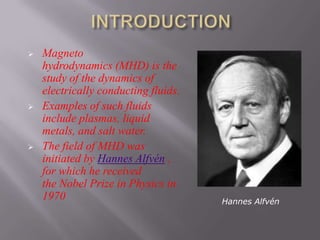
 The field of MHD was
initiated by Hannes Alfvén ,
for which he received
the Nobel Prize in Physics in
1970 Hannes Alfvén
 80 % in the world  hydal,
 20% in the world  nuclear, thermal, solar,
geothermal energy and from magneto hydro
dynamic (mhd) generator.
 MHD power generation has high efficiency and low
pollution.
 In advanced countries MHD generators are widely
used.
 In developing countries like INDIA, it is still under
construction, this construction work in in progress at
TRICHI in TAMIL NADU, under the joint efforts of
BARC and BHEL.
 Magneto hydro dynamics (MHD) is concerned with
 the flow of a conducting fluid
 in the presence of magnetic and electric field.
 An MHD generator is a device for converting
heat energy of a fuel directly into electrical
energy without conventional electric
generator.
 The thermal efficiency of an MHD converter
is increased by supplying
the heat at the highest practical temperature
rejecting it at the lowest practical
temperature.
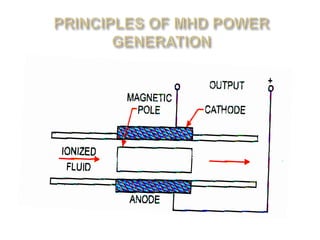
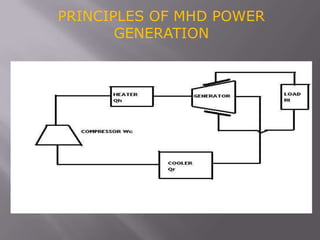
PRINCIPLES OF MHD POWER
GENERATION
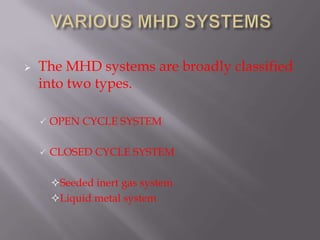
 The MHD systems are broadly classified
into two types.
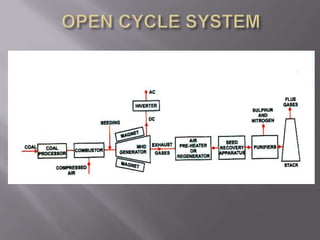
 OPEN CYCLE SYSTEM
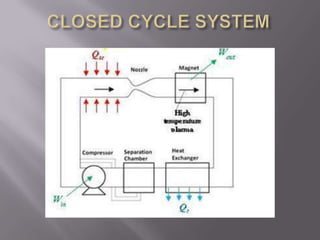
 CLOSED CYCLE SYSTEM
Seeded inert gas system
Liquid metal system
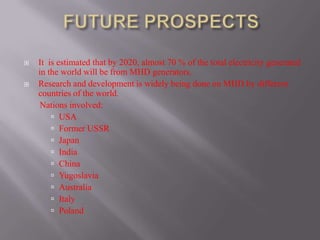
 It is estimated that by 2020, almost 70 % of the total electricity generated
in the world will be from MHD generators.
 Research and development is widely being done on MHD by different
countries of the world.
Nations involved:
 USA
 Former USSR
 Japan
 India
 China
 Yugoslavia
 Australia
 Italy
 Poland
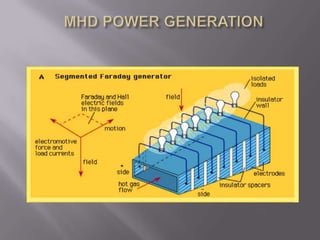
Magneto Hydro Dynamic Generator

Magneto Hydro Dynamic Generator

  • 1.
    Deivanayagam.H, Department of MechanicalEngineering, GCE, Tirunelveli.
  • 2.
     Magneto hydrodynamics (MHD)is the study of the dynamics of electrically conducting fluids.  Examples of such fluids include plasmas, liquid metals, and salt water.  The field of MHD was initiated by Hannes Alfvén , for which he received the Nobel Prize in Physics in 1970 Hannes Alfvén
  • 3.
     80 %in the world  hydal,  20% in the world  nuclear, thermal, solar, geothermal energy and from magneto hydro dynamic (mhd) generator.  MHD power generation has high efficiency and low pollution.  In advanced countries MHD generators are widely used.  In developing countries like INDIA, it is still under construction, this construction work in in progress at TRICHI in TAMIL NADU, under the joint efforts of BARC and BHEL.  Magneto hydro dynamics (MHD) is concerned with  the flow of a conducting fluid  in the presence of magnetic and electric field.
  • 4.
     An MHDgenerator is a device for converting heat energy of a fuel directly into electrical energy without conventional electric generator.  The thermal efficiency of an MHD converter is increased by supplying the heat at the highest practical temperature rejecting it at the lowest practical temperature.
  • 7.
    PRINCIPLES OF MHDPOWER GENERATION
  • 8.
     The MHDsystems are broadly classified into two types.  OPEN CYCLE SYSTEM  CLOSED CYCLE SYSTEM Seeded inert gas system Liquid metal system
  • 11.
     It isestimated that by 2020, almost 70 % of the total electricity generated in the world will be from MHD generators.  Research and development is widely being done on MHD by different countries of the world. Nations involved:  USA  Former USSR  Japan  India  China  Yugoslavia  Australia  Italy  Poland