This document discusses magneto hydrodynamics (MHD) generators. It begins with an introduction to MHD and the basic principle that a voltage is induced when a conductor and magnetic field move relative to each other. It then covers the history of MHD, the construction and working of MHD generators, their advantages of high efficiency and limitations of high costs. It describes open and closed cycle MHD systems and India's involvement with MHD generators through research institutions collaborating on a 5MW prototype plant.
PREFACE
INTRODUCTION TOMHD
PRINCIPLE
HISTORY
MHD GENERATOR
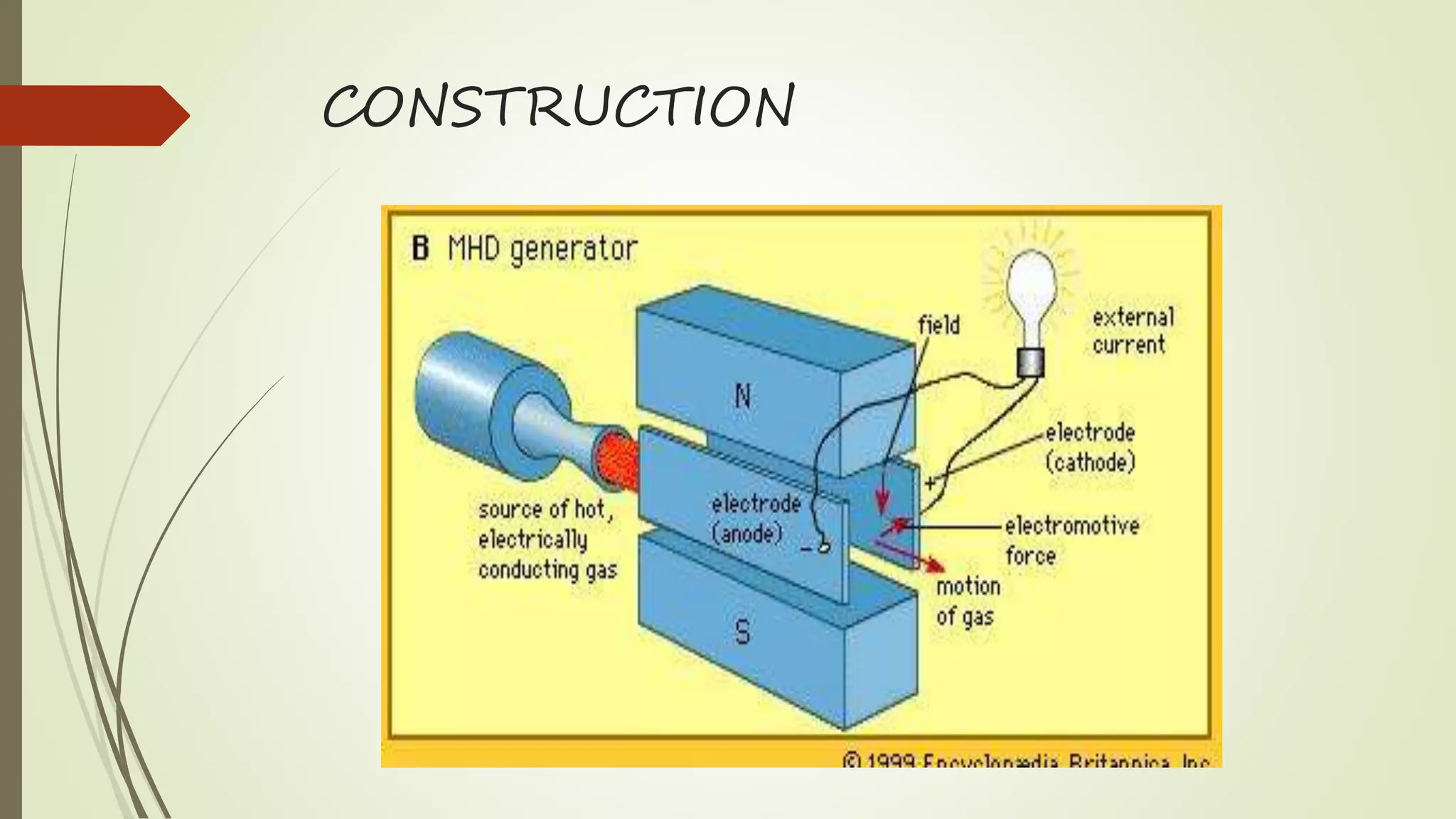
CONSTRUCTION
WORKING
CLASSIFICATION
ADVANTAGES
LIMITATIONS
INDIA & MHD
3.
What is MAGNETOHYDRODYNAMICS?
MagnetoHydrodynamics (MHD) is the
study of magnetic properties of electrically
conducting fluid.
The word Magneto Hydrodynamics is
derived from magneto-meaning Magnetic
field(B) ,hydro-meaning water , and
dynamics meaning movement.
4.
Principle
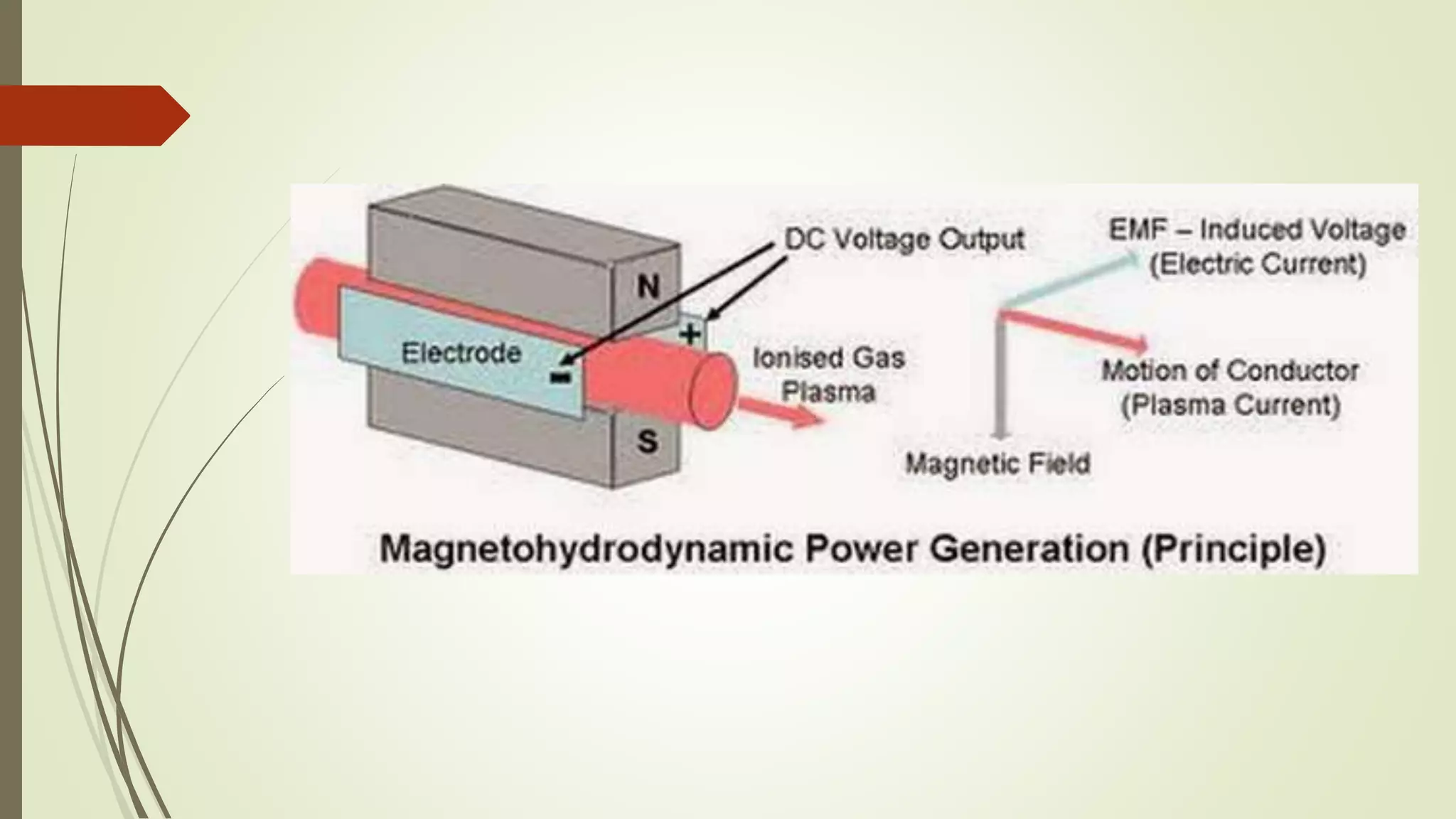
The principalof MHD is very simple and is based
on Faraday’s law of electromagnetic induction,
which states that when a conductor and a
magnetic field moves relative to each other, then
voltage is induced in the conductor, which results
in flow of current across the terminals.
6.
BEGINNING OF MHD
In 1832 , Michael Faraday carried out an experiment at the
Waterloo Bridge in Great Britain for measuring the current, from
the flow of the river Thames in earth's magnetic field , but he
failed to record that voltage due to the equipment of that time was
unable to read small current.
In 1851, Dr. William Hyde Wollaston was able to measure the
voltage induced by the tide in the English Channel.
The field of MHD was initiated by Hannes Alfvén , &for his work
on MHD he received the Nobel Prize in Physics in 1970.
7.
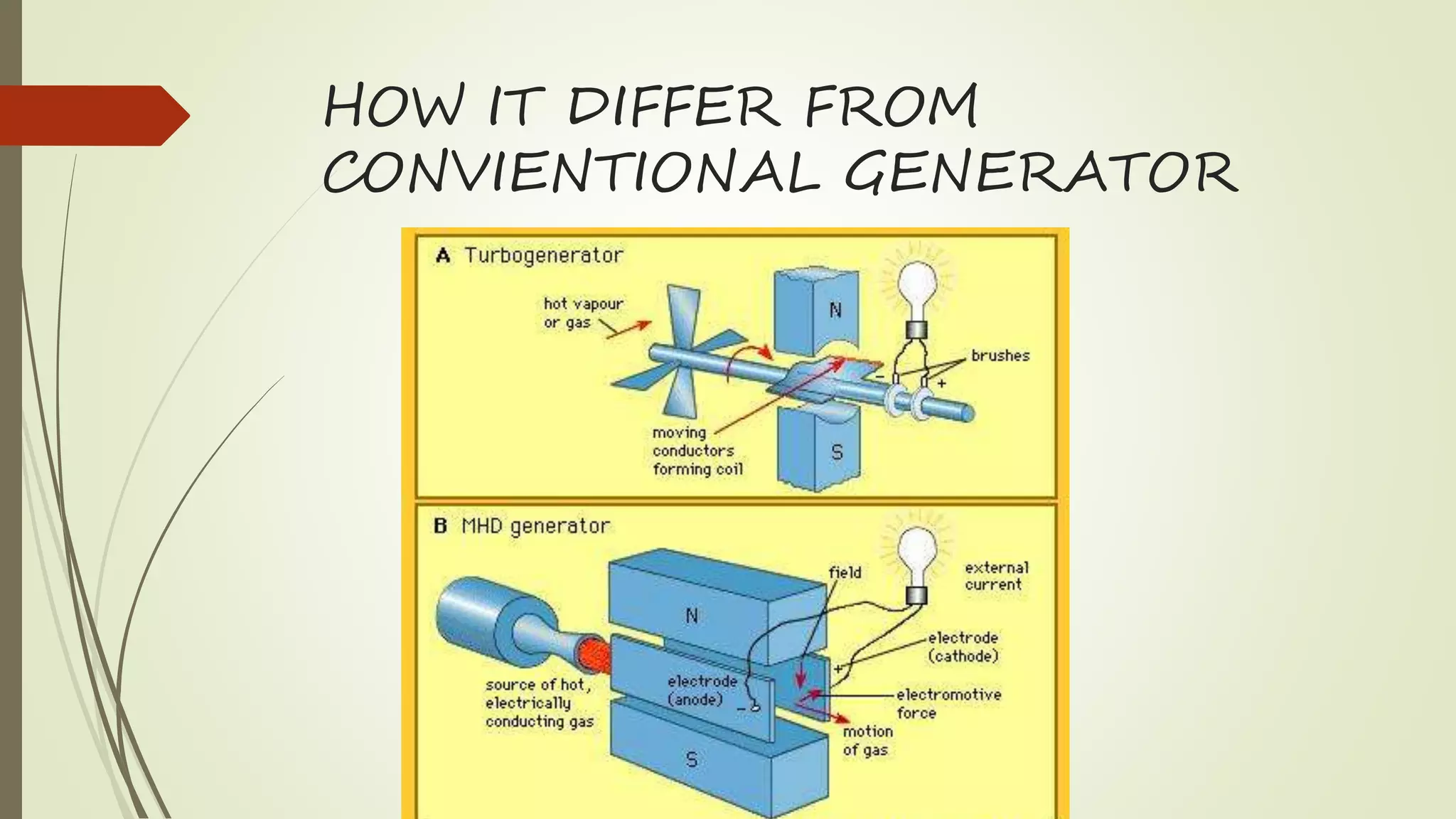
The MHD generationis a direct energy
conversion system which converts the heat
energy directly into electrical energy,
without any intermediate mechanical
energy conversion .
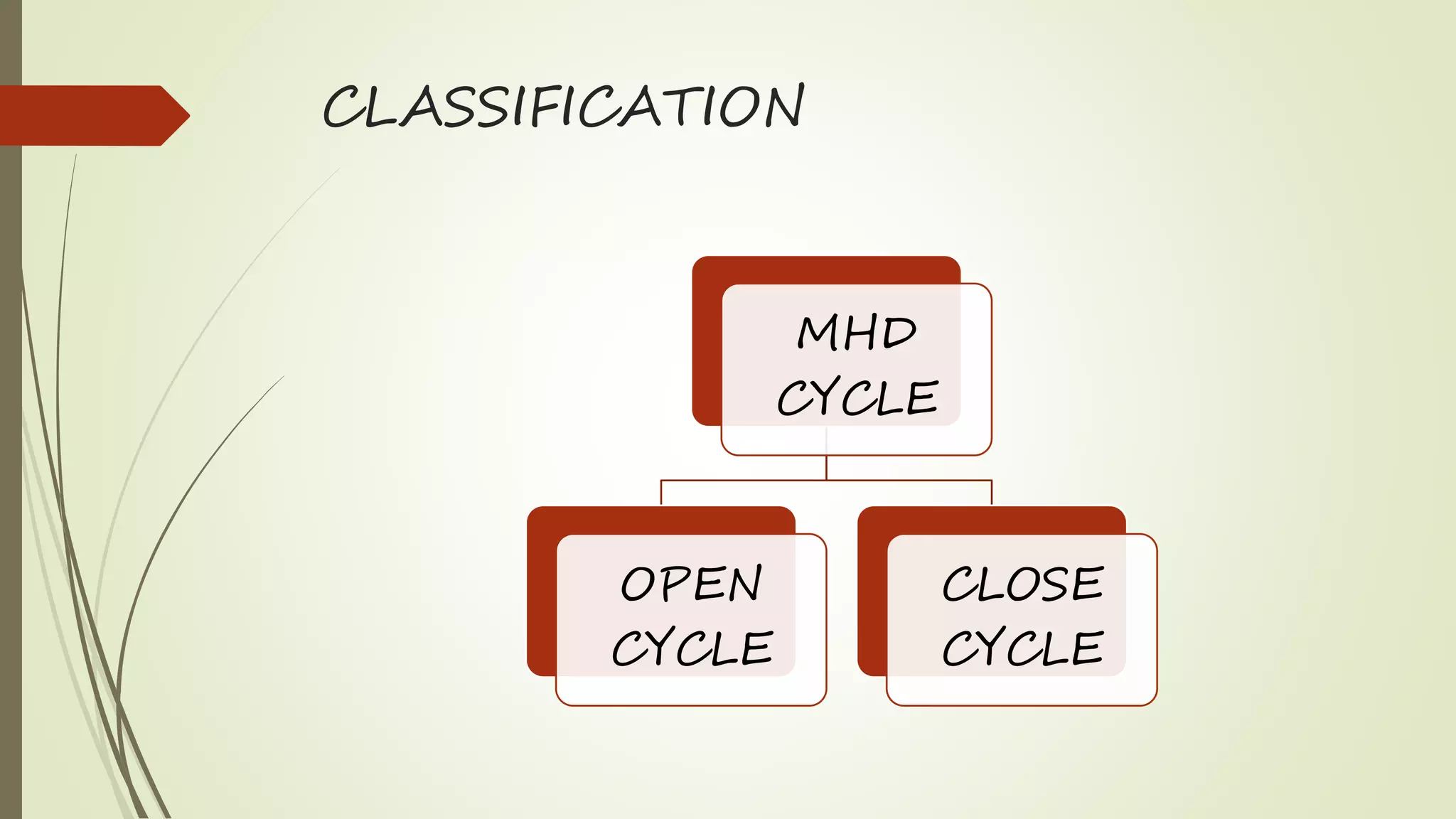
OPEN CYCLE
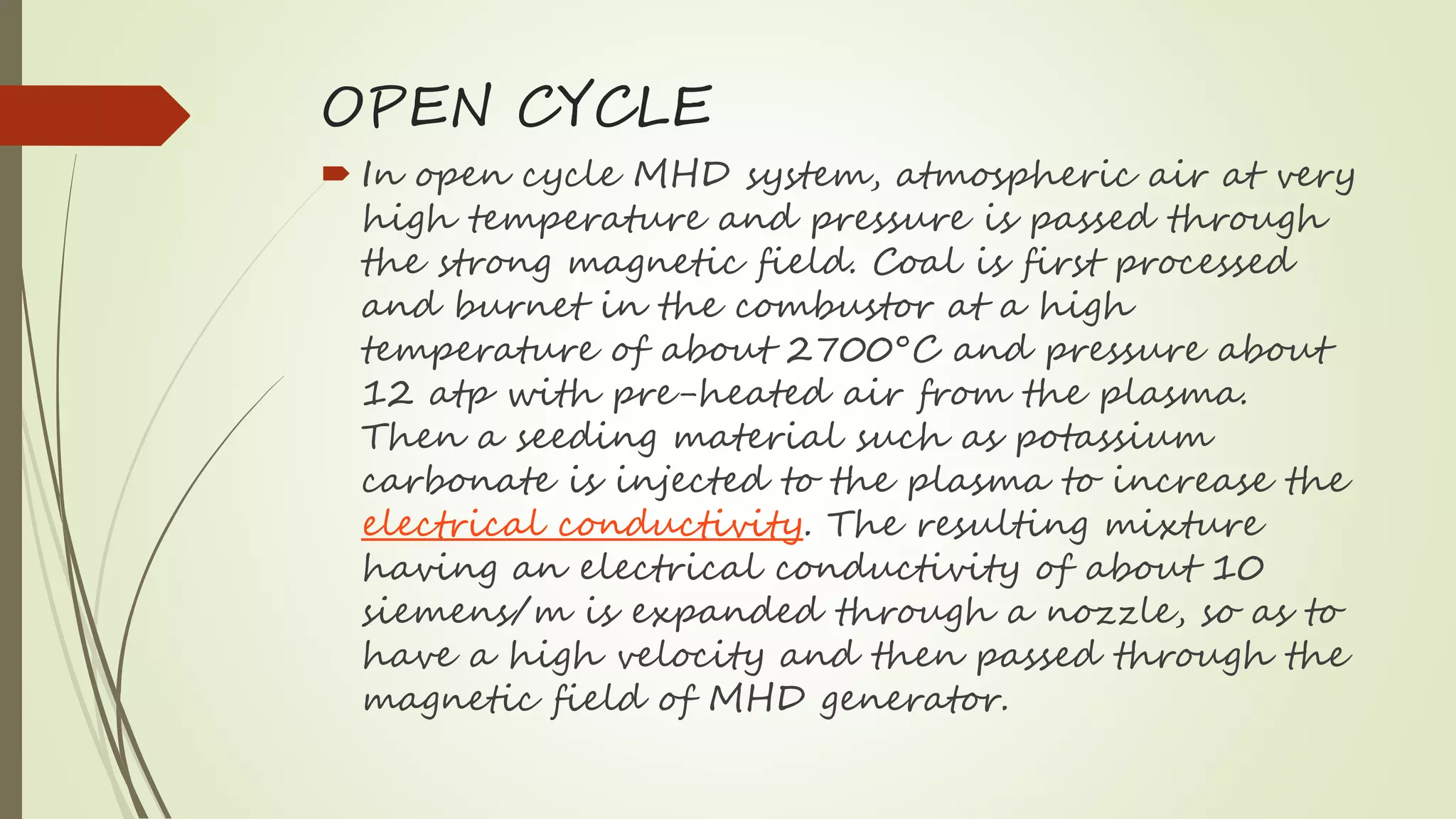
Inopen cycle MHD system, atmospheric air at very
high temperature and pressure is passed through
the strong magnetic field. Coal is first processed
and burnet in the combustor at a high
temperature of about 2700°C and pressure about
12 atp with pre-heated air from the plasma.
Then a seeding material such as potassium
carbonate is injected to the plasma to increase the
electrical conductivity. The resulting mixture
having an electrical conductivity of about 10
siemens/m is expanded through a nozzle, so as to
have a high velocity and then passed through the
magnetic field of MHD generator.
13.
CLOSE CYCLE
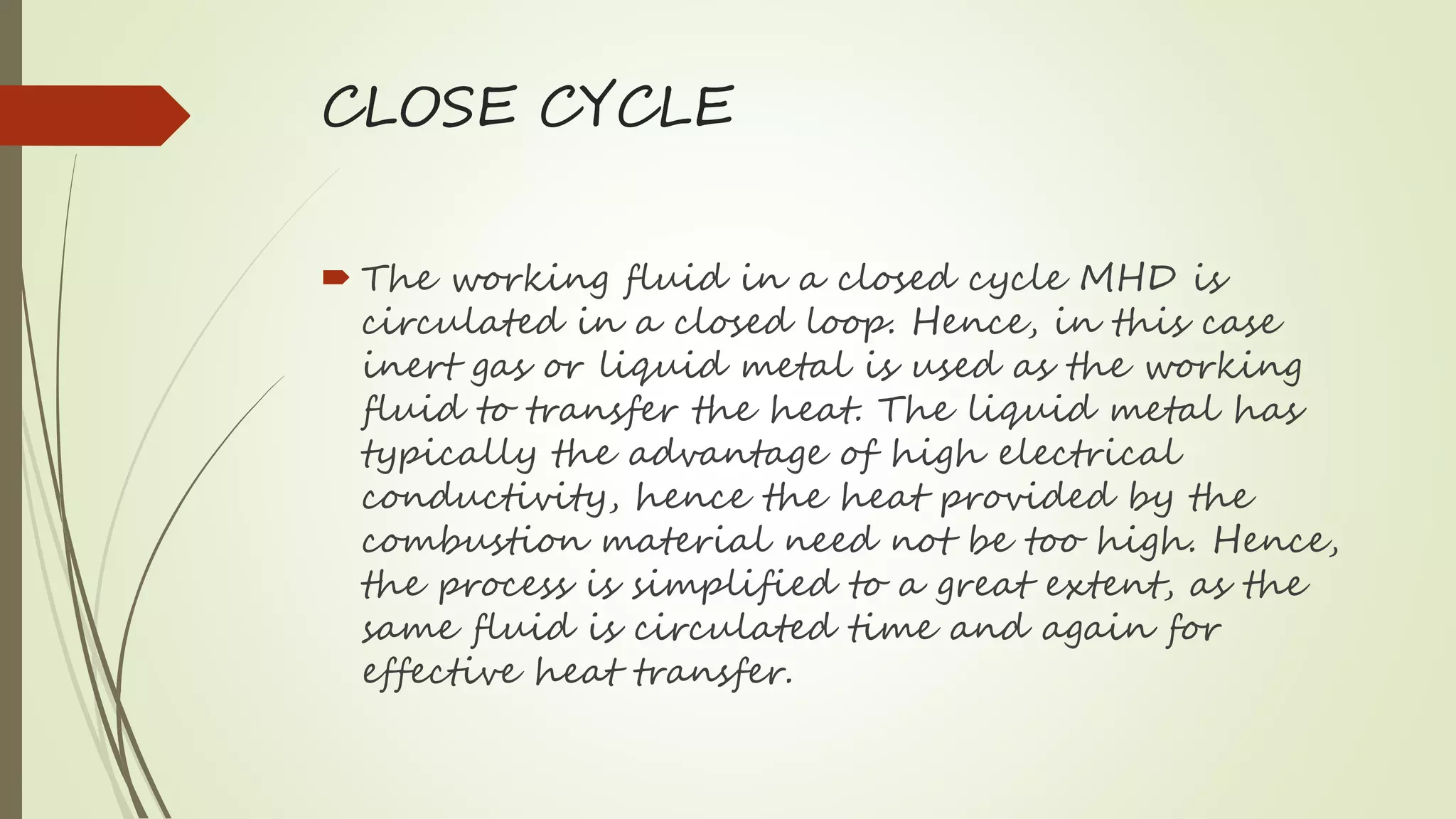
Theworking fluid in a closed cycle MHD is
circulated in a closed loop. Hence, in this case
inert gas or liquid metal is used as the working
fluid to transfer the heat. The liquid metal has
typically the advantage of high electrical
conductivity, hence the heat provided by the
combustion material need not be too high. Hence,
the process is simplified to a great extent, as the
same fluid is circulated time and again for
effective heat transfer.
14.
ADVANTAGES
There isno working mechanical element.
Frictionless process.
Increased efficiency to 50-60%.
No air pollution.
Can be easily operated from different fluids.
MHD has very high efficiency, which is higher than most of the
other conventional or non-conventional method of generation.
Economical
No fundamental technical problems reported till now.
Safe for environment .
15.
LIMITATIONS
Initial costis high.
Requires highly skilled labour.
Complicated then conventional source.
Requires large size magnets which is a setback of this concept.
High operating temperature.
Short circuit may occur.
16.
INDIA &MHD
BARCin collaboration of BHEL ,with technical consultation by High Temperature
Institute MOSCOW.
First phase of INDIAN MHD generator is at Tiruchirapalli ,with 5MW Thermal plant
using Blue water gas as working fluid.
First phase was operational by April 1981.
Second phase was with 15MW of Thermal input.