Gandhinagar Institute
of Technology
Renewable Energy Engineering (2181910)
Active Learning Assignment
MHD Power Generation
Mechanical 8-A1
Prepared By:
Nitin Rathod (140120119187)
Guided By :
Prof. Mrugesh Khatri
Introduction
• Magneto hydrodynamics (MHD)(magneto fluid
dynamics) is the academic discipline which studies the
dynamics of electrically conducting fluids.
• Examples of such fluids include plasmas, liquid metals,
and salt water.
• As its name implies, magneto hydro dynamics (MHD) is
concerned with the flow of a conducting fluid in the
presence of magnetic and electric field.
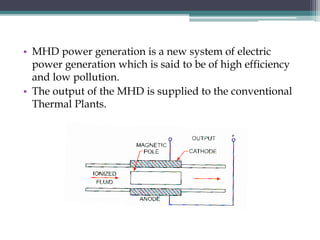
• An MHD generator is a device for converting heat
energy of a fuel directly into electrical energy without
conventional electric generator.
• MHD power generation is a new system of electric
power generation which is said to be of high efficiency
and low pollution.
• The output of the MHD is supplied to the conventional
Thermal Plants.
Principle
• The principle of MHD generation is same as the
principle of conventional electrical generator(Faraday’s
law).
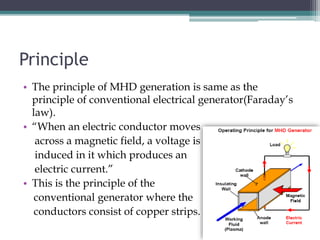
• “When an electric conductor moves
across a magnetic field, a voltage is
induced in it which produces an
electric current.”
• This is the principle of the
conventional generator where the
conductors consist of copper strips.
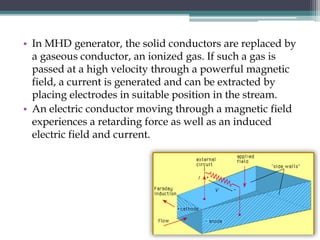
• In MHD generator, the solid conductors are replaced by
a gaseous conductor, an ionized gas. If such a gas is
passed at a high velocity through a powerful magnetic
field, a current is generated and can be extracted by
placing electrodes in suitable position in the stream.
• An electric conductor moving through a magnetic field
experiences a retarding force as well as an induced
electric field and current.
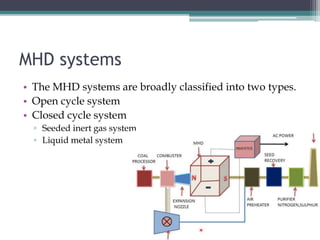
MHD systems
• The MHD systems are broadly classified into two types.
• Open cycle system
• Closed cycle system
▫ Seeded inert gas system
▫ Liquid metal system
Advantages
• Highly efficient.
• No moving part, hence more reliable.
• The closed cycle system produces power, free of
pollution.
• It has ability to reach the full power level as soon as
started.
• All kind of heat sources can be used.
• Operational & maintenance costs are low. Thus, the cost
of power generation per unit is less.
Disadvantages
• MHD equipments have shorter life due to high
temperature stresses.
• High fluid friction losses and heat transfer losses.
• Very high operating temperature.
• Technical limitation on enhancing the fluid conductivity
and strength of magnetic field.
140120119187 2181910

140120119187 2181910

  • 1.
    Gandhinagar Institute of Technology RenewableEnergy Engineering (2181910) Active Learning Assignment MHD Power Generation Mechanical 8-A1 Prepared By: Nitin Rathod (140120119187) Guided By : Prof. Mrugesh Khatri
  • 2.
    Introduction • Magneto hydrodynamics(MHD)(magneto fluid dynamics) is the academic discipline which studies the dynamics of electrically conducting fluids. • Examples of such fluids include plasmas, liquid metals, and salt water. • As its name implies, magneto hydro dynamics (MHD) is concerned with the flow of a conducting fluid in the presence of magnetic and electric field. • An MHD generator is a device for converting heat energy of a fuel directly into electrical energy without conventional electric generator.
  • 3.
    • MHD powergeneration is a new system of electric power generation which is said to be of high efficiency and low pollution. • The output of the MHD is supplied to the conventional Thermal Plants.
  • 4.
    Principle • The principleof MHD generation is same as the principle of conventional electrical generator(Faraday’s law). • “When an electric conductor moves across a magnetic field, a voltage is induced in it which produces an electric current.” • This is the principle of the conventional generator where the conductors consist of copper strips.
  • 5.
    • In MHDgenerator, the solid conductors are replaced by a gaseous conductor, an ionized gas. If such a gas is passed at a high velocity through a powerful magnetic field, a current is generated and can be extracted by placing electrodes in suitable position in the stream. • An electric conductor moving through a magnetic field experiences a retarding force as well as an induced electric field and current.
  • 6.
    MHD systems • TheMHD systems are broadly classified into two types. • Open cycle system • Closed cycle system ▫ Seeded inert gas system ▫ Liquid metal system
  • 7.
    Advantages • Highly efficient. •No moving part, hence more reliable. • The closed cycle system produces power, free of pollution. • It has ability to reach the full power level as soon as started. • All kind of heat sources can be used. • Operational & maintenance costs are low. Thus, the cost of power generation per unit is less.
  • 8.
    Disadvantages • MHD equipmentshave shorter life due to high temperature stresses. • High fluid friction losses and heat transfer losses. • Very high operating temperature. • Technical limitation on enhancing the fluid conductivity and strength of magnetic field.