Topic:-MAGNETO HYDRO DYNAMIC POWER GENERATION (MHD )
Presented by : Muzamil Yousf Mir
Roll no. : 01-ERE-2013
Department Of Electrical Engineering
SOET,BGSBU(Rajouri)
BABA GHULAM SHAH BADSHAH UNIVERSITY
10
Contents
INTRODUCTION
PRINCIPLE OF OPERATION
TYPES OF MHD SYSTEM
ADVANTAGES
DISADVANTAGES
FUTURE PROSPECTS
CONCLUSION
REFRENCES
Department of Electrical Engineering
2
Introduction
The concept of MHD power generation was introduced for the
very first time by Michael Faraday in the year 1832
The field of MHD power generation was initiated by Hannes
Alfvén , in 1970.
MHD power generation is a new system of electric power
generation which is said to be of high efficiency and low pollution.
Department of Electrical Engineering
3
Introduction(con.)
80 % of total electricity produced in the world is hydel, while
remaining 20% is produced from nuclear, thermal, solar,
geothermal energy and from magneto hydro dynamic (MHD)
generator.
MHD ( magneto hydrodynamic) power generation is a direct
energy conversion system which converts the heat energy directly
into electrical energy, without any intermediate mechanical
energy conversion, as opposed to the case in all other power
generating plants
Department of Electrical Engineering
4
Principle of MHD Generation
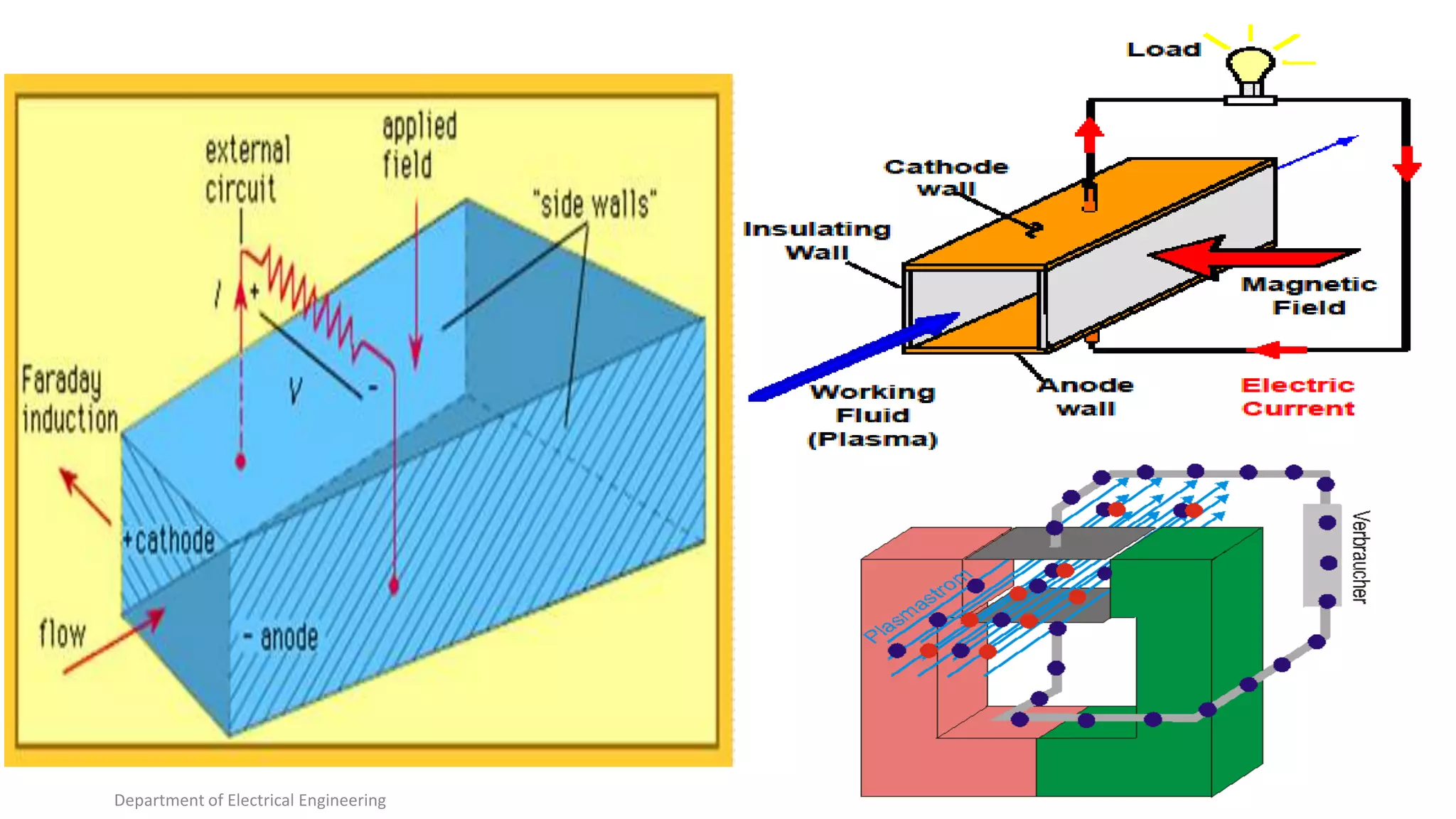
The principal of MHD power generation is very simple and is
based on Faraday’s law of electromagnetic induction , which
states that when a conductor and a magnetic field moves
relative to each other, then voltage is induced in the
conductor, which results in flow of current across the
terminals.
Department of Electrical Engineering
5
Principle
 In conventional generators, the conductors are copper
windings or strips, while in case of MHD generator, the
solid conductors are replaced by a gaseous conductor, an
ionized gas. If such a gas is passed at a high velocity
through a powerful magnetic field, a current is generated
and can be extracted by placing electrodes in suitable
position in the stream.
Department of Electrical Engineering
6
Department of Electrical Engineering
7
Power Generated
The power generated per unit length by MHD generator is
approximately given by, Where u is the fluid velocity,
B is the magnetic flux density, σ is the electrical conductivity
of conducting fluid and P is the density of fluid.
 For the higher power density of an MHD generator there
must be a strong magnetic field of 4-5 tesla and high flow
velocity of conducting fluid besides adequate conductivity.
Department of Electrical Engineering
8
Types of MHD Systems
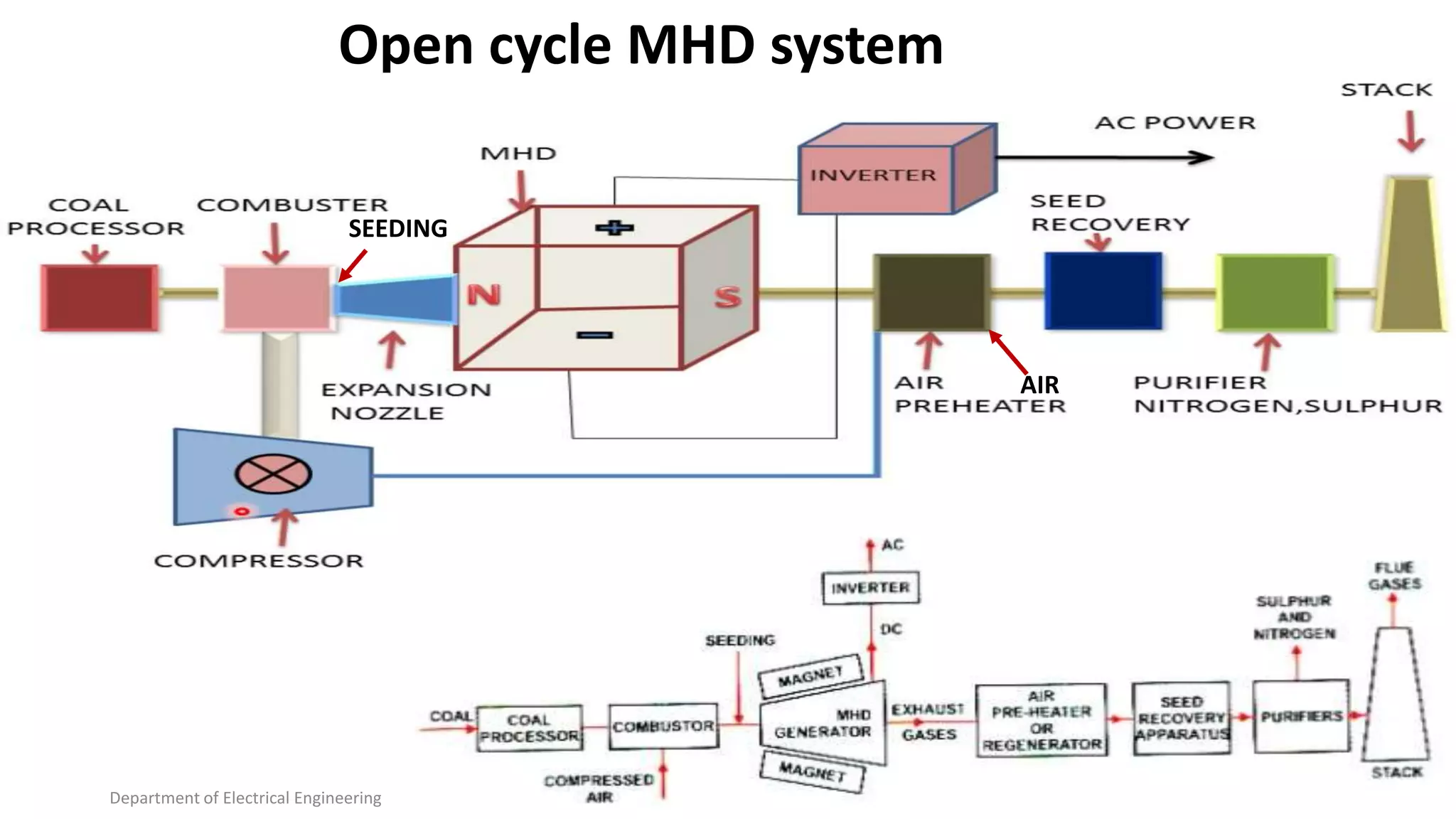
Open cycle MHD System
 Closed cycle MHD System
Department of Electrical Engineering
9
Seeding
AIR
Department of Electrical Engineering
10
Open cycle MHD system
SEEDING
AIR
Closed Cycle MHD System
As the name suggests the working fluid in a closed cycle MHD
is circulated in a closed loop. Hence, in this case inert
gas(helium or argon) is used as the working fluid to transfer
the heat. The liquid metal has typically the advantage of high
electrical conductivity, hence the heat provided by the
combustion material need not be too high. There is no inlet
and outlet for the atmospheric air. Hence the process is
simplified to a great extent, as the same fluid is circulated
again and again for effective heat transfer.
Department of Electrical Engineering
11
Closed Cycle MHD System
Department of Electrical Engineering
12
ARGON
Department of Electrical Engineering
13
Advantages
Overall efficiency is about 50%.
Less overall generation cost.
Less fuel consumption.
Large amount of pollution free power is generated.
It has no moving parts, so more reliable and no mechanical
losses.
Closed cycle system produces power, free of pollution.
It has ability to reach the full power level as soon as started.
Size of plant is small compared to other fossil fuel plants.
Department of Electrical Engineering
14
Disadvantages
 Suffers from reverse flow (short circuits) of electrons.
 It needs very large magnets and this is a major expense.
 High friction and heat transfer losses.
 High operating temperature.
 Coal used as fuel, produces molten ash which may short
circuit the electrodes. Hence, oil or natural gas are much
better fuels for MHDs. Restriction on use of fuel makes the
operation more expensive.
Department of Electrical Engineering
15
Future Prospects
It is estimated that in 2025, almost 70 % of the total
electricity generated in the world will be from MHD
generators.
Research and development is widely being done on MHD by
different countries of the world.
Nations involved:
USA
Japan
India
China
Australia
ItalyDepartment of Electrical Engineering
16
Conclusion
MHD power generation is a direct energy conversion system,
which converts the heat energy directly into electrical energy
by this generation technique large amount of power is
generated without pollution.
 This power resource play a minor role presently and its use
on a vast scale is yet to be confirmed as it is in its childhood
stage.
The magneto hydro dynamic power generation is one of the
examples of a new unique method of generation of electricity.
Department of Electrical Engineering
17
References
 Faraday, M. (1832). "Experimental Researches in Electricity." First Series, Philosophical Transactions of the Royal
Society, pp. 125–162.
 Sutton, George W., and Sherman, Arthur (1965) Engineering Magnetohydrodynamics, McGraw-Hill Book Company, New
York, OCLC 537669
 Popa, C. and Sritharan, S. S. (2003) "Fluid-magnetic splitting methods for magneto-hydrodynamics" Mathematical Methods
and Models in Applied Sciences 13(6): pp. 893–917.
 Roberts, Paul H. (1967) An Introduction to Magnetohydrodynamics Longmans Green, London, OCLC 489632043
 Rosa, Richard J. (1987) Magnetohydrodynamic Energy Conversion (2nd edition) Hemisphere Publishing, Washington,
D.C., ISBN 0-89116-690-4
Department of Electrical Engineering
18
Department of Electrical Engineering 19
Department of Electrical Engineering 20
ANY QUERY?

Magneto hydro dynamic power generation system(mhd)

  • 1.
    Topic:-MAGNETO HYDRO DYNAMICPOWER GENERATION (MHD ) Presented by : Muzamil Yousf Mir Roll no. : 01-ERE-2013 Department Of Electrical Engineering SOET,BGSBU(Rajouri) BABA GHULAM SHAH BADSHAH UNIVERSITY 10
  • 2.
    Contents INTRODUCTION PRINCIPLE OF OPERATION TYPESOF MHD SYSTEM ADVANTAGES DISADVANTAGES FUTURE PROSPECTS CONCLUSION REFRENCES Department of Electrical Engineering 2
  • 3.
    Introduction The concept ofMHD power generation was introduced for the very first time by Michael Faraday in the year 1832 The field of MHD power generation was initiated by Hannes Alfvén , in 1970. MHD power generation is a new system of electric power generation which is said to be of high efficiency and low pollution. Department of Electrical Engineering 3
  • 4.
    Introduction(con.) 80 % oftotal electricity produced in the world is hydel, while remaining 20% is produced from nuclear, thermal, solar, geothermal energy and from magneto hydro dynamic (MHD) generator. MHD ( magneto hydrodynamic) power generation is a direct energy conversion system which converts the heat energy directly into electrical energy, without any intermediate mechanical energy conversion, as opposed to the case in all other power generating plants Department of Electrical Engineering 4
  • 5.
    Principle of MHDGeneration The principal of MHD power generation is very simple and is based on Faraday’s law of electromagnetic induction , which states that when a conductor and a magnetic field moves relative to each other, then voltage is induced in the conductor, which results in flow of current across the terminals. Department of Electrical Engineering 5
  • 6.
    Principle  In conventionalgenerators, the conductors are copper windings or strips, while in case of MHD generator, the solid conductors are replaced by a gaseous conductor, an ionized gas. If such a gas is passed at a high velocity through a powerful magnetic field, a current is generated and can be extracted by placing electrodes in suitable position in the stream. Department of Electrical Engineering 6
  • 7.
  • 8.
    Power Generated The powergenerated per unit length by MHD generator is approximately given by, Where u is the fluid velocity, B is the magnetic flux density, σ is the electrical conductivity of conducting fluid and P is the density of fluid.  For the higher power density of an MHD generator there must be a strong magnetic field of 4-5 tesla and high flow velocity of conducting fluid besides adequate conductivity. Department of Electrical Engineering 8
  • 9.
    Types of MHDSystems Open cycle MHD System  Closed cycle MHD System Department of Electrical Engineering 9
  • 10.
    Seeding AIR Department of ElectricalEngineering 10 Open cycle MHD system SEEDING AIR
  • 11.
    Closed Cycle MHDSystem As the name suggests the working fluid in a closed cycle MHD is circulated in a closed loop. Hence, in this case inert gas(helium or argon) is used as the working fluid to transfer the heat. The liquid metal has typically the advantage of high electrical conductivity, hence the heat provided by the combustion material need not be too high. There is no inlet and outlet for the atmospheric air. Hence the process is simplified to a great extent, as the same fluid is circulated again and again for effective heat transfer. Department of Electrical Engineering 11
  • 12.
    Closed Cycle MHDSystem Department of Electrical Engineering 12
  • 13.
  • 14.
    Advantages Overall efficiency isabout 50%. Less overall generation cost. Less fuel consumption. Large amount of pollution free power is generated. It has no moving parts, so more reliable and no mechanical losses. Closed cycle system produces power, free of pollution. It has ability to reach the full power level as soon as started. Size of plant is small compared to other fossil fuel plants. Department of Electrical Engineering 14
  • 15.
    Disadvantages  Suffers fromreverse flow (short circuits) of electrons.  It needs very large magnets and this is a major expense.  High friction and heat transfer losses.  High operating temperature.  Coal used as fuel, produces molten ash which may short circuit the electrodes. Hence, oil or natural gas are much better fuels for MHDs. Restriction on use of fuel makes the operation more expensive. Department of Electrical Engineering 15
  • 16.
    Future Prospects It isestimated that in 2025, almost 70 % of the total electricity generated in the world will be from MHD generators. Research and development is widely being done on MHD by different countries of the world. Nations involved: USA Japan India China Australia ItalyDepartment of Electrical Engineering 16
  • 17.
    Conclusion MHD power generationis a direct energy conversion system, which converts the heat energy directly into electrical energy by this generation technique large amount of power is generated without pollution.  This power resource play a minor role presently and its use on a vast scale is yet to be confirmed as it is in its childhood stage. The magneto hydro dynamic power generation is one of the examples of a new unique method of generation of electricity. Department of Electrical Engineering 17
  • 18.
    References  Faraday, M.(1832). "Experimental Researches in Electricity." First Series, Philosophical Transactions of the Royal Society, pp. 125–162.  Sutton, George W., and Sherman, Arthur (1965) Engineering Magnetohydrodynamics, McGraw-Hill Book Company, New York, OCLC 537669  Popa, C. and Sritharan, S. S. (2003) "Fluid-magnetic splitting methods for magneto-hydrodynamics" Mathematical Methods and Models in Applied Sciences 13(6): pp. 893–917.  Roberts, Paul H. (1967) An Introduction to Magnetohydrodynamics Longmans Green, London, OCLC 489632043  Rosa, Richard J. (1987) Magnetohydrodynamic Energy Conversion (2nd edition) Hemisphere Publishing, Washington, D.C., ISBN 0-89116-690-4 Department of Electrical Engineering 18
  • 19.
  • 20.
    Department of ElectricalEngineering 20 ANY QUERY?