Magneto optic and Acousto optic effect
Unit-IV
Prepared by
S.Vijayakumar, AP/ECE
Ramco Institute of Technology
Academic year
(2017-2018 odd sem)
MAGNETO-OPTIC DEVICES
• The presence of magnetic field may also affect
the optical properties of some substances
thereby giving rise to a number of useful
devices
FARADAY EFFECT
• It concerns the change in refractive index of a
material s
• when a beam of plane polarized light passes
through a substance subjected to a magnetic
field, its plane of polarization is observed to
rotate by an amount proportional to the
magnetic field component parallel to the
direction of propagation. subjected to a
steady magnetic field
• The rotation of the plane of polarization is
given by
• 𝜃 = 𝑉𝑉𝑉 −−−− −(1)
• We can also express interms of refractive
indices 𝑛 𝑟 and 𝑛𝑙, that is
• 𝜃 =
𝜋
𝜆0
(𝑛 𝑟 − 𝑛𝑙)𝐿
• A Faraday rotator used in conjunction with a
pair of polarizers acts as an optical isolator
which allows a light beam to travel through it
in one direction but not in the opposite one
• The construction of a typical isolator is shown
in below figure.
Application
• One potential application of magneto-optics
currently receiving attention is large capacity
computer memories. Such memories must be
capable of storing very large amounts of
information in a relatively small area and
permit very rapid readout and preferably,
random access
• Writing may be achieved by heating the
memory elements on the storage medium to a
temperature above the Curie point using a
laser beam.
• The element is allowed to cool down in the
presence of an external magnetic field thereby
acquiring a magnetization in a given direction.
• Magnetizations of the elements in one
direction may represent ‘ones’, in the opposite
direction ‘zeros’.
• To read the information the irradiance of the
laser beam is reduced and then directed to
the memory elements.
• The direction of the change in the
polarization of the laser beam on passing
through or being reflected from the memory
elements depends on the directions of
magnetization; therefore we can decide if a
given element is storing a ‘one’ or ‘zero’.
ACOUSTO-OPTIC EFFECT
• The acousto-optic effect is the change in
refractive index of a medium caused by the
mechanical strains accompanying the passage
of surface acoustic (strain) wave along the
medium.
• The refractive index varies periodically with a
wavelength λ equal to that of the acoustic
wave.
• the acoustic wave sets up a diffraction grating
within the medium so that optical energy is
diffracted out of the incident beam into the
various orders.
• There are two main cases (a) The Raman-Nath
regime and (b) the Bragg regime.
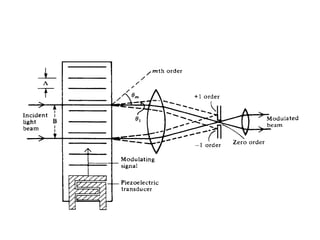
• In the Raman-Nath regime the acousting
diffraction grating is so thin.
• The light is diffracted from a simple plane
grating such that
• 𝑚𝑚 = ∆𝑠𝑠𝑠𝜃 𝑚 −−−− −(1)
• Where m=0,±1, ±2, … .is the order and 𝜃 𝑚 is
the corresponding angle of diffraction, as
illustrated in below figure
• The fraction of light removed from the zero-
order beam is
• 𝜂 = 𝐼0 − 𝐼 𝐼0⁄
• Where I0 is the transmitted irradiance in the
absence of the acoustic wave.
Bragg regime a ‘thick’ diffraction
grating.
• constructive interference occurs. The
conditions to be satisfied are:
• Light scattered from a given grating plane
must arrive in phase at the new wavefront and
• Light scattered from successive grating planes
must also arrive in phase at the new
wavefront, imlying that the path difference
must be an integral number of wavelengths.
• he first of these condition is satisfied when
𝜃 𝑑 = 𝜃𝑖, where 𝜃 𝑑 is the angle of diffraction.
The second condition requires that
• 𝑠𝑠𝑠𝜃𝑖 + 𝑠𝑠𝑠𝜃 𝑑 = 𝑚𝑚 ∆⁄
• With m=0,1,2…. The two conditions nare
simultaneously fulfilled when
• 𝑠𝑠𝑠𝜃𝑖 = 𝑠𝑠𝑠𝜃 𝑑 = 𝑚𝑚 2∆⁄ −− −(2)
• scattering only takes place when m=1. This is
shown in above figure. The equation called Bragg
angle θB becomes
• 𝑠𝑠𝑠𝜃 𝐵 = 𝜆 2∆⁄ −−− −(3)
• At the Bragg angle, η is given by
• η = sin2
φ 2⁄ −−− −(4)
• Where 𝜑 = 2𝜋 𝜆⁄ (∆𝑛𝑛 𝑐𝑐𝑐𝜃 𝐵⁄ ), in which ∆𝑛 is
the amplitude of the refractive index fluctuation,
L the length of the modulator

Magneto optic devices

  • 1.
    Magneto optic andAcousto optic effect Unit-IV Prepared by S.Vijayakumar, AP/ECE Ramco Institute of Technology Academic year (2017-2018 odd sem)
  • 2.
    MAGNETO-OPTIC DEVICES • Thepresence of magnetic field may also affect the optical properties of some substances thereby giving rise to a number of useful devices
  • 3.
    FARADAY EFFECT • Itconcerns the change in refractive index of a material s • when a beam of plane polarized light passes through a substance subjected to a magnetic field, its plane of polarization is observed to rotate by an amount proportional to the magnetic field component parallel to the direction of propagation. subjected to a steady magnetic field
  • 4.
    • The rotationof the plane of polarization is given by • 𝜃 = 𝑉𝑉𝑉 −−−− −(1) • We can also express interms of refractive indices 𝑛 𝑟 and 𝑛𝑙, that is • 𝜃 = 𝜋 𝜆0 (𝑛 𝑟 − 𝑛𝑙)𝐿
  • 5.
    • A Faradayrotator used in conjunction with a pair of polarizers acts as an optical isolator which allows a light beam to travel through it in one direction but not in the opposite one
  • 6.
    • The constructionof a typical isolator is shown in below figure.
  • 7.
    Application • One potentialapplication of magneto-optics currently receiving attention is large capacity computer memories. Such memories must be capable of storing very large amounts of information in a relatively small area and permit very rapid readout and preferably, random access
  • 8.
    • Writing maybe achieved by heating the memory elements on the storage medium to a temperature above the Curie point using a laser beam. • The element is allowed to cool down in the presence of an external magnetic field thereby acquiring a magnetization in a given direction.
  • 9.
    • Magnetizations ofthe elements in one direction may represent ‘ones’, in the opposite direction ‘zeros’.
  • 10.
    • To readthe information the irradiance of the laser beam is reduced and then directed to the memory elements. • The direction of the change in the polarization of the laser beam on passing through or being reflected from the memory elements depends on the directions of magnetization; therefore we can decide if a given element is storing a ‘one’ or ‘zero’.
  • 11.
    ACOUSTO-OPTIC EFFECT • Theacousto-optic effect is the change in refractive index of a medium caused by the mechanical strains accompanying the passage of surface acoustic (strain) wave along the medium. • The refractive index varies periodically with a wavelength λ equal to that of the acoustic wave.
  • 13.
    • the acousticwave sets up a diffraction grating within the medium so that optical energy is diffracted out of the incident beam into the various orders. • There are two main cases (a) The Raman-Nath regime and (b) the Bragg regime.
  • 14.
    • In theRaman-Nath regime the acousting diffraction grating is so thin. • The light is diffracted from a simple plane grating such that • 𝑚𝑚 = ∆𝑠𝑠𝑠𝜃 𝑚 −−−− −(1) • Where m=0,±1, ±2, … .is the order and 𝜃 𝑚 is the corresponding angle of diffraction, as illustrated in below figure
  • 16.
    • The fractionof light removed from the zero- order beam is • 𝜂 = 𝐼0 − 𝐼 𝐼0⁄ • Where I0 is the transmitted irradiance in the absence of the acoustic wave.
  • 17.
    Bragg regime a‘thick’ diffraction grating.
  • 18.
    • constructive interferenceoccurs. The conditions to be satisfied are: • Light scattered from a given grating plane must arrive in phase at the new wavefront and • Light scattered from successive grating planes must also arrive in phase at the new wavefront, imlying that the path difference must be an integral number of wavelengths.
  • 19.
    • he firstof these condition is satisfied when 𝜃 𝑑 = 𝜃𝑖, where 𝜃 𝑑 is the angle of diffraction. The second condition requires that • 𝑠𝑠𝑠𝜃𝑖 + 𝑠𝑠𝑠𝜃 𝑑 = 𝑚𝑚 ∆⁄ • With m=0,1,2…. The two conditions nare simultaneously fulfilled when • 𝑠𝑠𝑠𝜃𝑖 = 𝑠𝑠𝑠𝜃 𝑑 = 𝑚𝑚 2∆⁄ −− −(2)
  • 20.
    • scattering onlytakes place when m=1. This is shown in above figure. The equation called Bragg angle θB becomes • 𝑠𝑠𝑠𝜃 𝐵 = 𝜆 2∆⁄ −−− −(3) • At the Bragg angle, η is given by • η = sin2 φ 2⁄ −−− −(4) • Where 𝜑 = 2𝜋 𝜆⁄ (∆𝑛𝑛 𝑐𝑐𝑐𝜃 𝐵⁄ ), in which ∆𝑛 is the amplitude of the refractive index fluctuation, L the length of the modulator