Up-Conversion and Down-
Conversion in Solar Cells
AJIT MEENA
V21113
MSc physics
Special thanks
Project instructor
Dr. Ranbir Singh
PH-614 SEMINAR AND REPORT
INDIAN INSTITUTE OF TECHNOLOGY, MANDI HIMACHAL( 175005)
Content
1. Introduction
1.1 solar cells
1.2 Up-conversion( UC) and Down-conversion ( DC )
2. Up- conversion (UC) in solar cells
2.1 working mechanism
3. Down-conversion (DC) in solar cells
3.1 working mechanism
4. Solar spectral conversion in solar cell
5. Material choice for UC and DC
6. Efficiency improvement using UC and DC in solar cells
7. Other importance of UC and DC in solar cell
1. Introduction
Solar cell- Electronic device that converts the light energy directly into electricity by photovoltaic
effect.
 Cost and efficiency are related in solar cell
like: Cost/Watt
 Si –single junction solar cell- costly
Why up conversion and down
conversion in solar cell ?
1. Reducing thermalization loss via down conversion.
2. Decreasing transmission loss ( up conversion )
Fig. 1 Solar spectrum with energy losses in solar
cell
Watt Cost
[solar spectrum conversion for photovoltaics using
nanoparticles { fig .3}]
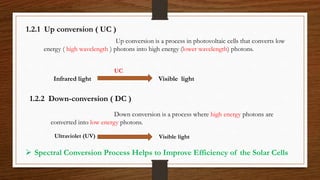
1.2.1 Up conversion ( UC )
Up conversion is a process in photovoltaic cells that converts low
energy ( high wavelength ) photons into high energy (lower wavelength) photons.
Infrared light Visible light
1.2.2 Down-conversion ( DC )
Down conversion is a process where high energy photons are
converted into low energy photons.
UC
 Spectral Conversion Process Helps to Improve Efficiency of the Solar Cells
Ultraviolet (UV) Visible light
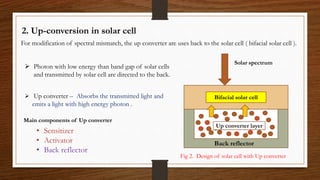
2. Up-conversion in solar cell
For modification of spectral mismatch, the up converter are uses back to the solar cell ( bifacial solar cell ).
 Photon with low energy than band gap of solar cells
and transmitted by solar cell are directed to the back.
 Up converter – Absorbs the transmitted light and
emits a light with high energy photon .
• Sensitizer
• Activator
• Back reflector
Fig 2. Design of solar cell with Up converter
Main components of Up converter
Bifacial solar cell
Up converter layer
Back reflector
Solar spectrum
2.1 Working principle of Up conversion in solar cell
Fig. 3 Working process with up converter
 Low energy photons –transmitted
by solar cell and absorbs by
sensitizer.
 low energy photon excite the
energy state of activator through
non radiative relaxation.
 Radiative emission ( excite state –
ground state )by activator as a high
energy photon Open AccessRev
[ Enhancing Solar Cell Efficiency Using Photon Up-conversion Materials fig. 7 ]
Fig.4 energy level or energy state of up converter
( lanthanide ions ) [1]
 Energy level representation of up convertor materials( lanthanide ions )--
4F7/2 - EXCITED STATE ( Er3+ )
2F5/2 - EXCITED STATE ( Yb3+ )
2F7/2
- GROUND STATE ( Yb3+ )
Up conversion
Photon
3. Down conversion in solar cell
 Splitting of one high energy photon
in two low energy photons
 It’s a linear process
Down conversion is beneficial for solar cells with small gap
where the thermalization is major factor.
 Wider portion of the solar spectrum
Solar cell
Down converter
Sun
Fig. 5 Down–converter with solar cell
[ https://www.researchgate.net/publication/224568913_Downconvers ]
3.1 Working principle for down conversion
4F7/2 - EXCITED STATE ( Er3+ )
2F7/2
2F5/2
- EXCITED STATE ( Yb3+ )
- GROUND STATE ( Yb3+ )
Fig. 6 energy state of lanthanide ion and mechanism for DC
PHOTON
Down conversion
[ https://www.researchgate.net/publication/224568913_Downconvers ]
4 Spectral conversion
Fig. 5 spectral conversion design for PV application
1. Down-shifting
2. Quantum-cutting
3. Up-conversion (NIR – Visible or UV)
(UV or Visible – NIR )
Spectral Wavelength Energy
Ultraviolet 10nm-400nm 124ev-3.3ev
Visible 400nm- 700nm 3.3ev-1.7ev
Infrared 700nm-1mm 1.7ev-1.24mev [ Enhancing solar cell efficiency- Xiaoyong Huang, sanyang Han ]
5. Material choice for Up-conversion and down-conversion
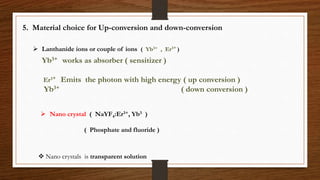
 Lanthanide ions or couple of ions ( Yb3+ , Er3+ )
Yb3+ works as absorber ( sensitizer )
Er3+ Emits the photon with high energy ( up conversion )
Yb3+ ( down conversion )
 Nano crystal ( NaYF4:Er3+, Yb3 )
( Phosphate and fluoride )
 Nano crystals is transparent solution
6. Efficiency improvement ( UC and DC )
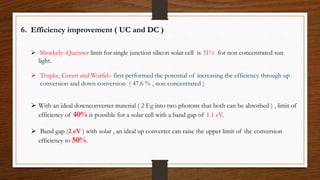
 Shockely–Queisser limit for single junction silicon solar cell is 31% for non concentrated sun
light.
 Trupke, Green and Wurfel– first performed the potential of increasing the efficiency through up
conversion and down conversion ( 47.6 % , non concentrated )
 With an ideal downconverter material ( 2 Eg into two photons that both can be absorbed ) , limit of
efficiency of 40% is possible for a solar cell with a band gap of 1.1 eV.
 Band gap (2 eV ) with solar , an ideal up converter can raise the upper limit of the conversion
efficiency to 50%.
7. Other importance of UC and DC
1. By using UC we can use low energy photon to produce the more electricity
2. We can reduce the thermalization loss by suing DC
3. Improvement of stability of other thin film technologies such perovskite &
organic solar cells ( by down conversion of UV light ), increment harvesting of
UV.
References
(1) van Sark, W. G., de Wild, J., Rath, J. K., Meijerink, A., & Schropp, R. E. (2013). Upconversion in
solar cells. Nanoscale research letters, 8(1), 1-10.
(2) Van Der Ende, B. M., Aarts, L., & Meijerink, A. (2009). Lanthanide ions as spectral converters for
solar cells. Physical Chemistry Chemical Physics, 11(47), 11081-11095.
(3) https://www.researchgate.net/publication/224568913_Downconvers
(4) Dong, J., Gao, W., Han, Q., Wang, Y., Qi, J., Yan, X., & Sun, M. (2019). Plasmon-enhanced
upconversion photoluminescence: Mechanism and application. Reviews in Physics, 4, 100026

up conversion and down conversion in solar (5).pptx

  • 1.
    Up-Conversion and Down- Conversionin Solar Cells AJIT MEENA V21113 MSc physics Special thanks Project instructor Dr. Ranbir Singh PH-614 SEMINAR AND REPORT INDIAN INSTITUTE OF TECHNOLOGY, MANDI HIMACHAL( 175005)
  • 2.
    Content 1. Introduction 1.1 solarcells 1.2 Up-conversion( UC) and Down-conversion ( DC ) 2. Up- conversion (UC) in solar cells 2.1 working mechanism 3. Down-conversion (DC) in solar cells 3.1 working mechanism 4. Solar spectral conversion in solar cell 5. Material choice for UC and DC 6. Efficiency improvement using UC and DC in solar cells 7. Other importance of UC and DC in solar cell
  • 3.
    1. Introduction Solar cell-Electronic device that converts the light energy directly into electricity by photovoltaic effect.  Cost and efficiency are related in solar cell like: Cost/Watt  Si –single junction solar cell- costly Why up conversion and down conversion in solar cell ? 1. Reducing thermalization loss via down conversion. 2. Decreasing transmission loss ( up conversion ) Fig. 1 Solar spectrum with energy losses in solar cell Watt Cost [solar spectrum conversion for photovoltaics using nanoparticles { fig .3}]
  • 4.
    1.2.1 Up conversion( UC ) Up conversion is a process in photovoltaic cells that converts low energy ( high wavelength ) photons into high energy (lower wavelength) photons. Infrared light Visible light 1.2.2 Down-conversion ( DC ) Down conversion is a process where high energy photons are converted into low energy photons. UC  Spectral Conversion Process Helps to Improve Efficiency of the Solar Cells Ultraviolet (UV) Visible light
  • 5.
    2. Up-conversion insolar cell For modification of spectral mismatch, the up converter are uses back to the solar cell ( bifacial solar cell ).  Photon with low energy than band gap of solar cells and transmitted by solar cell are directed to the back.  Up converter – Absorbs the transmitted light and emits a light with high energy photon . • Sensitizer • Activator • Back reflector Fig 2. Design of solar cell with Up converter Main components of Up converter Bifacial solar cell Up converter layer Back reflector Solar spectrum
  • 6.
    2.1 Working principleof Up conversion in solar cell Fig. 3 Working process with up converter  Low energy photons –transmitted by solar cell and absorbs by sensitizer.  low energy photon excite the energy state of activator through non radiative relaxation.  Radiative emission ( excite state – ground state )by activator as a high energy photon Open AccessRev [ Enhancing Solar Cell Efficiency Using Photon Up-conversion Materials fig. 7 ]
  • 7.
    Fig.4 energy levelor energy state of up converter ( lanthanide ions ) [1]  Energy level representation of up convertor materials( lanthanide ions )-- 4F7/2 - EXCITED STATE ( Er3+ ) 2F5/2 - EXCITED STATE ( Yb3+ ) 2F7/2 - GROUND STATE ( Yb3+ ) Up conversion Photon
  • 8.
    3. Down conversionin solar cell  Splitting of one high energy photon in two low energy photons  It’s a linear process Down conversion is beneficial for solar cells with small gap where the thermalization is major factor.  Wider portion of the solar spectrum Solar cell Down converter Sun Fig. 5 Down–converter with solar cell [ https://www.researchgate.net/publication/224568913_Downconvers ]
  • 9.
    3.1 Working principlefor down conversion 4F7/2 - EXCITED STATE ( Er3+ ) 2F7/2 2F5/2 - EXCITED STATE ( Yb3+ ) - GROUND STATE ( Yb3+ ) Fig. 6 energy state of lanthanide ion and mechanism for DC PHOTON Down conversion [ https://www.researchgate.net/publication/224568913_Downconvers ]
  • 10.
    4 Spectral conversion Fig.5 spectral conversion design for PV application 1. Down-shifting 2. Quantum-cutting 3. Up-conversion (NIR – Visible or UV) (UV or Visible – NIR ) Spectral Wavelength Energy Ultraviolet 10nm-400nm 124ev-3.3ev Visible 400nm- 700nm 3.3ev-1.7ev Infrared 700nm-1mm 1.7ev-1.24mev [ Enhancing solar cell efficiency- Xiaoyong Huang, sanyang Han ]
  • 11.
    5. Material choicefor Up-conversion and down-conversion  Lanthanide ions or couple of ions ( Yb3+ , Er3+ ) Yb3+ works as absorber ( sensitizer ) Er3+ Emits the photon with high energy ( up conversion ) Yb3+ ( down conversion )  Nano crystal ( NaYF4:Er3+, Yb3 ) ( Phosphate and fluoride )  Nano crystals is transparent solution
  • 12.
    6. Efficiency improvement( UC and DC )  Shockely–Queisser limit for single junction silicon solar cell is 31% for non concentrated sun light.  Trupke, Green and Wurfel– first performed the potential of increasing the efficiency through up conversion and down conversion ( 47.6 % , non concentrated )  With an ideal downconverter material ( 2 Eg into two photons that both can be absorbed ) , limit of efficiency of 40% is possible for a solar cell with a band gap of 1.1 eV.  Band gap (2 eV ) with solar , an ideal up converter can raise the upper limit of the conversion efficiency to 50%.
  • 13.
    7. Other importanceof UC and DC 1. By using UC we can use low energy photon to produce the more electricity 2. We can reduce the thermalization loss by suing DC 3. Improvement of stability of other thin film technologies such perovskite & organic solar cells ( by down conversion of UV light ), increment harvesting of UV.
  • 14.
    References (1) van Sark,W. G., de Wild, J., Rath, J. K., Meijerink, A., & Schropp, R. E. (2013). Upconversion in solar cells. Nanoscale research letters, 8(1), 1-10. (2) Van Der Ende, B. M., Aarts, L., & Meijerink, A. (2009). Lanthanide ions as spectral converters for solar cells. Physical Chemistry Chemical Physics, 11(47), 11081-11095. (3) https://www.researchgate.net/publication/224568913_Downconvers (4) Dong, J., Gao, W., Han, Q., Wang, Y., Qi, J., Yan, X., & Sun, M. (2019). Plasmon-enhanced upconversion photoluminescence: Mechanism and application. Reviews in Physics, 4, 100026