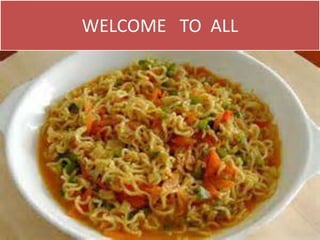
WELCOME TO ALL
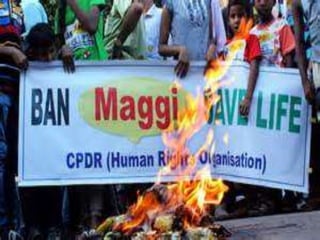
Maggi BAN
Presented by :
B. Muthumeenal
G. Gowsalya
B. Keerthana
K. Arunadevi
Introduction
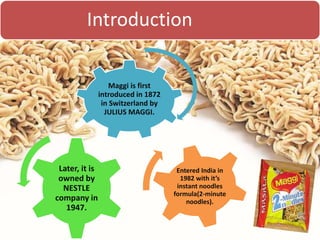
Maggi is first
introduced in 1872
in Switzerland by
JULIUS MAGGI.
Later, it is
owned by
NESTLE
company in
1947.
Entered India in
1982 with it’s
instant noodles
formula(2-minute
noodles).
NESTLE
 Nestle S.A was founded in 1867 in
Geneva, Switzerland by Henri Nestle.
 Basically the company started to meet
the need of milk during world war 1.
 Nestle's India started 1912
 Nestle formed a company in India,
namely Nestle India Ltd, and set up its
first factory in 1961 at Moga, Punjab.
Nestle is Swiss company founded
1866 by nestle.
Nestle market its products in 130
countries across the world.
Nestle sells over a billon product
everyday.
The consideration nestle is good food, good
health of consumer.
NESTLE AROUND THE GLOBE
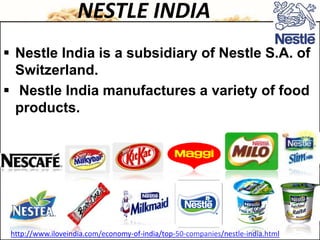
 Nestle India is a subsidiary of Nestle S.A. of
Switzerland.
 Nestle India manufactures a variety of food
products.
NESTLE INDIA
http://www.iloveindia.com/economy-of-india/top-50-companies/nestle-india.html
MAGGI IN INDIA
• Nestle unleashed brand Maggi in india
Almost 25 years ago in 1983 with launch
of its traditional 2 minutes noodles in
its masala, tomato and chicken flavors,
followed by its curry flavor some years
down the line.
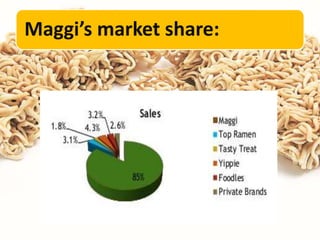
Maggi’s market share:
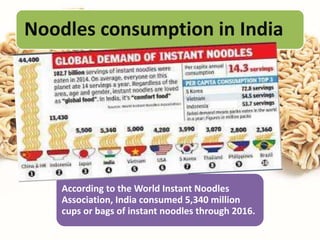
Noodles consumption in India
According to the World Instant Noodles
Association, India consumed 5,340 million
cups or bags of instant noodles through 2016.
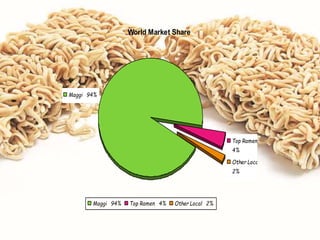
World Market Share
Maggi 94%
Top Ramen
4%
Other Local
2%
Maggi 94% Top Ramen 4% Other Local 2%
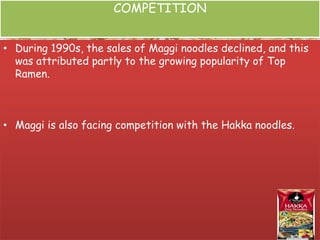
COMPETITION
• During 1990s, the sales of Maggi noodles declined, and this
was attributed partly to the growing popularity of Top
Ramen.
• Maggi is also facing competition with the Hakka noodles.
VARIOUS TAG LINES OF MAGGI
Through its ads, NIL positioned Maggi as a
‘fun’ food for kids which mother could
prepare easily. Tag lines of Maggi from their
various ads: -
• ‘Mummy, bhookh lagi hai’ (Mom, I’m hungry).
• ‘Bas 2-minute,’ (only 2 minutes)
• ‘Fast to Cook Good to Eat’
• ‘Taste bhi, Health bhi’
TIME LINE
• March 2014
• Authorities in the State of Uttar Pradesh inform Nestlé
India that MSG was detected in a sample of Maggi
noodles that carried a “No added MSG” claim on the
pack.
• Nestlé India states it does not add MSG to Maggi
noodles and requests a second sample to be sent to a
referral government laboratory in Kolkata.
• January 2015
• The second sample is received by the referral
laboratory in January 2015.
• It is analyzed from January 2015 to April 2015 –
significantly after the product’s shelf-life.
CONT…
• April 2015
• The referral government laboratory in Kolkata says it has detected lead
levels above permissible limits and the presence of MSG in its sample of
Maggi noodles.
• Ensuing tests on Maggi noodles samples - representing 165 million packets
- by both Nestlé India’s own accredited laboratories.
• 11 June 2015
• Nestlé India files a legal petition with the Bombay High Court, seeking a
judicial review of this order. As the case progresses the company cites a
number of arguments The FSSAI order was passed without giving Nestlé a
proper hearing as follows;
• The government laboratories that tested Maggi noodles for lead – on
behalf of the FSSAI and some Indian state FDAs (food and drug
administration) - were not accredited for lead testing.
• Tests by Nestlé and an independent accredited laboratory have found
Maggi noodles safe to eat
CONT…
• Tests by food standards authorities in six countries –
USA, Canada, UK, Australia, New Zealand and
Singapore – also found Indian-made Maggi noodles
safe for consumption.
• While legal proceedings are ongoing, Nestlé
continues to comply with the FSSAI order and
destroys over 35,000 tones of the product
• 15 JUNE 2015
• In light of growing consumer confusion, Nestlé India
decides to temporarily stop selling Maggi noodles
in India until the situation with the authorities is
resolved.
CONT…
• 11 August 2015
• The National Consumer Disputes Redressal Commission
(NCDRC) files a class action lawsuit against Nestlé India on
behalf of Indian consumers.
• It asks for close to USD 100 million (INR Rs 639.95 corer) in
damages on grounds of "unfair trade practices, sale of
defective goods and sale of goods to the public.”
• 13 August 2015
• The Bombay High Court overturns the government’s ban on
Maggi noodles, arguing that the move was “arbitrary” and
“that principles of natural justice were not followed.”
• The court rules that Nestlé India can bring the product back
to the market if fresh tests – conducted in three accredited
laboratories on the existing samples and subsequently on the
freshly manufactured product– find the product safe.
CONT…
• 16 October 2015
• Test results from all three laboratories mandated by the Bombay High Court show
Maggi noodles to be safe, with lead content well within the permissible limits.
• In compliance with the orders of the Bombay High Court, Nestlé India commences
manufacturing Maggi noodles and submits the new batches for fresh tests to
reconfirm they are safe for consumption.
• 4 November 2015
• All three NABL (National Accreditation Board for Testing and Calibration
Laboratories) accredited laboratories - mandated by the Bombay High Court – find
samples of the newly manufactured Maggi noodles to be safe for consumption,
with lead content well within permissible limits.
• 9 November 2015
• Now that the orders of the Bombay High Court have been complied with, Nestlé
India has made Maggi noodles available for sale once again
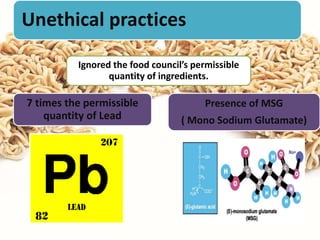
Unethical practices
Ignored the food council’s permissible
quantity of ingredients.
7 times the permissible
quantity of Lead
Presence of MSG
( Mono Sodium Glutamate)
Health hazards due to excessive Lead:
Children:
Learning disabilities resulting in
decreased intelligence (decreased IQ)
Attention deficit disorder
Behavior issues
Nervous system damage
Speech and language impairment
Decreased muscle growth
Decreased bone growth
Kidney damage
Adults:
Increased chance of illness during
pregnancy
Harm to a fetus, including brain
damage or death.
Fertility problems in both men and
women
High blood pressure
Digestive issues
Nerve disorders
Memory and concentration problems
Muscle and joint pain
Health hazards due to MSG:
• Severe headache
• Flushing
• Sweating
• Facial tightness
• Allergic response
• Chest pains
• Shortness of
breath
• Muscle weakness
and numbness,
• Heart
palpitations
Tingling or
burning in the
mouth, around
the face and in
the limbs
PANIC IN THE MARKET
• Not surprisingly investors panicked
and sold the stock. It share price fell
nearly 13.5% or by Rs.941 in the
fifteen days to June 10, 2015.
REAL STORY OF THE MAGGI CASE
Initially, Mr VK Pandey, Barabanki’s food
safety inspector was being hailed as the man who
lead the entire testing and reporting. In several
interviews, Pandey has described how his team
collected Maggi samples last year, sent it for tests
and then notified Nestle over the excess lead and
MSG, and then sent the samples for further tests to
the Central Food Laboratory in Kolkata to confirm
that Maggi was indeed dangerous for consumption.
CONT…
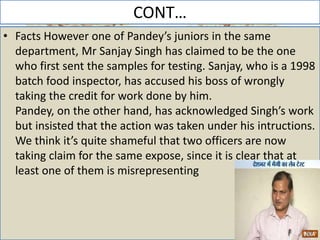
• Facts However one of Pandey’s juniors in the same
department, Mr Sanjay Singh has claimed to be the one
who first sent the samples for testing. Sanjay, who is a 1998
batch food inspector, has accused his boss of wrongly
taking the credit for work done by him.
Pandey, on the other hand, has acknowledged Singh’s work
but insisted that the action was taken under his intructions.
We think it’s quite shameful that two officers are now
taking claim for the same expose, since it is clear that at
least one of them is misrepresenting
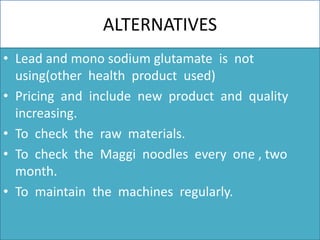
ALTERNATIVES
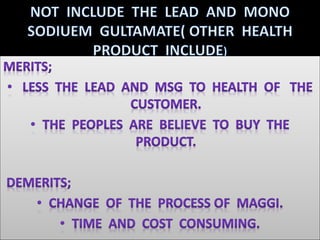
• Lead and mono sodium glutamate is not
using(other health product used)
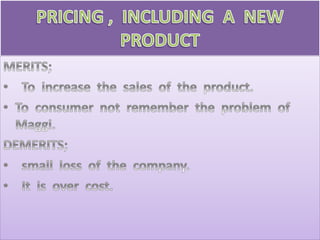
• Pricing and include new product and quality
increasing.
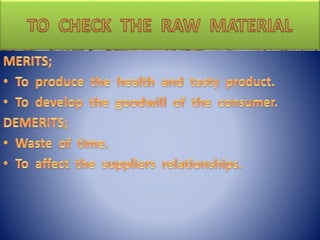
• To check the raw materials.
• To check the Maggi noodles every one , two
month.
• To maintain the machines regularly.
TO CHECK THE MAGGI NOODLES
SAFTEY
FOR MAGGI
• Fresh tests mandated by an Indian court on
Nestle's popular Maggi noodles have found them
to be safe with levels of lead well below
permissible limits, the company said in a
statement.
• Nestle had challenged a government ban on the
noodles after some tests found lead levels beyond
statutory limits.
• The Swiss food multinational has always said its
products are safe.
CONT…
• Nestle India said in a statement that it had received the
test results from three laboratories mandated by the
Bombay High Court.
• The court had lifted the "arbitrary" ban on the noodles,
but directed Nestle to "send five samples from each
batch of Maggi [noodles] for testing to three labs and
only if the lead is found to be lower than permitted will
they start manufacturing and sale again".
• The tests had found all 90 samples, covering six
varieties, safe for consumption, the statement from
Nestle India said.
CONT...
• India separately sued Nestle for $100m (£64m) over
"unfair trade practices".
• The company said it "will now commence
manufacture and will start selling [the noodles] only
after the newly manufactured products are also
cleared by the designated three laboratories".
• The company, which has 80% of India's instant
noodles market, has already destroyed 400 million
packets of Maggi products
MAGGI NOODLES COME BACK
• Test results from all three laboratories mandated by the
Bombay High Court show Maggi noodles to be safe,
with lead content well within the permissible limits.
• In compliance with the orders of the Bombay High
Court, we began manufacturing Maggi noodles and
submitted the new batches for testing as well. All three
NABL (National Accreditation Board for Testing and
Calibration Laboratories) accredited laboratories have
reconfirmed that Maggi noodles are safe for
consumption.
• Now that the orders of the Bombay High Court have
been complied with, Nestlé India has made Maggi
noodles available for sale once again
PRESENTED TO;
MR. R. MUTHU KUMER B.A., MBA., High Dip (FR).,
ANY QUESTIONS
THANK YOU FOR YOUR ATTENTION

Maggi ban

  • 1.
  • 2.
    Maggi BAN Presented by: B. Muthumeenal G. Gowsalya B. Keerthana K. Arunadevi
  • 3.
    Introduction Maggi is first introducedin 1872 in Switzerland by JULIUS MAGGI. Later, it is owned by NESTLE company in 1947. Entered India in 1982 with it’s instant noodles formula(2-minute noodles).
  • 4.
    NESTLE  Nestle S.Awas founded in 1867 in Geneva, Switzerland by Henri Nestle.  Basically the company started to meet the need of milk during world war 1.  Nestle's India started 1912  Nestle formed a company in India, namely Nestle India Ltd, and set up its first factory in 1961 at Moga, Punjab.
  • 5.
    Nestle is Swisscompany founded 1866 by nestle. Nestle market its products in 130 countries across the world. Nestle sells over a billon product everyday. The consideration nestle is good food, good health of consumer. NESTLE AROUND THE GLOBE
  • 6.
     Nestle Indiais a subsidiary of Nestle S.A. of Switzerland.  Nestle India manufactures a variety of food products. NESTLE INDIA http://www.iloveindia.com/economy-of-india/top-50-companies/nestle-india.html
  • 7.
    MAGGI IN INDIA •Nestle unleashed brand Maggi in india Almost 25 years ago in 1983 with launch of its traditional 2 minutes noodles in its masala, tomato and chicken flavors, followed by its curry flavor some years down the line.
  • 8.
  • 9.
    Noodles consumption inIndia According to the World Instant Noodles Association, India consumed 5,340 million cups or bags of instant noodles through 2016.
  • 10.
    World Market Share Maggi94% Top Ramen 4% Other Local 2% Maggi 94% Top Ramen 4% Other Local 2%
  • 11.
    COMPETITION • During 1990s,the sales of Maggi noodles declined, and this was attributed partly to the growing popularity of Top Ramen. • Maggi is also facing competition with the Hakka noodles.
  • 12.
    VARIOUS TAG LINESOF MAGGI Through its ads, NIL positioned Maggi as a ‘fun’ food for kids which mother could prepare easily. Tag lines of Maggi from their various ads: - • ‘Mummy, bhookh lagi hai’ (Mom, I’m hungry). • ‘Bas 2-minute,’ (only 2 minutes) • ‘Fast to Cook Good to Eat’ • ‘Taste bhi, Health bhi’
  • 14.
    TIME LINE • March2014 • Authorities in the State of Uttar Pradesh inform Nestlé India that MSG was detected in a sample of Maggi noodles that carried a “No added MSG” claim on the pack. • Nestlé India states it does not add MSG to Maggi noodles and requests a second sample to be sent to a referral government laboratory in Kolkata. • January 2015 • The second sample is received by the referral laboratory in January 2015. • It is analyzed from January 2015 to April 2015 – significantly after the product’s shelf-life.
  • 15.
    CONT… • April 2015 •The referral government laboratory in Kolkata says it has detected lead levels above permissible limits and the presence of MSG in its sample of Maggi noodles. • Ensuing tests on Maggi noodles samples - representing 165 million packets - by both Nestlé India’s own accredited laboratories. • 11 June 2015 • Nestlé India files a legal petition with the Bombay High Court, seeking a judicial review of this order. As the case progresses the company cites a number of arguments The FSSAI order was passed without giving Nestlé a proper hearing as follows; • The government laboratories that tested Maggi noodles for lead – on behalf of the FSSAI and some Indian state FDAs (food and drug administration) - were not accredited for lead testing. • Tests by Nestlé and an independent accredited laboratory have found Maggi noodles safe to eat
  • 16.
    CONT… • Tests byfood standards authorities in six countries – USA, Canada, UK, Australia, New Zealand and Singapore – also found Indian-made Maggi noodles safe for consumption. • While legal proceedings are ongoing, Nestlé continues to comply with the FSSAI order and destroys over 35,000 tones of the product • 15 JUNE 2015 • In light of growing consumer confusion, Nestlé India decides to temporarily stop selling Maggi noodles in India until the situation with the authorities is resolved.
  • 17.
    CONT… • 11 August2015 • The National Consumer Disputes Redressal Commission (NCDRC) files a class action lawsuit against Nestlé India on behalf of Indian consumers. • It asks for close to USD 100 million (INR Rs 639.95 corer) in damages on grounds of "unfair trade practices, sale of defective goods and sale of goods to the public.” • 13 August 2015 • The Bombay High Court overturns the government’s ban on Maggi noodles, arguing that the move was “arbitrary” and “that principles of natural justice were not followed.” • The court rules that Nestlé India can bring the product back to the market if fresh tests – conducted in three accredited laboratories on the existing samples and subsequently on the freshly manufactured product– find the product safe.
  • 18.
    CONT… • 16 October2015 • Test results from all three laboratories mandated by the Bombay High Court show Maggi noodles to be safe, with lead content well within the permissible limits. • In compliance with the orders of the Bombay High Court, Nestlé India commences manufacturing Maggi noodles and submits the new batches for fresh tests to reconfirm they are safe for consumption. • 4 November 2015 • All three NABL (National Accreditation Board for Testing and Calibration Laboratories) accredited laboratories - mandated by the Bombay High Court – find samples of the newly manufactured Maggi noodles to be safe for consumption, with lead content well within permissible limits. • 9 November 2015 • Now that the orders of the Bombay High Court have been complied with, Nestlé India has made Maggi noodles available for sale once again
  • 19.
    Unethical practices Ignored thefood council’s permissible quantity of ingredients. 7 times the permissible quantity of Lead Presence of MSG ( Mono Sodium Glutamate)
  • 21.
    Health hazards dueto excessive Lead: Children: Learning disabilities resulting in decreased intelligence (decreased IQ) Attention deficit disorder Behavior issues Nervous system damage Speech and language impairment Decreased muscle growth Decreased bone growth Kidney damage Adults: Increased chance of illness during pregnancy Harm to a fetus, including brain damage or death. Fertility problems in both men and women High blood pressure Digestive issues Nerve disorders Memory and concentration problems Muscle and joint pain
  • 22.
    Health hazards dueto MSG: • Severe headache • Flushing • Sweating • Facial tightness • Allergic response • Chest pains • Shortness of breath • Muscle weakness and numbness, • Heart palpitations Tingling or burning in the mouth, around the face and in the limbs
  • 23.
    PANIC IN THEMARKET • Not surprisingly investors panicked and sold the stock. It share price fell nearly 13.5% or by Rs.941 in the fifteen days to June 10, 2015.
  • 24.
    REAL STORY OFTHE MAGGI CASE Initially, Mr VK Pandey, Barabanki’s food safety inspector was being hailed as the man who lead the entire testing and reporting. In several interviews, Pandey has described how his team collected Maggi samples last year, sent it for tests and then notified Nestle over the excess lead and MSG, and then sent the samples for further tests to the Central Food Laboratory in Kolkata to confirm that Maggi was indeed dangerous for consumption.
  • 25.
    CONT… • Facts Howeverone of Pandey’s juniors in the same department, Mr Sanjay Singh has claimed to be the one who first sent the samples for testing. Sanjay, who is a 1998 batch food inspector, has accused his boss of wrongly taking the credit for work done by him. Pandey, on the other hand, has acknowledged Singh’s work but insisted that the action was taken under his intructions. We think it’s quite shameful that two officers are now taking claim for the same expose, since it is clear that at least one of them is misrepresenting
  • 26.
    ALTERNATIVES • Lead andmono sodium glutamate is not using(other health product used) • Pricing and include new product and quality increasing. • To check the raw materials. • To check the Maggi noodles every one , two month. • To maintain the machines regularly.
  • 30.
    TO CHECK THEMAGGI NOODLES
  • 32.
    SAFTEY FOR MAGGI • Freshtests mandated by an Indian court on Nestle's popular Maggi noodles have found them to be safe with levels of lead well below permissible limits, the company said in a statement. • Nestle had challenged a government ban on the noodles after some tests found lead levels beyond statutory limits. • The Swiss food multinational has always said its products are safe.
  • 33.
    CONT… • Nestle Indiasaid in a statement that it had received the test results from three laboratories mandated by the Bombay High Court. • The court had lifted the "arbitrary" ban on the noodles, but directed Nestle to "send five samples from each batch of Maggi [noodles] for testing to three labs and only if the lead is found to be lower than permitted will they start manufacturing and sale again". • The tests had found all 90 samples, covering six varieties, safe for consumption, the statement from Nestle India said.
  • 34.
    CONT... • India separatelysued Nestle for $100m (£64m) over "unfair trade practices". • The company said it "will now commence manufacture and will start selling [the noodles] only after the newly manufactured products are also cleared by the designated three laboratories". • The company, which has 80% of India's instant noodles market, has already destroyed 400 million packets of Maggi products
  • 35.
    MAGGI NOODLES COMEBACK • Test results from all three laboratories mandated by the Bombay High Court show Maggi noodles to be safe, with lead content well within the permissible limits. • In compliance with the orders of the Bombay High Court, we began manufacturing Maggi noodles and submitted the new batches for testing as well. All three NABL (National Accreditation Board for Testing and Calibration Laboratories) accredited laboratories have reconfirmed that Maggi noodles are safe for consumption. • Now that the orders of the Bombay High Court have been complied with, Nestlé India has made Maggi noodles available for sale once again
  • 36.
    PRESENTED TO; MR. R.MUTHU KUMER B.A., MBA., High Dip (FR).,
  • 37.
  • 38.
    THANK YOU FORYOUR ATTENTION