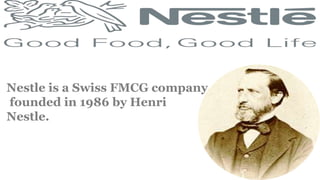
Nestle is a Swiss FMCG company
founded in 1986 by Henri
Nestle.
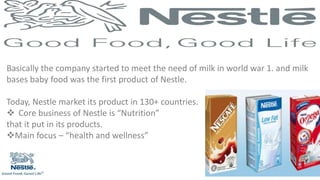
Basically the company started to meet the need of milk in world war 1. and milk
bases baby food was the first product of Nestle.
Today, Nestle market its product in 130+ countries.
 Core business of Nestle is “Nutrition”
that it put in its products.
Main focus – “health and wellness”
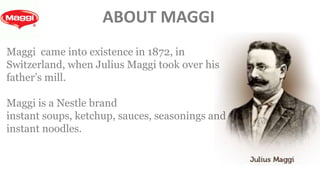
Maggi came into existence in 1872, in
Switzerland, when Julius Maggi took over his
father’s mill.
Maggi is a Nestle brand
instant soups, ketchup, sauces, seasonings and
instant noodles.
ABOUT MAGGI
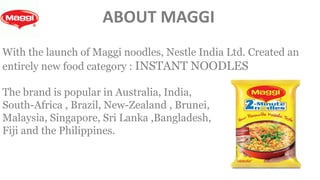
With the launch of Maggi noodles, Nestle India Ltd. Created an
entirely new food category : INSTANT NOODLES
The brand is popular in Australia, India,
South-Africa , Brazil, New-Zealand , Brunei,
Malaysia, Singapore, Sri Lanka ,Bangladesh,
Fiji and the Philippines.
ABOUT MAGGI
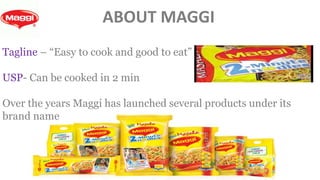
Tagline – “Easy to cook and good to eat”
USP- Can be cooked in 2 min
Over the years Maggi has launched several products under its
brand name
ABOUT MAGGI
• In 1982, Nestle India Ltd. (NIL), the Indian subsidiary of the global FMCG major, Nestle ,
introduced the Maggi brand in India.
• Initially it was launched at Rs. 2.10 with a nearby of 100% margin.
• With the launch of Maggi noodles, NIL(Nestle India limited) created an entirely new food
category- instant noodles- in the Indian packaged food market.
• Being the first-mover, NIL successfully managed to retain its leadership in the instant noodles
category even until the early 2000s
• In 2005, NIL started offering a range of new “healthy” products under the Maggi brand, in a
bid to attract health-conscious consumers.
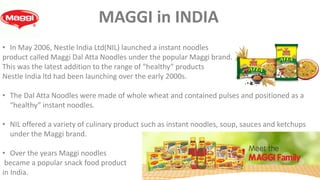
MAGGI in INDIA
• In May 2006, Nestle India Ltd(NIL) launched a instant noodles
product called Maggi Dal Atta Noodles under the popular Maggi brand.
This was the latest addition to the range of “healthy” products
Nestle India ltd had been launching over the early 2000s.
• The Dal Atta Noodles were made of whole wheat and contained pulses and positioned as a
“healthy” instant noodles.
• NIL offered a variety of culinary product such as instant noodles, soup, sauces and ketchups
under the Maggi brand.
• Over the years Maggi noodles
became a popular snack food product
in India.
MAGGI in INDIA
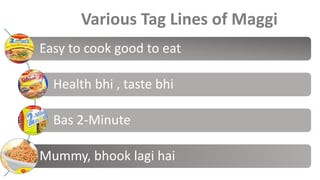
Various Tag Lines of Maggi
Easy to cook good to eat
Health bhi , taste bhi
Bas 2-Minute
Mummy, bhook lagi hai
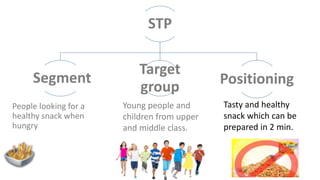
STP
Segment
Target
group Positioning
People looking for a
healthy snack when
hungry
Young people and
children from upper
and middle class.
Tasty and healthy
snack which can be
prepared in 2 min.
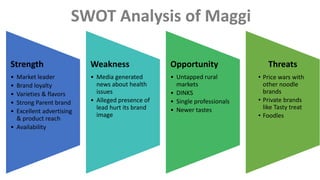
Strength
• Market leader
• Brand loyalty
• Varieties & flavors
• Strong Parent brand
• Excellent advertising
& product reach
• Availability
Weakness
• Media generated
news about health
issues
• Alleged presence of
lead hurt its brand
image
Opportunity
• Untapped rural
markets
• DINKS
• Single professionals
• Newer tastes
Threats
SWOT Analysis of Maggi
• Price wars with
other noodle
brands
• Private brands
like Tasty treat
• Foodles
Product Variants
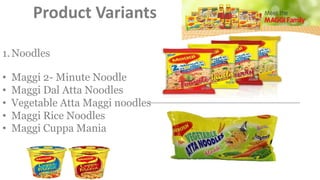
1.Noodles
• Maggi 2- Minute Noodle
• Maggi Dal Atta Noodles
• Vegetable Atta Maggi noodles
• Maggi Rice Noodles
• Maggi Cuppa Mania
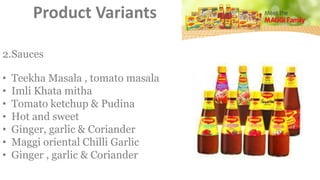
2.Sauces
• Teekha Masala , tomato masala
• Imli Khata mitha
• Tomato ketchup & Pudina
• Hot and sweet
• Ginger, garlic & Coriander
• Maggi oriental Chilli Garlic
• Ginger , garlic & Coriander
Product Variants
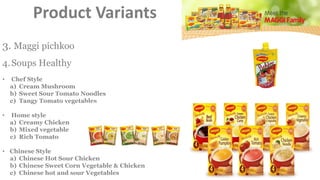
4.Soups Healthy
• Chef Style
a) Cream Mushroom
b) Sweet Sour Tomato Noodles
c) Tangy Tomato vegetables
• Home style
a) Creamy Chicken
b) Mixed vegetable
c) Rich Tomato
• Chinese Style
a) Chinese Hot Sour Chicken
b) Chinese Sweet Corn Vegetable & Chicken
c) Chinese hot and sour Vegetables
3. Maggi pichkoo
Product Variants
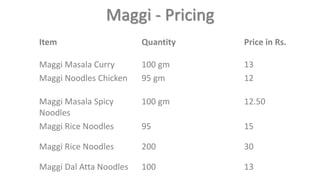
Maggi - Pricing
Item
Maggi Masala Curry
Quantity
100 gm
Price in Rs.
13
Maggi Noodles Chicken 95 gm 12
Maggi Masala Spicy
Noodles
100 gm 12.50
Maggi Rice Noodles 95 15
Maggi Rice Noodles 200 30
Maggi Dal Atta Noodles 100 13
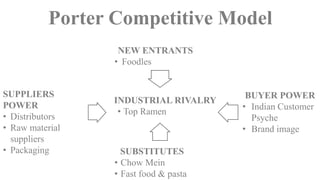
Porter Competitive Model
INDUSTRIAL RIVALRY
• Top Ramen
BUYER POWER
• Indian Customer
Psyche
• Brand image
SUPPLIERS
POWER
• Distributors
• Raw material
suppliers
• Packaging SUBSTITUTES
• Chow Mein
• Fast food & pasta
NEW ENTRANTS
• Foodles
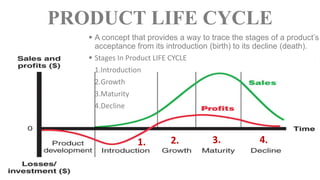
 A concept that provides a way to trace the stages of a product’s
acceptance from its introduction (birth) to its decline (death).
 Stages In Product LIFE CYCLE
1.Introduction
2.Growth
3.Maturity
4.Decline
1. 2.
PRODUCT LIFE CYCLE
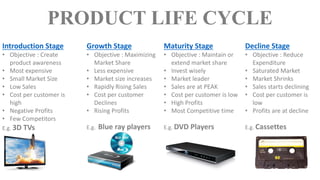
Introduction Stage
• Objective : Create
product awareness
• Most expensive
• Small Market Size
• Low Sales
• Cost per customer is
high
• Negative Profits
• Few Competitors
E.g. 3D TVs
Growth Stage
• Objective : Maximizing
Market Share
• Less expensive
• Market size increases
• Rapidly Rising Sales
• Cost per customer
Declines
• Rising Profits
E.g. Blue ray players
Maturity Stage
• Objective : Maintain or
extend market share
• Invest wisely
• Market leader
• Sales are at PEAK
• Cost per customer is low
• High Profits
• Most Competitive time
E.g. DVD Players
Decline Stage
• Objective : Reduce
Expenditure
• Saturated Market
• Market Shrinks
• Sales starts declining
• Cost per customer is
low
• Profits are at decline
E.g. Cassettes
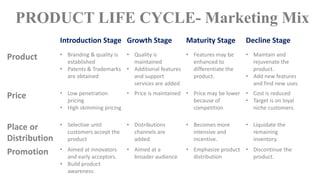
PRODUCT LIFE CYCLE
Introduction Stage Growth Stage Maturity Stage Decline Stage
Product • Branding & quality is
established
• Patents & Trademarks
are obtained
• Quality is
maintained
• Additional features
and support
services are added
• Features may be
enhanced to
differentiate the
product.
• Maintain and
rejuvenate the
product.
• Add new features
and find new uses
Price • Low penetration
pricing
• High skimming pricing
• Price is maintained • Price may be lower
because of
competition
• Cost is reduced
• Target is on loyal
niche customers.
Place or
Distribution
• Selective until
customers accept the
product
• Distributions
channels are
added.
• Becomes more
intensive and
incentive.
• Liquidate the
remaining
inventory.
Promotion • Aimed at innovators
and early acceptors.
• Build product
awareness
• Aimed at a
broader audience
• Emphasize product
distribution
• Discontinue the
product.
PRODUCT LIFE CYCLE- Marketing Mix
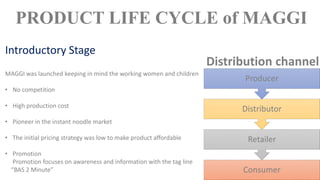
Introductory Stage
MAGGI was launched keeping in mind the working women and children
• No competition
• High production cost
• Pioneer in the instant noodle market
• The initial pricing strategy was low to make product affordable
• Promotion
Promotion focuses on awareness and information with the tag line
“BAS 2 Minute”
PRODUCT LIFE CYCLE of MAGGI
Consumer
Retailer
Distributor
Producer
Distribution channel
PRODUCT LIFE CYCLE of MAGGI
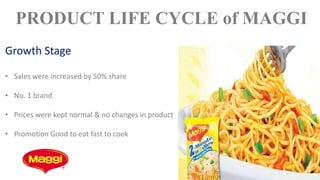
Growth Stage
• Sales were increased by 50% share
• No. 1 brand
• Prices were kept normal & no changes in product
• Promotion Good to eat fast to cook
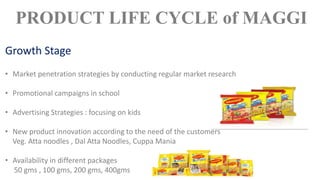
• Market penetration strategies by conducting regular market research
• Promotional campaigns in school
• Advertising Strategies : focusing on kids
• New product innovation according to the need of the customers
Veg. Atta noodles , Dal Atta Noodles, Cuppa Mania
• Availability in different packages
50 gms , 100 gms, 200 gms, 400gms
PRODUCT LIFE CYCLE of MAGGI
Growth Stage
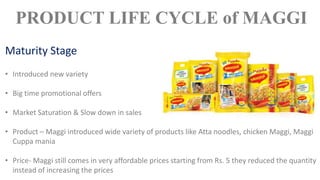
• Introduced new variety
• Big time promotional offers
• Market Saturation & Slow down in sales
• Product – Maggi introduced wide variety of products like Atta noodles, chicken Maggi, Maggi
Cuppa mania
• Price- Maggi still comes in very affordable prices starting from Rs. 5 they reduced the quantity
instead of increasing the prices
PRODUCT LIFE CYCLE of MAGGI
Maturity Stage
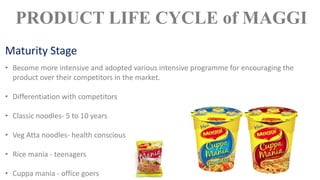
• Become more intensive and adopted various intensive programme for encouraging the
product over their competitors in the market.
• Differentiation with competitors
• Classic noodles- 5 to 10 years
• Veg Atta noodles- health conscious
• Rice mania - teenagers
• Cuppa mania - office goers
PRODUCT LIFE CYCLE of MAGGI
Maturity Stage
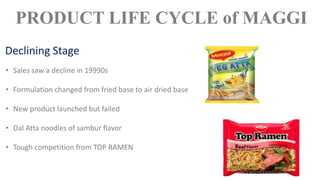
• Sales saw a decline in 19990s
• Formulation changed from fried base to air dried base
• New product launched but failed
• Dal Atta noodles of sambur flavor
• Tough competition from TOP RAMEN
PRODUCT LIFE CYCLE of MAGGI
Declining Stage
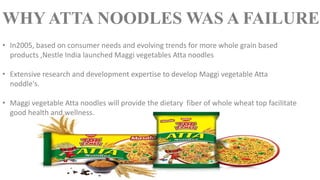
• In2005, based on consumer needs and evolving trends for more whole grain based
products ,Nestle India launched Maggi vegetables Atta noodles
• Extensive research and development expertise to develop Maggi vegetable Atta
noddle's.
• Maggi vegetable Atta noodles will provide the dietary fiber of whole wheat top facilitate
good health and wellness.
WHY ATTA NOODLES WAS A FAILURE
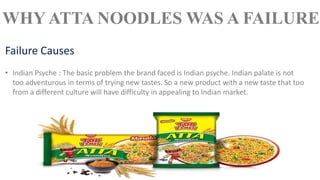
• Indian Psyche : The basic problem the brand faced is Indian psyche. Indian palate is not
too adventurous in terms of trying new tastes. So a new product with a new taste that too
from a different culture will have difficulty in appealing to Indian market.
Failure Causes
WHY ATTA NOODLES WAS A FAILURE
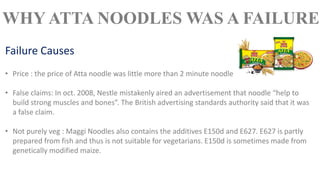
• Price : the price of Atta noodle was little more than 2 minute noodle
• False claims: In oct. 2008, Nestle mistakenly aired an advertisement that noodle “help to
build strong muscles and bones”. The British advertising standards authority said that it was
a false claim.
• Not purely veg : Maggi Noodles also contains the additives E150d and E627. E627 is partly
prepared from fish and thus is not suitable for vegetarians. E150d is sometimes made from
genetically modified maize.
Failure Causes
WHY ATTA NOODLES WAS A FAILURE
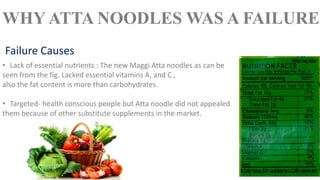
• Lack of essential nutrients : The new Maggi Atta noodles as can be
seen from the fig. Lacked essential vitamins A, and C ,
also the fat content is more than carbohydrates.
• Targeted- health conscious people but Atta noodle did not appealed
them because of other substitute supplements in the market.
Failure Causes
WHY ATTA NOODLES WAS A FAILURE
• They should conduct test marketing before launching new product.
• Focus on creating distinctive image, based on twin benefits of “instant “ and “healthy”
• Conduct promotional campaigns at schools in small towns with population more than 10,000.
• Strengthen the distribution channel of the rural areas within 100 KM, of all the metros.
• Launch new advertisement campaign (TV, radio and print media commercials) with the brand
ambassador.
• Conduct market research to find out the market penetration of the product in the rural areas
covered.
SUGGESTIVE PROMOTIONAL
STRATEGIES

Nestle Maggi

  • 2.
    Nestle is aSwiss FMCG company founded in 1986 by Henri Nestle.
  • 3.
    Basically the companystarted to meet the need of milk in world war 1. and milk bases baby food was the first product of Nestle. Today, Nestle market its product in 130+ countries.  Core business of Nestle is “Nutrition” that it put in its products. Main focus – “health and wellness”
  • 5.
    Maggi came intoexistence in 1872, in Switzerland, when Julius Maggi took over his father’s mill. Maggi is a Nestle brand instant soups, ketchup, sauces, seasonings and instant noodles. ABOUT MAGGI
  • 6.
    With the launchof Maggi noodles, Nestle India Ltd. Created an entirely new food category : INSTANT NOODLES The brand is popular in Australia, India, South-Africa , Brazil, New-Zealand , Brunei, Malaysia, Singapore, Sri Lanka ,Bangladesh, Fiji and the Philippines. ABOUT MAGGI
  • 7.
    Tagline – “Easyto cook and good to eat” USP- Can be cooked in 2 min Over the years Maggi has launched several products under its brand name ABOUT MAGGI
  • 8.
    • In 1982,Nestle India Ltd. (NIL), the Indian subsidiary of the global FMCG major, Nestle , introduced the Maggi brand in India. • Initially it was launched at Rs. 2.10 with a nearby of 100% margin. • With the launch of Maggi noodles, NIL(Nestle India limited) created an entirely new food category- instant noodles- in the Indian packaged food market. • Being the first-mover, NIL successfully managed to retain its leadership in the instant noodles category even until the early 2000s • In 2005, NIL started offering a range of new “healthy” products under the Maggi brand, in a bid to attract health-conscious consumers. MAGGI in INDIA
  • 9.
    • In May2006, Nestle India Ltd(NIL) launched a instant noodles product called Maggi Dal Atta Noodles under the popular Maggi brand. This was the latest addition to the range of “healthy” products Nestle India ltd had been launching over the early 2000s. • The Dal Atta Noodles were made of whole wheat and contained pulses and positioned as a “healthy” instant noodles. • NIL offered a variety of culinary product such as instant noodles, soup, sauces and ketchups under the Maggi brand. • Over the years Maggi noodles became a popular snack food product in India. MAGGI in INDIA
  • 10.
    Various Tag Linesof Maggi Easy to cook good to eat Health bhi , taste bhi Bas 2-Minute Mummy, bhook lagi hai
  • 11.
    STP Segment Target group Positioning People lookingfor a healthy snack when hungry Young people and children from upper and middle class. Tasty and healthy snack which can be prepared in 2 min.
  • 12.
    Strength • Market leader •Brand loyalty • Varieties & flavors • Strong Parent brand • Excellent advertising & product reach • Availability Weakness • Media generated news about health issues • Alleged presence of lead hurt its brand image Opportunity • Untapped rural markets • DINKS • Single professionals • Newer tastes Threats SWOT Analysis of Maggi • Price wars with other noodle brands • Private brands like Tasty treat • Foodles
  • 13.
    Product Variants 1.Noodles • Maggi2- Minute Noodle • Maggi Dal Atta Noodles • Vegetable Atta Maggi noodles • Maggi Rice Noodles • Maggi Cuppa Mania
  • 14.
    2.Sauces • Teekha Masala, tomato masala • Imli Khata mitha • Tomato ketchup & Pudina • Hot and sweet • Ginger, garlic & Coriander • Maggi oriental Chilli Garlic • Ginger , garlic & Coriander Product Variants
  • 15.
    4.Soups Healthy • ChefStyle a) Cream Mushroom b) Sweet Sour Tomato Noodles c) Tangy Tomato vegetables • Home style a) Creamy Chicken b) Mixed vegetable c) Rich Tomato • Chinese Style a) Chinese Hot Sour Chicken b) Chinese Sweet Corn Vegetable & Chicken c) Chinese hot and sour Vegetables 3. Maggi pichkoo Product Variants
  • 16.
    Maggi - Pricing Item MaggiMasala Curry Quantity 100 gm Price in Rs. 13 Maggi Noodles Chicken 95 gm 12 Maggi Masala Spicy Noodles 100 gm 12.50 Maggi Rice Noodles 95 15 Maggi Rice Noodles 200 30 Maggi Dal Atta Noodles 100 13
  • 17.
    Porter Competitive Model INDUSTRIALRIVALRY • Top Ramen BUYER POWER • Indian Customer Psyche • Brand image SUPPLIERS POWER • Distributors • Raw material suppliers • Packaging SUBSTITUTES • Chow Mein • Fast food & pasta NEW ENTRANTS • Foodles
  • 18.
     A conceptthat provides a way to trace the stages of a product’s acceptance from its introduction (birth) to its decline (death).  Stages In Product LIFE CYCLE 1.Introduction 2.Growth 3.Maturity 4.Decline 1. 2. PRODUCT LIFE CYCLE
  • 19.
    Introduction Stage • Objective: Create product awareness • Most expensive • Small Market Size • Low Sales • Cost per customer is high • Negative Profits • Few Competitors E.g. 3D TVs Growth Stage • Objective : Maximizing Market Share • Less expensive • Market size increases • Rapidly Rising Sales • Cost per customer Declines • Rising Profits E.g. Blue ray players Maturity Stage • Objective : Maintain or extend market share • Invest wisely • Market leader • Sales are at PEAK • Cost per customer is low • High Profits • Most Competitive time E.g. DVD Players Decline Stage • Objective : Reduce Expenditure • Saturated Market • Market Shrinks • Sales starts declining • Cost per customer is low • Profits are at decline E.g. Cassettes PRODUCT LIFE CYCLE
  • 20.
    Introduction Stage GrowthStage Maturity Stage Decline Stage Product • Branding & quality is established • Patents & Trademarks are obtained • Quality is maintained • Additional features and support services are added • Features may be enhanced to differentiate the product. • Maintain and rejuvenate the product. • Add new features and find new uses Price • Low penetration pricing • High skimming pricing • Price is maintained • Price may be lower because of competition • Cost is reduced • Target is on loyal niche customers. Place or Distribution • Selective until customers accept the product • Distributions channels are added. • Becomes more intensive and incentive. • Liquidate the remaining inventory. Promotion • Aimed at innovators and early acceptors. • Build product awareness • Aimed at a broader audience • Emphasize product distribution • Discontinue the product. PRODUCT LIFE CYCLE- Marketing Mix
  • 21.
    Introductory Stage MAGGI waslaunched keeping in mind the working women and children • No competition • High production cost • Pioneer in the instant noodle market • The initial pricing strategy was low to make product affordable • Promotion Promotion focuses on awareness and information with the tag line “BAS 2 Minute” PRODUCT LIFE CYCLE of MAGGI Consumer Retailer Distributor Producer Distribution channel
  • 22.
    PRODUCT LIFE CYCLEof MAGGI Growth Stage • Sales were increased by 50% share • No. 1 brand • Prices were kept normal & no changes in product • Promotion Good to eat fast to cook
  • 23.
    • Market penetrationstrategies by conducting regular market research • Promotional campaigns in school • Advertising Strategies : focusing on kids • New product innovation according to the need of the customers Veg. Atta noodles , Dal Atta Noodles, Cuppa Mania • Availability in different packages 50 gms , 100 gms, 200 gms, 400gms PRODUCT LIFE CYCLE of MAGGI Growth Stage
  • 24.
    • Introduced newvariety • Big time promotional offers • Market Saturation & Slow down in sales • Product – Maggi introduced wide variety of products like Atta noodles, chicken Maggi, Maggi Cuppa mania • Price- Maggi still comes in very affordable prices starting from Rs. 5 they reduced the quantity instead of increasing the prices PRODUCT LIFE CYCLE of MAGGI Maturity Stage
  • 25.
    • Become moreintensive and adopted various intensive programme for encouraging the product over their competitors in the market. • Differentiation with competitors • Classic noodles- 5 to 10 years • Veg Atta noodles- health conscious • Rice mania - teenagers • Cuppa mania - office goers PRODUCT LIFE CYCLE of MAGGI Maturity Stage
  • 26.
    • Sales sawa decline in 19990s • Formulation changed from fried base to air dried base • New product launched but failed • Dal Atta noodles of sambur flavor • Tough competition from TOP RAMEN PRODUCT LIFE CYCLE of MAGGI Declining Stage
  • 27.
    • In2005, basedon consumer needs and evolving trends for more whole grain based products ,Nestle India launched Maggi vegetables Atta noodles • Extensive research and development expertise to develop Maggi vegetable Atta noddle's. • Maggi vegetable Atta noodles will provide the dietary fiber of whole wheat top facilitate good health and wellness. WHY ATTA NOODLES WAS A FAILURE
  • 28.
    • Indian Psyche: The basic problem the brand faced is Indian psyche. Indian palate is not too adventurous in terms of trying new tastes. So a new product with a new taste that too from a different culture will have difficulty in appealing to Indian market. Failure Causes WHY ATTA NOODLES WAS A FAILURE
  • 29.
    • Price :the price of Atta noodle was little more than 2 minute noodle • False claims: In oct. 2008, Nestle mistakenly aired an advertisement that noodle “help to build strong muscles and bones”. The British advertising standards authority said that it was a false claim. • Not purely veg : Maggi Noodles also contains the additives E150d and E627. E627 is partly prepared from fish and thus is not suitable for vegetarians. E150d is sometimes made from genetically modified maize. Failure Causes WHY ATTA NOODLES WAS A FAILURE
  • 30.
    • Lack ofessential nutrients : The new Maggi Atta noodles as can be seen from the fig. Lacked essential vitamins A, and C , also the fat content is more than carbohydrates. • Targeted- health conscious people but Atta noodle did not appealed them because of other substitute supplements in the market. Failure Causes WHY ATTA NOODLES WAS A FAILURE
  • 31.
    • They shouldconduct test marketing before launching new product. • Focus on creating distinctive image, based on twin benefits of “instant “ and “healthy” • Conduct promotional campaigns at schools in small towns with population more than 10,000. • Strengthen the distribution channel of the rural areas within 100 KM, of all the metros. • Launch new advertisement campaign (TV, radio and print media commercials) with the brand ambassador. • Conduct market research to find out the market penetration of the product in the rural areas covered. SUGGESTIVE PROMOTIONAL STRATEGIES