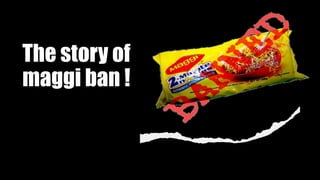
The story of
maggi ban !
INTRODUCTION
• Maggi instant noodles
was launched in India in
1983.
• For three decades, it was
a smooth sailing for
Maggi.
• Main motive was 'two
minute revolution' .
Catastrophe for maggi
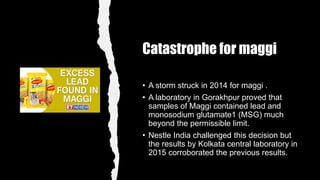
• A storm struck in 2014 for maggi .
• A laboratory in Gorakhpur proved that
samples of Maggi contained lead and
monosodium glutamate1 (MSG) much
beyond the permissible limit.
• Nestle India challenged this decision but
the results by Kolkata central laboratory in
2015 corroborated the previous results.
Two main reasons
for maggi ban -
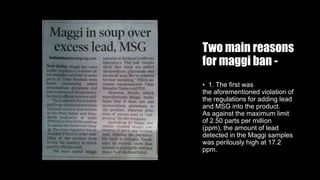
• 1. The first was
the aforementioned violation of
the regulations for adding lead
and MSG into the product.
As against the maximum limit
of 2.50 parts per million
(ppm), the amount of lead
detected in the Maggi samples
was perilously high at 17.2
ppm.
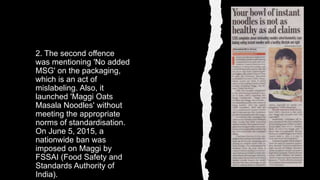
2. The second offence
was mentioning 'No added
MSG' on the packaging,
which is an act of
mislabeling. Also, it
launched 'Maggi Oats
Masala Noodles' without
meeting the appropriate
norms of standardisation.
On June 5, 2015, a
nationwide ban was
imposed on Maggi by
FSSAI (Food Safety and
Standards Authority of
India).
Nestle Maggi comeback
• In June 2015 itself, Nestle announced a recall of all its instant
noodles from the markets .
• Other step was confidence building measures.
• Used social media to gain back popularity .
• Nestle India said the noodles are “100% safe” and have cleared
laboratory tests mandated by the Bombay High Court and came
back .
Conclusion
• Maggie earned reputation throughout these decades but one
incident destroyed there whole reputation . Maggie did mislead the
consumers and did false claims . It's packaging clearly mentioned
that "NO MSG" but still there were added MSG , which is a act of
mislabelling .
• Maggie had to cut off all their stock which was in the market and
they did bear a huge loss because of their false claims and
cheating .

MISLEADING ADVERTISEMENT

  • 1.
  • 2.
    INTRODUCTION • Maggi instantnoodles was launched in India in 1983. • For three decades, it was a smooth sailing for Maggi. • Main motive was 'two minute revolution' .
  • 3.
    Catastrophe for maggi •A storm struck in 2014 for maggi . • A laboratory in Gorakhpur proved that samples of Maggi contained lead and monosodium glutamate1 (MSG) much beyond the permissible limit. • Nestle India challenged this decision but the results by Kolkata central laboratory in 2015 corroborated the previous results.
  • 4.
    Two main reasons formaggi ban - • 1. The first was the aforementioned violation of the regulations for adding lead and MSG into the product. As against the maximum limit of 2.50 parts per million (ppm), the amount of lead detected in the Maggi samples was perilously high at 17.2 ppm.
  • 5.
    2. The secondoffence was mentioning 'No added MSG' on the packaging, which is an act of mislabeling. Also, it launched 'Maggi Oats Masala Noodles' without meeting the appropriate norms of standardisation. On June 5, 2015, a nationwide ban was imposed on Maggi by FSSAI (Food Safety and Standards Authority of India).
  • 6.
    Nestle Maggi comeback •In June 2015 itself, Nestle announced a recall of all its instant noodles from the markets . • Other step was confidence building measures. • Used social media to gain back popularity . • Nestle India said the noodles are “100% safe” and have cleared laboratory tests mandated by the Bombay High Court and came back .
  • 7.
    Conclusion • Maggie earnedreputation throughout these decades but one incident destroyed there whole reputation . Maggie did mislead the consumers and did false claims . It's packaging clearly mentioned that "NO MSG" but still there were added MSG , which is a act of mislabelling . • Maggie had to cut off all their stock which was in the market and they did bear a huge loss because of their false claims and cheating .