Maggi-Nestle’s Problem Child ?

Case Study

Presented By:-
Aon
Amrut
Ankita
Arijit
Bhuvan
Christopher
Deepanshu
Darshan
Index
• Case Content
• Background
• SWOT Analysis
• Problems
• Measures & Outcomes
• Extensions
• Recommendations
• Learnings & Conclusion
Content

• Examination of brand & Line extension strategies
• Promotion & Advertisement strategies
• Rationale behind the launches & failures under
  the Umbrella Brand: MAGGI
• Problems Maggi faced during the years
• Strategies formulated to overcome the problems
• Recommendations & Conclusion
Background

• Nestlé S.A is a multinational packaged foods
  company founded and headquartered in vevey,
  switzerland
• Set up in 1866 by Henri Nestlé
• Produces Beverages,milk products,cooking
  aids,processed foods,chocolates etc.
• Presence in 83 Countries worldwide with 509
  factories spread across the globe
• World leader in coffee,mineral water & chocolates
• Ranked 55 in 2002 Fortune 500 list and established
  itself one of the most successful FMCG company
Continued….
• Entered India in 1959 through Nestle India
• Manufacturing Operations began in 1962 from Moga,Punjab
  to produce condensed milk brand “Milkmaid”
• In 1964 production of Nescafe started at the same factory
• Some of the products including Condensed milk(100%),baby
  food(87%),Coffee(60%) & Ketchup(43%) were market leaders
  in their respective categories
• By 2001 Nestle India was able to generate revenue of 18bn
  rupees with a net profit of 1.7bn
• Was adjudged the third largest food company after HUL and
  Amul
Giant In The Making
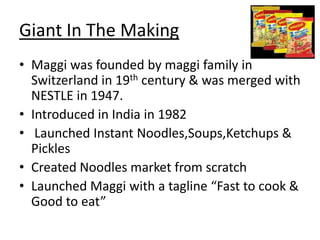
• Maggi was founded by maggi family in
  Switzerland in 19th century & was merged with
  NESTLE in 1947.
• Introduced in India in 1982
• Launched Instant Noodles,Soups,Ketchups &
  Pickles
• Created Noodles market from scratch
• Launched Maggi with a tagline “Fast to cook &
  Good to eat”
Contd….
•   Need recognition of Indian Consumer
•   Varieties: Tomato,Masala,Curry,Chicken
•   No competition
•   Because of its first-mover advantage
SWOT Analysis
Strengths:

•   Market leader in its segment
•   Strong brand,loyal Consumer base
•   Wide range of distribution channel
•   Effective Advertising
•   Innovative product range
 Weakness:
• New Innovations were not always successful
• Lack of research
• Undermines Competitor’s threat

 Opportunity:
• Product has been acceptable in youth category
• Shift to rural market
• Changing preference of consumer towards fast
  food
Threats:

• Price war with competitors
• Strong presence of regional competitors
Problems,Measures & Outcomes
 Traditional food preference by Indian consumers
• Company’s deviced a two point stratergy to attract mothers on the
  convenience plank & lure kids on fun plank
• Promotional activities of maggi included schemes offering gifts in return of
  empty noodles packs
• Taglines like ‘Mummy bhookh lagi hai’, ‘Bas 2-minute’ , ‘Fast to cook –
  Good to eat’ became part of indian advertising

 In 1993, “Sweet Maggi” variant of maggi noodles was launched only to
  withdraw it at the end.
• As the product was launched without any reseach,it failed to generate the
  desired sales. Nestle brought down the price of 100 gram pack of noodles
  to Rs 5 from Rs 7 which resulted into increase sales
• Used thinner & cheaper packaging material,Moneysaver Multipacks
 Sales stagnated in 1995 at the previous year’s
  level
• Nestle was in a fix to solve this issue during the
  year

 Knorr entered into soup business and launched
  ten flavours against Maggi’s four backed up by
  strong vegetarian theme
• Maggi relaunched its soups under the maggi rich
  brand . Packaging was made much more
  attractive along with key competitive prices
 Forayed into Pickles under the maggi brand & south indian
  food preparations
• Very limited success
 Failure of Maggi Tonite’s special
• As the product was launched without any market research
  so the response to the whole range was very poor
 Competition from rival brand TOP RAMEN
• Maggi macaroni was launched to deal with the growing
  popularity of noodels brand top ramen
 Pricing issues between Maggi macaroni & noodles
• Company failed to justify price anomalies between the two
  amounting to decrease in market share
• Taste of the new product i.e Maggi macaroni
  leads to its complete wipeout
 Knorr dethroned maggi as leader in soup
  segment in the end of 1997
• Relaunched maggi soups under the “Maggi rich”
  brand in 1998 to counter Knorr threat but was
  not counter-productive
 New formulation lead to decline of maggi in 1997
• Brought back old maggi due to customer backlash
  with the tagline’ Ab sab kuch pehle jaisa’ in
  march 1999
Extensions
• The company continuously focuses its efforts to understand
  the changing lifestyles of modern India and anticipate
  consumer needs in order to provide convenience, taste,
  nutrition, and wellness through its products.
• Launching of new flavours
• Packaged Coconut milk
• Maggi tamarind sauce and Chinese Noodles
• An offering that exemplifies ‘taste bhi health bhi’, MAGGI
  Vegetable Atta noodles is sucessful because it is loaded with
  everyone’s favorite MAGGI ‘masala’ and healthy because it
  now has more real vegetables and is packed with the power
  of fiber.
Recommendations
• Emphasis on segments with age goups 25-35
  and above
• Advertise its products by depicting attributes
  related to health like nutritional values
• Help customers perceiving the product as
  healthy
• Foray into other food products like
  Chips,Chocolate etc. under its sole brand
  name
Learnings
     &
Conclusion
Maggi presentation
Maggi presentation

Maggi presentation

  • 1.
    Maggi-Nestle’s Problem Child? Case Study Presented By:- Aon Amrut Ankita Arijit Bhuvan Christopher Deepanshu Darshan
  • 2.
    Index • Case Content •Background • SWOT Analysis • Problems • Measures & Outcomes • Extensions • Recommendations • Learnings & Conclusion
  • 3.
    Content • Examination ofbrand & Line extension strategies • Promotion & Advertisement strategies • Rationale behind the launches & failures under the Umbrella Brand: MAGGI • Problems Maggi faced during the years • Strategies formulated to overcome the problems • Recommendations & Conclusion
  • 4.
    Background • Nestlé S.Ais a multinational packaged foods company founded and headquartered in vevey, switzerland • Set up in 1866 by Henri Nestlé • Produces Beverages,milk products,cooking aids,processed foods,chocolates etc. • Presence in 83 Countries worldwide with 509 factories spread across the globe • World leader in coffee,mineral water & chocolates • Ranked 55 in 2002 Fortune 500 list and established itself one of the most successful FMCG company
  • 5.
    Continued…. • Entered Indiain 1959 through Nestle India • Manufacturing Operations began in 1962 from Moga,Punjab to produce condensed milk brand “Milkmaid” • In 1964 production of Nescafe started at the same factory • Some of the products including Condensed milk(100%),baby food(87%),Coffee(60%) & Ketchup(43%) were market leaders in their respective categories • By 2001 Nestle India was able to generate revenue of 18bn rupees with a net profit of 1.7bn • Was adjudged the third largest food company after HUL and Amul
  • 6.
    Giant In TheMaking • Maggi was founded by maggi family in Switzerland in 19th century & was merged with NESTLE in 1947. • Introduced in India in 1982 • Launched Instant Noodles,Soups,Ketchups & Pickles • Created Noodles market from scratch • Launched Maggi with a tagline “Fast to cook & Good to eat”
  • 7.
    Contd…. • Need recognition of Indian Consumer • Varieties: Tomato,Masala,Curry,Chicken • No competition • Because of its first-mover advantage
  • 8.
    SWOT Analysis Strengths: • Market leader in its segment • Strong brand,loyal Consumer base • Wide range of distribution channel • Effective Advertising • Innovative product range
  • 9.
     Weakness: • NewInnovations were not always successful • Lack of research • Undermines Competitor’s threat  Opportunity: • Product has been acceptable in youth category • Shift to rural market • Changing preference of consumer towards fast food
  • 10.
    Threats: • Price warwith competitors • Strong presence of regional competitors
  • 11.
    Problems,Measures & Outcomes Traditional food preference by Indian consumers • Company’s deviced a two point stratergy to attract mothers on the convenience plank & lure kids on fun plank • Promotional activities of maggi included schemes offering gifts in return of empty noodles packs • Taglines like ‘Mummy bhookh lagi hai’, ‘Bas 2-minute’ , ‘Fast to cook – Good to eat’ became part of indian advertising  In 1993, “Sweet Maggi” variant of maggi noodles was launched only to withdraw it at the end. • As the product was launched without any reseach,it failed to generate the desired sales. Nestle brought down the price of 100 gram pack of noodles to Rs 5 from Rs 7 which resulted into increase sales • Used thinner & cheaper packaging material,Moneysaver Multipacks
  • 12.
     Sales stagnatedin 1995 at the previous year’s level • Nestle was in a fix to solve this issue during the year  Knorr entered into soup business and launched ten flavours against Maggi’s four backed up by strong vegetarian theme • Maggi relaunched its soups under the maggi rich brand . Packaging was made much more attractive along with key competitive prices
  • 13.
     Forayed intoPickles under the maggi brand & south indian food preparations • Very limited success  Failure of Maggi Tonite’s special • As the product was launched without any market research so the response to the whole range was very poor  Competition from rival brand TOP RAMEN • Maggi macaroni was launched to deal with the growing popularity of noodels brand top ramen  Pricing issues between Maggi macaroni & noodles • Company failed to justify price anomalies between the two amounting to decrease in market share
  • 14.
    • Taste ofthe new product i.e Maggi macaroni leads to its complete wipeout  Knorr dethroned maggi as leader in soup segment in the end of 1997 • Relaunched maggi soups under the “Maggi rich” brand in 1998 to counter Knorr threat but was not counter-productive  New formulation lead to decline of maggi in 1997 • Brought back old maggi due to customer backlash with the tagline’ Ab sab kuch pehle jaisa’ in march 1999
  • 15.
    Extensions • The companycontinuously focuses its efforts to understand the changing lifestyles of modern India and anticipate consumer needs in order to provide convenience, taste, nutrition, and wellness through its products. • Launching of new flavours • Packaged Coconut milk • Maggi tamarind sauce and Chinese Noodles • An offering that exemplifies ‘taste bhi health bhi’, MAGGI Vegetable Atta noodles is sucessful because it is loaded with everyone’s favorite MAGGI ‘masala’ and healthy because it now has more real vegetables and is packed with the power of fiber.
  • 17.
    Recommendations • Emphasis onsegments with age goups 25-35 and above • Advertise its products by depicting attributes related to health like nutritional values • Help customers perceiving the product as healthy • Foray into other food products like Chips,Chocolate etc. under its sole brand name
  • 18.
    Learnings & Conclusion