Nestlé
Presentation
Aslı Bildik
Melih Zeren
Hanife Armut
İlkan Genç
Deniz Niyazi
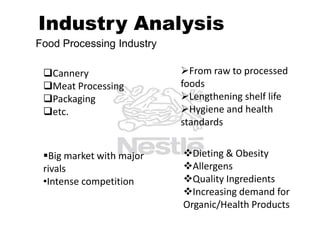
Industry Analysis
Food Processing Industry
Cannery
Meat Processing
Packaging
etc.

From raw to processed
foods
Lengthening shelf life
Hygiene and health
standards

Big market with major
rivals
•Intense competition

Dieting & Obesity
Allergens
Quality Ingredients
Increasing demand for
Organic/Health Products
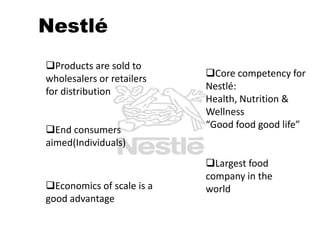
Nestlé
Products are sold to
wholesalers or retailers
for distribution
End consumers
aimed(Individuals)

Economics of scale is a
good advantage

Core competency for
Nestlé:
Health, Nutrition &
Wellness
“Good food good life”
Largest food
company in the
world
Nestlé

Corporate and
organizational culture
- Different stakeholders’ expectations and interactions with
the company and with each other shape the culture of
Nestlé.
- Fairness, honesty and concern for people

- Respect for diverse cultures, and developing long term
relationships with suppliers and customers.
- Commitment to a strong work ethic,integrity, honesty and
quality
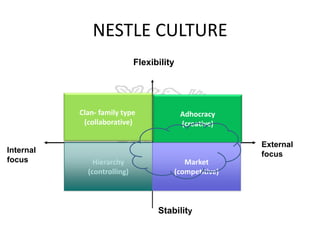
NESTLE CULTURE
Flexibility

Clan- family type
(collaborative)

Internal
focus

Adhocracy
(creative)
External
focus

Hierarchy
(controlling)

Market
(competitive)

Stability
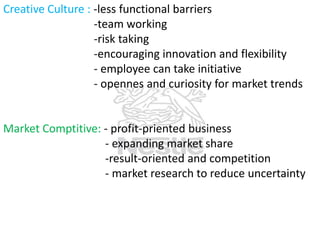
Creative Culture : -less functional barriers
-team working
-risk taking
-encouraging innovation and flexibility
- employee can take initiative
- opennes and curiosity for market trends
Market Comptitive: - profit-priented business
- expanding market share
-result-oriented and competition
- market research to reduce uncertainty
Nestlé Corpoarte Strategy
- Expectations and needs of consumers affect
business strategy and operations
- Strengthening their leadership in the global
market is key element of their corporate
straregy
- series of strategic business units based around
geography and product.
-‘CREATING SHARED VALUE’
-
Differentiation Strategy
-renovation and innovation of the Nestlé
product line
ex: FIRST infant formula, Farine Lactée
spread chocolate, Chokella
instant coffee, Nescafé
chocolate powder drink, Nesquik
coffee creamer, Coffee Mate
coffee mix, Nescafé 3 in 1
the largest R&D network of any food company in the world;
with 32 R&D centers and over 5,000 people directly involved
in R&D

-

- market resarch to provide deep consumer understanding to
create and deliver products, systems and services that its
competitors cannot
-Nestlé uses product differentiation strategy rather than
cost-leaderhip. Why?
Product Quality and Reputation
- the largest R&D network of any food company in the
world; with 32 R&D centers and over 5,000 people directly
involved in R&D
- market resarch to provide deep consumer understanding
to create and deliver products, systems and services that its
competitors cannot
-Nestlé uses product differentiation strategy rather than
cost-leaderhip. Why?
PRODUCT QUALITY AND REPUTATION
Acquisitions and joint ventures
• With the increase in competition, Nestlé has had to
both acquire other companies and
be prepared to enter into joint venture
ex: - alliances with Coca Cola and two Chinese
companies(1993)
- Nestlé and L'Oréal have two successful joint
ventures(2009)
-Nestlé and Colgate-Palmolive
Company(2003)
MISSION AND VISION
• Mission :
The mission of Nestlé nowadays – “Good Food, Good
Life” – is to provide consumers with the best tasting,
most nutritious choices in a wide range of food and
beverage categories and eating occasions and to put a
strong emphasize that leadership is not just about size;
it is also about behavior and trust earned over a long
period of time by consistently delivering on promises .
Vision :
Whether it is in terms of convenience,
health or pleasure, it is committed to
create trustworthy products, systems
and services that contribute to
improving the quality of consumers’
lives.
ORGANAZITIONAL STRUCTURE OF
NESTLE
GLOBAL NESTLE
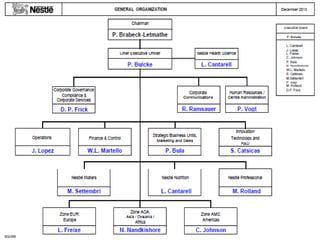
• Nestlé has a Board of Directors, led by
Chairman Peter Brabeck-Letmathe, who was
the former Nestlé CEO.
• The Nestlé Group is managed by geographies
(Zones Europe, Americas and
Asia/Oceania/Africa) for most of the food and
beverage business.Globally managed
businesses
• Vertical oraganazition structure
- Its global center office is in Switzerland but it is not
Swish company but it is a worldwide company in a
sense that Nestlé has about 250 000 shareholders,
none of whom individually own more than 3% of
the shares
NESTLE TURKEY
• the center of Nestle Turkey is in
Maslak,İstanbul.
• Gebze: distributing center
• Karacabey ,Bursa: manufacturing center
• Horizontal oraganazition structure
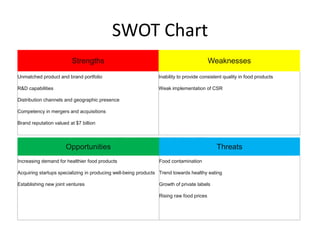
SWOT Chart
Strengths

Weaknesses

Unmatched product and brand portfolio

Inability to provide consistent quality in food products

R&D capabilities

Weak implementation of CSR

Distribution channels and geographic presence
Competency in mergers and acquisitions
Brand reputation valued at $7 billion

Opportunities
Increasing demand for healthier food products

Threats
Food contamination

Acquiring startups specializing in producing well-being products Trend towards healthy eating
Establishing new joint ventures

Growth of private labels
Rising raw food prices
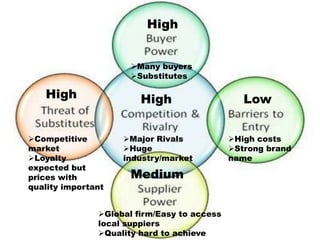
High
Many buyers
Substitutes

High

High

Competitive
market
Loyalty
expected but
prices with
quality important

Low

Major Rivals
Huge
industry/market

High costs
Strong brand
name

Medium

Global firm/Easy to access
local suppiers
Quality hard to achieve
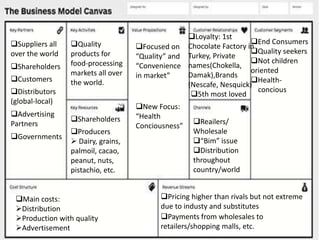
Suppliers all
over the world
Shareholders
Customers
Distributors
(global-local)
Advertising
Partners
Governments

Quality
products for
food-processing
markets all over
the world.

Loyalty: 1st
End Consumers
Focused on Chocolate Factory in
Quality seekers
“Quality” and Turkey, Private
Not children
“Convenience names(Chokella,
oriented
Damak),Brands
in market”
Health(Nescafe, Nesquick)
concious
5th most loved

Shareholders

New Focus:
“Health
Conciousness”

Producers
 Dairy, grains,
palmoil, cacao,
peanut, nuts,
pistachio, etc.

Main costs:
Distribution
Production with quality
Advertisement

Reailers/
Wholesale
“Bim” issue
Distribution
throughout
country/world

Pricing higher than rivals but not extreme
due to industy and substitutes
Payments from wholesales to
retailers/shopping malls, etc.
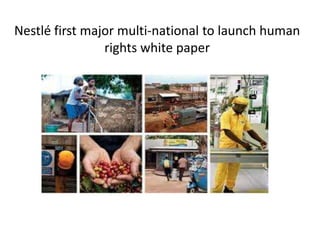
Nestlé first major multi-national to launch human
rights white paper
Social Responsibility
• Nestle’s education programs have reached 9 million people
•Nestle India supports local schools, themaintenance of public parks
and green belts.
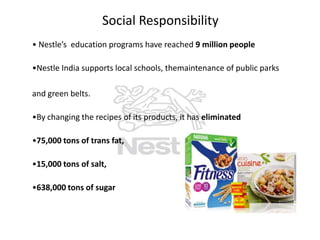
•By changing the recipes of its products, it has eliminated
•75,000 tons of trans fat,
•15,000 tons of salt,

•638,000 tons of sugar
• Water Education Programme in India,
informed the farmers on the
proper use of water.

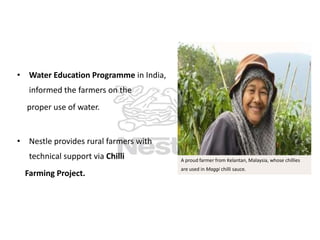
• Nestle provides rural farmers with

technical support via Chilli
Farming Project.

A proud farmer from Kelantan, Malaysia, whose chillies
are used in Maggi chilli sauce.
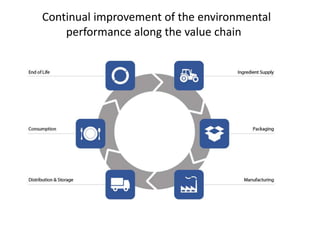
Continual improvement of the environmental
performance along the value chain
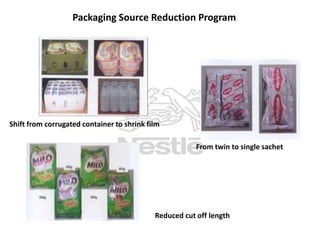
Packaging Source Reduction Program

Shift from corrugated container to shrink film
From twin to single sachet

Reduced cut off length
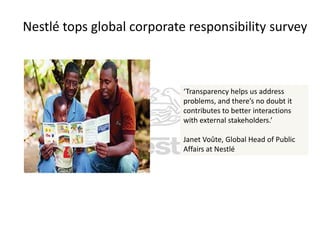
Nestlé tops global corporate responsibility survey

‘Transparency helps us address
problems, and there’s no doubt it
contributes to better interactions
with external stakeholders.’
Janet Voûte, Global Head of Public
Affairs at Nestlé
Challenges of Nestlé
Large Company
• Has issues about flexibility
• Time lost through decision periods

Solutions:
• Regional management empowerment
• Glocalization
Supplier Issues
• Cacao going exstinct in the world
• Natural diseasters such as flood
• Primitive agricultural methods

Solutions:
• Education to farmers
• R&D about seeds and agricultural methods
• Being prepared to crisis
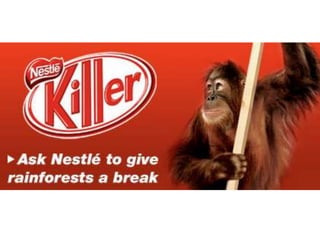
Image Problems
• Child Labor Issue
• Suggestion of privatization of water sources
• Working conditions
All above creating a very bad image

Solution:
• Legal issues
• Charity and Social Projects
• PR projects
• Better working conditions througout the world
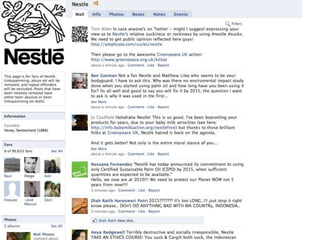
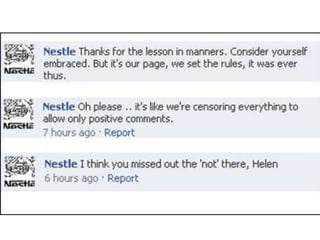
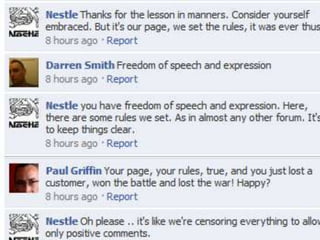
Social Media Usage
• Not much effective in social media
• Losing a channel for customer relationships
• Even not having social media pages is better(!)
Solution:
• Having more appropriate social media usage
Sources
•

•
•
•
•
•
•
•
•

http://blsciblogs.baruch.cuny.edu/mgt4880nestle/2013/04/03/nestle-industryanalysis/
http://www.slideshare.net/arif587/management-of-change-a-study-of-problemand-challenges-in-nestle
http://blogs.position2.com/nestles-pr-crisis-management-nightmare
articles.castelarhost.comhttp://www.nestle.co.uk/
manuscriptservices.co.uk/extras/examples/nestle.pdf
http://www.nestle.com/
http://www.rankia.com/blog/mundodelaempresa/1110186-empresas-nestlefeeds-the-world-in-english
http://en.wikipedia.org/wiki/Nestl%C3%A9
http://businesscasestudies.co.uk/nestle/doing-better-by-the-environment/waysin-which-nestle-is-doing-better-by-the-environment.html#axzz2oQrqLiZX
Thanks for Watching!

Nestle presentation

  • 1.
  • 2.
    Industry Analysis Food ProcessingIndustry Cannery Meat Processing Packaging etc. From raw to processed foods Lengthening shelf life Hygiene and health standards Big market with major rivals •Intense competition Dieting & Obesity Allergens Quality Ingredients Increasing demand for Organic/Health Products
  • 3.
    Nestlé Products are soldto wholesalers or retailers for distribution End consumers aimed(Individuals) Economics of scale is a good advantage Core competency for Nestlé: Health, Nutrition & Wellness “Good food good life” Largest food company in the world
  • 4.
  • 5.
    - Different stakeholders’expectations and interactions with the company and with each other shape the culture of Nestlé. - Fairness, honesty and concern for people - Respect for diverse cultures, and developing long term relationships with suppliers and customers. - Commitment to a strong work ethic,integrity, honesty and quality
  • 6.
    NESTLE CULTURE Flexibility Clan- familytype (collaborative) Internal focus Adhocracy (creative) External focus Hierarchy (controlling) Market (competitive) Stability
  • 7.
    Creative Culture :-less functional barriers -team working -risk taking -encouraging innovation and flexibility - employee can take initiative - opennes and curiosity for market trends Market Comptitive: - profit-priented business - expanding market share -result-oriented and competition - market research to reduce uncertainty
  • 9.
    Nestlé Corpoarte Strategy -Expectations and needs of consumers affect business strategy and operations - Strengthening their leadership in the global market is key element of their corporate straregy - series of strategic business units based around geography and product. -‘CREATING SHARED VALUE’ -
  • 10.
    Differentiation Strategy -renovation andinnovation of the Nestlé product line ex: FIRST infant formula, Farine Lactée spread chocolate, Chokella instant coffee, Nescafé chocolate powder drink, Nesquik coffee creamer, Coffee Mate coffee mix, Nescafé 3 in 1
  • 11.
    the largest R&Dnetwork of any food company in the world; with 32 R&D centers and over 5,000 people directly involved in R&D - - market resarch to provide deep consumer understanding to create and deliver products, systems and services that its competitors cannot -Nestlé uses product differentiation strategy rather than cost-leaderhip. Why? Product Quality and Reputation
  • 12.
    - the largestR&D network of any food company in the world; with 32 R&D centers and over 5,000 people directly involved in R&D - market resarch to provide deep consumer understanding to create and deliver products, systems and services that its competitors cannot -Nestlé uses product differentiation strategy rather than cost-leaderhip. Why? PRODUCT QUALITY AND REPUTATION
  • 13.
    Acquisitions and jointventures • With the increase in competition, Nestlé has had to both acquire other companies and be prepared to enter into joint venture ex: - alliances with Coca Cola and two Chinese companies(1993) - Nestlé and L'Oréal have two successful joint ventures(2009) -Nestlé and Colgate-Palmolive Company(2003)
  • 14.
    MISSION AND VISION •Mission : The mission of Nestlé nowadays – “Good Food, Good Life” – is to provide consumers with the best tasting, most nutritious choices in a wide range of food and beverage categories and eating occasions and to put a strong emphasize that leadership is not just about size; it is also about behavior and trust earned over a long period of time by consistently delivering on promises .
  • 15.
    Vision : Whether itis in terms of convenience, health or pleasure, it is committed to create trustworthy products, systems and services that contribute to improving the quality of consumers’ lives.
  • 16.
  • 18.
    GLOBAL NESTLE • Nestléhas a Board of Directors, led by Chairman Peter Brabeck-Letmathe, who was the former Nestlé CEO. • The Nestlé Group is managed by geographies (Zones Europe, Americas and Asia/Oceania/Africa) for most of the food and beverage business.Globally managed businesses • Vertical oraganazition structure
  • 19.
    - Its globalcenter office is in Switzerland but it is not Swish company but it is a worldwide company in a sense that Nestlé has about 250 000 shareholders, none of whom individually own more than 3% of the shares
  • 20.
    NESTLE TURKEY • thecenter of Nestle Turkey is in Maslak,İstanbul. • Gebze: distributing center • Karacabey ,Bursa: manufacturing center • Horizontal oraganazition structure
  • 21.
    SWOT Chart Strengths Weaknesses Unmatched productand brand portfolio Inability to provide consistent quality in food products R&D capabilities Weak implementation of CSR Distribution channels and geographic presence Competency in mergers and acquisitions Brand reputation valued at $7 billion Opportunities Increasing demand for healthier food products Threats Food contamination Acquiring startups specializing in producing well-being products Trend towards healthy eating Establishing new joint ventures Growth of private labels Rising raw food prices
  • 22.
    High Many buyers Substitutes High High Competitive market Loyalty expected but priceswith quality important Low Major Rivals Huge industry/market High costs Strong brand name Medium Global firm/Easy to access local suppiers Quality hard to achieve
  • 23.
    Suppliers all over theworld Shareholders Customers Distributors (global-local) Advertising Partners Governments Quality products for food-processing markets all over the world. Loyalty: 1st End Consumers Focused on Chocolate Factory in Quality seekers “Quality” and Turkey, Private Not children “Convenience names(Chokella, oriented Damak),Brands in market” Health(Nescafe, Nesquick) concious 5th most loved Shareholders New Focus: “Health Conciousness” Producers  Dairy, grains, palmoil, cacao, peanut, nuts, pistachio, etc. Main costs: Distribution Production with quality Advertisement Reailers/ Wholesale “Bim” issue Distribution throughout country/world Pricing higher than rivals but not extreme due to industy and substitutes Payments from wholesales to retailers/shopping malls, etc.
  • 24.
    Nestlé first majormulti-national to launch human rights white paper
  • 25.
    Social Responsibility • Nestle’seducation programs have reached 9 million people •Nestle India supports local schools, themaintenance of public parks and green belts. •By changing the recipes of its products, it has eliminated •75,000 tons of trans fat, •15,000 tons of salt, •638,000 tons of sugar
  • 26.
    • Water EducationProgramme in India, informed the farmers on the proper use of water. • Nestle provides rural farmers with technical support via Chilli Farming Project. A proud farmer from Kelantan, Malaysia, whose chillies are used in Maggi chilli sauce.
  • 27.
    Continual improvement ofthe environmental performance along the value chain
  • 28.
    Packaging Source ReductionProgram Shift from corrugated container to shrink film From twin to single sachet Reduced cut off length
  • 29.
    Nestlé tops globalcorporate responsibility survey ‘Transparency helps us address problems, and there’s no doubt it contributes to better interactions with external stakeholders.’ Janet Voûte, Global Head of Public Affairs at Nestlé
  • 30.
  • 31.
    Large Company • Hasissues about flexibility • Time lost through decision periods Solutions: • Regional management empowerment • Glocalization
  • 32.
    Supplier Issues • Cacaogoing exstinct in the world • Natural diseasters such as flood • Primitive agricultural methods Solutions: • Education to farmers • R&D about seeds and agricultural methods • Being prepared to crisis
  • 33.
    Image Problems • ChildLabor Issue • Suggestion of privatization of water sources • Working conditions All above creating a very bad image Solution: • Legal issues • Charity and Social Projects • PR projects • Better working conditions througout the world
  • 38.
    Social Media Usage •Not much effective in social media • Losing a channel for customer relationships • Even not having social media pages is better(!) Solution: • Having more appropriate social media usage
  • 39.
  • 40.