Submitted By – Aditi Dua
Introduction
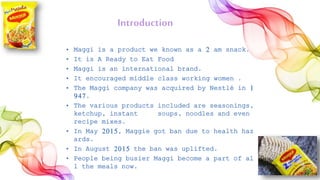
• Maggi is a product we known as a 2 am snack.
• It is A Ready to Eat Food
• Maggi is an international brand.
• It encouraged middle class working women .
• The Maggi company was acquired by Nestlé in 1
947.
• The various products included are seasonings,
ketchup, instant soups, noodles and even
recipe mixes.
• In May 2015, Maggie got ban due to health haz
ards.
• In August 2015 the ban was uplifted.
• People being busier Maggi become a part of al
l the meals now.
History ofMaggi
• The company originated in Switzerland in 1884
• Julius Maggi took over his father's mill.
• He aiming to improve the nutritional intake of worker
families.
• Maggi was the first to bring protein-rich legume meal
s to the market.
• In 1897, Julius Maggi founded the company Maggi GmbH
in Singe, Germany
• In 1947, Maggi was now owned by the Nestlé company to
form Nestlé- Alimentana S.A.
• In 1983, Maggi was first launched in India
Marketing Strategies of Maggi
• It was introduced as a 2- minute noodle
• It’s 1st tagline was - ‘Make the most of it’ and slogan was – ‘
Jab bhook ko ho jaldi mitana 2-minutes Maggi noodle banana
’
• Then it changed it’s flavor from written as “Masala” to “Your fa
vorite masala taste”
• Cup Noodles were introduced.
• It’s pack of 8 was known as “Hangrooo” and tag line became “Mumm
y I am Hungry”
• Then in TV Ad’s they also introduced a song – School
se aate roz chillate Maggi Maggi Maggi
• Atta Maggie was launched
• Also in association with Hindustan Uniliver They Intr
oduced “2 minutes for Education”
• The Oat’s Noodles were also launched
• Then the tagline was again changed to “Taste bhi Heal
th bhi”
• And lastly it became to “Aao kuch Acha Pakkaye”
The exact story of the BAN
• It all started from Barabanki, a district
of Uttar Pradesh, India
• Where it was reported that samples of ‘Mag
gi’ had unexpectedly high
levels of monosodium glutamate.
• Also seventeen times the permissible limit
of lead was present.
• A repeat test at the Central Food Laborato
ry in Kolkata, was conducted.
• The Gorakhpur lab tested for (MSG) to chec
k Nestlé's claim that Maggi had none of
it.
• MSG; in addition and very high quantities
of lead, 17.2 parts per million, was found
according to U.P. authorities.
Maggi instant noodles came under the scanner for t
hree main reasons.
1. The violation for adding lead and MSG into th
e product.
2. The second offence was mentioning 'No added MSG
'
on the packaging, which is an act of mislabeling.
3. It launched 'Maggi Oats Masala Noodles' witho
ut meeting the
appropriate norms of standardization.
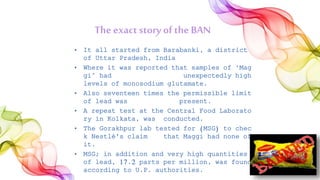
• On June 5, 2015, a nationwide ban was imposed o
n Maggi by FSSAI .
• Prior to the ban, Maggi owned nearly 80% of th
e market share in the instant noodles segment
.
• The crisis was serious and it was a state of emergen
cy for Nestle India.
• The company was not prepared for it neither it had a
ny immediate plan of action to overcome it.
• They only played with fire by initially denying th
e allegations.
• But when proven guilty for the second time, the cus
tomers were furious.
• There were mass protests by Maggi lovers who were hu
rt by the severe breach of trust.
• Maggi was losing not only its market share but als
o credibility.
• A three decade long relationship was at stake.
• It was time to act before it was too late.
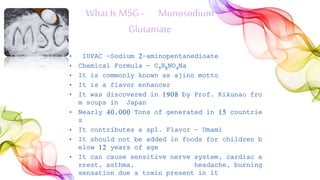
WhatIs MSG- Monosodium
Glutamate
• IUPAC -Sodium 2-aminopentanedioate
• Chemical Formula - C5H8NO4Na
• It is commonly known as ajino motto
• It is a flavor enhancer
• It was discovered in 1908 by Prof. Kikunao fro
m soups in Japan
• Nearly 40,000 Tons of generated in 15 countrie
s
• It contributes a spl. Flavor – Umami
• It should not be added in foods for children b
elow 12 years of age
• It can cause sensitive nerve system, cardiac a
rrest, asthma, headache, burning
sensation due a toxin present in it
The Charges Imposed
• IPC SECTION 270 (malignant act likely t
o spread infection of disease dangerous
to life)
• IPC SECTION 273 (sale of noxious food o
r drink)
• IPC SECTION 276 ( sale of drug as a dif
ferent drug or preparation)
• IPC SECTION 420 (cheating and dishonest
y)
Time Line
• 3rd June 2015, the New Delhi Government banned t
he sale of Maggi in New Delhi stores for 15 day
s.
• 4th June 2015, Gujarat FDA banned the noodles fo
r 30 days after 27 out of 39 samples were dete
cted with objectionable levels of metallic lead.
Assam had also banned sale, distribution and sto
rage of Maggi’s “extra delicious chicken noodles
” variety for 30 days
• 5th June 2015, FSSAI ordered a recall of all nin
e approved variants of from India.
On the same day, Food Safety Agency of United K
ingdom launched an investigation to find le
vels of lead in Maggi noodles.
• 6th June 2015, the Central Government of India b
anned nationwide sale of Maggi noodles for an in
definite period.
• Nepal also indefinitely banned Maggi over concer
ns about lead levels in the product.
• Maggi noodles has been withdrawn in five African
nations- Kenya, Uganda, Tanzania, Rwanda and
South Sudan by a super market chain after a comp
laint by the Consumer Federation of Kenya.
• After the complaint from the FDA in U.P., the F
ood Minister of India, Mr. Ram Vilas Paswan dire
cted the Food Safety and Standards A
uthority of India (FSSAI), to conduct the nation
wide test on Maggi.
Company’s Crisis Management Time Lin
e
• 21st May 2015 –A statement on their website sa
id that “The quality and safety of
our products are the top priorities for our
Company. We have in place strict food safety a
nd quality controls at out Maggi factories… W
e do not add MSG to Maggi Noodles and glut
amate, if present, may come from naturally occ
urring sources.”
• 1st June –On the official Maggi noodles India
Facebook page, Twitter and website, Ne
stlé states that extensive testing reveals no
excess lead in Maggi noodles
• 2nd June – Nestlé interacts with customers on
social media thanking them for t
heir support. Also Nestlé explained the
• 3rd June – Nestlé launches a FAQ page on th
e official Nestlé website
• 4th June – Nestlé recalls all Maggi noodles
from India Nestlé CEO Paul Bulcke said
that “We are working with authorities to c
larify the situation and in the meantime Ne
stlé will be withdrawing Magg
i noodles from shelves.”
• 16th June –Nestlé decided to destroy more t
han $50million worth of Maggi Noodl
es in India.
Loss To The Company
• A net profit of Rs. 287.8 crore in the cor
responding quarter in 2014 and a profit o
f Rs. 320 crore in the previous quarter
ended March 2015.
• This loss mainly due to ban on Maggi ,acco
unts for close to 20 % of Nestle India’
s revenue.
• Nestle India reported 20.1% decline in net
overall sales during the quarter.
• The net domestic sales decreased by 20.6%.
This comes as a setback to the firm that
registered record profits in the last
few quarters.
• Net sales worth Rs. 288.4 crore has been r
eversed.
To hit ball at the moment
 These company’s were the rival of the Ma
ggi noodle –
• Japan based Nissin Group’s ‘Top Ramen’,
- it even roped in Shah Rukh Khan as the
brand ambassador, but failed to get i
ts distribution network in place. The br
and had entered into a distributi
on tie-up with Marico, the owners of Saf
fola and Parachute.
• Nepal based CG Foods ‘Wai-Wai’ Noodles.
It was restricted to the eastern market
of West Bengal and Sikkim, where it c
ontrolled 70% of the market
 These companies surely tried to hit the ball ha
rd at the moment –
• ITC launched Sunfeast Yippee.
• Unilever, too, tried to create some competition
with Knorr Soupy Noodles.
• One reason why we see a spurt in this category
is that it is still growing at the
rate of 23%.
• Baba Ramdev launched a Patanjali noodles in 70
gram packs at Rs. 15 per packet on 16th Novembe
r 2015.
• Soon after its launch it got into major trouble
. The noodles packet displayed a license number
from FSSAI. But when Mr. Ashish Bahuguna, Ch
airperson of FSSAI said that no license has bee
n granted to Patanjali
• The biggest new competitor for Maggi will be Pa
Recent Reports
• In Nov 2017 at shahjahanpur, UP administ
ration reviled that ash contain is above
the prescribe limit.
• Administration decide to impose a fine o
f Rs 45 lakh on Nestle India. And a fine
of Rs 17 lakh on Nestle distributors in
the region.
• Ash contain both compounds with essentia
l minerals (k, cal) and toxic materials
(mercury)
RecentCFTRI Reports
• CFTRI submitted analysis reports on MAGGI Noodles to
the Hon’ble Supreme Court.
• CFTRI has clarified that the glutamic acid can be due
to presence of ingredients like t
omatoes, Cheese, Hydrolyzed Plant Protein, Hydrolyzed
Vegetable Protein etc.
• It has further stated that there are no analytical me
thods to distinguish between naturally pr
esent glutamic acid and additive MSG.
CFTRI has clarified that glutamic acid can
be due to presence of ingredients like
tomatoes, cheese, hydrolyzed plant protein,
hydrolyzed vegetable protein. It has
further stated that there are no analytical
methods to distinguish between naturally
present glutamic acid and additive MSG.
Submitted by
– Aditi Dua

Maggi case study

  • 1.
  • 2.
    Introduction • Maggi isa product we known as a 2 am snack. • It is A Ready to Eat Food • Maggi is an international brand. • It encouraged middle class working women . • The Maggi company was acquired by Nestlé in 1 947. • The various products included are seasonings, ketchup, instant soups, noodles and even recipe mixes. • In May 2015, Maggie got ban due to health haz ards. • In August 2015 the ban was uplifted. • People being busier Maggi become a part of al l the meals now.
  • 3.
    History ofMaggi • Thecompany originated in Switzerland in 1884 • Julius Maggi took over his father's mill. • He aiming to improve the nutritional intake of worker families. • Maggi was the first to bring protein-rich legume meal s to the market. • In 1897, Julius Maggi founded the company Maggi GmbH in Singe, Germany • In 1947, Maggi was now owned by the Nestlé company to form Nestlé- Alimentana S.A. • In 1983, Maggi was first launched in India
  • 4.
    Marketing Strategies ofMaggi • It was introduced as a 2- minute noodle • It’s 1st tagline was - ‘Make the most of it’ and slogan was – ‘ Jab bhook ko ho jaldi mitana 2-minutes Maggi noodle banana ’ • Then it changed it’s flavor from written as “Masala” to “Your fa vorite masala taste” • Cup Noodles were introduced. • It’s pack of 8 was known as “Hangrooo” and tag line became “Mumm y I am Hungry”
  • 5.
    • Then inTV Ad’s they also introduced a song – School se aate roz chillate Maggi Maggi Maggi • Atta Maggie was launched • Also in association with Hindustan Uniliver They Intr oduced “2 minutes for Education” • The Oat’s Noodles were also launched • Then the tagline was again changed to “Taste bhi Heal th bhi” • And lastly it became to “Aao kuch Acha Pakkaye”
  • 6.
    The exact storyof the BAN • It all started from Barabanki, a district of Uttar Pradesh, India • Where it was reported that samples of ‘Mag gi’ had unexpectedly high levels of monosodium glutamate. • Also seventeen times the permissible limit of lead was present. • A repeat test at the Central Food Laborato ry in Kolkata, was conducted. • The Gorakhpur lab tested for (MSG) to chec k Nestlé's claim that Maggi had none of it. • MSG; in addition and very high quantities of lead, 17.2 parts per million, was found according to U.P. authorities.
  • 7.
    Maggi instant noodlescame under the scanner for t hree main reasons. 1. The violation for adding lead and MSG into th e product. 2. The second offence was mentioning 'No added MSG ' on the packaging, which is an act of mislabeling. 3. It launched 'Maggi Oats Masala Noodles' witho ut meeting the appropriate norms of standardization. • On June 5, 2015, a nationwide ban was imposed o n Maggi by FSSAI . • Prior to the ban, Maggi owned nearly 80% of th e market share in the instant noodles segment .
  • 8.
    • The crisiswas serious and it was a state of emergen cy for Nestle India. • The company was not prepared for it neither it had a ny immediate plan of action to overcome it. • They only played with fire by initially denying th e allegations. • But when proven guilty for the second time, the cus tomers were furious. • There were mass protests by Maggi lovers who were hu rt by the severe breach of trust. • Maggi was losing not only its market share but als o credibility. • A three decade long relationship was at stake. • It was time to act before it was too late.
  • 9.
    WhatIs MSG- Monosodium Glutamate •IUPAC -Sodium 2-aminopentanedioate • Chemical Formula - C5H8NO4Na • It is commonly known as ajino motto • It is a flavor enhancer • It was discovered in 1908 by Prof. Kikunao fro m soups in Japan • Nearly 40,000 Tons of generated in 15 countrie s • It contributes a spl. Flavor – Umami • It should not be added in foods for children b elow 12 years of age • It can cause sensitive nerve system, cardiac a rrest, asthma, headache, burning sensation due a toxin present in it
  • 10.
    The Charges Imposed •IPC SECTION 270 (malignant act likely t o spread infection of disease dangerous to life) • IPC SECTION 273 (sale of noxious food o r drink) • IPC SECTION 276 ( sale of drug as a dif ferent drug or preparation) • IPC SECTION 420 (cheating and dishonest y)
  • 11.
    Time Line • 3rdJune 2015, the New Delhi Government banned t he sale of Maggi in New Delhi stores for 15 day s. • 4th June 2015, Gujarat FDA banned the noodles fo r 30 days after 27 out of 39 samples were dete cted with objectionable levels of metallic lead. Assam had also banned sale, distribution and sto rage of Maggi’s “extra delicious chicken noodles ” variety for 30 days • 5th June 2015, FSSAI ordered a recall of all nin e approved variants of from India. On the same day, Food Safety Agency of United K ingdom launched an investigation to find le vels of lead in Maggi noodles.
  • 12.
    • 6th June2015, the Central Government of India b anned nationwide sale of Maggi noodles for an in definite period. • Nepal also indefinitely banned Maggi over concer ns about lead levels in the product. • Maggi noodles has been withdrawn in five African nations- Kenya, Uganda, Tanzania, Rwanda and South Sudan by a super market chain after a comp laint by the Consumer Federation of Kenya. • After the complaint from the FDA in U.P., the F ood Minister of India, Mr. Ram Vilas Paswan dire cted the Food Safety and Standards A uthority of India (FSSAI), to conduct the nation wide test on Maggi.
  • 13.
    Company’s Crisis ManagementTime Lin e • 21st May 2015 –A statement on their website sa id that “The quality and safety of our products are the top priorities for our Company. We have in place strict food safety a nd quality controls at out Maggi factories… W e do not add MSG to Maggi Noodles and glut amate, if present, may come from naturally occ urring sources.” • 1st June –On the official Maggi noodles India Facebook page, Twitter and website, Ne stlé states that extensive testing reveals no excess lead in Maggi noodles • 2nd June – Nestlé interacts with customers on social media thanking them for t heir support. Also Nestlé explained the
  • 14.
    • 3rd June– Nestlé launches a FAQ page on th e official Nestlé website • 4th June – Nestlé recalls all Maggi noodles from India Nestlé CEO Paul Bulcke said that “We are working with authorities to c larify the situation and in the meantime Ne stlé will be withdrawing Magg i noodles from shelves.” • 16th June –Nestlé decided to destroy more t han $50million worth of Maggi Noodl es in India.
  • 15.
    Loss To TheCompany • A net profit of Rs. 287.8 crore in the cor responding quarter in 2014 and a profit o f Rs. 320 crore in the previous quarter ended March 2015. • This loss mainly due to ban on Maggi ,acco unts for close to 20 % of Nestle India’ s revenue. • Nestle India reported 20.1% decline in net overall sales during the quarter. • The net domestic sales decreased by 20.6%. This comes as a setback to the firm that registered record profits in the last few quarters. • Net sales worth Rs. 288.4 crore has been r eversed.
  • 16.
    To hit ballat the moment  These company’s were the rival of the Ma ggi noodle – • Japan based Nissin Group’s ‘Top Ramen’, - it even roped in Shah Rukh Khan as the brand ambassador, but failed to get i ts distribution network in place. The br and had entered into a distributi on tie-up with Marico, the owners of Saf fola and Parachute. • Nepal based CG Foods ‘Wai-Wai’ Noodles. It was restricted to the eastern market of West Bengal and Sikkim, where it c ontrolled 70% of the market
  • 17.
     These companiessurely tried to hit the ball ha rd at the moment – • ITC launched Sunfeast Yippee. • Unilever, too, tried to create some competition with Knorr Soupy Noodles. • One reason why we see a spurt in this category is that it is still growing at the rate of 23%. • Baba Ramdev launched a Patanjali noodles in 70 gram packs at Rs. 15 per packet on 16th Novembe r 2015. • Soon after its launch it got into major trouble . The noodles packet displayed a license number from FSSAI. But when Mr. Ashish Bahuguna, Ch airperson of FSSAI said that no license has bee n granted to Patanjali • The biggest new competitor for Maggi will be Pa
  • 18.
    Recent Reports • InNov 2017 at shahjahanpur, UP administ ration reviled that ash contain is above the prescribe limit. • Administration decide to impose a fine o f Rs 45 lakh on Nestle India. And a fine of Rs 17 lakh on Nestle distributors in the region. • Ash contain both compounds with essentia l minerals (k, cal) and toxic materials (mercury)
  • 19.
    RecentCFTRI Reports • CFTRIsubmitted analysis reports on MAGGI Noodles to the Hon’ble Supreme Court. • CFTRI has clarified that the glutamic acid can be due to presence of ingredients like t omatoes, Cheese, Hydrolyzed Plant Protein, Hydrolyzed Vegetable Protein etc. • It has further stated that there are no analytical me thods to distinguish between naturally pr esent glutamic acid and additive MSG. CFTRI has clarified that glutamic acid can be due to presence of ingredients like tomatoes, cheese, hydrolyzed plant protein, hydrolyzed vegetable protein. It has further stated that there are no analytical methods to distinguish between naturally present glutamic acid and additive MSG.
  • 20.