PROJECT ON
  THEORIES OF INFLATION

PREPARED BY:- SHAGUN,SACHIN,DIVYA,
        SOUMYA & MEHJABI
INFLATION
 “Inflation is a state of generally rising prices and
 falling value of money”

It is a rise in general level of prices of goods and services in
 an economy over a period of time and subsequently, the
 purchasing power is falling.
It is an increase in the quantity of money which is growing
 faster than real national output is expanding.
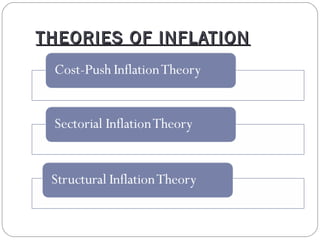
THEORIES OF INFLATION
Cost-Push Inflation Theor y
In the words of J.C Ranlert, “The basis of cost push
theory of inflation is that organised groups,
both business and labour, establish higher prices
for their products or services than would
prevail in perfectly competitive markets.”

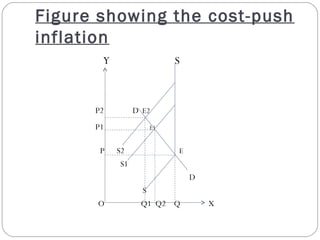
Thus → cost-push inflation is caused by an increase in
cost of production that results in a fall in aggregate
supply.
Figure showing the cost-push
inflation
       Y                 S


      P2         D E2
      P1            E1


       P   S2            E
            S1
                             D
                  S
      O           Q1 Q2 Q        X
Causes of Cost-Push Inflation


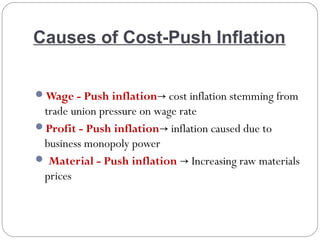
Wage - Push inflation→ cost inflation stemming from
 trade union pressure on wage rate
Profit - Push inflation→ inflation caused due to
 business monopoly power
 Material - Push inflation → Increasing raw materials
 prices
THEORIES OF INFLATION
 SECTORIAL INFLATION
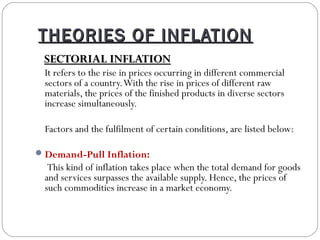
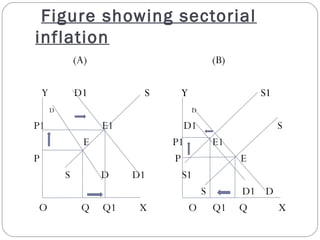
  It refers to the rise in prices occurring in different commercial
  sectors of a country. With the rise in prices of different raw
  materials, the prices of the finished products in diverse sectors
  increase simultaneously.

  Factors and the fulfilment of certain conditions, are listed below:

 Demand-Pull Inflation:
   This kind of inflation takes place when the total demand for goods
  and services surpasses the available supply. Hence, the prices of
  such commodities increase in a market economy.
THEORIES OF
INFLATION(Contd)..
INFLATION
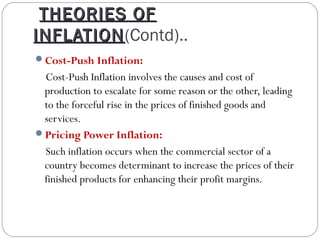
Cost-Push Inflation:
 Cost-Push Inflation involves the causes and cost of
 production to escalate for some reason or the other, leading
 to the forceful rise in the prices of finished goods and
 services.
Pricing Power Inflation:
 Such inflation occurs when the commercial sector of a
 country becomes determinant to increase the prices of their
 finished products for enhancing their profit margins.
Figure showing sectorial
inflation
                (A)                          (B)

    Y           D1          S    Y                     S1
        D                            D

P1                    E1          D1                        S
                  E             P1           E1
P                               P                  E
            S         D    D1     S1
                                         S         D1 D
O                Q    Q1    X        O       Q1    Q    X
STRUCTURAL INFLATION
THEORY
“STRUCTURAL” inflation arise due to unstable and slower
growth rate of export in the economy which is inadequate to
support the required growth rate of the economy.
A uniform rate of growth of money wages throughout the
economy must lead to permanent cost pressures in the
service sector, which is assumed to have the lower
productivity growth.

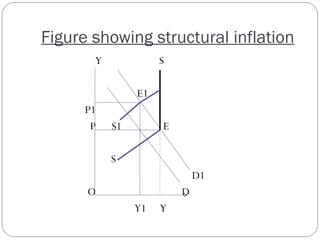
Thus, structural inflation results from supply inelasticies
leading to rise in agricultural prices and costs.
Figure showing structural inflation
       Y             S

                E1
      P1
       P   S1        E

           S
                             D1
      O                  D
                Y1   Y
THANK
YOU

Theories of Inflation

  • 1.
    PROJECT ON THEORIES OF INFLATION PREPARED BY:- SHAGUN,SACHIN,DIVYA, SOUMYA & MEHJABI
  • 2.
    INFLATION “Inflation isa state of generally rising prices and falling value of money” It is a rise in general level of prices of goods and services in an economy over a period of time and subsequently, the purchasing power is falling. It is an increase in the quantity of money which is growing faster than real national output is expanding.
  • 3.
  • 4.
    Cost-Push Inflation Theory In the words of J.C Ranlert, “The basis of cost push theory of inflation is that organised groups, both business and labour, establish higher prices for their products or services than would prevail in perfectly competitive markets.” Thus → cost-push inflation is caused by an increase in cost of production that results in a fall in aggregate supply.
  • 5.
    Figure showing thecost-push inflation Y S P2 D E2 P1 E1 P S2 E S1 D S O Q1 Q2 Q X
  • 6.
    Causes of Cost-PushInflation Wage - Push inflation→ cost inflation stemming from trade union pressure on wage rate Profit - Push inflation→ inflation caused due to business monopoly power  Material - Push inflation → Increasing raw materials prices
  • 7.
    THEORIES OF INFLATION SECTORIAL INFLATION It refers to the rise in prices occurring in different commercial sectors of a country. With the rise in prices of different raw materials, the prices of the finished products in diverse sectors increase simultaneously. Factors and the fulfilment of certain conditions, are listed below:  Demand-Pull Inflation: This kind of inflation takes place when the total demand for goods and services surpasses the available supply. Hence, the prices of such commodities increase in a market economy.
  • 8.
    THEORIES OF INFLATION(Contd).. INFLATION Cost-Push Inflation: Cost-Push Inflation involves the causes and cost of production to escalate for some reason or the other, leading to the forceful rise in the prices of finished goods and services. Pricing Power Inflation: Such inflation occurs when the commercial sector of a country becomes determinant to increase the prices of their finished products for enhancing their profit margins.
  • 9.
    Figure showing sectorial inflation (A) (B) Y D1 S Y S1 D D P1 E1 D1 S E P1 E1 P P E S D D1 S1 S D1 D O Q Q1 X O Q1 Q X
  • 10.
    STRUCTURAL INFLATION THEORY “STRUCTURAL” inflationarise due to unstable and slower growth rate of export in the economy which is inadequate to support the required growth rate of the economy. A uniform rate of growth of money wages throughout the economy must lead to permanent cost pressures in the service sector, which is assumed to have the lower productivity growth. Thus, structural inflation results from supply inelasticies leading to rise in agricultural prices and costs.
  • 11.
    Figure showing structuralinflation Y S E1 P1 P S1 E S D1 O D Y1 Y
  • 12.