Investment
Function
VAIBHAV
Introduction
 Consumption depends upon the propensity to consume, which, we have
learnt, in more or less stable in the short period and is less than unity.
Greater reliance, therefore, has to be placed on the other
constituent(investment) of income.
 Out of the two components (consumption and investment) of income,
consumption being stable, fluctuations in effective demand (income)are
to be traced through fluctuations in investment. Investment, thus, comes
to play a strategic role in determining the level of income, output and
employment at a time.
 In order to maintain an equilibrium level of income (Y = C + I)
 According to Psychological Law of Consumption given by Keynes, as
income increases consumption also increases but by less than the
increment in income. This means that a part of the increment in income is
not spent but saved.
Need of the Investment
The savings must be invested to bridge the
gap between an increase in income and
consumption.
If this gap is not plugged by an increase in
investment expenditures, the result would be
an unintended increase in the stocks of goods
(inventories), which in turn, would lead to
depression and mass unemployment.
Meaning investment
 Investment, in Economics, refers to expenditure on the purchase of
such goods which enhance overall production capacity in the
domestic economy. It is an expenditure on fixed assets such as
plant and machinery or expenditure on diverse types.
 In economics, investment means the new expenditure incurred on
addition of capital goods such as machine, buildings ,equipment's,
tools etc.
 In keynes view investment refers real investment which adds to
capital equipment.
 It leads to increase in the level of income, production and
purchase of capital goods.
Types of Investment:
1. Autonomous investment
2. Induced investment
Autonomous investment
 The investment which doesn’t change with the
change in income level and therefore independent
of income is said to be autonomous investment.
 This investment generally taken place in roads ,house
public undertaking and other types of economic
infrastructures such as power transport and
communication.
 This investment depends more on population growth
and technical progress than the level of income.
Autonomous investments are a peculiar
feature of a war or a planned economy,
for example, expenditures on arms and
equipment to strengthen the defence of
India may be called autonomous
investment as it is incurred irrespective of
the level of income or profits. Prof.
Hansen maintained that autonomous
investment is generally associated with
such factors as introduction of new
production techniques, products,
development of new resources or growth
of population.
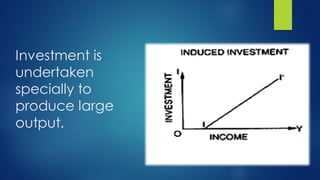
Induced investment:
Induced investment is that investment
which is affected by the change in level
of income
 The investment depends more on
income than on the rate of interest
The induced investment is undertaken
both fixed capital assets and
inventories.
Investment is
undertaken
specially to
produce large
output.
Determinants of induces investment
Marginal Efficiency of Capital
Rate of Interest
Marginal Efficiency of Capital
 Marginal efficiency of capital refers to the expected
profitability by the use of one more unit of capital. It
depends upon two factors:
 1. Prospective Yield: Prospective Yield of a capital good
like, machine, means that net income which is available
during the full life-time of that machine.
 2. Supply Price: Supply refers to the cost of a machine, but
it is not the cost of existing machine but that of a brand
new machine.
Rate of Interest
If money is borrowed from others to
invest, interest will have to be paid
on it. On the contrary, if the
investors has his own money that he
uses in buying government
securities, bonds, etc. he will get
regular interest on it.
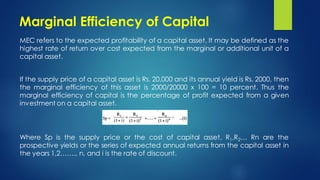
Marginal Efficiency of Capital
MEC refers to the expected profitability of a capital asset. It may be defined as the
highest rate of return over cost expected from the marginal or additional unit of a
capital asset.
If the supply price of a capital asset is Rs. 20,000 and its annual yield is Rs. 2000, then
the marginal efficiency of this asset is 2000/20000 x 100 = 10 percent. Thus the
marginal efficiency of capital is the percentage of profit expected from a given
investment on a capital asset.
Where Sp is the supply price or the cost of capital asset, R1,R2… Rn are the
prospective yields or the series of expected annual returns from the capital asset in
the years 1,2…….. n, and i is the rate of discount.
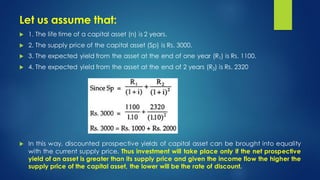
Let us assume that:
 1. The life time of a capital asset (n) is 2 years.
 2. The supply price of the capital asset (Sp) is Rs. 3000.
 3. The expected yield from the asset at the end of one year (R1) is Rs. 1100.
 4. The expected yield from the asset at the end of 2 years (R2) is Rs. 2320
 In this way, discounted prospective yields of capital asset can be brought into equality
with the current supply price. Thus investment will take place only if the net prospective
yield of an asset is greater than its supply price and given the income flow the higher the
supply price of the capital asset, the lower will be the rate of discount.
Theories of investment
 The Accelerator Theory of Investment
 The Flexible Accelerator Theory or Lags in
Investment
 The Profits Theory of Investment
 The Financial Theory of Investment
 Jorgensons’ Neoclassical Theory of Investment
 Tobin’s Q Theory of Investment
 Duesenberry’s Accelerator Theory of Investment
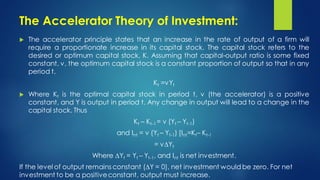
The Accelerator Theory of Investment:
 The accelerator principle states that an increase in the rate of output of a firm will
require a proportionate increase in its capital stock. The capital stock refers to the
desired or optimum capital stock, K. Assuming that capital-output ratio is some fixed
constant, v, the optimum capital stock is a constant proportion of output so that in any
period t,
Kt =vYt
 Where Kt is the optimal capital stock in period t, v (the accelerator) is a positive
constant, and Y is output in period t. Any change in output will lead to a change in the
capital stock. Thus
Kt – Kt-1 = v (Yt – Yt-1)
and Int = v (Yt – Yt-1) [Int=Kt– Kt-1
= v∆Yt
Where ∆Yt = Yt – Yt-1, and Int is net investment.
If the level of output remains constant (∆Y = 0), net investment would be zero. For net
investment to be a positiveconstant, output must increase.
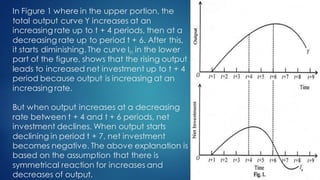
In Figure 1 where in the upper portion, the
total output curve Y increases at an
increasing rate up to t + 4 periods, then at a
decreasing rate up to period t + 6. After this,
it starts diminishing. The curve In in the lower
part of the figure, shows that the rising output
leads to increased net investment up to t + 4
period because output is increasing at an
increasing rate.
But when output increases at a decreasing
rate between t + 4 and t + 6 periods, net
investment declines. When output starts
declining in period t + 7, net investment
becomes negative. The above explanation is
based on the assumption that there is
symmetrical reaction for increases and
decreases of output.
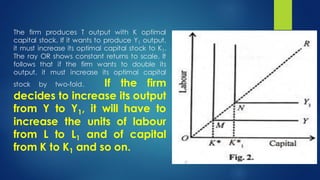
The firm produces T output with K optimal
capital stock. If it wants to produce Y1 output,
it must increase its optimal capital stock to K1.
The ray OR shows constant returns to scale. It
follows that if the firm wants to double its
output, it must increase its optimal capital
stock by two-fold. If the firm
decides to increase its output
from Y to Y1, it will have to
increase the units of labour
from L to L1 and of capital
from K to K1 and so on.
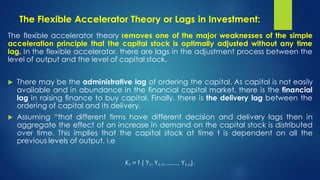
The Flexible Accelerator Theory or Lags in Investment:
The flexible accelerator theory removes one of the major weaknesses of the simple
acceleration principle that the capital stock is optimally adjusted without any time
lag. In the flexible accelerator, there are lags in the adjustment process between the
level of output and the level of capital stock.
 There may be the administrative lag of ordering the capital. As capital is not easily
available and in abundance in the financial capital market, there is the financial
lag in raising finance to buy capital. Finally, there is the delivery lag between the
ordering of capital and its delivery.
 Assuming “that different firms have different decision and delivery lags then in
aggregate the effect of an increase in demand on the capital stock is distributed
over time. This implies that the capital stock at time t is dependent on all the
previous levels of output, i.e
Kt = f ( Yt, Yt-1……., Yt-n).
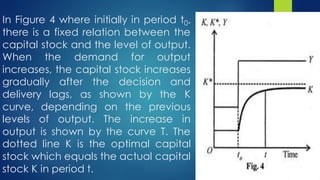
In Figure 4 where initially in period t0,
there is a fixed relation between the
capital stock and the level of output.
When the demand for output
increases, the capital stock increases
gradually after the decision and
delivery lags, as shown by the K
curve, depending on the previous
levels of output. The increase in
output is shown by the curve T. The
dotted line K is the optimal capital
stock which equals the actual capital
stock K in period t.
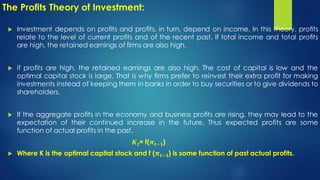
The Profits Theory of Investment:
 Investment depends on profits and profits, in turn, depend on income. In this theory, profits
relate to the level of current profits and of the recent past. If total income and total profits
are high, the retained earnings of firms are also high.
 if profits are high, the retained earnings are also high. The cost of capital is low and the
optimal capital stock is large. That is why firms prefer to reinvest their extra profit for making
investments instead of keeping them in banks in order to buy securities or to give dividends to
shareholders.
 If the aggregate profits in the economy and business profits are rising, they may lead to the
expectation of their continued increase in the future. Thus expected profits are some
function of actual profits in the past,
𝑲𝒕= f(𝝅𝒕−𝟏)
 Where K is the optimal capital stock and f (𝝅𝒕−𝟏) is some function of past actual profits.
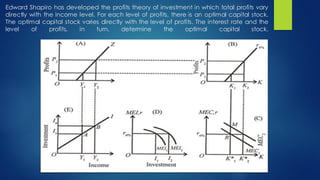
Edward Shapiro has developed the profits theory of investment in which total profits vary
directly with the income level. For each level of profits, there is an optimal capital stock.
The optimal capital stock varies directly with the level of profits. The interest rate and the
level of profits, in turn, determine the optimal capital stock.
In the profits theory of investment, the level of
aggregate profits varies with the level of national
income, and the optimal capital stock varies with the
level of aggregate profits. If at a particular level of
profits, the optimal capital stock exceeds the actual
capital stock, there is increase in investment to meet
the demand for capital. But the relationships between
investment and profits and between aggregate profits
and income are not proportional.
The Financial Theory of Investment
 The financial theory of investment has been developed by
James Duesenberry. It is also known as the cost of capital
theory of investment. The accelerator theories ignore the
role of cost of capital in investment decision by the firm.
 The supply of funds to the firm is very elastic. In reality, an
unlimited supply of funds is not available to the firm in any
time period at the market rate of interest. As more and
more funds are required by it for investment spending, the
cost of funds (rate of interest) rises. To finance investment
spending, the firm may borrow in the market at whatever
interest rate funds are available.
Sources of Funds:
 There are three sources of funds available to the firm
for investment which are grouped under internal
funds and external funds.
 1. Retained Earnings:
 2. Borrowed Funds:
 3. Equity Issue:
Cost of Funds:
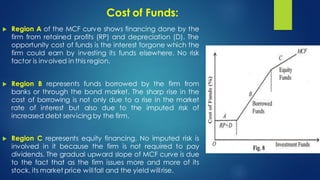
 Region A of the MCF curve shows financing done by the
firm from retained profits (RP) and depreciation (D). The
opportunity cost of funds is the interest forgone which the
firm could earn by investing its funds elsewhere. No risk
factor is involved in this region.
 Region B represents funds borrowed by the firm from
banks or through the bond market. The sharp rise in the
cost of borrowing is not only due to a rise in the market
rate of interest but also due to the imputed risk of
increased debt servicing by the firm.
 Region C represents equity financing. No imputed risk is
involved in it because the firm is not required to pay
dividends. The gradual upward slope of MCF curve is due
to the fact that as the firm issues more and more of its
stock, its market price willfall and the yield willrise.
Amount of investment
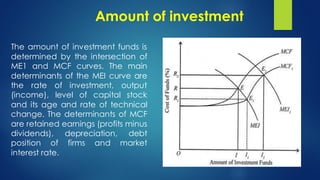
The amount of investment funds is
determined by the intersection of
ME1 and MCF curves. The main
determinants of the MEI curve are
the rate of investment, output
(income), level of capital stock
and its age and rate of technical
change. The determinants of MCF
are retained earnings (profits minus
dividends), depreciation, debt
position of firms and market
interest rate.
Neoclassical Theory of Investment:
 Jorgenson has developed a neoclassical theory of investment. His theory of
investment behaviour is based on the determination of the optimal capital
stock. His investment equation has been derived from the profit maximisation
theory of the firm.
 Jorgenson develops his theory of investment on the assumption that the firm
maximises its present value. In order to explain the present value of the firm, he
takes a production process with a single output (Q), a single variable input
labour (L), and a single capital input (I-investment in durable goods), and p, w,
and q representing their corresponding prices. The flow of net receipts (R) at
time t is givenby
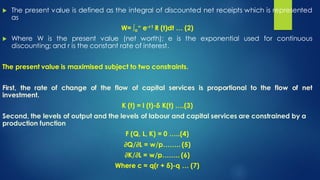
R (t) =p (t) Q (t) – w (t) L (t) – q(t) I(t) ….(1)
 Where Q is output and p is its price; L is the flow of labour services and w the
wage rate; I is investment and q is the price of capital goods.
 The present value is defined as the integral of discounted net receipts which is represented
as
W= ∫o
∞ e-r t R (t)dt … (2)
 Where W is the present value (net worth); e is the exponential used for continuous
discounting; and r is the constant rate of interest.
The present value is maximised subject to two constraints.
First, the rate of change of the flow of capital services is proportional to the flow of net
investment.
K (t) = I (t)-δ K(t) ….(3)
Second, the levels of output and the levels of labour and capital services are constrained by a
production function
F (Q, L, K) = 0 …..(4)
∂Q/∂L = w/p…….. (5)
∂K/∂L = w/p…….. (6)
Where c = q(r + δ)-q … (7)
 Equations (5) and (6) are called “myopic decision criteria”.
There are two reasons for the myopic decision in the case of
capital assets.
 First, it is due to the assumption of no adjustment costs so that
the firm does not gain by delaying the acquisition of capital.
Second, it is the result of the assumption that capital is
homogeneous and it can be bought and sold or rented in a
perfectly competitive market.
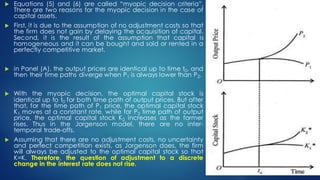
 in Panel (A), the output prices are identical up to time t0, and
then their time paths diverge when P1 is always lower than P2.
 With the myopic decision, the optimal capital stock is
identical up to t0 for both time path of output prices. But after
that, for the time path of P1 price, the optimal capital stock
K1 moves at a constant rate, while for P2 time path of output
price, the optimal capital stock K2 increases as the former
rises. Thus in the Jorgenson model, there are no inter-
temporal trade-offs.
 Assuming that there are no adjustment costs, no uncertainty
and perfect competition exists, as Jorgenson does, the firm
will always be adjusted to the optimal capital stock so that
K=K. Therefore, the question of adjustment to a discrete
change in the interest rate does not rise.
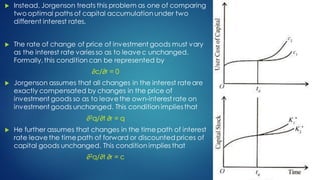
 Instead, Jorgenson treats this problem as one of comparing
two optimal paths of capital accumulation under two
different interest rates.
 The rate of change of price of investment goods must vary
as the interest rate varies so as to leave c unchanged.
Formally,this condition can be represented by
∂c/∂r = 0
 Jorgenson assumes that all changes in the interest rateare
exactly compensated by changes in the price of
investment goods so as to leavethe own-interest rate on
investment goods unchanged. This condition impliesthat
∂2q/∂t ∂r = q
 He further assumes that changes in the time path of interest
rate leave the time path of forward or discounted prices of
capital goods unchanged. This condition implies that
∂2q/∂t ∂r = c


Macro Economics: Investment Function Complete

  • 1.
  • 3.
    Introduction  Consumption dependsupon the propensity to consume, which, we have learnt, in more or less stable in the short period and is less than unity. Greater reliance, therefore, has to be placed on the other constituent(investment) of income.  Out of the two components (consumption and investment) of income, consumption being stable, fluctuations in effective demand (income)are to be traced through fluctuations in investment. Investment, thus, comes to play a strategic role in determining the level of income, output and employment at a time.  In order to maintain an equilibrium level of income (Y = C + I)  According to Psychological Law of Consumption given by Keynes, as income increases consumption also increases but by less than the increment in income. This means that a part of the increment in income is not spent but saved.
  • 4.
    Need of theInvestment The savings must be invested to bridge the gap between an increase in income and consumption. If this gap is not plugged by an increase in investment expenditures, the result would be an unintended increase in the stocks of goods (inventories), which in turn, would lead to depression and mass unemployment.
  • 5.
    Meaning investment  Investment,in Economics, refers to expenditure on the purchase of such goods which enhance overall production capacity in the domestic economy. It is an expenditure on fixed assets such as plant and machinery or expenditure on diverse types.  In economics, investment means the new expenditure incurred on addition of capital goods such as machine, buildings ,equipment's, tools etc.  In keynes view investment refers real investment which adds to capital equipment.  It leads to increase in the level of income, production and purchase of capital goods.
  • 6.
    Types of Investment: 1.Autonomous investment 2. Induced investment
  • 7.
    Autonomous investment  Theinvestment which doesn’t change with the change in income level and therefore independent of income is said to be autonomous investment.  This investment generally taken place in roads ,house public undertaking and other types of economic infrastructures such as power transport and communication.  This investment depends more on population growth and technical progress than the level of income.
  • 8.
    Autonomous investments area peculiar feature of a war or a planned economy, for example, expenditures on arms and equipment to strengthen the defence of India may be called autonomous investment as it is incurred irrespective of the level of income or profits. Prof. Hansen maintained that autonomous investment is generally associated with such factors as introduction of new production techniques, products, development of new resources or growth of population.
  • 9.
    Induced investment: Induced investmentis that investment which is affected by the change in level of income  The investment depends more on income than on the rate of interest The induced investment is undertaken both fixed capital assets and inventories.
  • 10.
  • 11.
    Determinants of inducesinvestment Marginal Efficiency of Capital Rate of Interest
  • 12.
    Marginal Efficiency ofCapital  Marginal efficiency of capital refers to the expected profitability by the use of one more unit of capital. It depends upon two factors:  1. Prospective Yield: Prospective Yield of a capital good like, machine, means that net income which is available during the full life-time of that machine.  2. Supply Price: Supply refers to the cost of a machine, but it is not the cost of existing machine but that of a brand new machine.
  • 13.
    Rate of Interest Ifmoney is borrowed from others to invest, interest will have to be paid on it. On the contrary, if the investors has his own money that he uses in buying government securities, bonds, etc. he will get regular interest on it.
  • 14.
    Marginal Efficiency ofCapital MEC refers to the expected profitability of a capital asset. It may be defined as the highest rate of return over cost expected from the marginal or additional unit of a capital asset. If the supply price of a capital asset is Rs. 20,000 and its annual yield is Rs. 2000, then the marginal efficiency of this asset is 2000/20000 x 100 = 10 percent. Thus the marginal efficiency of capital is the percentage of profit expected from a given investment on a capital asset. Where Sp is the supply price or the cost of capital asset, R1,R2… Rn are the prospective yields or the series of expected annual returns from the capital asset in the years 1,2…….. n, and i is the rate of discount.
  • 15.
    Let us assumethat:  1. The life time of a capital asset (n) is 2 years.  2. The supply price of the capital asset (Sp) is Rs. 3000.  3. The expected yield from the asset at the end of one year (R1) is Rs. 1100.  4. The expected yield from the asset at the end of 2 years (R2) is Rs. 2320  In this way, discounted prospective yields of capital asset can be brought into equality with the current supply price. Thus investment will take place only if the net prospective yield of an asset is greater than its supply price and given the income flow the higher the supply price of the capital asset, the lower will be the rate of discount.
  • 16.
    Theories of investment The Accelerator Theory of Investment  The Flexible Accelerator Theory or Lags in Investment  The Profits Theory of Investment  The Financial Theory of Investment  Jorgensons’ Neoclassical Theory of Investment  Tobin’s Q Theory of Investment  Duesenberry’s Accelerator Theory of Investment
  • 17.
    The Accelerator Theoryof Investment:  The accelerator principle states that an increase in the rate of output of a firm will require a proportionate increase in its capital stock. The capital stock refers to the desired or optimum capital stock, K. Assuming that capital-output ratio is some fixed constant, v, the optimum capital stock is a constant proportion of output so that in any period t, Kt =vYt  Where Kt is the optimal capital stock in period t, v (the accelerator) is a positive constant, and Y is output in period t. Any change in output will lead to a change in the capital stock. Thus Kt – Kt-1 = v (Yt – Yt-1) and Int = v (Yt – Yt-1) [Int=Kt– Kt-1 = v∆Yt Where ∆Yt = Yt – Yt-1, and Int is net investment. If the level of output remains constant (∆Y = 0), net investment would be zero. For net investment to be a positiveconstant, output must increase.
  • 18.
    In Figure 1where in the upper portion, the total output curve Y increases at an increasing rate up to t + 4 periods, then at a decreasing rate up to period t + 6. After this, it starts diminishing. The curve In in the lower part of the figure, shows that the rising output leads to increased net investment up to t + 4 period because output is increasing at an increasing rate. But when output increases at a decreasing rate between t + 4 and t + 6 periods, net investment declines. When output starts declining in period t + 7, net investment becomes negative. The above explanation is based on the assumption that there is symmetrical reaction for increases and decreases of output.
  • 19.
    The firm producesT output with K optimal capital stock. If it wants to produce Y1 output, it must increase its optimal capital stock to K1. The ray OR shows constant returns to scale. It follows that if the firm wants to double its output, it must increase its optimal capital stock by two-fold. If the firm decides to increase its output from Y to Y1, it will have to increase the units of labour from L to L1 and of capital from K to K1 and so on.
  • 20.
    The Flexible AcceleratorTheory or Lags in Investment: The flexible accelerator theory removes one of the major weaknesses of the simple acceleration principle that the capital stock is optimally adjusted without any time lag. In the flexible accelerator, there are lags in the adjustment process between the level of output and the level of capital stock.  There may be the administrative lag of ordering the capital. As capital is not easily available and in abundance in the financial capital market, there is the financial lag in raising finance to buy capital. Finally, there is the delivery lag between the ordering of capital and its delivery.  Assuming “that different firms have different decision and delivery lags then in aggregate the effect of an increase in demand on the capital stock is distributed over time. This implies that the capital stock at time t is dependent on all the previous levels of output, i.e Kt = f ( Yt, Yt-1……., Yt-n).
  • 21.
    In Figure 4where initially in period t0, there is a fixed relation between the capital stock and the level of output. When the demand for output increases, the capital stock increases gradually after the decision and delivery lags, as shown by the K curve, depending on the previous levels of output. The increase in output is shown by the curve T. The dotted line K is the optimal capital stock which equals the actual capital stock K in period t.
  • 22.
    The Profits Theoryof Investment:  Investment depends on profits and profits, in turn, depend on income. In this theory, profits relate to the level of current profits and of the recent past. If total income and total profits are high, the retained earnings of firms are also high.  if profits are high, the retained earnings are also high. The cost of capital is low and the optimal capital stock is large. That is why firms prefer to reinvest their extra profit for making investments instead of keeping them in banks in order to buy securities or to give dividends to shareholders.  If the aggregate profits in the economy and business profits are rising, they may lead to the expectation of their continued increase in the future. Thus expected profits are some function of actual profits in the past, 𝑲𝒕= f(𝝅𝒕−𝟏)  Where K is the optimal capital stock and f (𝝅𝒕−𝟏) is some function of past actual profits.
  • 23.
    Edward Shapiro hasdeveloped the profits theory of investment in which total profits vary directly with the income level. For each level of profits, there is an optimal capital stock. The optimal capital stock varies directly with the level of profits. The interest rate and the level of profits, in turn, determine the optimal capital stock.
  • 24.
    In the profitstheory of investment, the level of aggregate profits varies with the level of national income, and the optimal capital stock varies with the level of aggregate profits. If at a particular level of profits, the optimal capital stock exceeds the actual capital stock, there is increase in investment to meet the demand for capital. But the relationships between investment and profits and between aggregate profits and income are not proportional.
  • 25.
    The Financial Theoryof Investment  The financial theory of investment has been developed by James Duesenberry. It is also known as the cost of capital theory of investment. The accelerator theories ignore the role of cost of capital in investment decision by the firm.  The supply of funds to the firm is very elastic. In reality, an unlimited supply of funds is not available to the firm in any time period at the market rate of interest. As more and more funds are required by it for investment spending, the cost of funds (rate of interest) rises. To finance investment spending, the firm may borrow in the market at whatever interest rate funds are available.
  • 26.
    Sources of Funds: There are three sources of funds available to the firm for investment which are grouped under internal funds and external funds.  1. Retained Earnings:  2. Borrowed Funds:  3. Equity Issue:
  • 27.
    Cost of Funds: Region A of the MCF curve shows financing done by the firm from retained profits (RP) and depreciation (D). The opportunity cost of funds is the interest forgone which the firm could earn by investing its funds elsewhere. No risk factor is involved in this region.  Region B represents funds borrowed by the firm from banks or through the bond market. The sharp rise in the cost of borrowing is not only due to a rise in the market rate of interest but also due to the imputed risk of increased debt servicing by the firm.  Region C represents equity financing. No imputed risk is involved in it because the firm is not required to pay dividends. The gradual upward slope of MCF curve is due to the fact that as the firm issues more and more of its stock, its market price willfall and the yield willrise.
  • 28.
    Amount of investment Theamount of investment funds is determined by the intersection of ME1 and MCF curves. The main determinants of the MEI curve are the rate of investment, output (income), level of capital stock and its age and rate of technical change. The determinants of MCF are retained earnings (profits minus dividends), depreciation, debt position of firms and market interest rate.
  • 29.
    Neoclassical Theory ofInvestment:  Jorgenson has developed a neoclassical theory of investment. His theory of investment behaviour is based on the determination of the optimal capital stock. His investment equation has been derived from the profit maximisation theory of the firm.  Jorgenson develops his theory of investment on the assumption that the firm maximises its present value. In order to explain the present value of the firm, he takes a production process with a single output (Q), a single variable input labour (L), and a single capital input (I-investment in durable goods), and p, w, and q representing their corresponding prices. The flow of net receipts (R) at time t is givenby R (t) =p (t) Q (t) – w (t) L (t) – q(t) I(t) ….(1)  Where Q is output and p is its price; L is the flow of labour services and w the wage rate; I is investment and q is the price of capital goods.
  • 30.
     The presentvalue is defined as the integral of discounted net receipts which is represented as W= ∫o ∞ e-r t R (t)dt … (2)  Where W is the present value (net worth); e is the exponential used for continuous discounting; and r is the constant rate of interest. The present value is maximised subject to two constraints. First, the rate of change of the flow of capital services is proportional to the flow of net investment. K (t) = I (t)-δ K(t) ….(3) Second, the levels of output and the levels of labour and capital services are constrained by a production function F (Q, L, K) = 0 …..(4) ∂Q/∂L = w/p…….. (5) ∂K/∂L = w/p…….. (6) Where c = q(r + δ)-q … (7)
  • 31.
     Equations (5)and (6) are called “myopic decision criteria”. There are two reasons for the myopic decision in the case of capital assets.  First, it is due to the assumption of no adjustment costs so that the firm does not gain by delaying the acquisition of capital. Second, it is the result of the assumption that capital is homogeneous and it can be bought and sold or rented in a perfectly competitive market.  in Panel (A), the output prices are identical up to time t0, and then their time paths diverge when P1 is always lower than P2.  With the myopic decision, the optimal capital stock is identical up to t0 for both time path of output prices. But after that, for the time path of P1 price, the optimal capital stock K1 moves at a constant rate, while for P2 time path of output price, the optimal capital stock K2 increases as the former rises. Thus in the Jorgenson model, there are no inter- temporal trade-offs.  Assuming that there are no adjustment costs, no uncertainty and perfect competition exists, as Jorgenson does, the firm will always be adjusted to the optimal capital stock so that K=K. Therefore, the question of adjustment to a discrete change in the interest rate does not rise.
  • 32.
     Instead, Jorgensontreats this problem as one of comparing two optimal paths of capital accumulation under two different interest rates.  The rate of change of price of investment goods must vary as the interest rate varies so as to leave c unchanged. Formally,this condition can be represented by ∂c/∂r = 0  Jorgenson assumes that all changes in the interest rateare exactly compensated by changes in the price of investment goods so as to leavethe own-interest rate on investment goods unchanged. This condition impliesthat ∂2q/∂t ∂r = q  He further assumes that changes in the time path of interest rate leave the time path of forward or discounted prices of capital goods unchanged. This condition implies that ∂2q/∂t ∂r = c