Prepared By:
BINDU H A
M.Sc. (Agri.)
1
JOHNMAYNARDKEYNES(1883-1946)
He is an English
Economist, Journalist and
Financier, best known for his
economic theories. He is
widely considered to be one of
the most influential economists
and founder of modern
macroeconomics theory. His
ideas are the basis for the
school of thought of Keynesian
Economics.
2
Main Ideas:
Keynesgreatestcontributionishis‘TheoryofEmployment’.
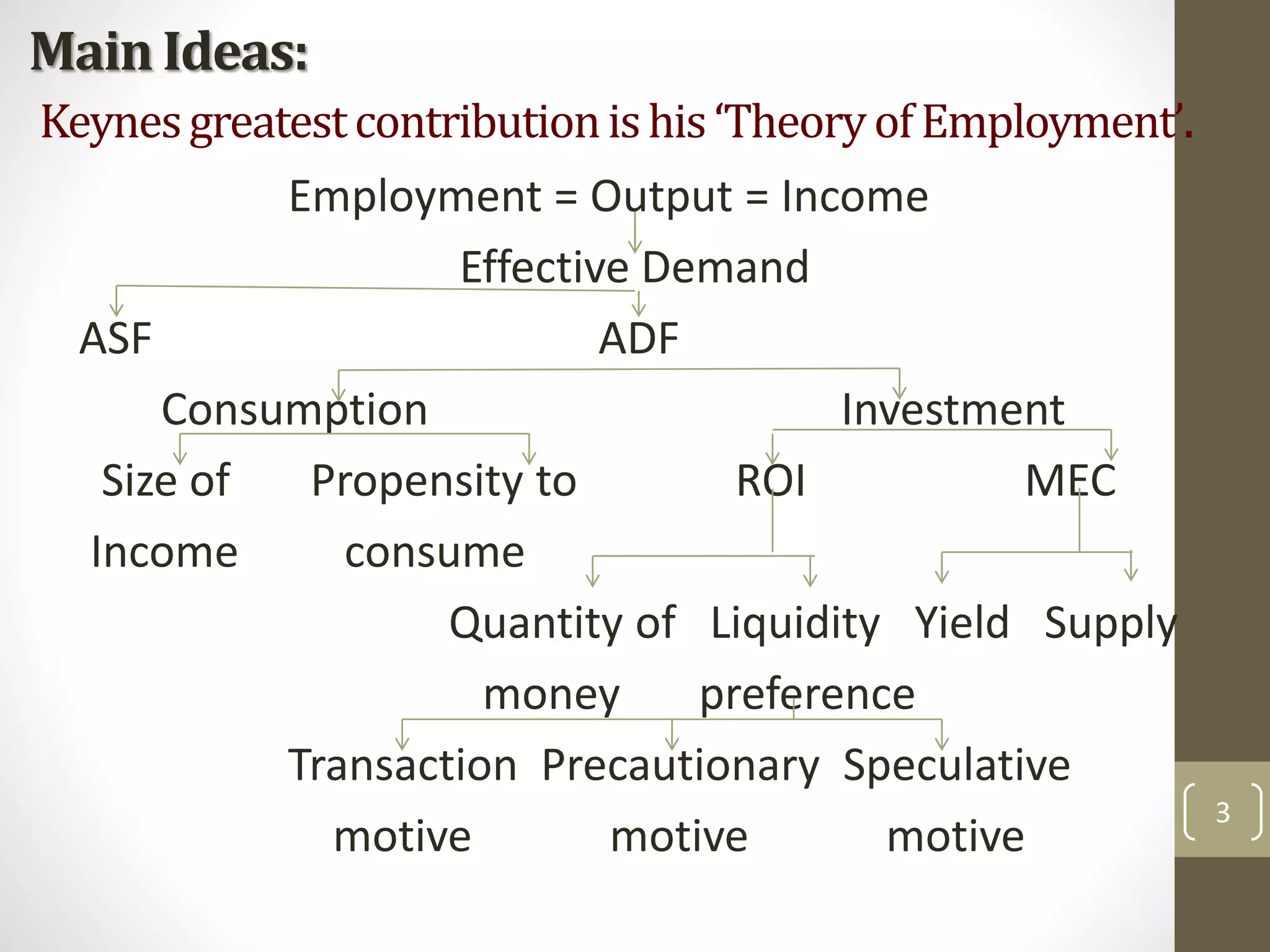
Employment = Output = Income
Effective Demand
ASF ADF
Consumption Investment
Size of Propensity to ROI MEC
Income consume
Quantity of Liquidity Yield Supply
money preference
Transaction Precautionary Speculative
motive motive motive
3
• Employment = Output = Income. As employment increases
output and income increases proportionately.
• Volume of employment depends upon effective demand which
in turn is determined by aggregate supply function and
aggregate demand function.
• Aggregate demand function is governed by consumption
expenditure and investment expenditure.
• Consumption expenditure depends upon size of income and
propensity to consume. It is fairly stable in the short period
because propensity to consume does not change quickly. 4
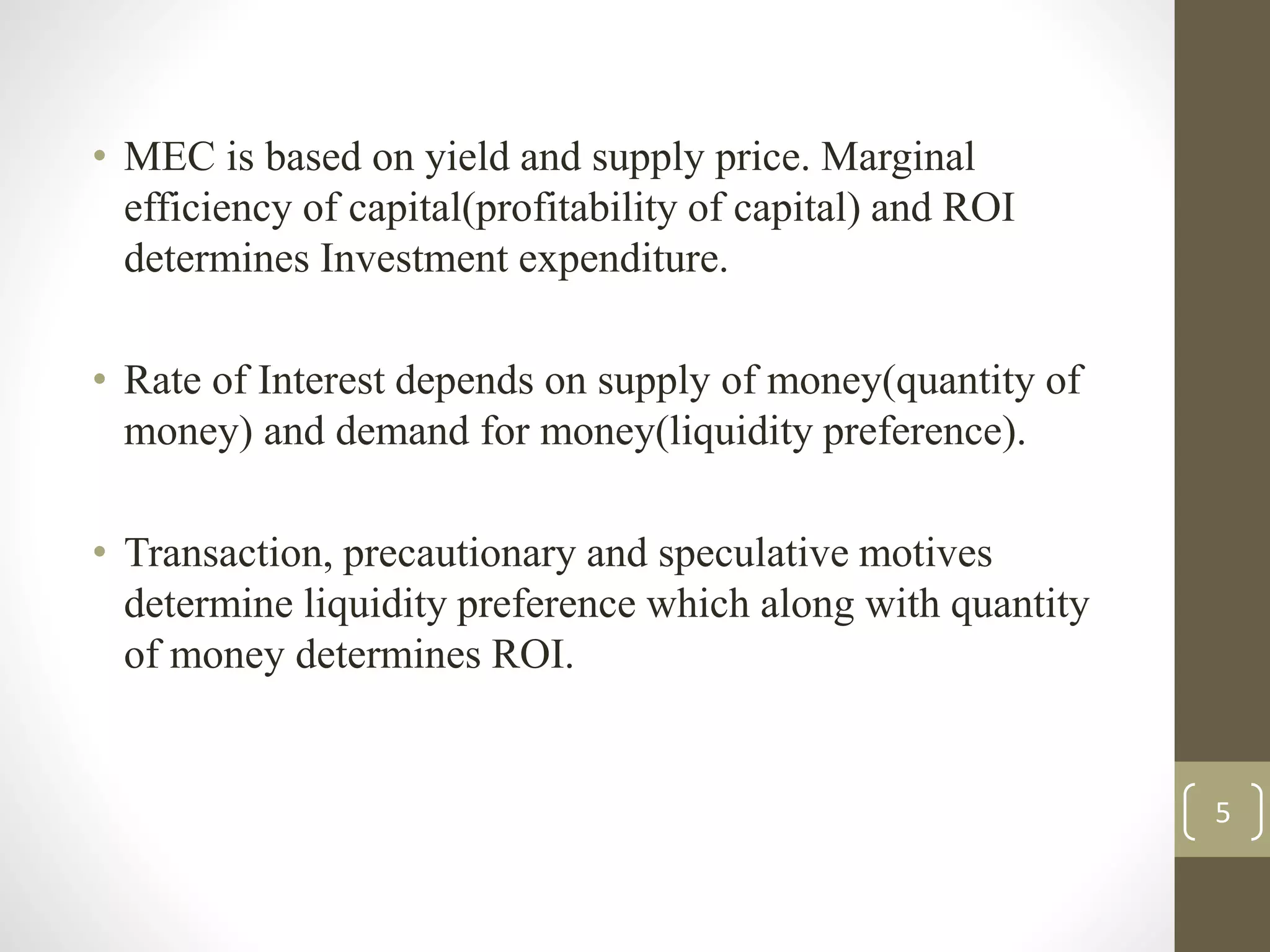
• MEC is based on yield and supply price. Marginal
efficiency of capital(profitability of capital) and ROI
determines Investment expenditure.
• Rate of Interest depends on supply of money(quantity of
money) and demand for money(liquidity preference).
• Transaction, precautionary and speculative motives
determine liquidity preference which along with quantity
of money determines ROI.
5
EFFECTIVE DEMAND:
It simply means desire, ability and willingness to buy
i.e., actual expenditure.
Aggregate demand function indicates different amounts
of money which the entrepreneurs expect to get from the sale of
output at varying level of employment.
Aggregate supply function indicates different levels of
income(output and employment) which entrepreneurs will
supply at different levels of expenditure(C+I). The intersection
of ADF and ASF indicates the effective demand.
6
CONSUMPTION FUNCTION or PSYCHOLOGICAL
LAW OF CONSUMPTION
Keynes says that psychology of the community is such
that when aggregate real income is increased, aggregate
consumption is also increased but not by so much as
income.
C = f(Y) C = a+bY
This law contains the following propositions:
a. When aggregate income increases, aggregate
consumption also increases, but by a smaller amount.
b. An increment of income will be divided in some ratio
between saving and consumption.
c. Both saving and consumption will increase as a result of
increase in income. 7
TECHNICAL ATTRIBUTES
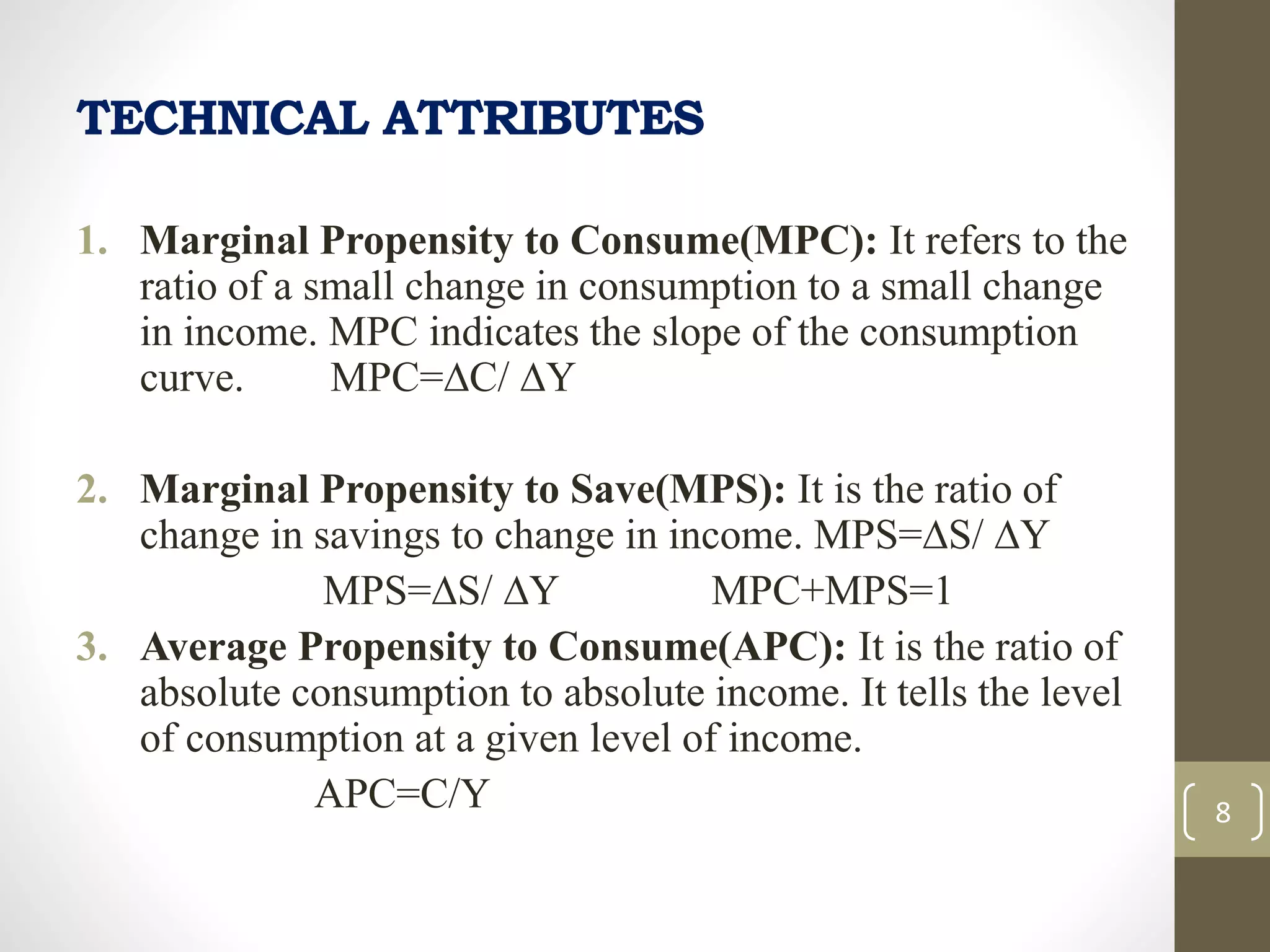
1. Marginal Propensity to Consume(MPC): It refers to the
ratio of a small change in consumption to a small change
in income. MPC indicates the slope of the consumption
curve. MPC=∆C/ ∆Y
2. Marginal Propensity to Save(MPS): It is the ratio of
change in savings to change in income. MPS=∆S/ ∆Y
MPS=∆S/ ∆Y MPC+MPS=1
3. Average Propensity to Consume(APC): It is the ratio of
absolute consumption to absolute income. It tells the level
of consumption at a given level of income.
APC=C/Y 8
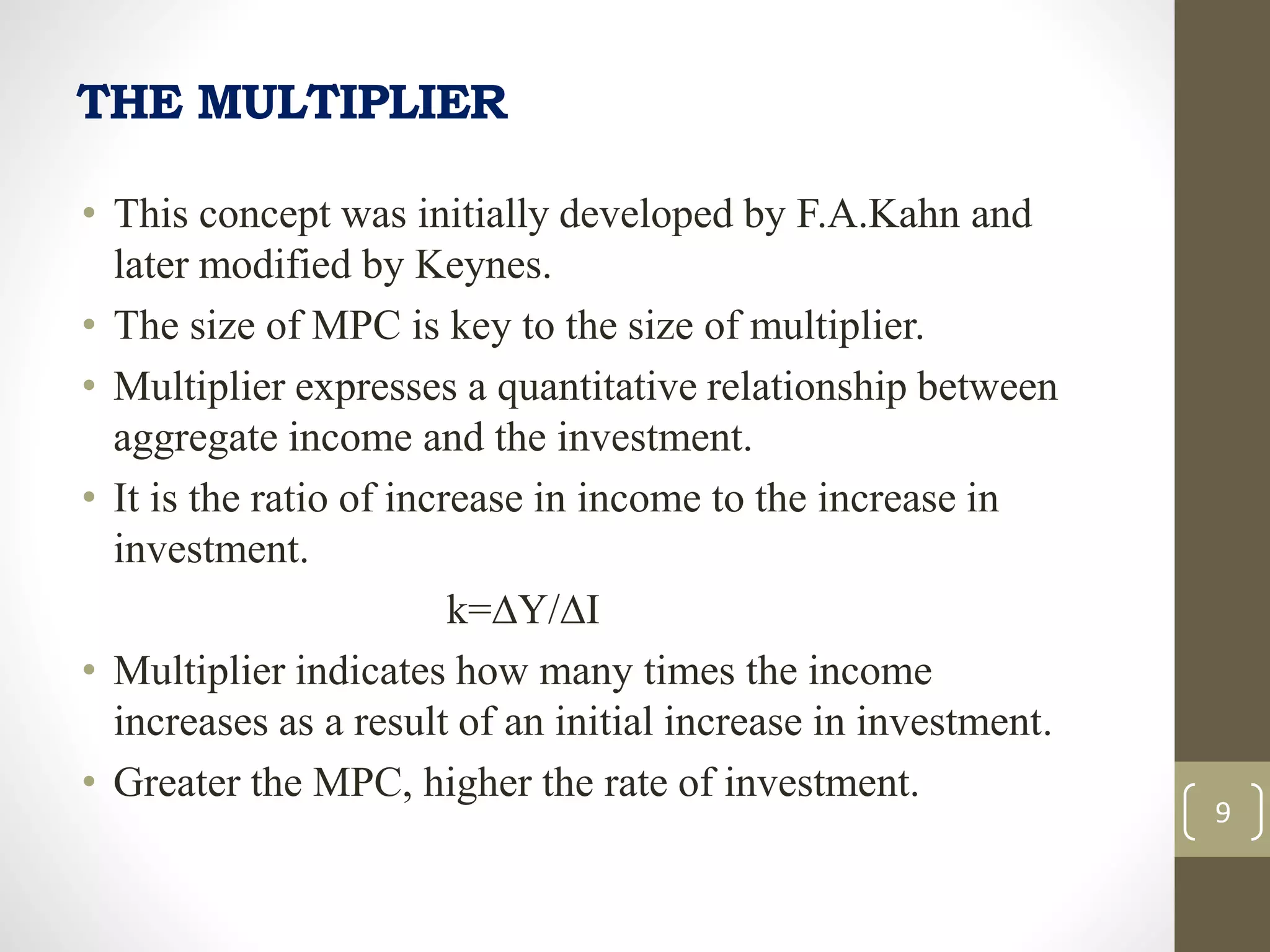
THE MULTIPLIER
• This concept was initially developed by F.A.Kahn and
later modified by Keynes.
• The size of MPC is key to the size of multiplier.
• Multiplier expresses a quantitative relationship between
aggregate income and the investment.
• It is the ratio of increase in income to the increase in
investment.
k=∆Y/∆I
• Multiplier indicates how many times the income
increases as a result of an initial increase in investment.
• Greater the MPC, higher the rate of investment.
9
INVESTMENT FUNCTION
Marginal Efficiency of Capital(MEC) is the expected rate of
return from the employment of a new capital asset and ROI
indicates the cost of investment.
According to Keynes if MEC is greater than ROI, investment
will increase, while decrease if MEC is less than ROI and
investment will stop if MEC is equal to the ROI.
MEC depends on yield from capital asset i.e. returns from output
of the asset and supply price which indicates the cost of
producing the asset.
Thus investment function indicates the relationship between
volume of investment and MEC. It also says that when
investment in capital asset increases, MEC decreases because
yield will fall and supply price increases.
As a whole volume of employment depends on propensity to
consume and inducement to invest.
10
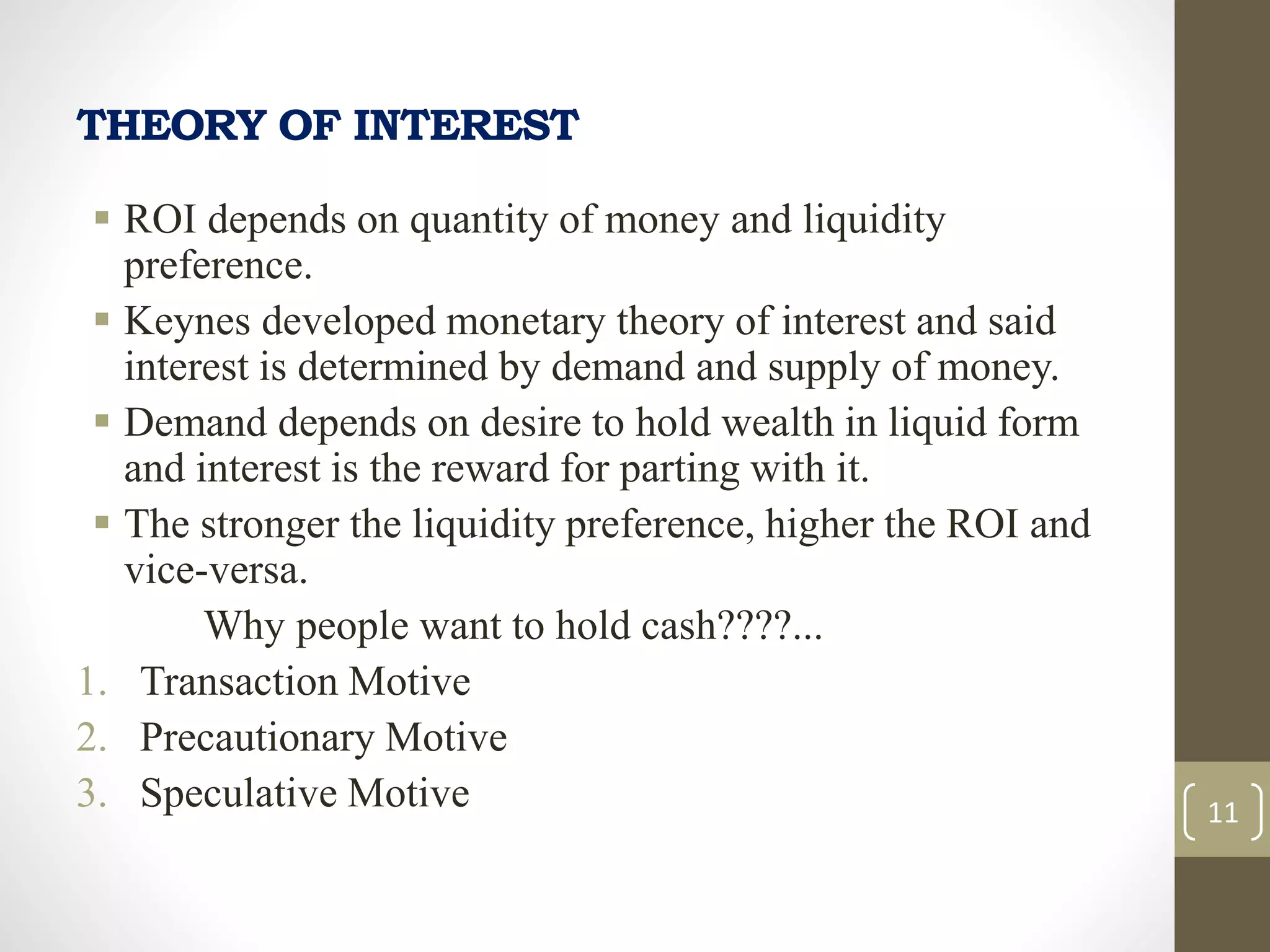
THEORY OF INTEREST
 ROI depends on quantity of money and liquidity
preference.
 Keynes developed monetary theory of interest and said
interest is determined by demand and supply of money.
 Demand depends on desire to hold wealth in liquid form
and interest is the reward for parting with it.
 The stronger the liquidity preference, higher the ROI and
vice-versa.
Why people want to hold cash????...
1. Transaction Motive
2. Precautionary Motive
3. Speculative Motive 11
KEYNES THEORY OF INTEREST
a. Given the liquidity preference , the rate of interest falls as
the supply of money increases and vice-versa.
b. Given the supply of money, the rate of interest rises as
liquidity preference increases and falls as the liquidity
preference decreases.
BUSINESS CYCLE: His theory of employment provides a
general explanation of the cyclical nature of the changes in
employment.
ECONOMIC POLICIES: His theory of employment also
indicated the programme of solving the problem of
unemployment through Taxation Policy, Investment Policy
and Public Investment.
12
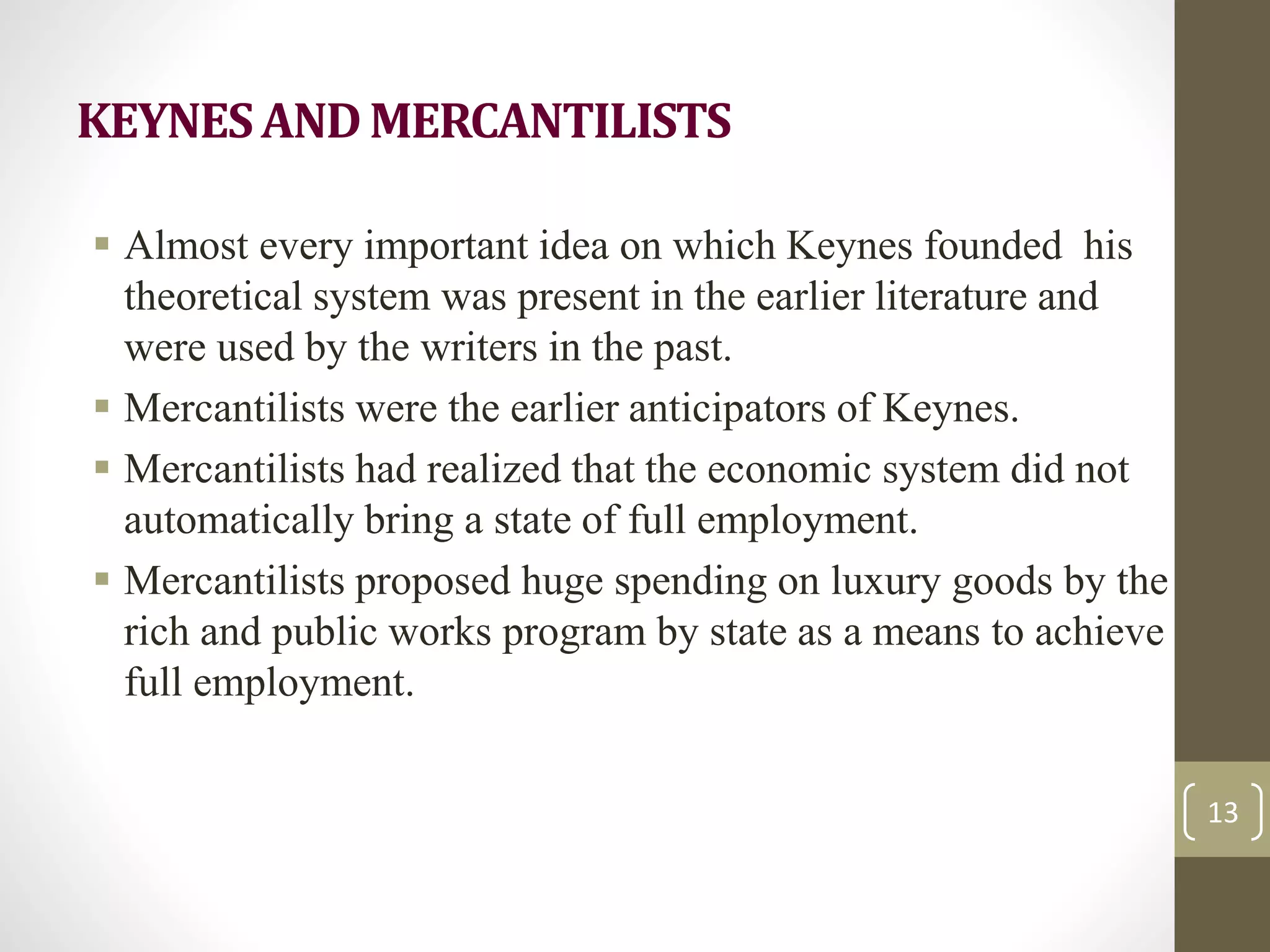
KEYNESANDMERCANTILISTS
 Almost every important idea on which Keynes founded his
theoretical system was present in the earlier literature and
were used by the writers in the past.
 Mercantilists were the earlier anticipators of Keynes.
 Mercantilists had realized that the economic system did not
automatically bring a state of full employment.
 Mercantilists proposed huge spending on luxury goods by the
rich and public works program by state as a means to achieve
full employment.
13
KEYNESANDCLASSICALECONOMICS
1. Assumption of full employment:
• Non-existence of involuntary unemployment.
• There is possibility of frictional unemployment and it will
disappear in the long run and tend towards full employment.
Criticisms by Keynes:
• He argued that there is a possibility of underemployment .
• Wages and prices do not adjust each as fast as the classical
economists assumed.
• He concluded that when liquidity preference become perfectly
elastic as a result of investor’s expectation that rate of interest
will not fall further.
• When inevstment function become interest elastic Even though
there is increase in income in price, they will not invest.
14
2. Say’s law of market:
• It says supply creates its own demand.
• When a factor of production is employed, it results in
production of good and generates income. This income is
spent on purchase of other goods.
• The employment of a factor pays its own way.
• It defines that increase in employment, increases income and
this is spent on either consumer goods or investment goods.
Criticism by Keynes:
• Keynes said that a part of increased income is spent on
consumer goods and the other is saved and there is no
guarantee that the saved income will be spent on investment.
15
CRITICISMSONKEYNESIANECONOMICS
Pigou Effect: Pigou was the chief defender of neo-classical
economics’. He said that given flexible wages and prices, an
economy does automatically tend towards the full
employment level and this was popularly known as Pigou
Effect’.
No determinate relationship between effective demand and
employment:
There is no direct relationship between ED and level of
employment and said everything depends on
interrelationship between wage rates, prices and money
supply.
Wholly aggregative in nature:
the aggregative concepts do not explain the economic
problems of individual firms, individual consumption etc.
16
REFERENCE:
Hansen, A.H., A guide to Keynes(1953)
17
‘I EVIDENTLY KNEW MORE ABOUT ECONOMICS
THAN MY EXAMINERS’.
- J.M.Keynes.
18

Keynesian economics

  • 1.
    Prepared By: BINDU HA M.Sc. (Agri.) 1
  • 2.
    JOHNMAYNARDKEYNES(1883-1946) He is anEnglish Economist, Journalist and Financier, best known for his economic theories. He is widely considered to be one of the most influential economists and founder of modern macroeconomics theory. His ideas are the basis for the school of thought of Keynesian Economics. 2
  • 3.
    Main Ideas: Keynesgreatestcontributionishis‘TheoryofEmployment’. Employment =Output = Income Effective Demand ASF ADF Consumption Investment Size of Propensity to ROI MEC Income consume Quantity of Liquidity Yield Supply money preference Transaction Precautionary Speculative motive motive motive 3
  • 4.
    • Employment =Output = Income. As employment increases output and income increases proportionately. • Volume of employment depends upon effective demand which in turn is determined by aggregate supply function and aggregate demand function. • Aggregate demand function is governed by consumption expenditure and investment expenditure. • Consumption expenditure depends upon size of income and propensity to consume. It is fairly stable in the short period because propensity to consume does not change quickly. 4
  • 5.
    • MEC isbased on yield and supply price. Marginal efficiency of capital(profitability of capital) and ROI determines Investment expenditure. • Rate of Interest depends on supply of money(quantity of money) and demand for money(liquidity preference). • Transaction, precautionary and speculative motives determine liquidity preference which along with quantity of money determines ROI. 5
  • 6.
    EFFECTIVE DEMAND: It simplymeans desire, ability and willingness to buy i.e., actual expenditure. Aggregate demand function indicates different amounts of money which the entrepreneurs expect to get from the sale of output at varying level of employment. Aggregate supply function indicates different levels of income(output and employment) which entrepreneurs will supply at different levels of expenditure(C+I). The intersection of ADF and ASF indicates the effective demand. 6
  • 7.
    CONSUMPTION FUNCTION orPSYCHOLOGICAL LAW OF CONSUMPTION Keynes says that psychology of the community is such that when aggregate real income is increased, aggregate consumption is also increased but not by so much as income. C = f(Y) C = a+bY This law contains the following propositions: a. When aggregate income increases, aggregate consumption also increases, but by a smaller amount. b. An increment of income will be divided in some ratio between saving and consumption. c. Both saving and consumption will increase as a result of increase in income. 7
  • 8.
    TECHNICAL ATTRIBUTES 1. MarginalPropensity to Consume(MPC): It refers to the ratio of a small change in consumption to a small change in income. MPC indicates the slope of the consumption curve. MPC=∆C/ ∆Y 2. Marginal Propensity to Save(MPS): It is the ratio of change in savings to change in income. MPS=∆S/ ∆Y MPS=∆S/ ∆Y MPC+MPS=1 3. Average Propensity to Consume(APC): It is the ratio of absolute consumption to absolute income. It tells the level of consumption at a given level of income. APC=C/Y 8
  • 9.
    THE MULTIPLIER • Thisconcept was initially developed by F.A.Kahn and later modified by Keynes. • The size of MPC is key to the size of multiplier. • Multiplier expresses a quantitative relationship between aggregate income and the investment. • It is the ratio of increase in income to the increase in investment. k=∆Y/∆I • Multiplier indicates how many times the income increases as a result of an initial increase in investment. • Greater the MPC, higher the rate of investment. 9
  • 10.
    INVESTMENT FUNCTION Marginal Efficiencyof Capital(MEC) is the expected rate of return from the employment of a new capital asset and ROI indicates the cost of investment. According to Keynes if MEC is greater than ROI, investment will increase, while decrease if MEC is less than ROI and investment will stop if MEC is equal to the ROI. MEC depends on yield from capital asset i.e. returns from output of the asset and supply price which indicates the cost of producing the asset. Thus investment function indicates the relationship between volume of investment and MEC. It also says that when investment in capital asset increases, MEC decreases because yield will fall and supply price increases. As a whole volume of employment depends on propensity to consume and inducement to invest. 10
  • 11.
    THEORY OF INTEREST ROI depends on quantity of money and liquidity preference.  Keynes developed monetary theory of interest and said interest is determined by demand and supply of money.  Demand depends on desire to hold wealth in liquid form and interest is the reward for parting with it.  The stronger the liquidity preference, higher the ROI and vice-versa. Why people want to hold cash????... 1. Transaction Motive 2. Precautionary Motive 3. Speculative Motive 11
  • 12.
    KEYNES THEORY OFINTEREST a. Given the liquidity preference , the rate of interest falls as the supply of money increases and vice-versa. b. Given the supply of money, the rate of interest rises as liquidity preference increases and falls as the liquidity preference decreases. BUSINESS CYCLE: His theory of employment provides a general explanation of the cyclical nature of the changes in employment. ECONOMIC POLICIES: His theory of employment also indicated the programme of solving the problem of unemployment through Taxation Policy, Investment Policy and Public Investment. 12
  • 13.
    KEYNESANDMERCANTILISTS  Almost everyimportant idea on which Keynes founded his theoretical system was present in the earlier literature and were used by the writers in the past.  Mercantilists were the earlier anticipators of Keynes.  Mercantilists had realized that the economic system did not automatically bring a state of full employment.  Mercantilists proposed huge spending on luxury goods by the rich and public works program by state as a means to achieve full employment. 13
  • 14.
    KEYNESANDCLASSICALECONOMICS 1. Assumption offull employment: • Non-existence of involuntary unemployment. • There is possibility of frictional unemployment and it will disappear in the long run and tend towards full employment. Criticisms by Keynes: • He argued that there is a possibility of underemployment . • Wages and prices do not adjust each as fast as the classical economists assumed. • He concluded that when liquidity preference become perfectly elastic as a result of investor’s expectation that rate of interest will not fall further. • When inevstment function become interest elastic Even though there is increase in income in price, they will not invest. 14
  • 15.
    2. Say’s lawof market: • It says supply creates its own demand. • When a factor of production is employed, it results in production of good and generates income. This income is spent on purchase of other goods. • The employment of a factor pays its own way. • It defines that increase in employment, increases income and this is spent on either consumer goods or investment goods. Criticism by Keynes: • Keynes said that a part of increased income is spent on consumer goods and the other is saved and there is no guarantee that the saved income will be spent on investment. 15
  • 16.
    CRITICISMSONKEYNESIANECONOMICS Pigou Effect: Pigouwas the chief defender of neo-classical economics’. He said that given flexible wages and prices, an economy does automatically tend towards the full employment level and this was popularly known as Pigou Effect’. No determinate relationship between effective demand and employment: There is no direct relationship between ED and level of employment and said everything depends on interrelationship between wage rates, prices and money supply. Wholly aggregative in nature: the aggregative concepts do not explain the economic problems of individual firms, individual consumption etc. 16
  • 17.
    REFERENCE: Hansen, A.H., Aguide to Keynes(1953) 17
  • 18.
    ‘I EVIDENTLY KNEWMORE ABOUT ECONOMICS THAN MY EXAMINERS’. - J.M.Keynes. 18