Welcome to Investment Presentation
Prepared by
Abdullah Al
Mahmud
 Generally, investment refers to purchase of existing
securities, like debentures, bonds, shares etc.
In the economics, an investment means the
purchase of new assets like factories, plants,
machineries, equipment's with the hope that it will
create assets, employment and generate income.
Investment means also the purchase of goods that
aren’t consumed today but are used in future to create
wealth.
“John Keynes refers invest as real investment and not
financial investment.”
Different types of investment are shown by following points:
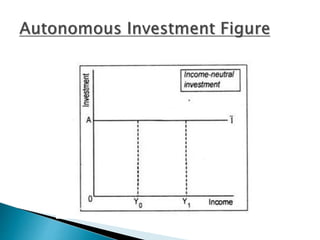
 Autonomous Investment:
Investment which doesn’t change with the change in
income level, is called as autonomous or Government
investment.
Autonomous investment remains constant irrespective of
income level which means even if income is low; the
autonomous investment remains the same. The Government
normally makes such type of investment.
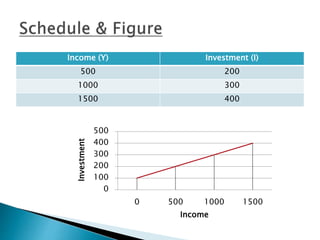
 INDUCED INVESTMENT:
Investment which varies with the change in national
income is called induced investment.
Change in national income brings about change in
aggregate demand which is turn affect the volume of
investment. When national income increases for
instance, aggregate demand increases.
It is also influenced by price change, interest change,
etc. It is income elastic.
Income (Y) Investment (I)
500 200
1000 300
1500 400
0
100
200
300
400
500
0 500 1000 1500
Investment
Income
 Gross Investment:
Gross investment means the total amount of money
spent for creation of new capital assets like plants and
machinery, factory, building, etc.
It is the total expenditure made on new capital assets
in a period.
 Net Investment:
Net investment is determined by less capital
consumption or depreciation from gross investment
during a period of time, usually a year.
 Formula:
Net Investment = Gross Investment – Depreciation.
Investment has another two types, they are-
 Private Investment:
Private investment is invested by private individual
sector. It is profit motive investment. Private
investments are such as private factory buildings,
roads, schools, park, etc.
 Public Investment:
Public investments are invested by Government, State,
and local authorities. They are such as public buildings,
roads, schools, electrical structures, etc.
 Marginal efficiency capital (MEC) is a Keynesian
concept. According to J.M. Keynes, nations output depends
on its stock capital. An increase in the stock of capital
increases output.
Well, this depends on the productivity of new capital i.e.
on the marginal efficiency of capital. Marginal efficiency of
capital is the rate return expected to be obtainable on a
new capital asset over its life time.
 J.M. Keynes defines marginal efficiency of capital as the:
“The rate of discount which makes the present value of the
prospective yield from the capital asset equal to its supply
price”.
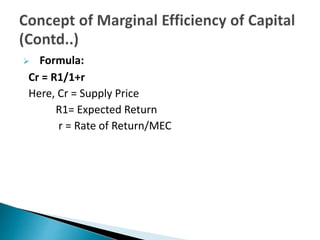
 Formula:
Cr = R1/1+r
Here, Cr = Supply Price
R1= Expected Return
r = Rate of Return/MEC
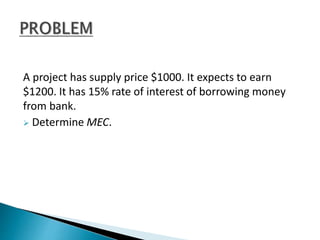
A project has supply price $1000. It expects to earn
$1200. It has 15% rate of interest of borrowing money
from bank.
 Determine MEC.
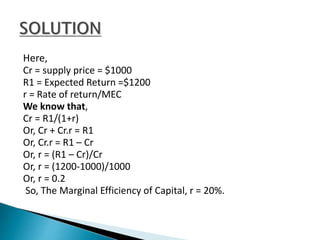
Here,
Cr = supply price = $1000
R1 = Expected Return =$1200
r = Rate of return/MEC
We know that,
Cr = R1/(1+r)
Or, Cr + Cr.r = R1
Or, Cr.r = R1 – Cr
Or, r = (R1 – Cr)/Cr
Or, r = (1200-1000)/1000
Or, r = 0.2
So, The Marginal Efficiency of Capital, r = 20%.
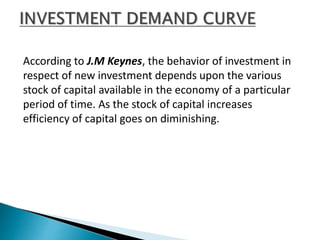
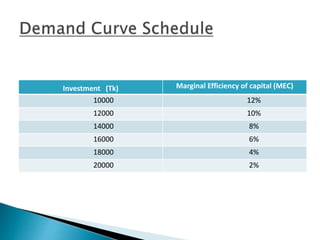
According to J.M Keynes, the behavior of investment in
respect of new investment depends upon the various
stock of capital available in the economy of a particular
period of time. As the stock of capital increases
efficiency of capital goes on diminishing.
Investment (Tk) Marginal Efficiency of capital (MEC)
10000 12%
12000 10%
14000 8%
16000 6%
18000 4%
20000 2%
0
5
10
15
10 12 14 16 18 20
MEC/RateofInterest
Investment( Thousand)
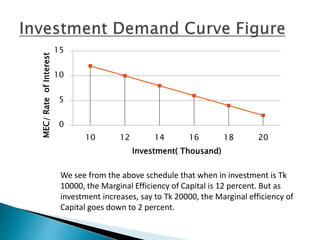
We see from the above schedule that when in investment is Tk
10000, the Marginal Efficiency of Capital is 12 percent. But as
investment increases, say to Tk 20000, the Marginal efficiency of
Capital goes down to 2 percent.
Summing up this chapter, investment in national
income accounts includes business fixed (purchases of
durable equipment & structure) residential
construction, investment, and changes in business
inventories.
For simplicity our discussion of investment theory is
confined to business investment.
THANK YOU

Investment

  • 1.
    Welcome to InvestmentPresentation Prepared by Abdullah Al Mahmud
  • 2.
     Generally, investmentrefers to purchase of existing securities, like debentures, bonds, shares etc. In the economics, an investment means the purchase of new assets like factories, plants, machineries, equipment's with the hope that it will create assets, employment and generate income. Investment means also the purchase of goods that aren’t consumed today but are used in future to create wealth. “John Keynes refers invest as real investment and not financial investment.”
  • 3.
    Different types ofinvestment are shown by following points:  Autonomous Investment: Investment which doesn’t change with the change in income level, is called as autonomous or Government investment. Autonomous investment remains constant irrespective of income level which means even if income is low; the autonomous investment remains the same. The Government normally makes such type of investment.
  • 5.
     INDUCED INVESTMENT: Investmentwhich varies with the change in national income is called induced investment. Change in national income brings about change in aggregate demand which is turn affect the volume of investment. When national income increases for instance, aggregate demand increases. It is also influenced by price change, interest change, etc. It is income elastic.
  • 6.
    Income (Y) Investment(I) 500 200 1000 300 1500 400 0 100 200 300 400 500 0 500 1000 1500 Investment Income
  • 7.
     Gross Investment: Grossinvestment means the total amount of money spent for creation of new capital assets like plants and machinery, factory, building, etc. It is the total expenditure made on new capital assets in a period.  Net Investment: Net investment is determined by less capital consumption or depreciation from gross investment during a period of time, usually a year.  Formula: Net Investment = Gross Investment – Depreciation.
  • 8.
    Investment has anothertwo types, they are-  Private Investment: Private investment is invested by private individual sector. It is profit motive investment. Private investments are such as private factory buildings, roads, schools, park, etc.  Public Investment: Public investments are invested by Government, State, and local authorities. They are such as public buildings, roads, schools, electrical structures, etc.
  • 9.
     Marginal efficiencycapital (MEC) is a Keynesian concept. According to J.M. Keynes, nations output depends on its stock capital. An increase in the stock of capital increases output. Well, this depends on the productivity of new capital i.e. on the marginal efficiency of capital. Marginal efficiency of capital is the rate return expected to be obtainable on a new capital asset over its life time.  J.M. Keynes defines marginal efficiency of capital as the: “The rate of discount which makes the present value of the prospective yield from the capital asset equal to its supply price”.
  • 10.
     Formula: Cr =R1/1+r Here, Cr = Supply Price R1= Expected Return r = Rate of Return/MEC
  • 11.
    A project hassupply price $1000. It expects to earn $1200. It has 15% rate of interest of borrowing money from bank.  Determine MEC.
  • 12.
    Here, Cr = supplyprice = $1000 R1 = Expected Return =$1200 r = Rate of return/MEC We know that, Cr = R1/(1+r) Or, Cr + Cr.r = R1 Or, Cr.r = R1 – Cr Or, r = (R1 – Cr)/Cr Or, r = (1200-1000)/1000 Or, r = 0.2 So, The Marginal Efficiency of Capital, r = 20%.
  • 13.
    According to J.MKeynes, the behavior of investment in respect of new investment depends upon the various stock of capital available in the economy of a particular period of time. As the stock of capital increases efficiency of capital goes on diminishing.
  • 14.
    Investment (Tk) MarginalEfficiency of capital (MEC) 10000 12% 12000 10% 14000 8% 16000 6% 18000 4% 20000 2%
  • 15.
    0 5 10 15 10 12 1416 18 20 MEC/RateofInterest Investment( Thousand) We see from the above schedule that when in investment is Tk 10000, the Marginal Efficiency of Capital is 12 percent. But as investment increases, say to Tk 20000, the Marginal efficiency of Capital goes down to 2 percent.
  • 16.
    Summing up thischapter, investment in national income accounts includes business fixed (purchases of durable equipment & structure) residential construction, investment, and changes in business inventories. For simplicity our discussion of investment theory is confined to business investment.
  • 17.