Investment and
Investment Function
Investment
 Net addition to the existing stock of capital
 assets
 E.g. new machines, factories and plants
 Does not refer to the purchase of existing
 bonds, securities, debentures, etc.
 Only real investment creates additional
 employment
Effective Demand

               ED = C + I
 Consumption function is more or less
 stable in the short-run
 Investment is the strategic variable for
 increasing employment
Characteristics of investment
 Most volatile component of GDP from demand /
 expenditure side
 Pro-cyclical
 Largely responsible for business cycles
 Major determinant of economic growth
 Dual role
   Aggregate demand
   Aggregate supply
 Self terminating and self financing
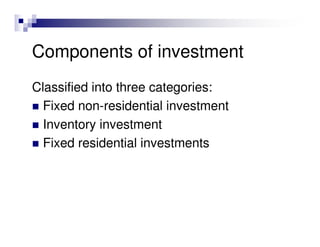
Components of investment
Classified into three categories:
  Fixed non-residential investment
  Inventory investment
  Fixed residential investments
Motivation for
Investment
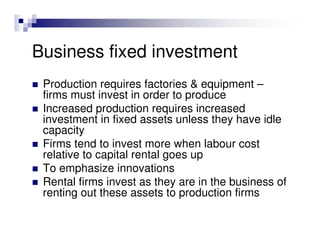
Business fixed investment
 Production requires factories & equipment –
 firms must invest in order to produce
 Increased production requires increased
 investment in fixed assets unless they have idle
 capacity
 Firms tend to invest more when labour cost
 relative to capital rental goes up
 To emphasize innovations
 Rental firms invest as they are in the business of
 renting out these assets to production firms
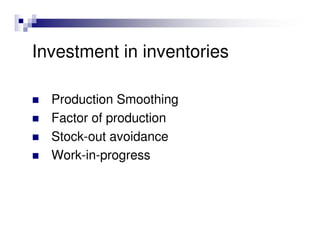
Investment in inventories

  Production Smoothing
  Factor of production
  Stock-out avoidance
  Work-in-progress
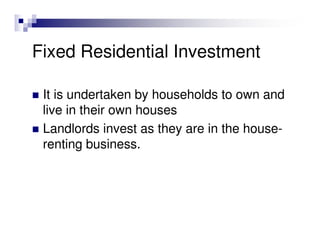
Fixed Residential Investment

 It is undertaken by households to own and
 live in their own houses
 Landlords invest as they are in the house-
 renting business.
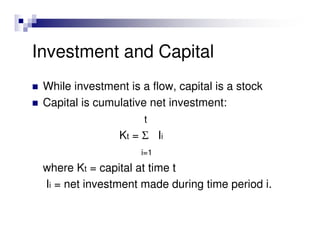
Investment and Capital
 While investment is a flow, capital is a stock
 Capital is cumulative net investment:
                      t
                Kt = Σ Ii
                     i=1

 where Kt = capital at time t
 Ii = net investment made during time period i.
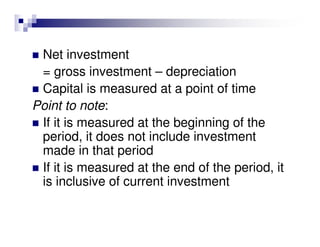
Net investment
 = gross investment – depreciation
 Capital is measured at a point of time
Point to note:
 If it is measured at the beginning of the
 period, it does not include investment
 made in that period
 If it is measured at the end of the period, it
 is inclusive of current investment
Kinds of Investment
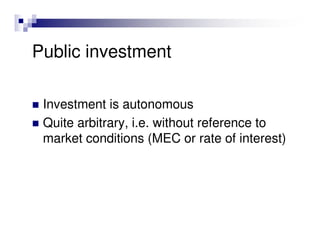
Public investment

 Investment is autonomous
 Quite arbitrary, i.e. without reference to
 market conditions (MEC or rate of interest)
Private investment
 Investment made by the private investors
 – households or firms
 Investment depends on market conditions
     High during prosperity
     Low during recession / depression
Determinants of
Investment

Private Investment
Volume of investment

 Depends upon two factors:
 Marginal efficiency of capital (MEC)
 Rate of interest
Rate of interest does not change much –
sticky or constant
MEC determines the volume of investment
in a community
Fluctuations in investment are mainly due
to fluctuations in MEC
MEC
 The expected profitability of a capital asset
Definition:
 Highest rate of return over cost expected from
 the marginal or additional unit of the capital
 asset
 Refers to
    Marginal unit
    Cost has to be deducted from returns
Two factors determine MEC


 Prospective yield from capital asset
 Supply price of capital asset
Prospective Yield of Capital
 Total net returns expected from the asset
 over its lifetime.
 ‘net’ means gross proceeds minus the
 ‘running costs’ of the asset
 Add together the annual net returns
 expected from the asset during its lifetime.
Points to note……
 reference here is not to the actual but to the
 expected annual returns from the asset.
 the asset is not to be considered in the sense of
 existing asset but in the sense of a brand new
 asset.
 all prospective net annual returns from an asset
 (during its lifetime) may not be equal, unless we
 assume the existence of a stationary or static
 society.
Supply price
 Supply price is the cost of producing a
 brand new asset of that kind, not the
 supply price of an existing asset.
 The supply price of an asset is also
 referred to as its replacement cost.
Determining MEC
 Relating the two factors – prospective
 yield and supply price – gives MEC of an
 asset.

 The MEC of an asset thus, means what an
 investor expects to earn from an additional
 unit of it compared with what it costs him.
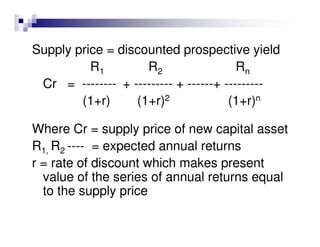
Supply price = discounted prospective yield
          R1        R2                  Rn
 Cr = -------- + --------- + ------+ ---------
        (1+r)     (1+r)2              (1+r)n

Where Cr = supply price of new capital asset
R1, R2 ---- = expected annual returns
r = rate of discount which makes present
  value of the series of annual returns equal
  to the supply price
Rate of Interest

 Price paid for loanable funds

 Determined by supply and demand for
 loanable funds
MEC & Rate of Interest
 Potential investor will weigh MEC on new
 investment with rate of interest
 MEC > rate of interest
    Investment will be made
 MEC = rate of interest
    Equilibrium investment
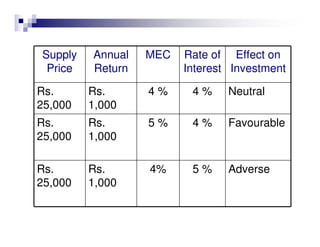
Supply   Annual   MEC   Rate of Effect on
 Price   Return         Interest Investment

Rs.      Rs.      4%     4%     Neutral
25,000   1,000
Rs.      Rs.      5%     4%     Favourable
25,000   1,000

Rs.      Rs.      4%     5%     Adverse
25,000   1,000
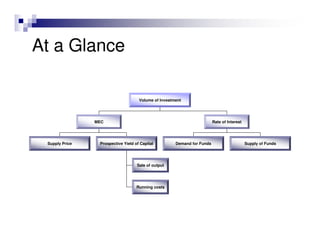
At a Glance

                                     Volume of Investment


                MEC                                                      Rate of Interest


 Supply Price    Prospective Yield of Capital         Demand for Funds                      Supply of Funds


                                    Sale of output


                                    Running costs
Factors Affecting
MEC
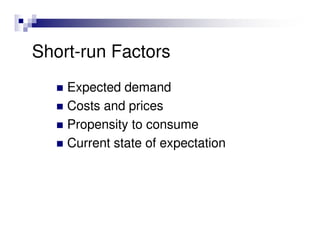
Short-run Factors
    Expected demand
    Costs and prices
    Propensity to consume
    Current state of expectation
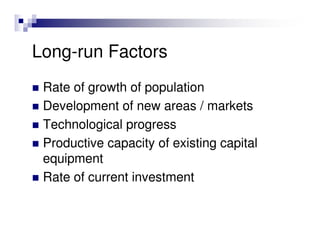
Long-run Factors
 Rate of growth of population
 Development of new areas / markets
 Technological progress
 Productive capacity of existing capital
 equipment
 Rate of current investment
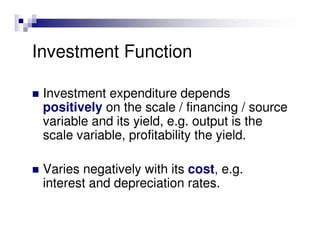
Investment Function

 Investment expenditure depends
 positively on the scale / financing / source
 variable and its yield, e.g. output is the
 scale variable, profitability the yield.

 Varies negatively with its cost, e.g.
 interest and depreciation rates.
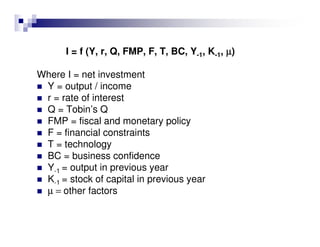
I = f (Y, r, Q, FMP, F, T, BC, Y-1, K-1, µ)

Where I = net investment
 Y = output / income
 r = rate of interest
 Q = Tobin’s Q
 FMP = fiscal and monetary policy
 F = financial constraints
 T = technology
 BC = business confidence
 Y-1 = output in previous year
 K-1 = stock of capital in previous year
 µ = other factors
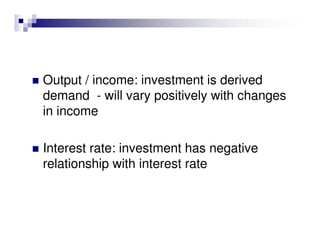
Output / income: investment is derived
demand - will vary positively with changes
in income

Interest rate: investment has negative
relationship with interest rate
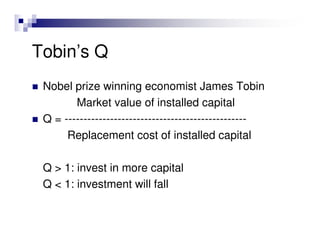
Tobin’s Q
 Nobel prize winning economist James Tobin
        Market value of installed capital
 Q = ------------------------------------------------
      Replacement cost of installed capital

 Q > 1: invest in more capital
 Q < 1: investment will fall
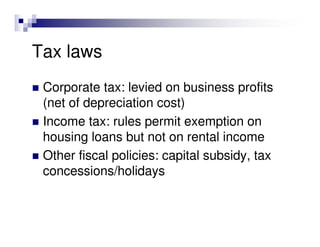
Tax laws
 Corporate tax: levied on business profits
 (net of depreciation cost)
 Income tax: rules permit exemption on
 housing loans but not on rental income
 Other fiscal policies: capital subsidy, tax
 concessions/holidays
Financing constraints

Technology

Business confidence

6 investment and_investment_function

  • 1.
  • 2.
    Investment Net additionto the existing stock of capital assets E.g. new machines, factories and plants Does not refer to the purchase of existing bonds, securities, debentures, etc. Only real investment creates additional employment
  • 3.
    Effective Demand ED = C + I Consumption function is more or less stable in the short-run Investment is the strategic variable for increasing employment
  • 4.
    Characteristics of investment Most volatile component of GDP from demand / expenditure side Pro-cyclical Largely responsible for business cycles Major determinant of economic growth Dual role Aggregate demand Aggregate supply Self terminating and self financing
  • 5.
    Components of investment Classifiedinto three categories: Fixed non-residential investment Inventory investment Fixed residential investments
  • 6.
  • 7.
    Business fixed investment Production requires factories & equipment – firms must invest in order to produce Increased production requires increased investment in fixed assets unless they have idle capacity Firms tend to invest more when labour cost relative to capital rental goes up To emphasize innovations Rental firms invest as they are in the business of renting out these assets to production firms
  • 8.
    Investment in inventories Production Smoothing Factor of production Stock-out avoidance Work-in-progress
  • 9.
    Fixed Residential Investment It is undertaken by households to own and live in their own houses Landlords invest as they are in the house- renting business.
  • 10.
    Investment and Capital While investment is a flow, capital is a stock Capital is cumulative net investment: t Kt = Σ Ii i=1 where Kt = capital at time t Ii = net investment made during time period i.
  • 11.
    Net investment =gross investment – depreciation Capital is measured at a point of time Point to note: If it is measured at the beginning of the period, it does not include investment made in that period If it is measured at the end of the period, it is inclusive of current investment
  • 12.
  • 13.
    Public investment Investmentis autonomous Quite arbitrary, i.e. without reference to market conditions (MEC or rate of interest)
  • 14.
    Private investment Investmentmade by the private investors – households or firms Investment depends on market conditions High during prosperity Low during recession / depression
  • 15.
  • 16.
    Volume of investment Depends upon two factors: Marginal efficiency of capital (MEC) Rate of interest
  • 17.
    Rate of interestdoes not change much – sticky or constant MEC determines the volume of investment in a community Fluctuations in investment are mainly due to fluctuations in MEC
  • 18.
    MEC The expectedprofitability of a capital asset Definition: Highest rate of return over cost expected from the marginal or additional unit of the capital asset Refers to Marginal unit Cost has to be deducted from returns
  • 19.
    Two factors determineMEC Prospective yield from capital asset Supply price of capital asset
  • 20.
    Prospective Yield ofCapital Total net returns expected from the asset over its lifetime. ‘net’ means gross proceeds minus the ‘running costs’ of the asset Add together the annual net returns expected from the asset during its lifetime.
  • 21.
    Points to note…… reference here is not to the actual but to the expected annual returns from the asset. the asset is not to be considered in the sense of existing asset but in the sense of a brand new asset. all prospective net annual returns from an asset (during its lifetime) may not be equal, unless we assume the existence of a stationary or static society.
  • 22.
    Supply price Supplyprice is the cost of producing a brand new asset of that kind, not the supply price of an existing asset. The supply price of an asset is also referred to as its replacement cost.
  • 23.
    Determining MEC Relatingthe two factors – prospective yield and supply price – gives MEC of an asset. The MEC of an asset thus, means what an investor expects to earn from an additional unit of it compared with what it costs him.
  • 24.
    Supply price =discounted prospective yield R1 R2 Rn Cr = -------- + --------- + ------+ --------- (1+r) (1+r)2 (1+r)n Where Cr = supply price of new capital asset R1, R2 ---- = expected annual returns r = rate of discount which makes present value of the series of annual returns equal to the supply price
  • 25.
    Rate of Interest Price paid for loanable funds Determined by supply and demand for loanable funds
  • 26.
    MEC & Rateof Interest Potential investor will weigh MEC on new investment with rate of interest MEC > rate of interest Investment will be made MEC = rate of interest Equilibrium investment
  • 27.
    Supply Annual MEC Rate of Effect on Price Return Interest Investment Rs. Rs. 4% 4% Neutral 25,000 1,000 Rs. Rs. 5% 4% Favourable 25,000 1,000 Rs. Rs. 4% 5% Adverse 25,000 1,000
  • 28.
    At a Glance Volume of Investment MEC Rate of Interest Supply Price Prospective Yield of Capital Demand for Funds Supply of Funds Sale of output Running costs
  • 29.
  • 30.
    Short-run Factors Expected demand Costs and prices Propensity to consume Current state of expectation
  • 31.
    Long-run Factors Rateof growth of population Development of new areas / markets Technological progress Productive capacity of existing capital equipment Rate of current investment
  • 32.
    Investment Function Investmentexpenditure depends positively on the scale / financing / source variable and its yield, e.g. output is the scale variable, profitability the yield. Varies negatively with its cost, e.g. interest and depreciation rates.
  • 33.
    I = f(Y, r, Q, FMP, F, T, BC, Y-1, K-1, µ) Where I = net investment Y = output / income r = rate of interest Q = Tobin’s Q FMP = fiscal and monetary policy F = financial constraints T = technology BC = business confidence Y-1 = output in previous year K-1 = stock of capital in previous year µ = other factors
  • 34.
    Output / income:investment is derived demand - will vary positively with changes in income Interest rate: investment has negative relationship with interest rate
  • 35.
    Tobin’s Q Nobelprize winning economist James Tobin Market value of installed capital Q = ------------------------------------------------ Replacement cost of installed capital Q > 1: invest in more capital Q < 1: investment will fall
  • 36.
    Tax laws Corporatetax: levied on business profits (net of depreciation cost) Income tax: rules permit exemption on housing loans but not on rental income Other fiscal policies: capital subsidy, tax concessions/holidays
  • 37.