Leontief Paradox
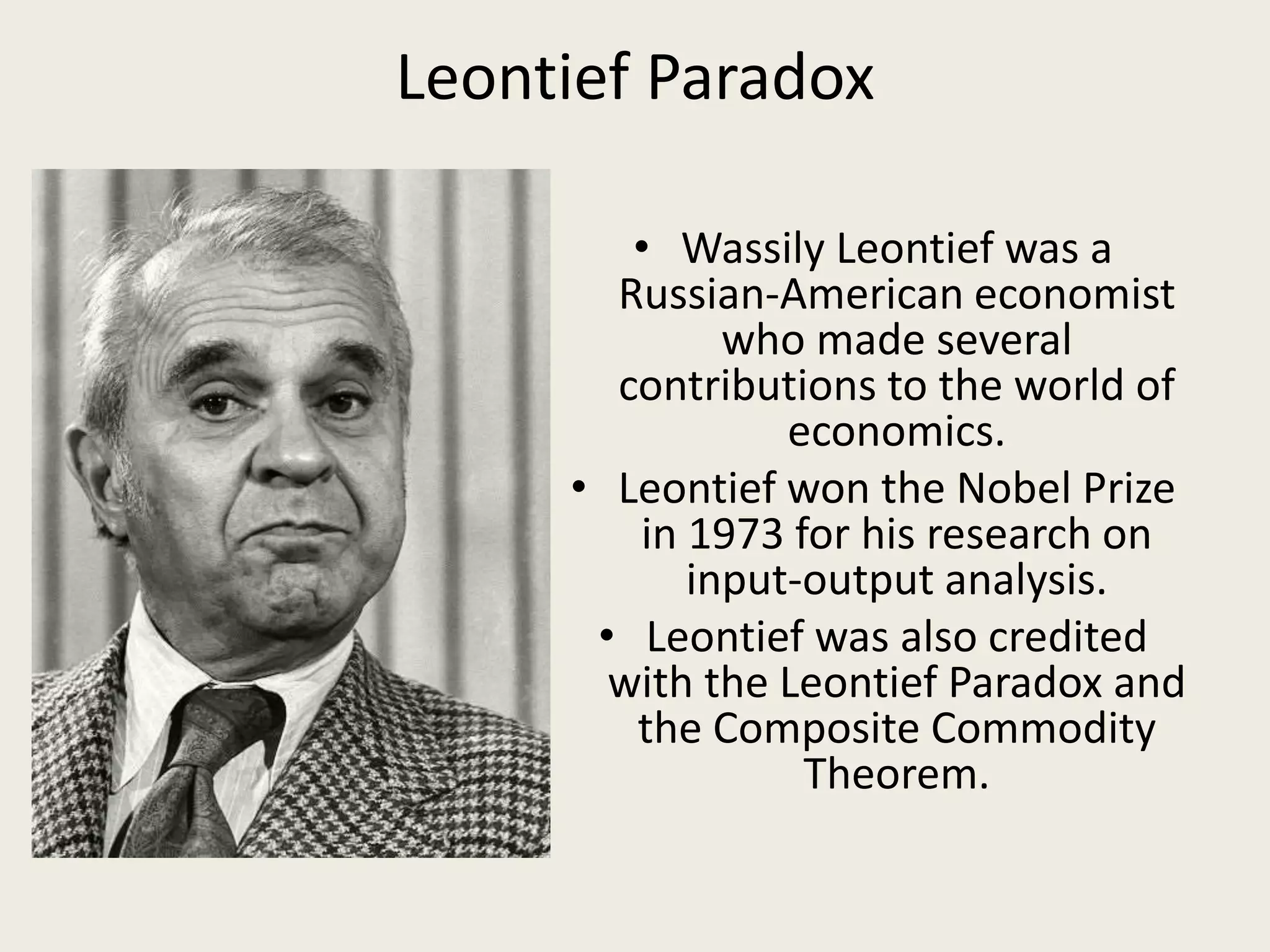
• Wassily Leontief was a
Russian-American economist
who made several
contributions to the world of
economics.
• Leontief won the Nobel Prize
in 1973 for his research on
input-output analysis.
• Leontief was also credited
with the Leontief Paradox and
the Composite Commodity
Theorem.
Leontief Paradox
• First Empirical Test of H-O Theory (1953)
• Used 1947 input output table of the US economy
• Leontief reached a paradoxical conclusion that the
US—the most capital abundant country in the
world by any criterion—exported labor-intensive
commodities and imported capital- intensive
commodities. This result has come to be known as
the Leontief Paradox.
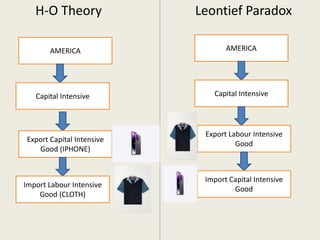
H-O Theory Leontief Paradox
AMERICA
Capital Intensive
Export Capital Intensive
Good (IPHONE)
Import Labour Intensive
Good (CLOTH)
AMERICA
Capital Intensive
Export Labour Intensive
Good
Import Capital Intensive
Good
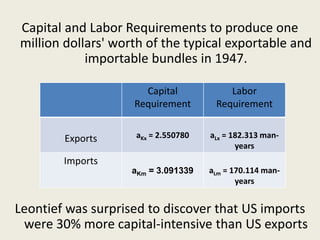
Capital and Labor Requirements to produce one
million dollars' worth of the typical exportable and
importable bundles in 1947.
Leontief was surprised to discover that US imports
were 30% more capital-intensive than US exports
Capital
Requirement
Labor
Requirement
Exports aKx = 2.550780 aLx = 182.313 man-
years
Imports
aKm = 3.091339 aLm = 170.114 man-
years
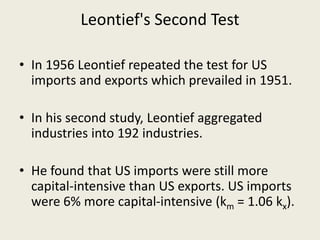
Leontief's Second Test
• In 1956 Leontief repeated the test for US
imports and exports which prevailed in 1951.
• In his second study, Leontief aggregated
industries into 192 industries.
• He found that US imports were still more
capital-intensive than US exports. US imports
were 6% more capital-intensive (km = 1.06 kx).
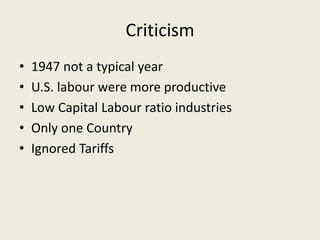
Criticism
• 1947 not a typical year
• U.S. labour were more productive
• Low Capital Labour ratio industries
• Only one Country
• Ignored Tariffs
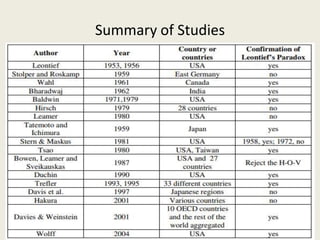
Summary of Studies
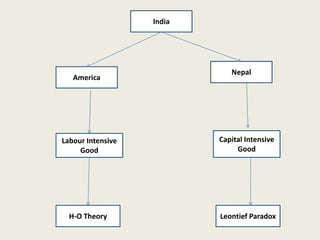
India
America
Nepal
Labour Intensive
Good
Capital Intensive
Good
H-O Theory Leontief Paradox
Leontief Paradox.pptx

Leontief Paradox.pptx

  • 1.
    Leontief Paradox • WassilyLeontief was a Russian-American economist who made several contributions to the world of economics. • Leontief won the Nobel Prize in 1973 for his research on input-output analysis. • Leontief was also credited with the Leontief Paradox and the Composite Commodity Theorem.
  • 2.
    Leontief Paradox • FirstEmpirical Test of H-O Theory (1953) • Used 1947 input output table of the US economy • Leontief reached a paradoxical conclusion that the US—the most capital abundant country in the world by any criterion—exported labor-intensive commodities and imported capital- intensive commodities. This result has come to be known as the Leontief Paradox.
  • 3.
    H-O Theory LeontiefParadox AMERICA Capital Intensive Export Capital Intensive Good (IPHONE) Import Labour Intensive Good (CLOTH) AMERICA Capital Intensive Export Labour Intensive Good Import Capital Intensive Good
  • 4.
    Capital and LaborRequirements to produce one million dollars' worth of the typical exportable and importable bundles in 1947. Leontief was surprised to discover that US imports were 30% more capital-intensive than US exports Capital Requirement Labor Requirement Exports aKx = 2.550780 aLx = 182.313 man- years Imports aKm = 3.091339 aLm = 170.114 man- years
  • 5.
    Leontief's Second Test •In 1956 Leontief repeated the test for US imports and exports which prevailed in 1951. • In his second study, Leontief aggregated industries into 192 industries. • He found that US imports were still more capital-intensive than US exports. US imports were 6% more capital-intensive (km = 1.06 kx).
  • 6.
    Criticism • 1947 nota typical year • U.S. labour were more productive • Low Capital Labour ratio industries • Only one Country • Ignored Tariffs
  • 7.
  • 8.