Presented To: Presented By:
Asst. Proff. Akash kumar
Nidhi jain Ma’am Sonam Jain
Sneha Narvariya
Man Singh
MEANING
CLASSIFICATION OF INVESTMENT
DETERMINANTS OF INVESTMENT
FACTORS INFLUENCING
SOURCES
 In economics, investment means the new
expenditure incurred on addition of capital
goods such as machine, buildings
,equipment's, tools etc.
 In keynes view investment refers real
investment which adds to capital equipment.
 It leads to increase in the level of
income, production and purchase of
capital goods.
-Increase in capital stock is Investment.
I= Kt - Kt-1
Where,
I= Investment
Kt= Present capital stock
Kt-1= Previous capital stock
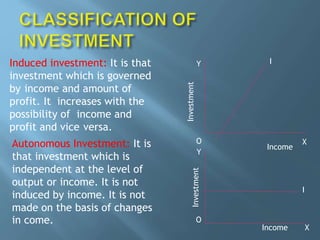
Induced investment: It is that
investment which is governed
by income and amount of
profit. It increases with the
possibility of income and
profit and vice versa.
Autonomous Investment: It is
that investment which is
independent at the level of
output or income. It is not
induced by income. It is not
made on the basis of changes
in come.
Investment
Y
O
Y
Income
I
I
Income
O
X
X
Investment
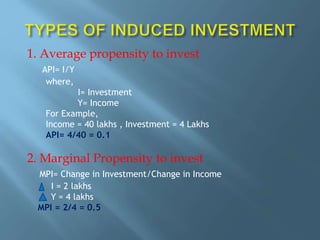
1. Average propensity to invest
API= I/Y
where,
I= Investment
Y= Income
For Example,
Income = 40 lakhs , Investment = 4 Lakhs
API= 4/40 = 0.1
2. Marginal Propensity to invest
MPI= Change in Investment/Change in Income
I = 2 lakhs
Y = 4 lakhs
MPI = 2/4 = 0.5
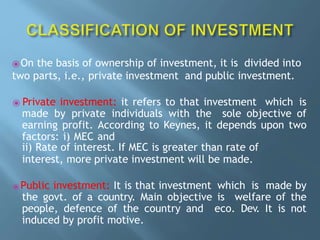
⦿On the basis of ownership of investment, it is divided into
two parts, i.e., private investment and public investment.
⦿ Private investment: it refers to that investment which is
made by private individuals with the sole objective of
earning profit. According to Keynes, it depends upon two
factors: i) MEC and
ii) Rate of interest. If MEC is greater than rate of
interest, more private investment will be made.
⦿Public investment: It is that investment which is made by
the govt. of a country. Main objective is welfare of the
people, defence of the country and eco. Dev. It is not
induced by profit motive.
⦿ Technological advance and innovation
⦿ Discovery of natural resources
⦿ Govt. policy
⦿ Foreign trade
⦿ Rate of population growth
⦿ Price level
⦿ Market structure
⦿ Availability of finance
Marginal efficiency of capital(MEC):
⚫The Marginal efficiency of capital is the highest rate of
return expected from an additional unit of a capital asset
over its cost
⚫If the value of MEC is high, more capital will be
invested and vice versa.
⚫For example, If the supply price of a capital asset is
Rs. 10,000 and its annual yield is Rs. 2000, the
marginal efficiency of this asset is :
2000/10,000x100=20%
⚫Thus, the MEC is the % of profit expected from a
given investment on a capital.
Rate of interest :
 The interest rate is the percentage of the loan
amount that the lender charge to lend money.
Relation between MEC and ROI:
R
R1
K K1
ROI/MEC
Capital Stock
MEC
MEC ROI
• Capital stock increase MEC will decrease because of law of
diminishing returns.
MEC=ROI=Optimum capital stock
Demand forecast:
⚫The long-term demand forecast is one of the
determinants of investment decision.
⚫If the firms finds market potential for the product in the
long run, the firm will increase its investment
Level of income:
⚫If the level of income increases in an economy through
increase in money wage rate the demand for goods will
increase .
⚫This will induce to investment and vice versa.
 Reduction in the rate of Interest
 Reduction in Taxes
 Increase in Government Expenditure
 Price support Policy
 Pump Priming
 Policy of Wage Cut
 Promotion of research
 It is a great source of passive income
 Brings financial Independence
 It lets you follow your passion
 Helps to beat inflation
 Helps in economic development
Investment function.pptx

Investment function.pptx

  • 1.
    Presented To: PresentedBy: Asst. Proff. Akash kumar Nidhi jain Ma’am Sonam Jain Sneha Narvariya Man Singh
  • 2.
    MEANING CLASSIFICATION OF INVESTMENT DETERMINANTSOF INVESTMENT FACTORS INFLUENCING SOURCES
  • 3.
     In economics,investment means the new expenditure incurred on addition of capital goods such as machine, buildings ,equipment's, tools etc.  In keynes view investment refers real investment which adds to capital equipment.  It leads to increase in the level of income, production and purchase of capital goods.
  • 4.
    -Increase in capitalstock is Investment. I= Kt - Kt-1 Where, I= Investment Kt= Present capital stock Kt-1= Previous capital stock
  • 5.
    Induced investment: Itis that investment which is governed by income and amount of profit. It increases with the possibility of income and profit and vice versa. Autonomous Investment: It is that investment which is independent at the level of output or income. It is not induced by income. It is not made on the basis of changes in come. Investment Y O Y Income I I Income O X X Investment
  • 6.
    1. Average propensityto invest API= I/Y where, I= Investment Y= Income For Example, Income = 40 lakhs , Investment = 4 Lakhs API= 4/40 = 0.1 2. Marginal Propensity to invest MPI= Change in Investment/Change in Income I = 2 lakhs Y = 4 lakhs MPI = 2/4 = 0.5
  • 7.
    ⦿On the basisof ownership of investment, it is divided into two parts, i.e., private investment and public investment. ⦿ Private investment: it refers to that investment which is made by private individuals with the sole objective of earning profit. According to Keynes, it depends upon two factors: i) MEC and ii) Rate of interest. If MEC is greater than rate of interest, more private investment will be made. ⦿Public investment: It is that investment which is made by the govt. of a country. Main objective is welfare of the people, defence of the country and eco. Dev. It is not induced by profit motive.
  • 8.
    ⦿ Technological advanceand innovation ⦿ Discovery of natural resources ⦿ Govt. policy ⦿ Foreign trade ⦿ Rate of population growth ⦿ Price level ⦿ Market structure ⦿ Availability of finance
  • 9.
    Marginal efficiency ofcapital(MEC): ⚫The Marginal efficiency of capital is the highest rate of return expected from an additional unit of a capital asset over its cost ⚫If the value of MEC is high, more capital will be invested and vice versa. ⚫For example, If the supply price of a capital asset is Rs. 10,000 and its annual yield is Rs. 2000, the marginal efficiency of this asset is : 2000/10,000x100=20% ⚫Thus, the MEC is the % of profit expected from a given investment on a capital.
  • 10.
    Rate of interest:  The interest rate is the percentage of the loan amount that the lender charge to lend money. Relation between MEC and ROI: R R1 K K1 ROI/MEC Capital Stock MEC MEC ROI • Capital stock increase MEC will decrease because of law of diminishing returns. MEC=ROI=Optimum capital stock
  • 11.
    Demand forecast: ⚫The long-termdemand forecast is one of the determinants of investment decision. ⚫If the firms finds market potential for the product in the long run, the firm will increase its investment Level of income: ⚫If the level of income increases in an economy through increase in money wage rate the demand for goods will increase . ⚫This will induce to investment and vice versa.
  • 12.
     Reduction inthe rate of Interest  Reduction in Taxes  Increase in Government Expenditure  Price support Policy  Pump Priming  Policy of Wage Cut  Promotion of research
  • 13.
     It isa great source of passive income  Brings financial Independence  It lets you follow your passion  Helps to beat inflation  Helps in economic development

Editor's Notes

  • #3 MEANING
  • #5 Increase in capital stock is Investment
  • #7 1. Average propensity to invest
  • #11 Capital