Investment Function
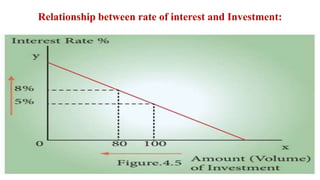
• The investment function refers to investment -interest rate relationship.
There is a functional and inverse relationship between rate of interest and
investment. The investment function slopes downward.
• I = f (r)
• I= Investment (Dependent variable)
• r = Rate of interest (Independent variable)
Meaning of investment
• The term investment means purchase of stocks and shares, debentures,
government bonds and equities. According to Keynes, it is only financial
investment and not real investment. This type of investment does result in an
addition to the stock of real capital of the nation.
• In the views of Keynes, Investment includes expenditure on capital investment.
2. Types of investment
 Autonomous Investment
 Induced Investment
The determinants of investment
• The expected return on the investment
• Business confidence
• Changes in national income
• Interest rates
• General expectations
• Corporation tax
• The accelerator effect
• Rate of interest:
• Technological changes:
• Demand Forecast:
• Fiscal policy:
• Cash Flow:
• Outlook of management:
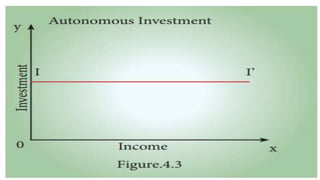
Autonomous Investment
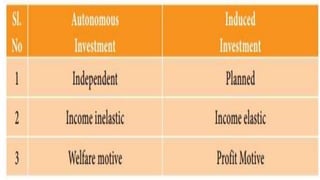
● Investment that is not dependent on the national income
● Mainly done with the welfare motive and not for making profits
● Examples: Construction of road, bridges, School, Charitable houses
● Not affected by rise in raw materials or wages of workers
● Essential to development of nation and out of depression
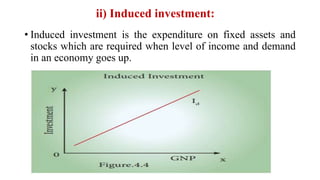
ii) Induced investment:
• Induced investment is the expenditure on fixed assets and
stocks which are required when level of income and demand
in an economy goes up.
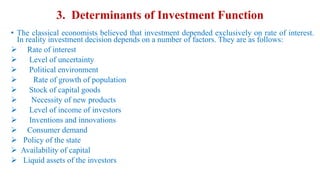
3. Determinants of Investment Function
• The classical economists believed that investment depended exclusively on rate of interest.
In reality investment decision depends on a number of factors. They are as follows:
 Rate of interest
 Level of uncertainty
 Political environment
 Rate of growth of population
 Stock of capital goods
 Necessity of new products
 Level of income of investors
 Inventions and innovations
 Consumer demand
 Policy of the state
 Availability of capital
 Liquid assets of the investors
Relationship between rate of interest and Investment:
Marginal Efficiency of Capital.
• MEC was first introduced by J.M Keynes in 1936 as an important determinant
of autonomous investment. The MEC is the expected profitability of an additional
capital asset. It may be defined as the highest rate of return over cost expected
from the additional unit of capital asset.
• Meaning of Marginal Efficiency of Capital (MEC) is the rate of discount which
makes the discounted present value of expected income stream equal to the cost
of capital.
MEC depends on two factors:
•1. The prospective yield from a capital asset.
•2. The supply price of a capital asset
Factors Affecting MEC:
• The marginal efficiency of capital is influenced by short - run as well as long-
run factors. These factors are discussed in brief:
a) Short - Run Factors
b)Long - Run Factors
a) Short - Run Factors
(i) Demand for the product:
(ii) Liquid assets:
(iii) Sudden changes in income:
(iv) Current rate of investment:
(v) Waves of optimism and pessimism:
b)Long - Run Factors
(i) Rate of growth of population:
(ii) Technological progress:
(iii) Monetary and Fiscal policies:
(iv) Political environment:
(v) Resource availability:
THANK YOU

Macro economics

  • 1.
    Investment Function • Theinvestment function refers to investment -interest rate relationship. There is a functional and inverse relationship between rate of interest and investment. The investment function slopes downward. • I = f (r) • I= Investment (Dependent variable) • r = Rate of interest (Independent variable)
  • 2.
    Meaning of investment •The term investment means purchase of stocks and shares, debentures, government bonds and equities. According to Keynes, it is only financial investment and not real investment. This type of investment does result in an addition to the stock of real capital of the nation. • In the views of Keynes, Investment includes expenditure on capital investment.
  • 3.
    2. Types ofinvestment  Autonomous Investment  Induced Investment The determinants of investment • The expected return on the investment • Business confidence • Changes in national income • Interest rates • General expectations • Corporation tax • The accelerator effect • Rate of interest: • Technological changes: • Demand Forecast: • Fiscal policy: • Cash Flow: • Outlook of management:
  • 4.
    Autonomous Investment ● Investmentthat is not dependent on the national income ● Mainly done with the welfare motive and not for making profits ● Examples: Construction of road, bridges, School, Charitable houses ● Not affected by rise in raw materials or wages of workers ● Essential to development of nation and out of depression
  • 6.
    ii) Induced investment: •Induced investment is the expenditure on fixed assets and stocks which are required when level of income and demand in an economy goes up.
  • 8.
    3. Determinants ofInvestment Function • The classical economists believed that investment depended exclusively on rate of interest. In reality investment decision depends on a number of factors. They are as follows:  Rate of interest  Level of uncertainty  Political environment  Rate of growth of population  Stock of capital goods  Necessity of new products  Level of income of investors  Inventions and innovations  Consumer demand  Policy of the state  Availability of capital  Liquid assets of the investors
  • 9.
    Relationship between rateof interest and Investment:
  • 10.
    Marginal Efficiency ofCapital. • MEC was first introduced by J.M Keynes in 1936 as an important determinant of autonomous investment. The MEC is the expected profitability of an additional capital asset. It may be defined as the highest rate of return over cost expected from the additional unit of capital asset. • Meaning of Marginal Efficiency of Capital (MEC) is the rate of discount which makes the discounted present value of expected income stream equal to the cost of capital.
  • 11.
    MEC depends ontwo factors: MEC depends on two factors: •1. The prospective yield from a capital asset. •2. The supply price of a capital asset
  • 12.
    Factors Affecting MEC: •The marginal efficiency of capital is influenced by short - run as well as long- run factors. These factors are discussed in brief: a) Short - Run Factors b)Long - Run Factors a) Short - Run Factors (i) Demand for the product: (ii) Liquid assets: (iii) Sudden changes in income: (iv) Current rate of investment: (v) Waves of optimism and pessimism:
  • 13.
    b)Long - RunFactors (i) Rate of growth of population: (ii) Technological progress: (iii) Monetary and Fiscal policies: (iv) Political environment: (v) Resource availability:
  • 14.